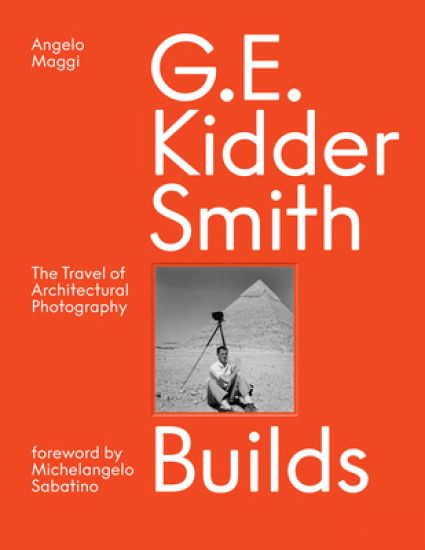
"...the structure of G. E. Kidder Smith Builds, which traces his career first through books and then with exhibitions, means the book is more bibliographical than biographical... it illuminates many aspects of his life not widely known." — Archidose "His life’s work captures an evolutionary era in world history and—as a result—G.E. Kidder Smith Builds is, simply, a book to savor."— More to Come George Everard Kidder Smith (1913–1997) was a multidimensional figure within the wide-ranging field of North American architectural professionals in the second half of the twentieth century. Although he trained as an architect, he chose not to practice within the conventional strictures of an architecture office. Instead, Kidder Smith “designed,” researched, wrote, and photographed a remarkably diverse collection of books about architecture and the built environment. His work and life were deeply interwoven and punctuated by travel related to the research, writing, and promotion of books that sought to reveal the genius loci of the countries whose built environments he admired and wished to share with a broader audience. From the early 1940s to the late 1950s his interest in architecture led him to describe visually the architectural and historical identity of many European countries. After his far-flung travels over the decades, with his wife Dorothea, Kidder Smith focused on his own country and produced a series of ambitious books focused on the United States. Kidder Smith’s vision and narrative betray the gaze of the traveller, the scholar, and the architect.
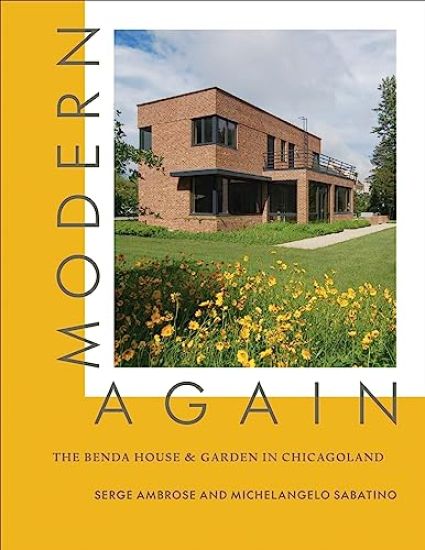
Modern, Again: The Benda House & Garden in Chicagoland is equal parts a history of modern residential architecture in America and a rewarding journey of preservation and stewardship. Ambrose and Sabatino — co-authors of this book and co-owners of the Winston Elting designed Benda house — summarise their in-depth archival research and hands-on work undertaken for the restoration of their 1939 International Style house in Riverside, a historic village designed by Olmsted & Vaux in Chicago’s western suburbs. The Benda House was commissioned during a time when excitement for modern architecture, art, and design was very much alive amongst the public in America, partly due to the enthusiasm created by Chicago’s Century of Progress International Exposition held between 1933 and 1934 and culminated with the New York World’s Fair of 1939. This book features archival materials ranging from architectural drawings to historic building product catalogues alongside contemporary photographs taken before and after the restoration process. Finally, the co-authors discuss their addition of a new landscaped garden that re-establishes the relationship between nature and this modern house while extending Olmsted’s vision of idealised suburban living in America.
This book examines the changes in the career experiences and profiles of 350 European prime ministers in 26 European democracies from 1945 to 2020. It builds on a theoretical framework, which claims that the decline of party government along with the increase of populism, technocracy, and the presidentialization of politics have influenced the careers of prime ministers over the past 70 years. The findings show that prime ministers’ career experiences became less political and more technical. Moreover, their career profiles shifted from a traditional type of ‘party-agent’ to a new type of ‘party-principal’. These changes affected the recruitment of executive elites and their political representation in European democracies, albeit with different intensity and speed.
This book examines the changes in the career experiences and profiles of 350 European prime ministers in 26 European democracies from 1945 to 2020. It builds on a theoretical framework, which claims that the decline of party government along with the increase of populism, technocracy, and the presidentialization of politics have influenced the careers of prime ministers over the past 70 years. The findings show that prime ministers’ career experiences became less political and more technical. Moreover, their career profiles shifted from a traditional type of ‘party-agent’ to a new type of ‘party-principal’. These changes affected the recruitment of executive elites and their political representation in European democracies, albeit with different intensity and speed.
Eighty-four Etched Fac-Similes - on a reduced scale, after the original studies by Michael Angelo and Raffaelle in the University Galleries, Oxford. Second Series is an unchanged, high-quality reprint of the original edition of 1862. Hansebooks is editor of the literature on different topic areas such as research and science, travel and expeditions, cooking and nutrition, medicine, and other genres. As a publisher we focus on the preservation of historical literature. Many works of historical writers and scientists are available today as antiques only. Hansebooks newly publishes these books and contributes to the preservation of literature which has become rare and historical knowledge for the future.
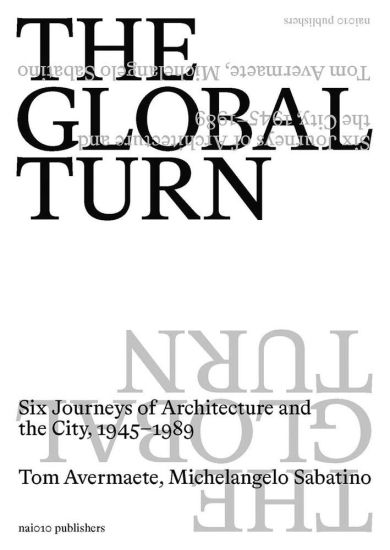
An investigation of globalization's effects on architecture and urban design between the start of World War II and the fall of the Berlin WallTo what extent did the circulation of people, commodities and knowledge affect architecture and urban design between World War II and the fall of the Berlin Wall in 1989? Swiss urban studies professor Tom Avermaete teams up with Chicago-based architect Michelangelo Sabatino to interrogate the influence of globalization on postwar architecture. Globalization is a complex phenomenon that has profoundly affected the practice of designers and engineers in the postwar era as it simultaneously expands and shrinks the world in which we live. Avermaete and Sabatino arrive at several conclusions through a diligent analysis of spatial, political and social geographies, from airports and hotels to construction materials and labor. The Global Turn presents their findings in a series of six short essays, providing a fresh viewpoint on a new worldwide environment that gives as much as it takes.