Kirjojen hintavertailu. Mukana 12 386 805 kirjaa ja 12 kauppaa.

Kirjahaku

Etsi kirjoja tekijän nimen, kirjan nimen tai ISBN:n perusteella.

1000 tulosta hakusanalla Peter G Filene

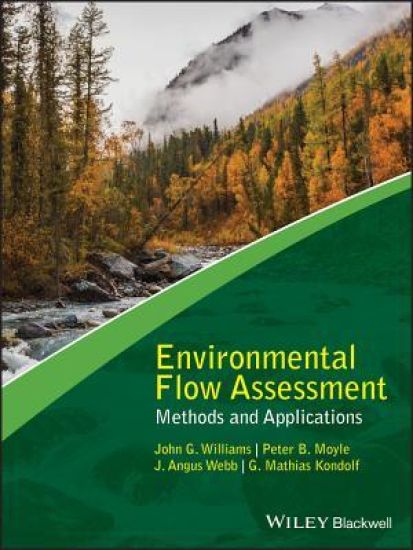
Environmental Flow Assessment

Environmental Flow Assessment

John G. Williams; Peter B. Moyle; J. Angus Webb; G. Mathias Kondolf

Wiley-Blackwell
2019
sidottu
Provides critiques of current practices for environmental flow assessment and shows how they can be improved, using case studies. In Environmental Flow Assessment: Methods and Applications, four leading experts critique methods used to manage flows in regulated streams and rivers to balance environmental (instream) and out-of-stream uses of water. Intended for managers as well as practitioners, the book dissects the shortcomings of commonly used approaches, and offers practical advice for selecting and implementing better ones. The authors argue that methods for environmental flow assessment (EFA) can be defensible as well as practicable only if they squarely address uncertainty, and provide guidance for doing so. Introductory chapters describe the scientific and social reasons that EFA is hard, and provide a brief history. Because management of regulated streams starts with understanding freshwater ecosystems, Environmental Flow Assessment: Methods and Applications includes chapters on flow and organisms in streams. The following chapters assess standard and emerging methods, how they should be tested, and how they should (or should not) be applied. The book concludes with practical recommendations for implementing environmental flow assessment. Describes historical and recent trends in environmental flow assessmentDirectly addresses practical difficulties with applying a scientifically informed approach in contentious circumstancesServes as an effective introduction to the relevant literature, with many references to articles in related scientific fieldsPays close attention to statistical issues such as sampling, estimation of statistical uncertainty, and model selectionIncludes recommendations for methods and approachesExamines how methods have been tested in the past and shows how they should be tested today and in the future Environmental Flow Assessment: Methods and Applications is an excellent book for biologists and specialists in allied fields such as engineering, ecology, fluvial geomorphology, environmental planning, landscape architecture, along with river managers and decision makers.
Risk and Social Change in an African Rural Economy

Risk and Social Change in an African Rural Economy

John G. McPeak; Peter D. Little; Cheryl R. Doss

Routledge
2016
nidottu
Pastoralists’ role in contemporary Africa typically goes underappreciated and misunderstood by development agencies, external observers, and policymakers. Yet, arid and semi-arid lands (ASAL), which are used predominantly for extensive livestock grazing, comprise nearly half of the continent’s land mass, while a substantial proportion of national economies are based on pastoralist activities. Pastoralists use these drylands to generate income for themselves through the use of livestock and for the coffers of national trade and revenue agencies. They are frequently among the continent’s most contested and lawless regions, providing sanctuary to armed rebel groups and exposing residents to widespread insecurity and destructive violence. The continent’s millions of pastoralists thus inhabit some of Africa’s harshest and most remote, but also most ecologically, economically, and politically important regions.This study summarizes the findings of a multi-year interdisciplinary research project in pastoral areas of Kenya and Ethiopia. The cultures and ecology of these areas are described, with a particular focus on the myriad risks that confront people living in these drylands, and how these risks are often triggered by highly variable rainfall conditions. The authors examine the markets used by residents of these areas to sell livestock and livestock products and purchase consumer goods before turning to an analysis of evolving livelihood strategies. Furthermore, they focus on how well-being is conditioned upon access to livestock and access to the cash economy, gender patterns within households and the history of development activities in the area. The book concludes with a report on how these activities are assessed by people in the area and what activities they prioritize for the future. Policy in pastoral areas is often formulated on the basis of assumptions and stereotypes, without adequate empirical foundations. This book provides evidence on livelihood strategies being followed in pastoral areas, and investigates patterns in decision making and well being. It indicates the importance of livestock to the livelihoods of people in these areas, and identifies the critical and widespread importance of access to the cash economy, concluding that future development activities need to be built on the foundation of the livestock economy, instead of seeking to replace it.
Employee Retention and Turnover

Employee Retention and Turnover

Peter W. Hom; David G. Allen; Rodger W. Griffeth

Routledge
2019
sidottu
This exploration of what employee turnover is, why it happens, and what it means for companies and employees draws together contemporary and classic theories and research to present a well-rounded perspective on employee retention and turnover. The book uses models such as job embeddedness theory, proximal withdrawal states, and context-emergent turnover theory, as well as highlights cultural differences affecting global differences in turnover.Employee Retention and Turnover contextualises the issue of turnover, its causes and its consequences, before discussing underrepresented antecedents of turnover, key aspects of retention and methods for regulating turnover, and future research directions. Ideal for both academics and advanced students of industrial/organizational psychology, Employee Retention and Turnover is essential for understanding the past, present, and future of turnover and related research.
Employee Retention and Turnover

Employee Retention and Turnover

Peter W. Hom; David G. Allen; Rodger W. Griffeth

Routledge
2019
nidottu
This exploration of what employee turnover is, why it happens, and what it means for companies and employees draws together contemporary and classic theories and research to present a well-rounded perspective on employee retention and turnover. The book uses models such as job embeddedness theory, proximal withdrawal states, and context-emergent turnover theory, as well as highlights cultural differences affecting global differences in turnover.Employee Retention and Turnover contextualises the issue of turnover, its causes and its consequences, before discussing underrepresented antecedents of turnover, key aspects of retention and methods for regulating turnover, and future research directions. Ideal for both academics and advanced students of industrial/organizational psychology, Employee Retention and Turnover is essential for understanding the past, present, and future of turnover and related research.
Concepts of Forest Entomology

Concepts of Forest Entomology

Kenneth G. Graham; Peter Gray

Literary Licensing, LLC
2012
sidottu
Concepts of Forest Entomology is a comprehensive textbook written by Kenneth G. Graham that covers the study of insects and their interactions with forest ecosystems. The book is divided into four parts, each of which explores different aspects of forest entomology. Part one provides an introduction to the field, including the history of forest entomology and the basic principles of insect biology. Part two focuses on the ecology of forest insects, including their interactions with other organisms and their role in ecosystem processes. Part three covers the management of forest insects, including methods for controlling insect pests and the use of biological control agents. Finally, part four explores the future of forest entomology, including emerging technologies and the potential impacts of climate change on forest insect populations. Throughout the book, Graham emphasizes the importance of understanding the complex interactions between insects and their environment in order to effectively manage forest ecosystems. Concepts of Forest Entomology is an essential resource for students and professionals in the fields of entomology, forestry, and ecology.This scarce antiquarian book is a facsimile reprint of the old original and may contain some imperfections such as library marks and notations. Because we believe this work is culturally important, we have made it available as part of our commitment for protecting, preserving, and promoting the world's literature in affordable, high quality, modern editions, that are true to their original work.
The Warren Buffett Way, 30th Anniversary Edition

The Warren Buffett Way, 30th Anniversary Edition

Robert G. Hagstrom; Peter Lynch; Bill Miller; Howard Marks

JOHN WILEY SONS INC
2024
sidottu
An insightful new take on the life and work of one of the world's most remarkable investors: Warren Buffett In the 30th Anniversary Edition of The Warren Buffett Way, celebrated author and investor Robert Hagstrom delivers the definitive version of his bestselling compendium of the investment strategies made famous by Warren Buffett. The Warren Buffett Way describes the twelve investment tenets of Warren Buffett's strategy called business-driven investing and his distinct approach to managing a portfolio of businesses. You'll learn how you can apply these same principles to building your own portfolio and find discussions on the psychology of long-term investing, its optimal benefits, and how to avoid the most common pitfalls and mistakes encountered by investors. This latest edition includes: A new author preface to complement the existing forewords from Peter Lynch, Bill Miller, and Howard Marks.Insights on how to achieve worldly wisdom advanced by Warren Buffett's longtime business partner Charlie Munger.Footnotes and references to academic work that supports and expands on Warren Buffett's investment approach and portfolio management.The complete Berkshire Hathaway common stocks portfolios from 1977-2021. An indispensable guide to the remarkable work and accomplishments of Warren Buffett, The Warren Buffett Way is a can't-miss resource for professional and individual investors who want to learn from the world's greatest investor.
Pacing Options in the Adult Patient with Congenital Heart Disease

Pacing Options in the Adult Patient with Congenital Heart Disease

Harry G. Mond; Peter P. Karpawich

Wiley-Blackwell (an imprint of John Wiley Sons Ltd)
2006
sidottu
Finally, a pacing book dedicated to the adult patient with CHD. Drawing on their vast experience, Drs. Mond and Karpawich join forces to show you what to do, how to do it, and what to avoid. Building on more than 60 years of device therapy Pacing Options in the Adult Patient with Congenital Heart Disease leads you through the many congenital heart defects now seen in adults. This essential resource: Describes the various anatomical characteristics of repaired and non-repaired congenital heart defects and compares these with the normal anatomy, allowing you to easily identify the differences Guides you through the implant techniques, highlighting the specific problems that might be encountered and providing proven techniques to overcome technically difficult anatomical variations in patients with and without congenital heart disease Throughout the book, schematic diagrams of the diverse anatomy of the congenital heart support the textual descriptions, and x-rays and fluoroscopic images illustrate the physiology and maximize understanding.
Conductive Electroactive Polymers

Conductive Electroactive Polymers

Gordon G. Wallace; Peter R. Teasdale; Geoffrey M. Spinks; Leon A. P. Kane-Maguire

CRC Press Inc
2008
sidottu
Rapid advances in synthetic polymer science and nanotechnology have revealed new avenues of development in conductive electroactive polymers that take greater advantage of this versatile class of materials’ unique properties. This third edition of Conductive Electroactive Polymers: Intelligent Polymer Systems continues to provide an in-depth understanding of how to engineer dynamic properties in inherently conducting polymers from the molecular level. New to the third edition: Biomedical, MEMS, and electronic textile applicationsThe synthesis and fabrication of nanocomponents and nanostructuresThe energy role of nanotechnology in improving the performance of conducting materials in devicesElectrochemical Raman, electrochemical ESR, and scanning vibrating reference electrode studiesAfter establishing the basic principles of polymer chemistry, the book pinpoints the dynamic properties of the more useful conducting polymers, such as polupyrroles, polythiophenes, and polyanilines. It then demonstrates how the control of these properties enables cutting-edge applications in nano, biomedicine, and MEMS as well as sensors and artificial muscles. Subsequent chapters discuss the effect of nanodimensional control on the resultant properties.Updated to reflect substantial developments and advances that have occurred in the past few years, this third edition of Conductive Electroactive Polymers unlocks a world of potential for integrating and interfacing conductive polymers.
The Method Framework for Engineering System Architectures

The Method Framework for Engineering System Architectures

Donald G. Firesmith; Peter Capell; Dietrich Falkenthal; Charles B. Hammons; DeWitt T. Latimer IV; Tom Merendino

Auerbach Publishers Inc.
2008
sidottu
The architects of today’s large and complex systems all too often struggle with the lack of a consistent set of principles and practices that adequately address the entire breadth of systems architecture. The Method Framework for Engineering System Architectures (MFESA) enables system architects and process engineers to create methods for effectively and efficiently engineering high-quality architecture for systems, subsystems, and software components.Meets the Needs of Specific ProjectsThe book begins by documenting the common challenges that must be addressed by system architecture engineering. It explores the major principles answering these challenges and forming the basis of MFESA. Next, the authors introduce MFESA, including its primary goals, inputs, tasks, outputs, and assumptions. Then they describe the fundamental concepts and terminology on which the systems architecture engineering is founded. This is followed by a description of each of the ten system architecture engineering tasks including associated goals and objectives, preconditions, inputs, steps, postconditions, work products, guidelines, and pitfalls.Finally, the book documents the relationship between quality and architecture, explains the quality model underlying MFESA, and provides a summary of MFESA method framework, as well as a list of points to remember and future directions planned for MFESA.Explains Specific RationalesOrganized as a handy desk reference, this book harnesses more than 100 years of the authors’ combined professional experience to provide extensive guidelines, best practices, and tips on avoiding possible pitfalls. It presents a direct rationale of why steps are taken, how things can go wrong, and guidance for how and when to tailor the model for a system’s specific context.CRC Press is pleased to announce that The Method Framework for Engineering System Architectures has been added to Intel Corporation’s Recommended Reading List. Intel’s Recommended Reading program provides technical professionals a simple and handy reference list of what to read to stay abreast of new technologies. Dozens of industry technologists, corporate fellows, and engineers have helped by suggesting books and reviewing the list. This is the most comprehensive reading list available for professional computer developers.
Humanitarianism, War, and Politics

Humanitarianism, War, and Politics

Peter J. Hoffman; Thomas G. Weiss; Jan Egeland

Rowman Littlefield
2017
sidottu
What is humanitarianism? This authoritative book provides a comprehensive analysis of the original idea and its evolution, exploring its triangulation with war and politics. Peter J. Hoffman and Thomas G. Weiss trace the origins of humanitarianism, its social movement, and the institutions (international humanitarian law) and organizations (providers of assistance and protection) that comprise it. They consider the international humanitarian system’s ability to regulate the conduct of war, to improve the wellbeing of its victims, and to prosecute war criminals. Probing the profound changes in the culture and capacities that underpin the sector and alter the meaning of humanitarianism, they assess the reinventions that constitute “revolutions in humanitarian affairs.” The book begins with traditions and perspectives—ranging from classic international relations approaches to “Critical Humanitarian Studies” —and reviews seminal wartime emergencies and the creation and development of humanitarian agencies in the late nineteenth and twentieth centuries. The authors then examine the rise of “new humanitarianisms” after the Cold War’s end and contemporary cases after 9/11. The authors continue by unpacking the most recent “revolutions”—the International Criminal Court and the “Responsibility to Protect”—as well as such core challenges as displacement camps, infectious diseases, eco-refugees, and marketization. They conclude by evaluating the contemporary system and the prospects for further transformations, identifying scholarly puzzles and the acute operational problems faced by practitioners.
Humanitarianism, War, and Politics

Humanitarianism, War, and Politics

Peter J. Hoffman; Thomas G. Weiss; Jan Egeland

Rowman Littlefield
2017
nidottu
What is humanitarianism? This authoritative book provides a comprehensive analysis of the original idea and its evolution, exploring its triangulation with war and politics. Peter J. Hoffman and Thomas G. Weiss trace the origins of humanitarianism, its social movement, and the institutions (international humanitarian law) and organizations (providers of assistance and protection) that comprise it. They consider the international humanitarian system’s ability to regulate the conduct of war, to improve the wellbeing of its victims, and to prosecute war criminals. Probing the profound changes in the culture and capacities that underpin the sector and alter the meaning of humanitarianism, they assess the reinventions that constitute “revolutions in humanitarian affairs.” The book begins with traditions and perspectives—ranging from classic international relations approaches to “Critical Humanitarian Studies” —and reviews seminal wartime emergencies and the creation and development of humanitarian agencies in the late nineteenth and twentieth centuries. The authors then examine the rise of “new humanitarianisms” after the Cold War’s end and contemporary cases after 9/11. The authors continue by unpacking the most recent “revolutions”—the International Criminal Court and the “Responsibility to Protect”—as well as such core challenges as displacement camps, infectious diseases, eco-refugees, and marketization. They conclude by evaluating the contemporary system and the prospects for further transformations, identifying scholarly puzzles and the acute operational problems faced by practitioners.
Energy-Efficient Train Control

Energy-Efficient Train Control

Philip G. Howlett; Peter J. Pudney

Springer London Ltd
2011
nidottu
Rail is potentially a very efficient form of transport, but must be convenient, reliable and cost-effective to compete with road and air transport. Optimal control can be used to find energy-efficient driving strategies for trains. This book describes the train control problem and shows how a solution was found at the University of South Australia. This research was used to develop the Metromiser system, which provides energy-efficient driving advice on suburban trains. Since then, this work has been modified to find practical driving strategies for long-haul trains. The authors describe the history of the problem, reviewing the basic mathematical analysis and relevant techniques of constrained optimisation. They outline the modelling and solution of the problem and finally explain how the fuel consumption can be minimised for a journey, showing the effect of speed limits and track gradients on the optimal driving strategy.
Golf Steps to Success

Golf Steps to Success

Paul G. Schemmp; Peter Mattsson

Human Kinetics Publishers
2014
pokkari
Develop a consistent swing and master every golf shot on your way to a lower handicap. Golf: Steps to Success provides detailed, progressive instruction with accompanying full colour photographs for every shot, from putts, chip shots, and pitch shots to shots from the fairway, off the tee, bunker and rough and bad lies. Practice and improve your shotmaking with drills that feature a scoring system to gauge and accelerate your progress. After building a strong skill base, readers can improve the mental side of the game by learning to select the right club, analyse ball flight, and manage their emotions and raise their level of play and enjoyment of the game. This self-paced learning tool allows golfers to develop a solid overall game and build on any initial golf lessons they may have had. As part of the bestselling Steps to Success Sports Series, Golf: Steps to Success is the instructional guide you'll find most valuable not only on the practice range and green but also on every hole played.
Serial-Data Computation

Serial-Data Computation

Stewart G. Smith; Peter B. Denyer

Springer-Verlag New York Inc.
2011
nidottu
This book is concerned with advances in serial-data computa­ tional architectures, and the CAD tools for their implementation in silicon. The bit-serial tradition at Edinburgh University (EU) stretches back some 6 years to the conception of the FIRST silicon compiler. FIRST owes much of its inspiration to Dick Lyon, then at Xerox P ARC, who proposed a 'structured-design' methodology for construction of signal processing systems from bit-serial building blocks. Based on an nMOS cell-library, FIRST automates much of Lyon's physical design process. More recently, we began to feel that FIRST should be able to exploit more modern technologies. Before this could be achieved, we were faced with a massive manual re-design task, i. e. the porting of FIRST cell-library to a new technology. As it was to avoid such tasks that FIRST was conceived in the first place, we decided to move the level of user-specification much nearer to the silicon level (while still hiding details of transistor circuit design, place and route etc. , from the user), and by so doing, enable the specification of more functionally powerful libraries in technology-free form. The results of this work are in evidence as advances in serial-data design techniques, and the SECOND silicon compiler, introduced later in this book. These achievements could not have been accomplished without help from various sources. We take this opportunity to thank Profs.
How to Write a Statement of Work

How to Write a Statement of Work

Peter S. Cole; Michael G. Martin

Management Concepts, Inc
2012
pokkari
The standard on government statements of work just got better! How to Write a Statement of Work has been a standard reference for government employees and contractors for many years. Now, with this sixth edition, it is even more relevant and useful. Based on the excellent foundation laid by the late Peter Cole, Michael Martin has updated and added material to guarantee this handbook’s place in the list of “must haves” for working with government contracts. As in the earlier editions, the emphasis is on providing practical, detailed guidance on writing and preparing a description of government requirements, whether a statement of work (SOW), a performance work statement (PWS), or a statement of objectives (SOO). Among the many additions to this sixth edition are updates to reflect the current definition of an SOO as well as references and guidance regarding the development and application of the SOO. There is a new chapter on why change management is so important on projects, legal precedents supporting change management, and how to identify when a change occurs using the SOW. This new chapter also includes information on the federal government’s Standard Form 30 (SF30) to provide perspective on how change orders are used and applied in the federal government. If you are working in government contracting in any capacity, you should have this book on hand!
Mentalizing in Clinical Practice

Mentalizing in Clinical Practice

Jon G. Allen; Peter Fonagy; Anthony W. Bateman

American Psychiatric Association Publishing
2008
nidottu
Mentalizing, the fundamental human capacity to understand behavior in relation to mental states such as thoughts and feelings, is the basis of healthy relationships and self-awareness. A growing evidence base supports the effectiveness of mentalizing-focused interventions in the treatment of borderline personality disorder. This volume explores wider applications, construing mentalizing as a core common factor in the effectiveness of psychotherapeutic interventions that cuts across treatment modalities and theoretical approaches ranging from psychodynamic to interpersonal and cognitive therapies.This book distills the burgeoning literature on mentalizing for clinicians of diverse professional backgrounds. The book is divided into two parts: Understanding Mentalizing fully explicates the concept of mentalizing and its foundations in developmental research and social-cognitive neuroscience; Practicing Mentalizing presents the general principles of psychotherapeutic interventions that promote mentalizing as well as a range of current clinical applications. Mentalizing is multifaceted - for example, pertaining to self and others as well as explicit and implicit processes - and links to myriad overlapping concepts including empathy, metacognition, theory of mind, mindfulness, and psychological mindedness. Two sides of research on the development of mentalizing in attachment relationships have significant clinical implications: interactions in secure attachment relationships enhance mentalizing and illuminate the conditions of optimal psychotherapeutic relationships; conversely, trauma in attachment relationships undermines the development of mentalizing and eventuates in developmental psychopathology that poses special challenges for psychotherapy. Neuroimaging is illuminating diverse brain regions that contribute to mentalizing capacity, including a ""mentalizing region"" in the medial prefrontal cortex that is consistently activated in mentalizing tasks; concomitantly, research on autism and psychopathy attests to the neurobiological basis of psychopathologies in which stable impairments of mentalizing are most conspicuous. In development and in psychotherapy, mentalizing begets mentalizing, as exemplified by a mentalizing stance that fosters inquisitiveness and curiosity about mental states in oneself and others; basic principles and clinical examples, including the use of transference, demonstrate the spirit and technique of mentalizing, capped off by a patient's first-hand account of mentalization-based treatment for borderline personality disorder. Attachment trauma is the wellspring of disrupted mentalizing capacity, and a focus on mentalizing provides an integrative framework for psychodynamic and cognitive-behavioral treatment of trauma as well as for parenting, family, and social-systems interventions directed toward interrupting the perpetuation of trauma in relationships. Psychoeducational interventions, including patient education and structured exercises, are employed to cultivate a therapeutic alliance around mentalizing; the book includes a straightforward explanation clinicians can use with patients, ""What is Mentalizing and Why Do It?"" In the chapter on mentalizing interventions, the authors propose to clinicians, ""You are already doing it."" If the effectiveness of treatment depends on therapists mentalizing and helping their patients do so more consistently and skillfully, clinicians of all persuasions can benefit from the extensive knowledge now available to hone further their attention to this vital therapeutic process.
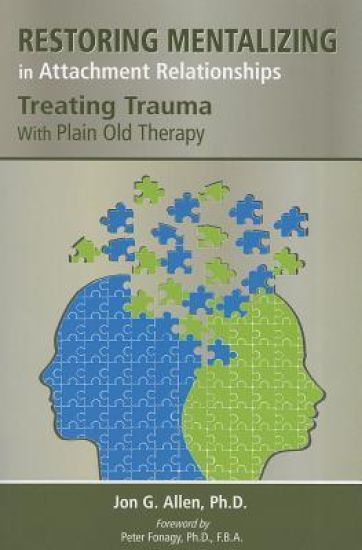
Restoring Mentalizing in Attachment Relationships

Restoring Mentalizing in Attachment Relationships

Jon G. Allen; Peter Fonagy

American Psychiatric Association Publishing
2012
pokkari
In Restoring Mentalizing in Attachment Relationships: Treating Trauma With Plain Old Therapy, Jon G. Allen, Ph.D., argues that the incorporation of mentalizing into attachment theory and research provides a solid foundation for trauma treatment, and offers therapists and patients a pathway to recovery. In plain language accessible to clinicians and laypeople alike, Allen describes trauma in attachment relationships, reviews the literature, and makes a compelling, evidence-based argument for the efficacy of psychotherapy. Specifically, the book: • Presents a comprehensive view of attachment trauma across diverse diagnostic conditions, directly linking these to the psychotherapeutic interventions that work best.• Allows therapists from different theoretical frameworks, by using these best practices, to treat patients with a wide range of problems and disorders.• Situates mindfulness and mentalizing as central to secure attachment, focusing clinicians' attention on these most critical dimensions of healing relationships.• Provides a thorough review of the research on attachment, mindfulness, and mentalizing, and evaluates the effectiveness of the most popular trauma treatments, thereby equipping clinicians to treat patients across the spectrum of trauma-related psychiatric disorders.• Employs a down-to-earth, conversational writing style that makes the book accessible to patients and family members as well as to professionals. Trauma can be the result of blatant events, such as violence, abuse, and neglect, or the subtle yet pervasive failure to connect. Both contribute to developmental psychopathology and cause lasting emotional pain. "Plain old therapy," according to Allen, is a valuable and proven resource for addressing trauma and treating patients with complex psychiatric disorders. This fascinating and eminently useful book should help to restore psychotherapy to its well-deserved stature.
The Ayahuasca Visions of Pablo Amaringo

The Ayahuasca Visions of Pablo Amaringo

Howard G. Charing; Peter Cloudsley; Pablo Amaringo

Inner Traditions Bear and Company
2011
sidottu
Recognized as one of the world’s great visionary artists, Pablo Amaringo was renowned for his intricate, colorful paintings inspired by his shamanic visions. A master communicator of the ayahuasca experience--where snakes, jaguars, subterranean beings, celestial palaces, aliens, and spacecraft all converge--Amaringo’s art presents a doorway to the transcendent worlds of ayahuasca intended for contemplation, meditation, and inspiration. Illustrating the evolution of his intricate and colorful art, this book contains 47 full-color reproductions of Amaringo’s latest works with detailed explorations of the rich Amazonian mythology underlying each painting. Through their longstanding relationship with Amaringo, coauthors Charing and Cloudsley are able to share the personal stories behind his visions and experiences with Amazonian people and folklore, capturing Amaringo’s powerful ecological and spiritual message through his art and words. With contributions by Graham Hancock, Jeremy Narby, Robert Venosa, Dennis McKenna, Stephan Beyer, and Jan Kounen, this book brings the ayahuasca experience to life as we travel on Amaringo’s visionary brush and palette.
Warrior Diplomat

Warrior Diplomat

Michael G. Waltz; Peter Bergen

Potomac Books Inc
2023
pokkari
Grappling with centuries-old feuds, defeating a shrewd insurgency, and navigating the sometimes paralyzing bureaucracy of the U.S. military are issues that prompt sleepless nights for both policymakers in Washington DC and soldiers at war, albeit for different reasons. Few, however, have dealt with these issues in the White House situation room and on the front line. Michael G. Waltz has done just that, working as a policy advisor to Vice President Richard B. Cheney and also serving in the mountains of Afghanistan as a Green Beret, directly implementing strategy in the field that he helped devise in Washington. In Warrior Diplomat Waltz shares his unique firsthand experiences, revealing the sights, sounds, emotions, and complexities involved in the war in Afghanistan. Waltz also highlights the policy issues that have plagued the war effort throughout the past decade, from the drug trade, to civilian casualties, to a lack of resources in comparison to Iraq, to the overall coalition strategy. At the same time, he points out that stabilizing Afghanistan and the region remains crucial to national security and that a long-term commitment along the lines of South Korea or Germany is imperative if America is to remain secure.