Kirjojen hintavertailu. Mukana 11 342 296 kirjaa ja 12 kauppaa.

Kirjahaku

Etsi kirjoja tekijän nimen, kirjan nimen tai ISBN:n perusteella.

1000 tulosta hakusanalla Ray Perman

X-Ray Scattering of Soft Matter

X-Ray Scattering of Soft Matter

Norbert Stribeck

Springer-Verlag Berlin and Heidelberg GmbH Co. K
2010
nidottu
Applications of X-ray scattering to soft matter have advanced considerably within recent years, both conceptually and technically – mature high-power X-ray sources, synchrotrons and rotating anodes, as well as high-speed detectors have become readily available. High-quality time-resolved experiments on polymer structure now can be performed with ease, a major advancement due to the genuine power of the scattering method.This manual summarizes the analytical power of modern X-ray scattering in the field of soft matter. Description of simple tools that can elucidate the mechanisms of structure evolution in the studied materials is followed by a step-by-step guide and breakdown of the more advanced methods. Data analysis based on clear, unequivocal results is rendered simple and straightforward – with a stress on the carefully planning of the experiments and adequate recording of all required data. To this end, this book serves as a useful ready-reference guide.
X-ray and Neutron Reflectivity

X-ray and Neutron Reflectivity

Springer-Verlag Berlin and Heidelberg GmbH Co. K
2010
nidottu
ways in which the magnetic interaction between neutrons and magnetic moments can yield information on the magnetization densities of thin ?lms and multilayers. I commend the organizers for having organized a group of expert lecturers to present this subject in a detailed but clear fashion, as the importance of the subject deserves. Argonne, IL S. K. Sinha Contents 1 The Interaction of X-Rays (and Neutrons) with Matter . . . . . . . . . . . . . . 1 F. de Bergevin 1. 1 Introduction . . . . . . . . . . . . . . . . . . . . . . . . . . . . . . . . . . . . . . . . . . . . . . 1 1. 2 Generalities and De?nitions . . . . . . . . . . . . . . . . . . . . . . . . . . . . . . . . 2 1. 3 From the Scattering by an Object to the Propagation in a Medium . 14 1. 4 X-Rays . . . . . . . . . . . . . . . . . . . . . . . . . . . . . . . . . . . . . . . . . . . . . . . . . . 26 1. 5 X-Rays: Anisotropic Scattering . . . . . . . . . . . . . . . . . . . . . . . . . . . . . . 47 1. A Appendix: the Born Approximation . . . . . . . . . . . . . . . . . . . . . . . . . . 54 References . . . . . . . . . . . . . . . . . . . . . . . . . . . . . . . . . . . . . . . . . . . . . . . . . . . . . 56 2 Statistical Aspects of Wave Scattering at Rough Surfaces . . . . . . . . . . . . 59 A. Sentenac and J. Daillant 2. 1 Introduction . . . . . . . . . . . . . . . . . . . . . . . . . . . . . . . . . . . . . . . . . . . . . . 59 2. 2 Description of Randomly Rough Surfaces . . . . . . . . . . . . . . . . . . . . . 60 2. 3 Description of a Surface Scattering Experiment, Coherence Domains . . . . . . . . . . . . . . . . . . . . . . . . . . . . . . . . . . . . . . . . . . . . . . . . . 67 2. 4 Statistical Formulation of the Diffraction Problem . . . . . . . . . . . . . . 72 2. 5 Statistical Formulation of theScattered Intensity Under the Born Approximation . . . . . . . . . . . . . . . . . . . . . . . . . . . . . . . . . . . . . . . . . . . 79 References . . . . . . . . . . . . . . . . . . . . . . . . . . . . . . . . . . . . . . . . . . . . . . . . . . . . . 84 3 Specular Re?ectivity from Smooth and Rough Surfaces . . . . . . . . . . . . . 85 A. Gibaud and G. Vignaud 3. 1 The Re?ected Intensity from an Ideally Flat Surface . . . . . . . . . . . . 85 3. 2 X-Ray Re?ectivity in Strati?ed Media . . . . . . . . . . . . . . . . . . . . . . . . 98 3. 3 From Dynamical to Kinematical Theory . . . . . . . . . . . . . . . . . . . . . . 107 3. 4 In?uence of the Roughness on the Matrix Coef?cients . . . . . . . . . . 111 3. A Appendix: The Treatment of Roughness in Specular Re?ectivity . . 113 3. B Appendix: Inversion of re?ectivity data . . . . . . . . . . . . . . . . . . . . . . .
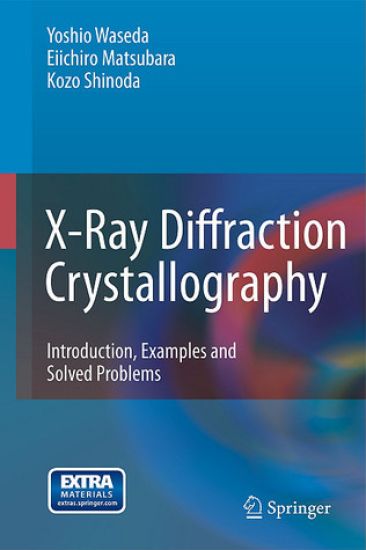
X-Ray Diffraction Crystallography

X-Ray Diffraction Crystallography

Yoshio Waseda; Eiichiro Matsubara; Kozo Shinoda

Springer-Verlag Berlin and Heidelberg GmbH Co. K
2011
sidottu
X-ray diffraction crystallography for powder samples is a well-established and widely used method. It is applied to materials characterization to reveal the atomic scale structure of various substances in a variety of states. The book deals with fundamental properties of X-rays, geometry analysis of crystals, X-ray scattering and diffraction in polycrystalline samples and its application to the determination of the crystal structure. The reciprocal lattice and integrated diffraction intensity from crystals and symmetry analysis of crystals are explained. To learn the method of X-ray diffraction crystallography well and to be able to cope with the given subject, a certain number of exercises is presented in the book to calculate specific values for typical examples. This is particularly important for beginners in X-ray diffraction crystallography. One aim of this book is to offer guidance to solving the problems of 90 typical substances. For further convenience, 100 supplementary exercises are also provided with solutions. Some essential points with basic equations are summarized in each chapter, together with some relevant physical constants and the atomic scattering factors of the elements.
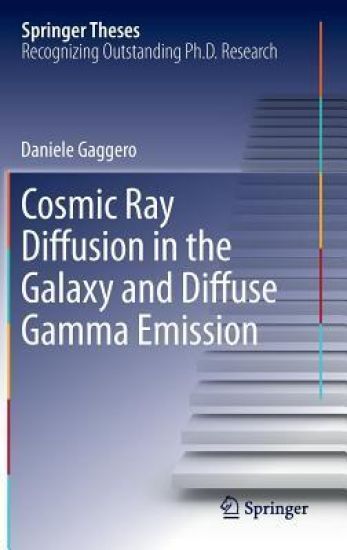
Cosmic Ray Diffusion in the Galaxy and Diffuse Gamma Emission

Cosmic Ray Diffusion in the Galaxy and Diffuse Gamma Emission

Daniele Gaggero

Springer-Verlag Berlin and Heidelberg GmbH Co. K
2012
sidottu
The original work presented in this thesis constitutes an important contribution to modern Cosmic Ray (CR) physics, and comes during one of the most exciting periods of this field. The first part introduces a new numerical code (DRAGON) to model the CR propagation in our Galaxy. The code is then used to perform a combined analysis of CR data, making it possible to determine their propagation properties with unprecedented accuracy. The second part is dedicated to a theoretical interpretation of the recent crucial experimental results on cosmic electron and positron spectra (PAMELA, Fermi-LAT experiments). Using the tools developed in the first part of the thesis, the author convincingly argues for the existence of a new spectral component, which could arise either from local astrophysical sources, such as pulsars, or from Dark Matter annihilation or decay. This thesis is a highly advanced work; the methods, analysis and results are clearly and carefully presented. This work is set to become an important reference document for any future work in this area.
X-Ray Diffraction Crystallography

X-Ray Diffraction Crystallography

Yoshio Waseda; Eiichiro Matsubara; Kozo Shinoda

Springer-Verlag Berlin and Heidelberg GmbH Co. K
2014
nidottu
X-ray diffraction crystallography for powder samples is a well-established and widely used method. It is applied to materials characterization to reveal the atomic scale structure of various substances in a variety of states. The book deals with fundamental properties of X-rays, geometry analysis of crystals, X-ray scattering and diffraction in polycrystalline samples and its application to the determination of the crystal structure. The reciprocal lattice and integrated diffraction intensity from crystals and symmetry analysis of crystals are explained. To learn the method of X-ray diffraction crystallography well and to be able to cope with the given subject, a certain number of exercises is presented in the book to calculate specific values for typical examples. This is particularly important for beginners in X-ray diffraction crystallography. One aim of this book is to offer guidance to solving the problems of 90 typical substances. For further convenience, 100 supplementary exercises are also provided with solutions. Some essential points with basic equations are summarized in each chapter, together with some relevant physical constants and the atomic scattering factors of the elements.
X-Ray Emission of Auroral Electrons and Magnetospheric Dynamics

X-Ray Emission of Auroral Electrons and Magnetospheric Dynamics

Leonid L. Lazutin

Springer-Verlag Berlin and Heidelberg GmbH Co. K
2011
nidottu
The experimental study of magnetospheric processes consists of several disci­ plines or methods, developing in two general directions. The first, internal trend covers the progress in experimental techniques and methods and re­ search specific to this discipline. The other trend combines with other methods in a mutual attempt at understanding the boiling whirlpool of the disturbed magnetosphere. Investigations of auroral X-rays began after Van Allen's (1957) discovery of hard radiation in the upper atmosphere of the auroral zone, and are based on high latitude balloon observations. Scientific apparatus, payload equip­ ment, and particular questions of scientific ballooning are discussed in Chap­ ter 1. Chapter 2 concludes the internal trend of the subject by describing the problems of X-ray generation at the boundary of the atmosphere and propa­ gation downward to balloon altitudes. Auroral X-rays are closely related to most of the processes of the disturbed magnetosphere through energetic auroral electrons; precipitating into the at­ mosphere, the latter create bremsstrahlung photons able to penetrate to an at­ mospheric depth of 10- 20 g cm - 2. In quiet periods auroral electron flux ex­ ists only in embryo, as a hot plasma layer at the inner edge of the plasma sheet: in general it is a transient phenomenon caused by magnetospheric distur­ bances and carrying valuable information of the magnetospheric dynamics.
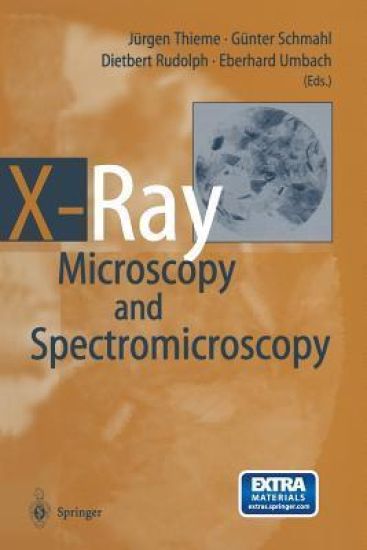
X-Ray Microscopy and Spectromicroscopy

X-Ray Microscopy and Spectromicroscopy

Springer-Verlag Berlin and Heidelberg GmbH Co. K
2014
nidottu
This book is based on presentations to the International Conference of X-Ray Micro­ scopy and Spectromicroscopy, XRM 96, which took place in Wiirzburg, August 19- 23, 1996. The conference also celebrated the lOOth anniversary of the discovery of X­ rays by Wilhelm Conrad Rontgen on November 8, 1895, in Wiirzburg. This book contains state-of-the-art reviews and up-to-date progress reports in the field of X-ray microscopy and spectromicroscopy, including related new X-ray optics and X-ray sources. It reflects the lively activities within a relatively new field of science which combines the development of new instruments and methods with their applications to numerous topical scientific questions. The applications range from biological and medical topics, colloid physics, and soil sciences to solid-state physics, material sciences, and surface sciences. Their variety demonstrates the interdisci­ plinary and cooperative character of this field and the growing demand for micro­ scopic and spectromicroscopic information on the nanometer scale and under specific sample conditions, for example in wet (natural) surroundings or on a solid surface.
X-ray Microscopy

X-ray Microscopy

Springer-Verlag Berlin and Heidelberg GmbH Co. K
2011
nidottu
In 1979, a conference on x-ray microscopy was organized by the New York Academy of Sciences, and in 1983, the Second Interna­ tional Symposium on X-ray Imaging was organized by the Akademie der Wissenschaften in Gottingen, Federal Republic of Germany. This volume contains the contributions to the symposium "X-ray Microscopy '86", held in Taipei, Taiwan, the Republic of China in August 1986. This is the first volume which intends to provide up-to­ date information on x-ray imaging to biologists, therefore, emphasis was given to specimen preparation techniques and image interpreta­ tion. Specimen preparation represents a major part of every microscopy work, therefore, it should be strongly emphasized in this emerging field of x-ray microscopy. Theoretically, x-ray microscopy offers the potential for the study of unfixed, hydrated biological ma­ terials. Since very few biological system can be directly observed without specimen preparation, we would like to emphasize that new information on biological specimens can only be obtained if the speci­ men is properly prepared. In the past decade, many of the published x-ray images were obtained from poorly prepared biological speci­ mens, mainly air-dried materials. Therefore, one of the goals of this conference is to bring the importance of specimen preparation to the attention of x-ray microscopy community. X-ray microscopy can be subdivided into several major areas. They are the classic x-ray projection microscope, x-ray contact imag­ ing (microradiography) and the more recent x-ray scanning micro­ scope, x-ray photoelectron microscope and x-ray imaging microscope.
X-Ray and Neutron Diffraction in Nonideal Crystals

X-Ray and Neutron Diffraction in Nonideal Crystals

Mikhail A. Krivoglaz

Springer-Verlag Berlin and Heidelberg GmbH Co. K
2011
nidottu
Mikhail Alexandrovich Krivoglaz died unexpectedly when he was preparing the English edition of his two-volume monograph on diffraction and diffuse scatter­ ing of X-rays and neutrons in imperfect crystals. His death was a heavy blow to all who knew him, who had worked with him and to the world science community as a whole. The application of the diffraction techniques for the study of imperfections of crystal structures was the major field of Krivoglaz' work throughout his career in science. He started working in the field in the mid-fifties and since then made fundamental contributions to the theory of real crystals. His results have largely determined the current level of knowledge in this field for more than thirty years. Until the very last days of his life, Krivoglaz continued active studies in the physics of diffraction effects in real crystals. His interest in the theory aided in the explanation of the rapidly advancing experimental studies. The milestones marking important stages of his work were the first mono­ graph on the theory of X-ray and neutron scattering in real crystals which was published in Russian in 1967 (a revised English edition in 1969), and the two­ volume monograph published in Russian in 1983-84 (this edition is the revised translation of the latter).
X-Ray Diffraction by Disordered Lamellar Structures

X-Ray Diffraction by Disordered Lamellar Structures

Victor A. Drits; Andre Guinier; Cyril Tchoubar

Springer-Verlag Berlin and Heidelberg GmbH Co. K
2011
nidottu
New methods for the determination of the nature, proportion, and distribution of structural defects in microcrystallized lamellar systems are of utmost importance not only to experimentalists but also to theoreticians. Mathematical formalism - indispensable for such analyses - is well-illustrated by various examples, allowing this method to be easily adopted and even to be applied to other solids with lamellar or pseudo-lamellar structures.
X-Ray Spectra and Chemical Binding

X-Ray Spectra and Chemical Binding

Armin Meisel; Gunter Leonhardt; Rüdiger Szargan

Springer-Verlag Berlin and Heidelberg GmbH Co. K
2011
nidottu
In the 12 years that have passed since the publication of Riintgenspektren und chemische Bindung, the original German work on which· this text is based, several aspects of high-resolution X-ray spectroscopy have devel­ oped rapidly. After accepting the suggestion of Dr. R.D. Deslattes that a translation should be prepared, we thoroughly revised the book in order to include these recent developments in theory, equipment and applications. The latest reSearch results and publications that had appeared by 1987/1988 have been taken into account in the analysis. However, as the general treatment of the German edition is still valid today, the organization of the contents did -not have to be modified. The present status of the field is adequately described just by the addition of supplementary material in the English edition. We have merely rearranged what was previously Chapter 4 into tabular form and placed it as an appendix. This presentation produces greater clarity and increases the ease with which the information can be referred to. We thank Dr. E. Kallne for undertaking the translation. We are grate­ ful to Dr. R.D. Deslattes and Dr. H. Lotsch for their conscientious and critical checking of the translation. Chapters 3 and 6 were updated by our colleague Dr. H. Sommer, to whom special thanks are due. It is our hope that this transiation and revision will make our text available to a larger section of the scientific community.