Kirjojen hintavertailu. Mukana 11 342 296 kirjaa ja 12 kauppaa.

Kirjahaku

Etsi kirjoja tekijän nimen, kirjan nimen tai ISBN:n perusteella.

1000 tulosta hakusanalla ART WIEDERHOLD

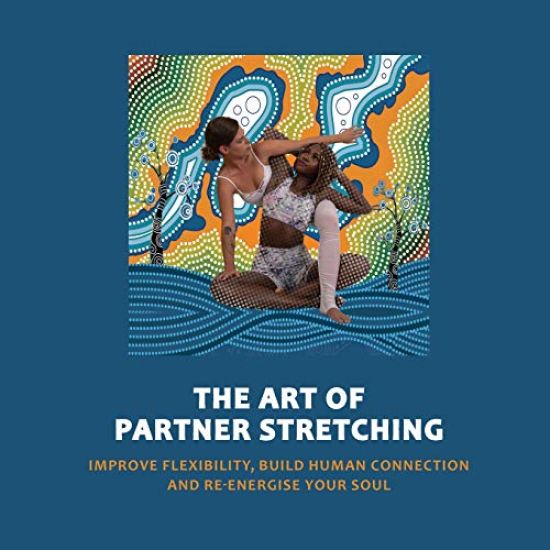
Art of Partner Stretching

Art of Partner Stretching

Manu Sood

Wild Cleanse
2020
pokkari
Flexibility is important no matter what your passion is - the gym, a sport, fitness, acro yoga, massage muscle rehabilitation or feeling better about yourself.But stretching can be boring and repetitive. Adding the magical touch of a partner can make your flexibility workout a whole lot more fun and effective A partner can help you increase your range of motion by correcting, guiding and assisting you to hold your stretch.This book aims to be a visual reference guide so that two people can follow the illustrations and give each other a full body stretch. Here is what to expect: - Each stretch contains an explanation of muscles targeted, steps and where relevant, tips, cautions and progressions.- 60 beautiful photographs, many with added artistic touches, demonstrate each stretch.- A diagram explaining basic human anatomy - Logically sequenced stretches so that no muscle group is forgotten.- For couples this is a fun way to connect and play with each other. - Written by a beginner for beginners. So everything is explained in simple terms with no assumption of prior knowledge.But most importantly, as you practice these poses, the power of human touch and the energy flows between us will become evident This book is part of a forthcoming series on Acro Yoga (Partner Acrobatics). The book will contain basic Acro Yoga poses and how to build the strength and flexibility to achieve them. For more information go to: www.wildcleanse.com or Instagram: wildcleanse.
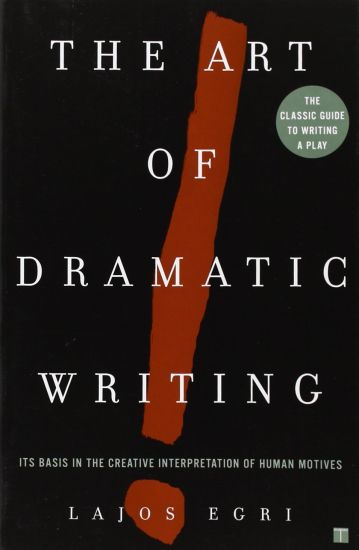
Art Of Dramatic Writing

Art Of Dramatic Writing

Lajos Egri

Touchstone
2004
pokkari
Lajos Egri examines a play from the inside out, starting with the heart of any drama: its characters. For it is people - their private natures and their inter-relationships - that move a story and give it life. All good dramatic writing depends upon an understanding of human motives. Why do people act as they do? What forces transform a coward into a hero, a hero into a coward? What is it that Romeo does early in Shakespeare's play that makes his later suicide seem inevitable? Why must Nora leave her husband at the end of A Doll's House? These are a few of the fascinating problems which Egri analyzes. He shows how it is essential for the author to have a basic premise - a thesis, demonstrated in terms of human behaviour - and to develop his dramatic conflict on the basis of that behaviour. Premise, character, conflict: this is Egri's ABC. His book is a direct, jargon-free approach to the problem of achieving truth in a literary creation.
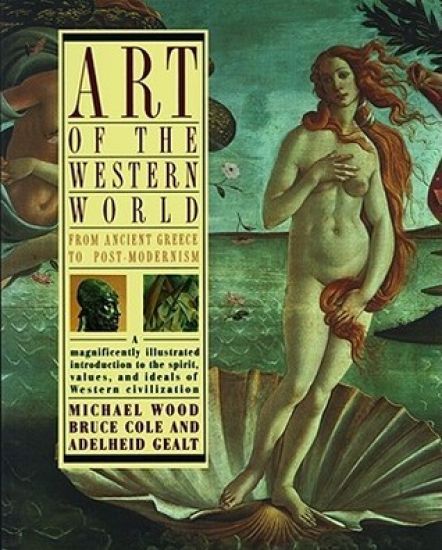
Art of the Western World: From Ancient Greece to Post Modernism
In this magnificently illustrated and comprehensive book, readers will take one of the most beautiful journeys our world has to offer: an exploration of the greatest are and architecture of Western civilization. Art of the Western World -- the companion volume to the nine-part PBS television series -- traces the history of Western art from its classical roots in ancient Greece up to the present day and the international Post-Modernism of artists as diverse as Christo, Hockney, and Kiefer. Along the way experts Bruce Cole and Adelheid Gealt carefully chart the evolution of the Western tradition, from the grandeur of Roman architecture to the symbolic language of medieval art, through the unparalleled achievements of the Renaissance, the turbulent emotionalism of the Romantics like Turner and Constable, the Impressionists' search for a new reality, and the revolution of the Abstract Expressionists of the twentieth century. Art of the Western World integrates the works of each period with the history, values, and ideals that gave birth to them: the influence of the Medicis and other great patrons of Renaissance Italy; the resurgence of the classical style, inspired by the French Revolution; the break with the past evidenced in the works of the Impressionists; and the tortured visions of the modern world devastated by wars depicted in the paintings of Picasso, Marc, Groez, and others. A valuable key to understanding the language of art, Art of the Western World offers fresh insight into what the great works meant at the time they were created and why they maintain their special meaning to us now. It is the perfect guide to the masterpieces of Western art.
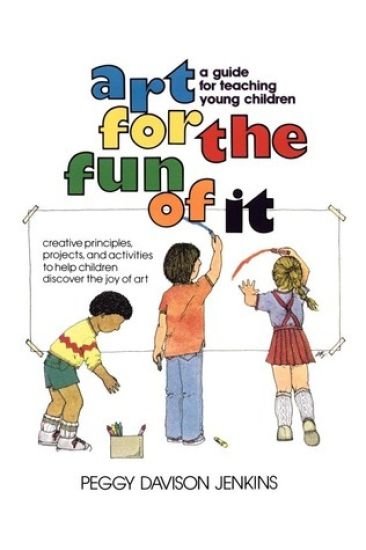
Art for the Fun of It

Art for the Fun of It

Peggy Davison Jenkins

Touchstone
1980
pokkari
Every child is born with the power to create, to be original, spontaneous, and innovative. With this book, you can create the climate, provide the encouragement, and supply the material support needed for children to develop their innate creativity.Art for the Fun of It is a guide for teaching young children the joys of art and exploration. Perfect for children of all ages.
Art and the Christian Intelligence in St. Augustine

Art and the Christian Intelligence in St. Augustine

O'Connell Robert J.

Harvard University Press
1978
sidottu
Although it is widely acknowledged that St. Augustine was a consummate artist as well as a great philosopher, and that he was deeply concerned with art, beauty and human values, relatively little attention has been paid to his theory of aesthetics. Now a distinguished Augustine scholar turns to this important subject and offers a book that is at once engaging, comprehensive and complete. Father O'Connell begins with a paradox: how could so dedicated a literary artist propose, at times, a theory of art that amounts to the banishment of art? In attempting to answer this and other important questions, the author's purpose is not merely to recount but to retrieve St. Augustine's views. He suggests that Augustine's need to understand, and by understanding to exorcise, art's spell on him provides a key to all the philosophical and theological questions that absorbed him. Seen in this light, St. Augustine's aesthetic may lie at the very heart of his philosophy.
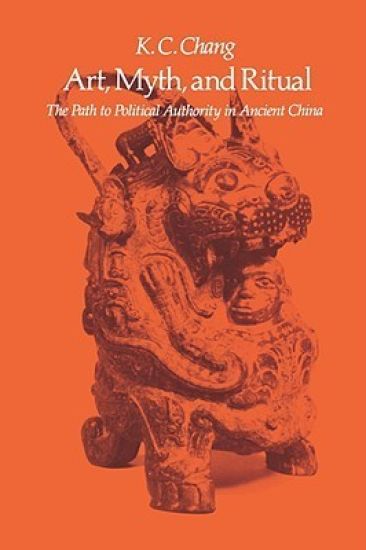
Art, Myth, and Ritual

Art, Myth, and Ritual

K. C. Chang

Harvard University Press
1988
nidottu
A leading scholar in the United States on Chinese archaeology challenges long-standing conceptions of the rise of political authority in ancient China. Questioning Marx’s concept of an “Asiatic” mode of production, Wittfogel’s “hydraulic hypothesis,” and cultural-materialist theories on the importance of technology, K. C. Chang builds an impressive counterargument, one which ranges widely from recent archaeological discoveries to studies of mythology, ancient Chinese poetry, and the iconography of Shang food vessels.
Art, Interpretation, and the Rest of Life: Essays in Aesthetics
Arguing that modern aesthetics has divorced art from beauty and therefore from life itself, a renowned philosopher seeks to reintegrate art and everyday experience. Supposedly there is a distinction between art and life, such that one can at best imitate the other. Alexander Nehamas, one of most respected philosophers of his age, makes clear just how far we have been led astray by this false dichotomy. He argues that art can only diverge from life when we scorn beauty, which connects and adorns the two. Art, Interpretation, and the Rest of Life takes as a starting point Plato's attacks on poetry and drama. Subsequent generations reinforced his contempt, and during the eighteenth century institutionalized it in an asserted distinction between high and low art. It was this elitist move, establishing a realm of cultivated sensibility accessible only to the educated, that resolutely severed art from experience. Instead art was imagined independent of everyday interests and popular concerns, so that aesthetic pleasure was alienated from the hopes and disappointments of life as we generally know it. Central to the conceit of modern aesthetics--and conceit it was, for the trifles of one age are often fine art in the next--was the divorce of art from beauty: beauty provokes the desire and discontents that have no place in an intellectualized order of high art. Attending to the likes of Goya, Proust, Duchamp, Mann, and Nabokov, crime novels and TV shows, Nehamas reintroduces art to beauty so that we may find art everywhere and see it for what it is: not an esoteric stimulation for the few but an integral and multifaceted component of all people's lives.
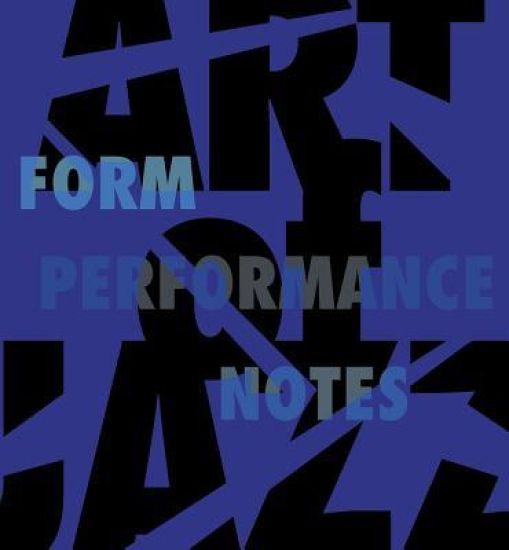
Art of Jazz

Art of Jazz

Ethelbert Cooper Gallery of African and African American Art
2017
nidottu
This catalogue documents the exhibition Art of Jazz, a collaborative installation at the Ethelbert Cooper Gallery of African & African American Art with one section (“Form”) installed at the Harvard Art Museum. The book explores the intersection of the visual arts and jazz music, and presents a visual feast of full color plates of artworks, preceded by a series of essays.“Form,” curated by Suzanne Preston Blier and David Bindman in the teaching gallery of the Harvard Art Museum, ushers in a dialogue between visual representation and jazz music, showcasing artists’ responses to jazz. “Performance,” also curated by Blier and Bindman, guides us through a rich collection of books, album covers, photographs, and other ephemera installed at the Cooper Gallery. “Notes,” curated by Cooper Gallery director Vera Ingrid Grant, fills five of the gallery’s curatorial spaces with contemporary art that illustrates how late twentieth- and early twenty-first century artists hear, view, and engage with jazz.Visual artists represented in “Form” include Matisse, Jackson Pollock, Romare Bearden, and Stuart Davis. “Performance” includes art by Hugh Bell, Carl Van Vechten, and Romare Bearden; additional album cover art by Joseph Albers, Ben Shahn, Andy Warhol, and the Fisk Jubilee Singers; and posters and photographs of Josephine Baker and Lena Horne. “Notes” includes art by Cullen Washington, Norman Lewis, Walter Davis, Lina Viktor, Petite Noir, Ming Smith, Richard Yarde, Christopher Myers, Whitfield Lovell, and Jason Moran.
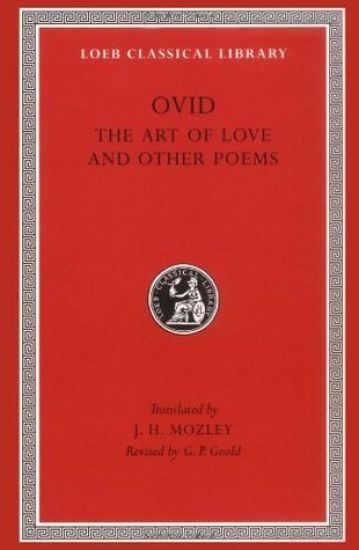
Art of Love. Cosmetics. Remedies for Love. Ibis. Walnut-tree. Sea Fishing. Consolation
Seductive verse.Ovid (Publius Ovidius Naso, 43 BC–AD 17), born at Sulmo, studied rhetoric and law at Rome. Later he did considerable public service there, and otherwise devoted himself to poetry and to society. Famous at first, he offended the emperor Augustus by his Ars Amatoria, and was banished because of this work and some other reason unknown to us, and dwelt in the cold and primitive town of Tomis on the Black Sea. He continued writing poetry, a kindly man, leading a temperate life. He died in exile.Ovid’s main surviving works are the Metamorphoses, a source of inspiration to artists and poets including Chaucer and Shakespeare; the Fasti, a poetic treatment of the Roman year of which Ovid finished only half; the Amores, love poems; the Ars Amatoria, not moral but clever and in parts beautiful; Heroides, fictitious love letters by legendary women to absent husbands; and the dismal works written in exile: the Tristia, appeals to persons including his wife and also the emperor; and similar Epistulae ex Ponto. Poetry came naturally to Ovid, who at his best is lively, graphic and lucid.The Loeb Classical Library edition of Ovid is in six volumes.
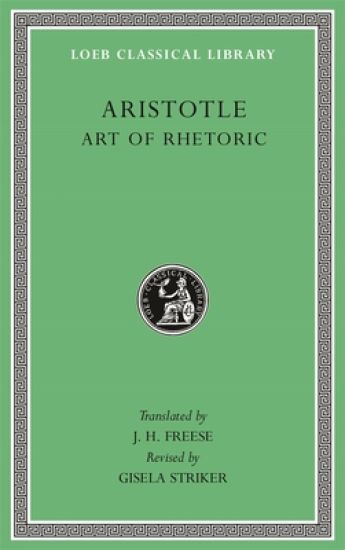
Art of Rhetoric

Art of Rhetoric

Aristotle

Harvard University Press
2020
sidottu
Persuasion analyzed.Aristotle (384–322 BC), the great Greek thinker, researcher, and educator, ranks among the most important and influential figures in the history of philosophy, theology, and science. He joined Plato’s Academy in Athens in 367 and remained there for twenty years. After spending three years at the Asian court of a former pupil, Hermeias, where he married Pythias, one of Hermeias’ relations, and living for a time at Mytilene, he was appointed by Philip of Macedon in 343/2 to become tutor of his teenaged son, Alexander. After Philip’s death in 336, Aristotle became head of his own school, the Lyceum at Athens, whose followers were known as the Peripatetics. Because of anti-Macedonian feeling in Athens after Alexander’s death in 323, Aristotle withdrew to Chalcis in Euboea, where he died in 322.Aristotle wrote voluminously on a broad range of subjects analytical, practical, and theoretical, but nearly all the works that he prepared for publication are lost; extant are lecture-materials, notes, and memoranda, some spurious. Rhetoric, a manual for public speakers, was probably composed while Aristotle was still at the Academy and Isocrates was still alive. Instead of the sophistic and Isocratean method of imitating model speeches, Aristotle devised a systematic method based in dialectic, on which he had recently written the first manual. The goal of rhetoric is to find the available means of persuasion for any given case using argument, the character of the speaker, and the emotions of the audience. Rhetoric, he says, is “a kind of offshoot from dialectic and the study of character, which is justly called the science of politics.”This edition of Aristotle’s Rhetoric, which replaces the original Loeb edition by J. H. Freese, supplies a Greek text based on that of Rudolf Kassel, a fresh translation, and ample annotation fully current with modern scholarship.
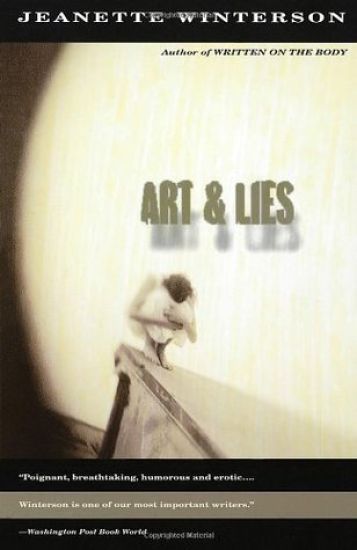
Art & Lies

Art & Lies

Jeanette Winterson

Knopf Doubleday Publishing Group
1996
nidottu
One of the most audacious and provocative writers on either side of the Atlantic now gives readers a dazzling, arousing, and wise improvisation on art, Eros, language, and identity. "A series of intense, artful musings that are exhilarating and visionary. . . . Unsettling yet strangely satisfying."--Newsday.