This book is an introduction to constructive mathematics with an emphasis on techniques and results obtained in the last twenty years. The text covers fundamental theory of the real line and metric spaces, focusing on locatedness in normed spaces and with associated results about operators and their adjoints on a Hilbert space. The first appendix gathers together some basic notions about sets and orders, the second gives the axioms for intuitionistic logic. No background in intuitionistic logic or constructive analysis is needed in order to read the book, but some familiarity with the classical theories of metric, normed and Hilbert spaces is necessary.
Aimed at mathematicians and computer scientists who will only be exposed to one course in this area, Computability: A Mathematical Sketchbook provides a brief but rigorous introduction to the abstract theory of computation, sometimes also referred to as recursion theory. It develops major themes in computability theory, such as Rice's theorem and the recursion theorem, and provides a systematic account of Blum's complexity theory as well as an introduction to the theory of computable real numbers and functions. The book is intended as a university text, but it may also be used for self-study; appropriate exercises and solutions are included.
The core of this book, Chapters three through five, presents a course on metric, normed, and Hilbert spaces at the senior/graduate level. The motivation for each of these chapters is the generalisation of a particular attribute of the n Euclidean space R: in Chapter 3, that attribute is distance; in Chapter 4, length; and in Chapter 5, inner product. In addition to the standard topics that, arguably, should form part of the armoury of any graduate student in mathematics, physics, mathematical economics, theoretical statistics,. . . , this part of the book contains many results and exercises that are seldom found in texts on analysis at this level. Examples of the latter are Wong’s Theorem (3.3.12) showing that the Lebesgue covering property is equivalent to the uniform continuity property, and Motzkin’s result (5. 2. 2) that a nonempty closed subset of Euclidean space has the unique closest point property if and only if it is convex. The sad reality today is that, perceiving them as one of the harder parts of their mathematical studies, students contrive to avoid analysis courses at almost any cost, in particular that of their own educational and technical deprivation. Many universities have at times capitulated to the negative demand of students for analysis courses and have seriously watered down their expectations of students in that area. As a result, mathematics majors are graduating, sometimes with high honours, with little exposure to anything but a rudimentary course or two on real and complex analysis, often without even an introduction to the Lebesgue integral.
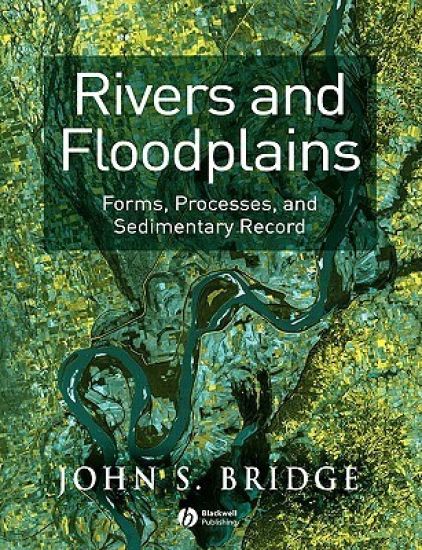
Rivers and Floodplains is concerned with the origin, geometry, water flow, sediment transport, erosion and deposition associated with modern alluvial rivers and floodplains, how they vary in time and space, and how this information is used to interpret deposits of ancient rivers and floodplains. There is specific reference to the types and lifestyles of organisms associated with fluvial environments, human interactions with rivers and floodplains, associated environmental and engineering concerns, as well as the economic aspects of fluvial deposits, particularly the modeling of fluvial hydrocarbon reservoirs and aquifers. Methods of studying rivers and floodplains and their deposits are also discussed. Although basic principles are emphasized, many examples are detailed. Particular emphasis is placed on how an understanding of the nature of modern rivers and floodplains is required before any problems concerning rivers and floodplains, past or present, can be addressed rationally. Rivers and Floodplains is designed as a core text for senior undergraduate and graduate students studying modern or ancient fluvial environments, particularly in earth sciences, environmental sciences and physical geography, but also in civil and agricultural engineering. College teachers, researchers, and practising professionals will also find the book an invaluable reference. Presents a process-based approach, which is relevant to modern curricula. Discusses methods of studying rivers and floodplains and their deposits. Provides many detailed examples throughout the text. Emphasises the basic principles of this subject. As the first synthesis of this entire field, it will be a must-have for all students studying modern or ancient fluvial environments. Teachers, researchers and practising professionals will find this an invaluable reference tool. Rivers and Floodplains will also be of interest to geologists, geographers and engineers.
This is a solid representation of criminological articles that are important to the discipline. The important material from each article has been retained, yet an undergraduate won't be overwhelmed. The articles are germane and flow together; a certain consistency in thought is presented to the student, as opposed to interesting but often semi-related articles. This book is accessible and, in several areas, very enjoyable reading. -- A. L. Marsteller, Drury College Also by the Editors: Crime (Vol. 1) and Juvenile Delinquency (Vol. 2) Why are these edited collections THE anthologies to use for teaching Criminal Justice, Criminology, or Juvenile Delinquency? * All volumes present the field accurately and completely to students and in a way that is understandable to undergraduates and, therefore, teachable. * All include rich collections of classic and contemporary articles, all of which have been carefully edited so that students can master the material. * All volumes contain essays written by the Editors, which provide the coherence and structure to the collections that undergraduate students need. Questions for Discussion and Writing and well-prepared indexes help to make these anthologies even more teachable. * All are edited by scholars who have the credentials and the undergraduate teaching experience to make this three volume set a particularly rich resource.
Aimed at mathematicians and computer scientists who will only be exposed to one course in this area, Computability: A Mathematical Sketchbook provides a brief but rigorous introduction to the abstract theory of computation, sometimes also referred to as recursion theory. It develops major themes in computability theory, such as Rice's theorem and the recursion theorem, and provides a systematic account of Blum's complexity theory as well as an introduction to the theory of computable real numbers and functions. The book is intended as a university text, but it may also be used for self-study; appropriate exercises and solutions are included.
The core of this book, Chapters three through five, presents a course on metric, normed, and Hilbert spaces at the senior/graduate level. The motivation for each of these chapters is the generalisation of a particular attribute of the n Euclidean space R: in Chapter 3, that attribute is distance; in Chapter 4, length; and in Chapter 5, inner product. In addition to the standard topics that, arguably, should form part of the armoury of any graduate student in mathematics, physics, mathematical economics, theoretical statistics,. . . , this part of the book contains many results and exercises that are seldom found in texts on analysis at this level. Examples of the latter are Wong’s Theorem (3.3.12) showing that the Lebesgue covering property is equivalent to the uniform continuity property, and Motzkin’s result (5. 2. 2) that a nonempty closed subset of Euclidean space has the unique closest point property if and only if it is convex. The sad reality today is that, perceiving them as one of the harder parts of their mathematical studies, students contrive to avoid analysis courses at almost any cost, in particular that of their own educational and technical deprivation. Many universities have at times capitulated to the negative demand of students for analysis courses and have seriously watered down their expectations of students in that area. As a result, mathematics majors are graduating, sometimes with high honours, with little exposure to anything but a rudimentary course or two on real and complex analysis, often without even an introduction to the Lebesgue integral.
A basic assumption made by pioneers of classical microeconomics such as Edgeworth and Pareto was that the ranking of a consumer's preferences could always be measured numerically, by associating to each possible con- sumption bundle a real number that measured its utility: the greater the utility, the more preferred was the bundle, and conversely. It took several decades before the naivety of this assumption was seriously challenged by economists, such as Wold, attempting to find conditions under which it could be justified mathematically. Wold's work was the first in a long chain of results of that type, leading to the definitive theorems of Debreu and oth- ers in the 1960s, and subsequently to the refinements and generalisations that have appeared in the last twenty-five years. Out of this historical background there has appeared a general mathe- matical problem which, as well as having applications in economics, psy- chology, and measurement theory, arises naturally in the study of sets bear- ing order relations: Given some kind of ordenng t on a set 5, fina a real-valued mapping u on 5 such that for any elements x, y of 5, x t yif and only if u(x) 2: u(y). If also 5 has a topology (respective/y, differential structure), find conditions that ensure the continuity (respectively, differentiability) of the mapping u. A mapping *u of this kind is called a representation of the ordering C:::.
The theory presented in this book is developed constructively, is based on a few axioms encapsulating the notion of objects (points and sets) being apart, and encompasses both point-set topology and the theory of uniform spaces. While the classical-logic-based theory of proximity spaces provides some guidance for the theory of apartness, the notion of nearness/proximity does not embody enough algorithmic information for a deep constructive development. The use of constructive (intuitionistic) logic in this book requires much more technical ingenuity than one finds in classical proximity theory -- algorithmic information does not come cheaply -- but it often reveals distinctions that are rendered invisible by classical logic.In the first chapter the authors outline informal constructive logic and set theory, and, briefly, the basic notions and notations for metric and topological spaces. In the second they introduce axioms for a point-set apartness and then explore some of the consequences of those axioms. In particular, they examine a natural topology associated with an apartness space, and relations between various types of continuity of mappings. In the third chapter the authors extend the notion of point-set (pre-)apartness axiomatically to one of (pre-)apartness between subsets of an inhabited set. They then provide axioms for a quasiuniform space, perhaps the most important type of set-set apartness space. Quasiuniform spaces play a major role in the remainder of the chapter, which covers such topics as the connection between uniform and strong continuity (arguably the most technically difficult part of the book), apartness and convergence in function spaces, types of completeness, and neat compactness. Each chapter has a Notes section, in which are found comments on the definitions, results, and proofs, as well as occasional pointers to future work. The book ends with a Postlude that refers to other constructive approaches to topology, with emphasis on the relation between apartness spaces and formal topology.Largely an exposition of the authors' own research, this is the first book dealing with the apartness approach to constructive topology, and is a valuable addition to the literature on constructive mathematics and on topology in computer science. It is aimed at graduate students and advanced researchers in theoretical computer science, mathematics, and logic who are interested in constructive/algorithmic aspects of topology.
The theory presented in this book is developed constructively, is based on a few axioms encapsulating the notion of objects (points and sets) being apart, and encompasses both point-set topology and the theory of uniform spaces. While the classical-logic-based theory of proximity spaces provides some guidance for the theory of apartness, the notion of nearness/proximity does not embody enough algorithmic information for a deep constructive development. The use of constructive (intuitionistic) logic in this book requires much more technical ingenuity than one finds in classical proximity theory -- algorithmic information does not come cheaply -- but it often reveals distinctions that are rendered invisible by classical logic.In the first chapter the authors outline informal constructive logic and set theory, and, briefly, the basic notions and notations for metric and topological spaces. In the second they introduce axioms for a point-set apartness and then explore some of the consequences of those axioms. In particular, they examine a natural topology associated with an apartness space, and relations between various types of continuity of mappings. In the third chapter the authors extend the notion of point-set (pre-)apartness axiomatically to one of (pre-)apartness between subsets of an inhabited set. They then provide axioms for a quasiuniform space, perhaps the most important type of set-set apartness space. Quasiuniform spaces play a major role in the remainder of the chapter, which covers such topics as the connection between uniform and strong continuity (arguably the most technically difficult part of the book), apartness and convergence in function spaces, types of completeness, and neat compactness. Each chapter has a Notes section, in which are found comments on the definitions, results, and proofs, as well as occasional pointers to future work. The book ends with a Postlude that refers to other constructive approaches to topology, with emphasis on the relation between apartness spaces and formal topology.Largely an exposition of the authors' own research, this is the first book dealing with the apartness approach to constructive topology, and is a valuable addition to the literature on constructive mathematics and on topology in computer science. It is aimed at graduate students and advanced researchers in theoretical computer science, mathematics, and logic who are interested in constructive/algorithmic aspects of topology.
Policies to increase the level of enterprise and entrepreneurship, in many countries and regions, have often failed. This book explores this and gives alternative views to derive a different model, based on social influence, which is consistent with the evidence and which might therefore lead to better policy.
This issue of Rheumatic Disease Clinics focuses on Genetics. Article topics cover: Genetic Influences on Susceptibility and Severity of Rheumatoid Arthritis; HLA-disease associations in rheumatoid arthritis; Autoinflammatory Syndromes as a Model of Monogenic Diseases; Genomic Influences on Hyperuricaemia and Gout; Genetics of Systemic Lupus Erythematosus; Genetics of Ankylosing Spondylitis;Genetics of Scleroderma; Genetics of Osteoarthritis; Genetics of Juvenile Inflammatory Arthritis; Genetic Influences on Treatment Response in Rheumatic Diseases; Integrative approaches/computational biology; Future directions of genetic research in rheumatic diseases; and Population genetics and natural selection in rheumatic disease.
This insightful practical guide argues that the traditional business plan may not be appropriate for many new ventures and presents an alternative, effectual approach that encourages flexibility and development through exploration and experience. 10 principles demonstrate how to respond better to uncertainty during the business development process.
Policies to increase the level of enterprise and entrepreneurship, in many countries and regions, have often failed. This book explores this and gives alternative views to derive a different model, based on social influence, which is consistent with the evidence and which might therefore lead to better policy.
This insightful practical guide argues that the traditional business plan may not be appropriate for many new ventures and presents an alternative, effectual approach that encourages flexibility and development through exploration and experience. 10 principles demonstrate how to respond better to uncertainty during the business development process.
CORRUPTION. STRANGE ALLIES. A DEADLY ASSASINATION PLOT WITH FAR REACHING CONSEQUENCES. Lawyer turned Hitman Mark King returns for another gripping adventure in his quest for justice. 18 months after the battle at Ain M'lila airfield & plagued by nightmares and flashbacks about his late wife, Mark is enjoying a well-earned holiday in the Scottish Highlands when he stumbles across some hitmen trying to assassinate a woman, Nadia Moore, a Hit woman out for revenge. After rescuing her, the two begin to uncover a threat which draws Mark back into the violent world of professional Hitmen. Mark follows a lead to the Ukraine and, with the help of Elena, a woman he rescues at the airport from her abusive boyfriend, he discovers a Sex Trafficking ring, a plot to assassinate the President of Ukraine, and a task force, created to eliminate a group of men who broke away from Invictus Advoca many years ago. Mark has also come to the attention of MI6 and an agent with an ulterior motive is sent to 'supervise' Mark. In a deadly game of cat and mouse, Mark King races to get to these men before Invictus Advoca do, and to the truth. He also learns Thomas Lundon has somehow survived but, that someone exists more senior than Lundon; someone more terrifying and more sinister, who will stop at nothing to take out Mark King. This time, they know he's coming. But they don't know where, they don't know when and Mark King could strike at any moment. People are beginning to question whether Mark King still has a grip on reality as the line between revenge and justice, seems to become blurred.
This issue of the Rheumatic Disease Clinics of North America provides the rheumatologist with the latest information on diagnosis and treatment of antineutrophil cytoplasmic antibodies (ANCA)-associated vasculitis. Topics covered inlucde epidemiology; history; pathogenesis; autoantibodies in ANCA-associated vasculitis (including drug-induced ANCAs); pauci-immune renal disease; ocular manifestations; diagnostic approach (including mimickers); Wegener's Granulomatosis; Churg-Strauss Syndrome; microscopic polyangiitis; outcome measures; and the future of ANCA-Associated Vasculitis.
Jointly hosted by the Ergonomics Society of South Africa (ESSA) and the International Ergonomics Association (IEA), this conference was attended by over 300 delegates and represented the largest and most prestigious gathering of eminent international ergonomists in the history of Africa. It also marked the beginning of a revival in concern for the well-being and productivity of people at work in South Africa. The conference aimed to juxtapose two great ergonomic themes – the under-developed ethos of the affluent societies and the technologically advanced ethos of the most affluent societies. The structure of the proceedings reflects this with the first section addressing the priorities of countries in transition and the last section addressing the priorities of the most industrially-developed countries, who have, by and large, long since solved the sorts of ergonomics problems currently of concern in the under-developed world. In between these, in a roughly hierarchical arrangement from micro- to macro- levels of analysis, are sections which collectively help span the whole field of ergonomics. Section overviews are provided to outline the topics included in each section.
Designed for undergraduate juvenile delinquency courses, this book actively involves students in the literature of the discipline, presents the field in a format that is accessible, understandable, and enjoyable, and is edited by well-known scholars who are experienced researchers and teachers. · The readings in this anthology have been very carefully edited and pruned by the Editors so that undergraduate students can easily read them without getting bogged down or confused and lost in the technical, methodological details. · At no additional cost, we have included 5 substantial data analysis exercises spread throughout the book. These exercises not only teach students the basic of SPSS, the "standard" data analysis software in social science, but also show them how they can test the delinquency theories and propositions covered in the reader, using current delinquency data packaged with the book. This absolutely unique feature is structured into fill-in-the-blank exercise sets that are easy to grade for large numbers of students by a single instructor. · Over 150 very good questions have been put together for the readings so that instructors can easily test, even in large courses, whether or not their students are keeping up with the reading.