A groundbreaking study of Farid al-Din ?A??ar, one of Persian literature's greatest poets.Religion of Love explores the life and work of the Persian Sufi poet and sage Farid al-Din ?A??ar. ?A??ar changed the face of world literature, leaving his impact on all cultures that have valued Persian Sufi writings. Considered for the first time through the lens of religious studies, ?A??ar's oeuvre offers much to contemporary readers. ?A??ar's poems cast a light on the relationship between revelation and the intellect. They also encourage liberation from self-centeredness through the fiery path of love. Thus, Religion of Love considers one of Persian literature's greatest poets as more than just a poet, but also as a thinker and a commentator on moral psychology, ethics, and the intellectual debates of his age, debates that shed light on today's religious complexities.
A groundbreaking study of Farid al-Din ?A??ar, one of Persian literature's greatest poets.Religion of Love explores the life and work of the Persian Sufi poet and sage Farid al-Din ?A??ar. ?A??ar changed the face of world literature, leaving his impact on all cultures that have valued Persian Sufi writings. Considered for the first time through the lens of religious studies, ?A??ar's oeuvre offers much to contemporary readers. ?A??ar's poems cast a light on the relationship between revelation and the intellect. They also encourage liberation from self-centeredness through the fiery path of love. Thus, Religion of Love considers one of Persian literature's greatest poets as more than just a poet, but also as a thinker and a commentator on moral psychology, ethics, and the intellectual debates of his age, debates that shed light on today's religious complexities.
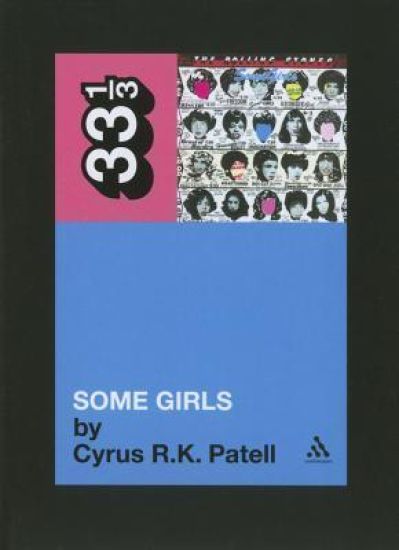
This is a fascinating look at the Stones in the late 70s - inspired by a year just spent in the disco/punk cauldron of New York City. It's October 1977, and the Rolling Stones are in a Paris recording studio. They're under siege. Keith Richards' legal troubles after his arrest for heroin possession in Canada threaten the band's future, and the broad consensus among is that the band will never again reach the heights of Exile on Main Street. But Mick Jagger is writing lyrics inspired by the year he has just spent in New York City, where he was hanging out with the punks at CBGB and with the glitterati at Studio 54. And new bandmember Ron Wood is helping Richards recapture the two-guitar groove that the band had been missing since the Brian Jones era. The result? Some Girls, the band's response both to punk rock and to disco, an album that crackles with all the energy, decadence, and violence of New York in the 1970s. Weaving together the history of the band and the city, Cyrus Patell traces the genesis and legacy of the album that Jagger would later call the band's best since "Let It Bleed". "33 1/3" is a series of short books about a wide variety of albums, by artists ranging from James Brown to the Beastie Boys. Launched in September 2003, the series now contains over 60 titles and is acclaimed and loved by fans, musicians and scholars alike. It was only a matter of time before a clever publisher realized that there is an audience for whom "Exile on Main Street" or "Electric Ladyland" are as significant and worthy of study as "The Catcher in the Rye" or "Middlemarch...The" series, which now comprises 29 titles with more in the works, is freewheeling and eclectic, ranging from minute rock-geek analysis to idiosyncratic personal celebration - "The New York Times Book Review", 2006. This is a brilliant series...each one a word of real love - NME (UK). For more information on the series and on individual titles in the series, check out our blog.
Leaf Cell and Hierarchical Compaction Techniques presents novel algorithms developed for the compaction of large layouts. These algorithms have been implemented as part of a system that has been used on many industrial designs. The focus of Leaf Cell and Hierarchical Compaction Techniques is three-fold. First, new ideas for compaction of leaf cells are presented. These cells can range from small transistor-level layouts to very large layouts generated by automatic Place and Route tools. Second, new approaches for hierarchical pitchmatching compaction are described and the concept of a Minimum Design is introduced. The system for hierarchical compaction is built on top of the leaf cell compaction engine and uses the algorithms implemented for leaf cell compaction in a modular fashion. Third, a new representation for designs called Virtual Interface, which allows for efficient topological specification and representation of hierarchical layouts, is outlined. The Virtual Interface representation binds all of the algorithms and their implementations for leaf and hierarchical compaction into an intuitive and easy-to-use system. From the Foreword: `...In this book, the authors provide a comprehensive approach to compaction based on carefully conceived abstractions. They describe the design of algorithms that provide true hierarchical compaction based on linear programming, but cut down the complexity of the computations through introduction of innovative representations that capture the provably minimum amount of required information needed for correct compaction. In most compaction algorithms, the complexity goes up with the number of design objects, but in this approach, complexity is due to the irregularity of the design, and hence is often tractable for most designs which incorporate substantial regularity. Here the reader will find an elegant treatment of the many challenges ofcompaction, and a clear conceptual focus that provides a unified approach to all aspects of the compaction task...' Jonathan Allen, Massachusetts Institute of Technology