Now a major motion picture A breathtaking debut of literary suspense about a young boy's struggle against his inner demons--a fight to the death against his secret shadow self. On a chilly November afternoon, six-year-old Luke Nightingale's life changes forever. On the playground across from the Metropolitan Museum of Art, he encounters Daniel. Soon the boys are hiding from dinosaurs and shooting sniper rifles. Within hours, Luke and his mother, Claire, are welcoming Daniel into their Upper East Side apartment--and their lives. Daniel and Luke are soon inseparable. With his parents divorcing, Luke takes comfort in having a near-constant playmate. But there's something strange about Daniel, who is more than happy to bind himself to the Nightingales. The divorce has cut Luke's father out of the picture, and as his increasingly fragile mother struggles with the insidious family depression, Daniel--shrewd, adventurous, and insightful--provides Luke both recreation and refuge. As Luke grows from a child to an adolescent to a young man, he realizes that as much as his mother needs him, Daniel needs him more. Jealous of Luke's other attachments, Daniel moves from gestures of friendship into increasingly sinister manipulations. In the end, Luke finds himself in a daily battle for control of his own life--wondering whether he or Daniel will emerge victorious. Brian DeLeeuw's debut is a haunting and provocative story of a family's love and madness that you will not be able to put down. *This title was previously published as In This Way I Was Saved.
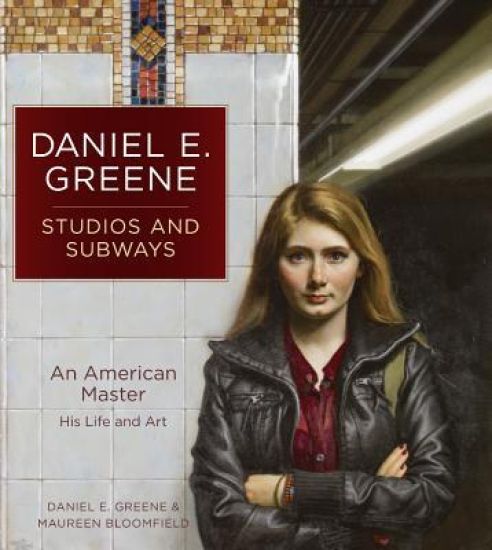
Celebrating the Life and Art of an American Master! "Here is a picture that demonstrates classical mastery and offers allusions to the history of art, all the while acknowledging the art and issues of its time." -p66 From one of America's most accomplished artists and a pioneer of figurative realism, this unprecedented collection celebrates a body of work spanning six prolific decades. A brilliant collaboration between the artist and art critic Maureen Bloomfield, this impressive monograph features more than 200 of Daniel E. Greene's best oil paintings and pastels--from the underworlds of pool halls, carnivals, and New York subways, to classically posed nudes and the elite culture of auction houses. Also included are his still lifes, self-portraits, and commissioned portraits of such illustrious subjects as Eleanor Roosevelt, Ayn Rand, and astronaut Walter Schirra Jr. Essays offer an intimate look at the techniques, ideas, and influences--contemporary and historical--behind these provocative paintings. Equally fascinating is Greene's personal journey: starting with his early days in Cincinnati and drawing quick-portraits of tourists on Miami Beach...to his time at the Art Students League in New York, his stint in the Army, and his distinguished teaching career at the League and the National Academy of Design. Reflecting a lifetime of dedication and originality, Daniel E. Greene: Studios and Subways is the definitive study of this legendary artist, full of insight and inspiration for artists and art-lovers alike.
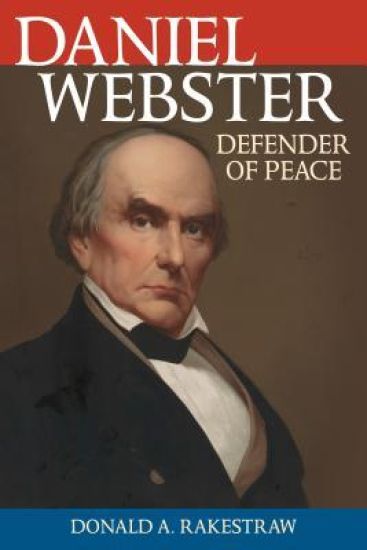
Few names in American history are more recognizable than that of Daniel Webster. No one would deny that Webster’s substantive domestic achievements assured his prominent place in American history and that his virtual embodiment of nation and union guaranteed his rank among the most significant personalities of the Jacksonian era. It can, however, be argued that his domestic resumé that garnered him the title “Defender of the Constitution” is rivaled by an impressive international one that yielded far-reaching results for a nation still struggling to find a respectable position among the Atlantic powers. In fact, his adroit handling of his signature accomplishment with Lord Ashburton earned him the additional title of “Defender of Peace.” Webster’s foreign policy achievements are too often given short shrift, falling victim to the textbook author’s inclination to hold Webster to the dominant domestic narrative that would ultimately see the nation fractured. Donald A. Rakestraw focuses on Webster’s critical diplomatic efforts--efforts that produced a legacy that ranges from the delineation of America’s northeastern boundary with Canada to the prevention of a serious rupture with Britain; from the advancement of national commercial expansion in the Pacific and East Asia to the establishment of a long-lived model for U.S. extradition policy; from his successful intervention on behalf of the so-called “Santa Fe prisoners” in Mexico to his role in promoting a crucial Anglo-American rapprochement.
A highly conscious wordsmith, Daniel Defoe used expository styles in his fiction and non-fiction that reflected his ability to perceive material and intellectual phenomena from opposing, but not contradictory perspectives. Moreover, the boundaries of genre within his wide-ranging oeuvre can prove highly fluid. In this study, Robert James Merrett approaches Defoe’s body of work using interdisciplinary methods that recognize dialectic in his verbal creativity and cognitive awareness. Examining more than ninety of Defoe’s works, Merrett contends that this author’s literariness exploits a conscious dialogue that fosters the reciprocity of traditional and progressive authorial procedures. Along the way, he discusses Defoe’s lexical and semantic sensibility, his rhetorical and aesthetic theories, his contrarian theology, and more. Merrett proposes that Defoe’s contrarian outlook celebrates a view of consciousness that acknowledges the brain’s bipartite structure, and in so doing illustrates how cognitive science may be applied to further explorations of narrative art.
Daniel-François-Esprit Auber (1782–1871), the most amiable French composer of the 19th century, came to his abilities late in life. After a stalled commercial career, he studied with Cherubini. His first works were not a success, but La Bergère Châteleine (1820), written at the age of 38, established him as an operatic composer. He then met the librettist Eugène Scribe (1791–1861), with whom he developed a working partnership, one of the most successful in musical history, that lasted until Scribe's death. After Le Maçon (1825) and La Muette de Portici (1828), Auber's life was filled with success. In 1829 he was appointed a member of the Institut, in 1839 Director of Concerts at Court, in 1842 Director of the Conservatoire, in 1852 Musical Director of the Imperial Chapel, and in 1861 Grand Officer of the Légion d'Honneur.Auber's famous historical grand opera La Muette de Portici (also known by its hero's name as Masaniello) is a key work in operatic history, and helped to inspire the 1830 revolution in Brussels that led to the separation of Belgium from Holland. Auber himself experienced four French Revolutions (1789, 1830, 1848, 1870). The latter (the Commune) hastened the end of his life. He died on 12 May 1871, at the advanced old age of 89, and in the pitiful conditions of civil strife, after a long and painful illness which worsened during the Siege of Paris. He had refused to leave the city he had always loved despite the dangers and privation, even after his house had been set on fire by the petroleurs et petroleuses. By some irony a mark had been placed against the house of the composer of Masaniello, the very voice of Romantic liberty!Auber's overtures were once known everywhere, a staple of the light Classical repertoire. The influence of his gracious melodies and dance rhythms on piano and instrumental music, and on the genre of Romantic comic opera, especially in Germany, was overwhelming. The operas themselves, apart from Fra Diavolo (1830), have virtually passed out of the repertoire, since Auber's elegant and restrained art now has little appeal for the world of music, attuned as it is to the meatier substance of verismo, high Wagnerian transcendentalism, and 20th-century experimentalism.L'Ambassadrice, an opéra-comique in three acts with libretto by Eugène Scribe, had its first performance at the Opéra-Comique (Salle de la Place de la Bourse) on 21 December 1836.This tale of social intrigue and artistic integrity centres around the lives of two opera singers in Munich, Henriette and Charlotte. Henriette is wooed by the Prussian ambassador, Count Benedict de Valberg, and is persuaded by her aunt, Mme Barnek, a social climber, to accept him. In Berlin, where Henriette awaits the sovereign's consent to the marriage, she and her aunt pass themselves off as Bavarian aristocrats, but when the Munich opera company arrives in Berlin, Charlotte, recognizing her old rival, betrays her. Henriette then finds a compromising note in Charlotte's handwriting addressed to the Count, and vows revenge on both of them. Henriette takes Charlotte's place on the stage, and after the performance, she tears up the marriage contract, vowing to devote her life to the stage rather than to continue aristocratic pretence with an unfaithful husband.This work is one of the composer's best. The libretto is ingenious and charming. The score was written especially for Laure Cinti-Damoreau, and is rich in vocal display, fitting for a prima donna. The original success of this opera was later augmented in 1850 by topical developments, when the famous singer Henriette Sontag left the stage to marry the Sardinian diplomat the Comte de Rossi. The whole scenario is buoyed by the perennial and resonant folk motif of personal victory over challenge, optimally realized in professional success combined with social advancement. The scale and structure of the opera reflects a more intimate dramaturgy. Auber's music is by turns lively, touching, playful and tender. There are some fascinating touches, especially in the variety and subtly demanding nature of the heroine's vocal line.The opera was created by Laure Cinti-Damoreau (Henriette), Jenny Colon (Charlotte), Théodore-Étienne Moreau-Sainti (Valberg), Marie-Julienne Boulanger (Madame Barnek), Roy (Fortunatus), Mlle Mousel (Countess Augusta de Fierschemberg), and Joseph-Antoine-Charles Couderc (Bénédict).L'Ambassadrice was in the repertoire from 1836–73. There were 417 performances altogether, and the work was translated into German, Danish, English, Swedish and Spanish.