Kirjojen hintavertailu. Mukana 12 595 353 kirjaa ja 12 kauppaa.

Kirjahaku

Etsi kirjoja tekijän nimen, kirjan nimen tai ISBN:n perusteella.

1000 tulosta hakusanalla Gary Duffey Jr

Ethics and the Orator

Ethics and the Orator

Gary A. Remer

University of Chicago Press
2017
sidottu
For thousands of years, critics have attacked rhetoric and the actual practice of politics as unprincipled, insincere, and manipulative. In Ethics and the Orator, Gary A. Remer disagrees, offering the Ciceronian rhetorical tradition as a rejoinder. He argues that the Ciceronian tradition is based on practical or "rhetorical" politics, rather than on idealistic visions of a politics-that-never-was a response that is ethically sound, if not altogether morally pure. Remer's study is distinct from other works on political morality in that it turns to Cicero, not Aristotle, as the progenitor of an ethical rhetorical perspective. Contrary to many, if not most, studies of Cicero since the mid-nineteenth century, which have either attacked him as morally indifferent or have only taken his persuasive ends seriously (setting his moral concerns to the side), Ethics and the Orator demonstrates how Cicero presents his ideal orator as exemplary not only in his ability to persuade, but in his capacity as an ethical person. Remer makes a compelling case that Ciceronian values balancing the moral and the useful, prudential reasoning, and decorum are not particular only to the philosopher himself, but are distinctive of a broader Ciceronian rhetorical tradition that runs through the history of Western political thought post-Cicero, including the writings of Quintilian, John of Salisbury, Justus Lipsius, Edmund Burke, the authors of The Federalist, and John Stuart Mill.
Improvising Improvisation

Improvising Improvisation

Gary Peters

University of Chicago Press
2017
sidottu
There are an ever-increasing number of books on improvisation, ones that richly recount experiences in the heat of the creative moment, theorize on the essence of improvisation, and offer convincing arguments for improvisation's impact across a wide range of human activity. This book is nothing like that. In a provocative and at times moving experiment, Gary Peters takes a different approach, turning the philosophy of improvisation upside down and inside out. Guided by Kant, Hegel, Heidegger, and especially Deleuze and exploring a range of artists from Hendrix to Borges Peters illuminates new fundamentals about what, as an experience, improvisation truly is. As he shows, improvisation isn't so much a genre, idiom, style, or technique it's a predicament we are thrown into, one we find ourselves in. The predicament, he shows, is a complex entwinement of choice and decision. The performativity of choice during improvisation may happen "in the moment," but it is already determined by an a priori mode of decision. In this way, improvisation happens both within and around the actual moment, negotiating a simultaneous past, present, and future. Examining these and other often ignored dimensions of spontaneous creativity, Peters proposes a consistently challenging and rigorously argued new perspective on improvisation across an extraordinary range of disciplines.
Fighting Financial Crises

Fighting Financial Crises

Gary B. Gorton; Ellis W. Tallman

University of Chicago Press
2018
sidottu
If you’ve got some money in the bank, chances are you’ve never seriously worried about not being able to withdraw it. But there was a time in the United States, an era that ended just over a hundred years ago, in which bank customers had to pay close attention to whether the banking system would remain solvent, knowing they might have to rush to retrieve their savings before the bank collapsed. During the National Banking Era (1863–1914), before the establishment of the Federal Reserve, widespread banking panics were indeed rather common. Yet these pre-Fed banking panics, as Gary B. Gorton and Ellis W. Tallman show, bear striking similarities to our recent financial crisis. In both cases, something happened to make depositors—whether individual customers or corporate investors—“act differently” and find reason to question the value of their bank debt. Fighting Financial Crises thus turns to the past for a fuller understanding of our uncertain present, investigating how panics during the National Banking Era played out and how they were eventually quelled and prevented. Gorton and Tallman open with a survey of the period’s “information environment,” tracing the development of national bank notes, checks, and clearing houses to show how the key to keeping order was to disseminate information very carefully. Identifying the most effective responses based on the framework of the National Banking Era, they then consider the Fed’s and the SEC’s reactions to the recent crisis, building an informative new perspective on how the modern economy works.
The Eloquent Shakespeare

The Eloquent Shakespeare

Gary Logan

University of Chicago Press
2009
sidottu
An actor's deepest desire is to be understood. But when asked to pronounce such words as 'chanson,' 'phantasime,' or 'quaestor,' many otherwise unflappable actors can be rendered speechless."The Eloquent Shakespeare" aims to untie those tongues and help anyone speak Shakespeare's language with ease. More than 17,000 entries make it the most comprehensive pronunciation guide to Shakespeare's words, from the common to the arcane. Each entry is written in the International Phonetic Alphabet and represents standard American pronunciations, making this dictionary perfect for North American professionals or non-native speakers of American English.Renowned Shakespearean voice and text coach Gary Logan has spent years teaching Shakespeare's works to some of the best actors in the world. His book includes proper names and foreign words and phrases, as well as an extensive introduction that covers everything from how to interpret the entries to scansion dynamics. Designed especially for actors, directors, stage managers, and teachers, "The Eloquent Shakespeare" is a one-of-a-kind resource for performing Shakespeare's dramatic works.
The Future of Conservation in America

The Future of Conservation in America

Gary E. Machlis

University of Chicago Press
2018
sidottu
This is a turbulent time for the conservation of America's natural and cultural heritage. From the current assaults on environmental protection to the threats of climate change, biodiversity loss, and disparity of environmental justice, the challenges facing the conservation movement are both immediate and long term. In this time of uncertainty, we need a clear and compelling guide for the future of conservation in America; a declaration to inspire the next generation of conservation leaders. This is that guide--what the authors describe as "a chart for rough water." Written by the first scientist appointed as science advisor to the director of the National Park Service and the eighteenth director of the National Park Service, this is a candid, passionate, and ultimately hopeful book. The authors describe a unified vision of conservation that binds nature protection, historical preservation, sustainability, public health, civil rights and social justice, and science into common cause--and offer real-world strategies for progress. To be read, pondered, debated, and often revisited, The Future of Conservation in America is destined to be a touchstone for the conservation movement in the decades ahead.
The Future of Conservation in America

The Future of Conservation in America

Gary E. Machlis

University of Chicago Press
2018
pokkari
This is a turbulent time for the conservation of America's natural and cultural heritage. From the current assaults on environmental protection to the threats of climate change, biodiversity loss, and disparity of environmental justice, the challenges facing the conservation movement are both immediate and long term. In this time of uncertainty, we need a clear and compelling guide for the future of conservation in America; a declaration to inspire the next generation of conservation leaders. This is that guide--what the authors describe as "a chart for rough water." Written by the first scientist appointed as science advisor to the director of the National Park Service and the eighteenth director of the National Park Service, this is a candid, passionate, and ultimately hopeful book. The authors describe a unified vision of conservation that binds nature protection, historical preservation, sustainability, public health, civil rights and social justice, and science into common cause--and offer real-world strategies for progress. To be read, pondered, debated, and often revisited, The Future of Conservation in America is destined to be a touchstone for the conservation movement in the decades ahead.
Deliberative Choices

Deliberative Choices

Gary Mucciaroni; Paul J. Quirk

University of Chicago Press
2006
sidottu
The task of deliberating public policy falls preeminently to Congress. But decisions on matters ranging from budget deficits to the war with Iraq, among others, raise serious doubts about its performance. In "Deliberative Choices", Gary Mucciaroni and Paul J. Quirk assess congressional deliberation by analyzing debate on the House and Senate floors. Does debate genuinely inform members of Congress and the public? Or does it mostly mislead and manipulate them? Mucciaroni and Quirk argue that in fashioning the claims they use in debate, legislators make a strategic trade-off between boosting their rhetorical force and ensuring their ability to withstand scrutiny. Using three case studies - welfare reform, repeal of the estate tax, and telecommunications deregulation - the authors show how legislators' varying responses to such a trade-off shape the issues they focus on, the claims they make, and the information they provide in support of those claims. Mucciaroni and Quirk conclude that congressional debate generally is only moderately realistic and informed. It often trades in half-truths, omissions, and sometimes even outright falsehoods. Yet some debates are highly informative. Moreover, the authors believe it's possible to improve congressional deliberation, and they recommend reforms designed to do so.
Deliberative Choices

Deliberative Choices

Gary Mucciaroni; Paul J. Quirk

University of Chicago Press
2006
nidottu
The task of deliberating public policy falls preeminently to Congress. But decisions on matters ranging from budget deficits to the war with Iraq, among others, raise serious doubts about its performance. In "Deliberative Choices", Gary Mucciaroni and Paul J. Quirk assess congressional deliberation by analyzing debate on the House and Senate floors. Does debate genuinely inform members of Congress and the public? Or does it mostly mislead and manipulate them? Mucciaroni and Quirk argue that in fashioning the claims they use in debate, legislators make a strategic trade-off between boosting their rhetorical force and ensuring their ability to withstand scrutiny. Using three case studies - welfare reform, repeal of the estate tax, and telecommunications deregulation - the authors show how legislators' varying responses to such a trade-off shape the issues they focus on, the claims they make, and the information they provide in support of those claims. Mucciaroni and Quirk conclude that congressional debate generally is only moderately realistic and informed. It often trades in half-truths, omissions, and sometimes even outright falsehoods. Yet some debates are highly informative. Moreover, the authors believe it's possible to improve congressional deliberation, and they recommend reforms designed to do so.
Same Sex, Different Politics

Same Sex, Different Politics

Gary Mucciaroni

University of Chicago Press
2008
sidottu
Why, for American same-sex couples, is it so much easier to adopt children than it is to get married? And why does our military prevent gays from serving openly even though jurisdictions nationwide continue to render such discrimination illegal? Illuminating the conditions that engender these contradictory policies, "Same Sex, Different Politics" explains why gay rights advocates have achieved dramatically different levels of success from one policy area to another.The first book to compare results across a wide range of gay rights struggles, this volume explores debates over laws governing military service, homosexual conduct, adoption, marriage and partner recognition, hate crimes, and civil rights. It reveals that in each area, the gay rights movement's achievements depend both on Americans' perceptions of its demands and on the political venue in which the conflict plays out. Adoption policy, for example, generally takes shape in a decentralized system of courts that enables couples to target sympathetic judges, while fights for gay marriage generally culminate in legislation or ballot referenda against which it is easier to mount opposition. Brilliantly synthesizing all the factors that contribute to each kind of outcome, "Same Sex, Different Politics" establishes a new framework for understanding the trajectory of a movement.
Same Sex, Different Politics

Same Sex, Different Politics

Gary Mucciaroni

University of Chicago Press
2008
nidottu
Why, for American same-sex couples, is it so much easier to adopt children than it is to get married? And why does our military prevent gays from serving openly even though jurisdictions nationwide continue to render such discrimination illegal? Illuminating the conditions that engender these contradictory policies, "Same Sex, Different Politics" explains why gay rights advocates have achieved dramatically different levels of success from one policy area to another.The first book to compare results across a wide range of gay rights struggles, this volume explores debates over laws governing military service, homosexual conduct, adoption, marriage and partner recognition, hate crimes, and civil rights. It reveals that in each area, the gay rights movement's achievements depend both on Americans' perceptions of its demands and on the political venue in which the conflict plays out. Adoption policy, for example, generally takes shape in a decentralized system of courts that enables couples to target sympathetic judges, while fights for gay marriage generally culminate in legislation or ballot referenda against which it is easier to mount opposition. Brilliantly synthesizing all the factors that contribute to each kind of outcome, "Same Sex, Different Politics" establishes a new framework for understanding the trajectory of a movement.
Culture and the Course of Human Evolution

Culture and the Course of Human Evolution

Gary Tomlinson

University of Chicago Press
2018
sidottu
The rapid evolutionary development of modern Homo sapiens over the past 200,000 years is a topic of fevered interest in numerous disciplines. How did humans, while undergoing few physical changes from their first arrival, so quickly develop the capacities to transform their world? Gary Tomlinson’s Culture and the Course of Human Evolution is aimed at both scientists and humanists, and it makes the case that neither side alone can answer the most important questions about our origins. Tomlinson offers a new model for understanding this period in our emergence, one based on analysis of advancing human cultures in an evolution that was simultaneously cultural and biological—a biocultural evolution. He places front and center the emergence of culture and the human capacities to create it, in a fashion that expands the conceptual framework of recent evolutionary theory. His wide-ranging vision encompasses arguments on the development of music, modern technology, and metaphysics. At the heart of these developments, he shows, are transformations in our species’ particular knack for sign making. With its innovative synthesis of humanistic and scientific ideas, this book will be an essential text.
Culture and the Course of Human Evolution

Culture and the Course of Human Evolution

Gary Tomlinson

University of Chicago Press
2018
pokkari
The rapid evolutionary development of modern Homo sapiens over the past 200,000 years is a topic of fevered interest in numerous disciplines. How did humans, while undergoing few physical changes from their first arrival, so quickly develop the capacities to transform their world? Gary Tomlinson’s Culture and the Course of Human Evolution is aimed at both scientists and humanists, and it makes the case that neither side alone can answer the most important questions about our origins. Tomlinson offers a new model for understanding this period in our emergence, one based on analysis of advancing human cultures in an evolution that was simultaneously cultural and biological—a biocultural evolution. He places front and center the emergence of culture and the human capacities to create it, in a fashion that expands the conceptual framework of recent evolutionary theory. His wide-ranging vision encompasses arguments on the development of music, modern technology, and metaphysics. At the heart of these developments, he shows, are transformations in our species’ particular knack for sign making. With its innovative synthesis of humanistic and scientific ideas, this book will be an essential text.
Machines of Youth

Machines of Youth

Gary S. Cross

University of Chicago Press
2018
pokkari
For American teenagers, getting a driver’s license has long been a watershed moment, separating teens from their childish pasts as they accelerate toward the sweet, sweet freedom of their futures. With driver’s license in hand, teens are on the road to buying and driving(and maybe even crashing) their first car, a machine which is home to many a teenage ritual—being picked up for a first date, “parking” at a scenic overlook, or blasting the radio with a gaggle of friends in tow. So important is this car ride into adulthood that automobile culture has become a stand-in, a shortcut to what millions of Americans remember about their coming of age. Machines of Youth traces the rise, and more recently the fall, of car culture among American teens. In this book, Gary S. Cross details how an automobile obsession drove teen peer culture from the 1920s to the 1980s, seducing budding adults with privacy, freedom, mobility, and spontaneity. Cross shows how the automobile redefined relationships between parents and teenage children, becoming a rite of passage, producing new courtship rituals, and fueling the growth of numerous car subcultures. Yet for teenagers today the lure of the automobile as a transition to adulthood is in decline.Tinkerers are now sidelined by the advent of digital engine technology and premolded body construction, while the attention of teenagers has been captured by iPhones, video games, and other digital technology. And adults have become less tolerant of teens on the road, restricting both cruising and access to drivers’ licenses. Cars are certainly not going out of style, Cross acknowledges, but how upcoming generations use them may be changing. He finds that while vibrant enthusiasm for them lives on, cars may no longer be at the center of how American youth define themselves. But, for generations of Americans, the modern teen experience was inextricably linked to this particularly American icon.
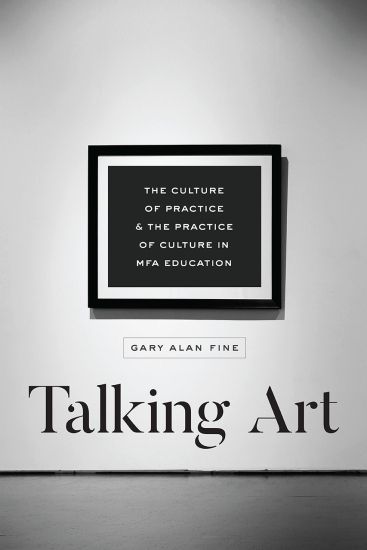
Talking Art

Talking Art

Gary Alan Fine

University of Chicago Press
2018
sidottu
The idea of a graduate art program likely conjures up images of young artists in lofty studios, learning advanced techniques and honing the physical practice of their creativity. In truth, however, today’s MFA culture is centered almost entirely around discussing art rather than actually making it. In Talking Art, ethnographer Gary Alan Fine gives us an eye-opening look at the culture and practices of the contemporary university-based master’s level art program. Central to this culture is the act of the critique, an often harrowing process—depicted here in dramatic and illuminating detail—where artists in training must defend their work before classmates and instructors. Through analysis of the practice of the critique and other aspects of the curriculum, Fine reveals how art schools have changed the very conception of the artist: no longer a misunderstood loner toiling away in a garret, now an artist is closer to being an articulate tour guide through the maze of contemporary art rhetoric. More importantly, he tells us, MFA programs have shifted the goal of creating art away from beauty and toward theory. Contemporary visual art, Fine argues, is no longer a calling or a passion—it’s a discipline, with an academic culture that requires its practitioners to be verbally skilled in the presentation of their intentions. Talking Art offers a remarkable and disconcerting view into the crucial role that universities play in creating that culture.
Talking Art

Talking Art

Gary Alan Fine

University of Chicago Press
2018
pokkari
The idea of a graduate art program likely conjures up images of young artists in lofty studios, learning advanced techniques and honing the physical practice of their creativity. In truth, however, today’s MFA culture is centered almost entirely around discussing art rather than actually making it. In Talking Art, ethnographer Gary Alan Fine gives us an eye-opening look at the culture and practices of the contemporary university-based master’s level art program. Central to this culture is the act of the critique, an often harrowing process—depicted here in dramatic and illuminating detail—where artists in training must defend their work before classmates and instructors. Through analysis of the practice of the critique and other aspects of the curriculum, Fine reveals how art schools have changed the very conception of the artist: no longer a misunderstood loner toiling away in a garret, now an artist is closer to being an articulate tour guide through the maze of contemporary art rhetoric. More importantly, he tells us, MFA programs have shifted the goal of creating art away from beauty and toward theory. Contemporary visual art, Fine argues, is no longer a calling or a passion—it’s a discipline, with an academic culture that requires its practitioners to be verbally skilled in the presentation of their intentions. Talking Art offers a remarkable and disconcerting view into the crucial role that universities play in creating that culture.
Presidents and Parties in the Public Mind

Presidents and Parties in the Public Mind

Gary C. Jacobson

University of Chicago Press
2019
sidottu
How is Donald Trump's presidency likely to affect the reputation and popular standing of the Republican Party? Profoundly, according to Gary C. Jacobson. From Harry S. Truman to Barack Obama, every postwar president has powerfully shaped Americans' feelings, positive or negative, about their party. The effect is pervasive, influencing the parties' reputations for competence, their perceived principles, and their appeal as objects of personal identification. It is also enduring, as presidents' successes and failures continue to influence how we see their parties well beyond their time in office. With Presidents and Parties in the Public Mind, Gary C. Jacobson draws on survey data from the past seven administrations to show that the expansion of the executive branch in the twentieth century that gave presidents a greater role in national government also gave them an enlarged public presence, magnifying their role as the parties' public voice and face. As American politics has become increasingly nationalized and president-centered over the past few decades, the president's responsibility for the party's image and status has continued to increase dramatically. Jacobson concludes by looking at the most recent presidents' effects on our growing partisan polarization, analyzing Obama's contribution to this process and speculating about Trump's potential for amplifying the widening demographic and cultural divide.
Presidents and Parties in the Public Mind

Presidents and Parties in the Public Mind

Gary C. Jacobson

University of Chicago Press
2019
pokkari
How is Donald Trump’s presidency likely to affect the reputation and popular standing of the Republican Party? Profoundly, according to Gary C. Jacobson. From Harry S. Truman to Barack Obama, every postwar president has powerfully shaped Americans’ feelings, positive or negative, about their party. The effect is pervasive, influencing the parties’ reputations for competence, their perceived principles, and their appeal as objects of personal identification. It is also enduring, as presidents’ successes and failures continue to influence how we see their parties well beyond their time in office. With Presidents and Parties in the Public Mind, Gary C. Jacobson draws on survey data from the past seven administrations to show that the expansion of the executive branch in the twentieth century that gave presidents a greater role in national government also gave them an enlarged public presence, magnifying their role as the parties’ public voice and face. As American politics has become increasingly nationalized and president-centered over the past few decades, the president’s responsibility for the party’s image and status has continued to increase dramatically. Jacobson concludes by looking at the most recent presidents’ effects on our growing partisan polarization, analyzing Obama’s contribution to this process and speculating about Trump’s potential for amplifying the widening demographic and cultural divide.
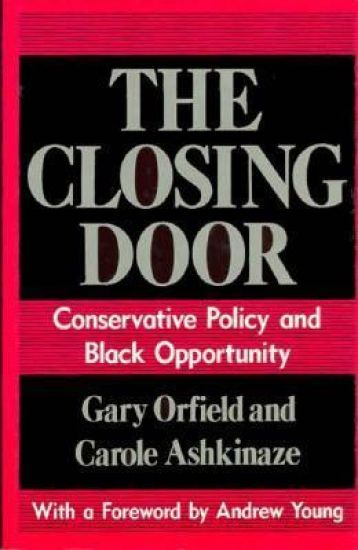
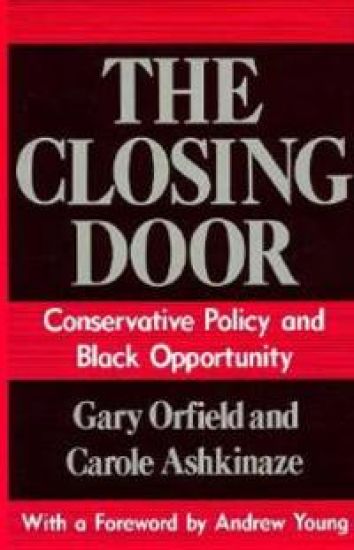
The Closing Door

The Closing Door

Gary Orfield; Carole Ashkinaze

University of Chicago Press
1991
sidottu
The Closing Door is the first major critique of the effect of conservative policies on urban race and poverty in the 1980s. Atlanta, with its booming economy, strong elected black leadership, and many highly educated blacks, seemed to be the perfect site for those policies and market solutions to prove themselves. Unfortunately, not only did expected economic opportunity fail to materialize but many of the hard-won gains of the civil rights movement were lost. Orfield and Ashkinaze painstakingly analyze the evidence from Atlanta to show why black opportunity deteriorated over the 1980s and outline possible remedies for the damage inflicted by the Reagan and Bush administrations. "The Closing Door is a crucial breath of fresh air ...an important and timely text which will help to alter the 'underclass' debate in favor of reconsidering race-specific policies. Orfield and Ashkinaze construct a convincing argument with which those who favor 'race-neutrality' will have to contend. In readable prose they make a compelling case that economic growth is not enough."--Preston H. Smith II, Transition
The Closing Door

The Closing Door

Gary Orfield; Carole Ashkinaze

University of Chicago Press
1993
nidottu
The Closing Door is the first major critique of the effect of conservative policies on urban race and poverty in the 1980s. Atlanta, with its booming economy, strong elected black leadership, and many highly educated blacks, seemed to be the perfect site for those policies and market solutions to prove themselves. Unfortunately, not only did expected economic opportunity fail to materialize but many of the hard-won gains of the civil rights movement were lost. Orfield and Ashkinaze painstakingly analyze the evidence from Atlanta to show why black opportunity deteriorated over the 1980s and outline possible remedies for the damage inflicted by the Reagan and Bush administrations."The Closing Door is a crucial breath of fresh air . . . an important and timely text which will help to alter the 'underclass' debate in favor of reconsidering race-specific policies. Orfield and Ashkinaze construct a convincing argument with which those who favor 'race-neutrality' will have to contend. In readable prose they make a compelling case that economic growth is not enough."—Preston H. Smith II, Transition
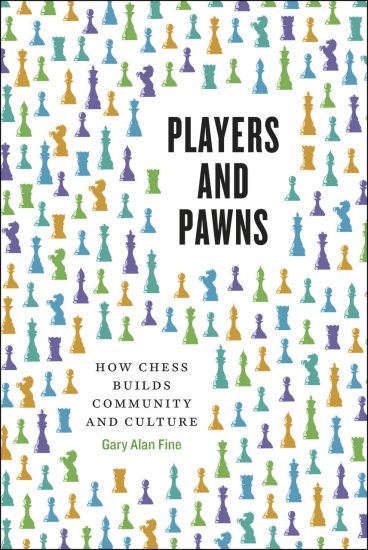
Players and Pawns

Players and Pawns

Gary Alan Fine

University of Chicago Press
2019
nidottu
A chess match seems as solitary an endeavor as there is in sports: two minds, on their own, in fierce opposition. In contrast, Gary Alan Fine argues that chess is a social duet: two players in silent dialogue who always take each other into account in their play. Surrounding that one-on-one contest is a community life that can be nearly as dramatic and intense as the across-the-board confrontation. Fine has spent years immersed in the communities of amateur and professional chess players, and with Players and Pawns he takes readers deep inside them, revealing a complex, brilliant, feisty world of commitment and conflict. Within their community, chess players find both support and challenges, all amid a shared interest in and love of the long-standing traditions of the game, traditions that help chess players build a communal identity. Full of idiosyncratic characters and dramatic gameplay, Players and Pawns is a celebration of the fascinating world of serious chess.