Kirjojen hintavertailu. Mukana 11 244 527 kirjaa ja 12 kauppaa.

Kirjahaku

Etsi kirjoja tekijän nimen, kirjan nimen tai ISBN:n perusteella.

1000 tulosta hakusanalla James M. Hutchisson

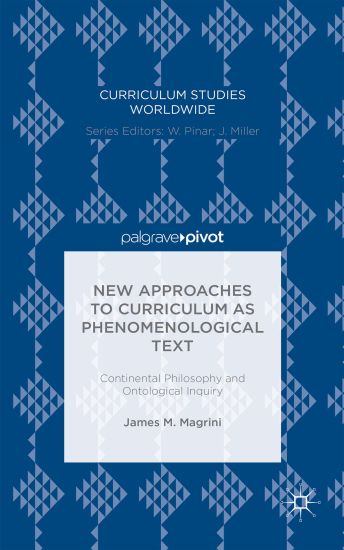
New Approaches to Curriculum as Phenomenological Text
The scholarship of New Directions in Curriculum as Phenomenological Text manifests through close readings and interpretations of curriculum theorists and Continental philosophers, presented in the form of 'speculative philosophical essays,' an important form of curriculum thinking-writing all but lost to the general contemporary field of research.
Heidegger on Literature, Poetry, and Education after the "Turn"

Heidegger on Literature, Poetry, and Education after the "Turn"

James M. Magrini; Elias Schwieler

Routledge
2017
sidottu
Offering new and original readings of literature, poetry, and education as interpreted through the conceptual lens of Heidegger’s later philosophy of the "Turn", this book helps readers understand Heidegger’s later thought and presents new takes on how to engage the themes that emerged from his later writing. Suggesting novel ways to consider Heidegger’s ideas on literature, poetry, and education, Magrini and Schwieler provide a deep understanding of the "Turn," a topic not often explored in contemporary Heideggerian scholarship. Their inter- and extra-disciplinary postmodern approaches offer a nuanced examination, taking into account Heidegger’s controversial place in history, and filling a gap in educational research.
Social Efficiency and Instrumentalism in Education
Distinct among contemporary philosophical studies focused on education, this book engages the history of phenomenological thought as it moves from philosophy proper (the European phenomenological-hermeneutic tradition) through curriculum studies. It thus presents the "best of both worlds" for the reader; there is a "play" or movement from philosophy proper to educational philosophy and then back again in order to locate and explicate what is intimated, suggested, and in some cases, left "unsaid" by educational philosophers. This amounts to a work on education-philosophy that elucidates, through various permutations within the unique foci of each essay, the general phenomenological theme of the fundamental ontology of the human being as primordial learner. Reflecting his experience as scholar, teacher, and perennial learner, the author suggests how research in phenomenology might prove beneficial to the enhancement of both the theoretical and practical aspects of education; readers are invited to envision education as far more than merely a means by which to organize an effective learning experience in which knowledge is assimilated and skill sets are efficiently imparted, but rather as a holistic and integrated process in which knowing, acting, and valuing are original ways of Being-in-the-world.
The Efficacy of Antidumping Duties

The Efficacy of Antidumping Duties

James M. DeVault

Routledge
2017
sidottu
The postwar era was characterized by unprecedented economic expansion. The growth in international trade contributed significantly to this expansion, the growth being the product of the reduction of tariff barriers. As protectionism increased in the 1970s and 80s, the use of non-tariff barriers rose dramatically. This book, first published in 1993, explores how the use of one such barrier, antidumping laws, influenced the US economy.
The Efficacy of Antidumping Duties

The Efficacy of Antidumping Duties

James M. DeVault

Routledge
2019
nidottu
The postwar era was characterized by unprecedented economic expansion. The growth in international trade contributed significantly to this expansion, the growth being the product of the reduction of tariff barriers. As protectionism increased in the 1970s and 80s, the use of non-tariff barriers rose dramatically. This book, first published in 1993, explores how the use of one such barrier, antidumping laws, influenced the US economy.
Reconceptualizing Plato’s Socrates at the Limit of Education
Bridging the gap between interpretations of "Third Way" Platonic scholarship and "phenomenological-ontological" scholarship, this book argues for a unique ontological-hermeneutic interpretation of Plato and Plato’s Socrates. Reconceptualizing Plato’s Socrates at the Limit of Education offers a re-reading of Plato and Plato’s Socrates in terms of interpreting the practice of education as care for the soul through the conceptual lenses of phenomenology, philosophical hermeneutics, and ontological inquiry. Magrini contrasts his re-reading with the views of Plato and Plato’s Socrates that dominate contemporary education, which, for the most part, emerge through the rigid and reductive categorization of Plato as both a "realist" and "idealist" in philosophical foundations texts (teacher education programs). This view also presents what he terms the questionable "Socrates-as-teacher" model, which grounds such contemporary educational movements as the Paideia Project, which claims to incorporate, through a "scripted-curriculum" with "Socratic lesson plans," the so-called "Socratic Method" into the Common Core State Standards Curriculum as a "technical" skill that can be taught and learned as part of the students’ "critical thinking" skills. After a careful reading incorporating what might be termed a "Third Way" of reading Plato and Plato’s Socrates, following scholars from the Continental tradition, Magrini concludes that a so-called "Socratic education" would be nearly impossible to achieve and enact in the current educational milieu of standardization or neo-Taylorism (Social Efficiency). However, despite this, he argues in the affirmative that there is much educators can and must learn from this "non-doctrinal" re-reading and re-characterization of Plato and Plato’s Socrates.
The Crusades, The Kingdom of Sicily, and the Mediterranean
In this collection of studies by James M. Powell, two related centres of attention can be seen. One is the campaigns undertaken by western Europeans in the eastern Mediterranean, chiefly in the late twelfth and thirteenth centuries - the Crusades - the reasons for them and manner in which they were organized and promoted. The other is the Kingdom of Sicily under Frederick II, himself a Crusader, and its society and economy, including its Muslim population. A characteristic feature is the author's interest in ordinary participants and the attempt to get behind the generalizations of macro-historians to the extent that may be possible.
Worked Solutions in Organic Chemistry

Worked Solutions in Organic Chemistry

James M. Coxon; J.A. Gerrard

CRC Press
2017
sidottu
This book illustrates and teaches the finer details of the tactics and strategies employed in the synthesis of organic molecules. As well as providing model answers to the problems, the book discusses, in detail, the reasons why particular strategies are chosen, and why, in given circumstances, alternative methods or routes may or may not be appropriate. As such it could be used as a stand alone volume for the teaching of organic chemistry with a modern and appropriate emphasis on synthesis. Extensive cross referencing to Principles of Organic Synthesis allows the two books to be used as companion volumes.
Wicked Deeds

Wicked Deeds

James M. O'Kane

Routledge
2018
nidottu
To most Americans, homicide appears to be a random act, one committed by a deranged and irrational killer in a haphazard, unpredictable manner. Murder is seen as a chaotic, disorganized act beyond the realm of reason. In Wicked Deeds, James O'Kane shows that homicide is actually rather predictable, and patterned with respect to its assailants and victims, the circumstances in which it takes place, the time and location where it occurs, and the motives which precipitate the murderous act. Engagingly written and solidly grounded in evidence, this is a definitive study of murder in the United States.O'Kane explores the phenomena of homicide, illustrating the journalists' "who, what, why, when, and where" of murder. He differentiates criminal homicide, such as murder in the first and second degree, from other types of killings, including legal and quasi-legal killings. These include suicide, abortion, accidental death, terrorism, and other non-criminal types of homicide, such as justifiable and excusable homicide. The author's focus is criminal homicide, and he uses age, sex, race, and socioeconomic status, as well as demographic data to explain ever-recurring patterns of murder in the United States.Wicked Deeds analyzes numerous categories of murder: intimate partner homicide, child and family murders, multiple victim killings, including mass murder and serial homicide. Each type of murder is illustrated by accounts of actual murders reported in the media and on internet sites. Approximately 200 cases illustrate the typical homicides as well as the bizarre ones.In portraying the patterns and regularities of murder in the United States, Wicked Deeds is an essential treatment of a subject too often given over to sensationalism. It will be of keen interest to professionals and students of criminal justice, as well as those interested in American culture and the general reader who wants to grasp the patterns underlying the headlines.
The Business of the Supreme Court

The Business of the Supreme Court

James M. Landis

Routledge
2017
sidottu
As Felix Frankfurter and James Landis write in their preface to The Business of the Supreme Court, "To an extraordinary degree legal thinking dominates the United States. Every act of government, every law passed by Congress, every treaty ratified by the Senate, every executive order issued by the President is tested by legal considerations and may be subjected to the hazards of litigation. Other Nations, too, have a written Constitution. But no other country in the world leaves to the judiciary the powers which it exercises over us." This classic volume, first published in 1928, originated in a series of articles written by Frankfurter, then a professor of law at Harvard University, and his student, Landis, for the Harvard Law Review. These articles chronicled and analyzed the many judiciary acts that were passed between 1789 and 1925, and illuminated the intimate connection between form and substance in the life of American law. For instance: When a community first decided to enact zoning laws--the Supreme Court had to approve. When the United States made a treaty with Germany following World War I--the Supreme Court had to define the limits and meaning of the treaty.Newly reissued with an introduction by constitutional expert Richard G. Stevens, The Business of the Supreme Court is still as fresh and relevant today as it was when first published. It is a work that will aid the student of the law to both love the law and remain true to its purposes.
The Crooked Ladder

The Crooked Ladder

James M. O'Kane

Routledge
2017
sidottu
Ethnic organized crime is a phenomenon that has been largely ignored by social scientists and historians, and dismissed as a subject not to be taken too seriously by those researching the mobility patterns of their own ethnic ancestors or current minority newcomers. The Crooked Ladder represents a groundbreaking attempt to describe how some members of ethnic minorities have utilized organized crime as one vehicle of upward mobility, advancing from lower-class status to middle-class power and respectability.O'Kane illustrates the criminal road to prosperity as a process of displacement and succession: each group competes with and eventually eliminates its more established predecessor from the upper echelons of organized crime. This historical criminal succession mirrors the upward mobility of the Irish, Jews, and Italians in the larger, conventional noncriminal realm. Arguing that African Americans, Asians, and Hispanics are pursuing similar criminal routes, O'Kane takes issue with contemporary social scientists who view the current plight of minorities as unique in American social life.As a fundamental rethinking of the American ethnic experience with crime, The Crooked Ladder will be essential reading for social historians, sociologists, and criminologists. Now available in paperback, it will be useful in criminology courses and well as classes in ethnicity and social relations.
Untouchable

Untouchable

James M. Freeman

Routledge
2017
sidottu
Nearly 16% of India’s population – or over 100 million people – are untouchables. Most of them, despite decades of government efforts to improve their economic and social position, remain desperately poor, illiterate, subject to brutal discrimination and economic exploitation, and with no prospect for improvement of their condition. This is the autobiography, first published in 1979, of Muli, a 40-year-old untouchable of the Bauri caste, living in the Indian state of Orissa, as told to an American anthropologist. Muli is a narrator who combines rich descriptions of daily life with perceptive observations of his social surroundings. He describes with absorbing detail what it is like to be at the bottom of Indian life, and what happens when an untouchable attempts to break out of his accepted role.
Untouchable

Untouchable

James M. Freeman

Routledge
2018
nidottu
Nearly 16% of India’s population – or over 100 million people – are untouchables. Most of them, despite decades of government efforts to improve their economic and social position, remain desperately poor, illiterate, subject to brutal discrimination and economic exploitation, and with no prospect for improvement of their condition. This is the autobiography, first published in 1979, of Muli, a 40-year-old untouchable of the Bauri caste, living in the Indian state of Orissa, as told to an American anthropologist. Muli is a narrator who combines rich descriptions of daily life with perceptive observations of his social surroundings. He describes with absorbing detail what it is like to be at the bottom of Indian life, and what happens when an untouchable attempts to break out of his accepted role.
Strategies and Tactics of Behavioral Research and Practice

Strategies and Tactics of Behavioral Research and Practice

James M. Johnston; Gina Green

Routledge
2019
sidottu
Strategies and Tactics of Behavioral Research and Practice focuses on the most effective methods for measuring and evaluating changes in behavior. The authors provide the rationale for different procedures for measuring behavior and designing within-subject comparisons between control and intervention conditions. The text explains the strengths and weaknesses of methodological alternatives for every topic so that behavioral researchers and practitioners can make the best decisions in each situation.This classic text has been extensively revised to be more accessible and practical. Not only does it feature much more discussion of how research methods are relevant to today’s practitioners, it also includes additional examples based on field research and service delivery scenarios. With expanded coverage on creating experimental designs, as well as new chapters on behavioral assessment, the statistical analysis of data, and ethical issues associated with research methods, this book provides a strong foundation for direct behavioral measurement, within-subject research design, and interpretation of behavioral interventions. Enriched with more pedagogical features, including key terms, tables summarizing important points, figures to help readers visualize text, and updated examples and suggested readings, this book is an invaluable resource for students taking courses in research methods. This book is appropriate for researchers and practitioners in behavior analysis, psychology, education, social work, and other social and health science programs that address questions about behavior in research or practice settings.
Strategies and Tactics of Behavioral Research and Practice

Strategies and Tactics of Behavioral Research and Practice

James M. Johnston; Gina Green

Routledge
2019
nidottu
Strategies and Tactics of Behavioral Research and Practice focuses on the most effective methods for measuring and evaluating changes in behavior. The authors provide the rationale for different procedures for measuring behavior and designing within-subject comparisons between control and intervention conditions. The text explains the strengths and weaknesses of methodological alternatives for every topic so that behavioral researchers and practitioners can make the best decisions in each situation.This classic text has been extensively revised to be more accessible and practical. Not only does it feature much more discussion of how research methods are relevant to today’s practitioners, it also includes additional examples based on field research and service delivery scenarios. With expanded coverage on creating experimental designs, as well as new chapters on behavioral assessment, the statistical analysis of data, and ethical issues associated with research methods, this book provides a strong foundation for direct behavioral measurement, within-subject research design, and interpretation of behavioral interventions. Enriched with more pedagogical features, including key terms, tables summarizing important points, figures to help readers visualize text, and updated examples and suggested readings, this book is an invaluable resource for students taking courses in research methods. This book is appropriate for researchers and practitioners in behavior analysis, psychology, education, social work, and other social and health science programs that address questions about behavior in research or practice settings.
OPEC Behaviour and World Oil Prices

OPEC Behaviour and World Oil Prices

James M. Griffin; David J. Teece

Routledge
2016
sidottu
This volume, originally published in 1982, brings together economists, political scientists and industry experts to explain OPEC’s past achievements and future (in the early 1980s) prospects. The book opens with a clear, concise amd easy to follow treatment of the economics of exhaustible resources under monopoly and competition, the framework frequently used to examine pricing issues. The role of wealth maximisation, wealth satisficing and political factors as OPEC objectives are discussed and implications for world oil prices assessed. The stability of OPEC and the limitations of its pricing policy are examined and OPEC oil pricing and importers’ policies analysed.
OPEC Behaviour and World Oil Prices

OPEC Behaviour and World Oil Prices

James M. Griffin; David J. Teece

Routledge
2018
nidottu
This volume, originally published in 1982, brings together economists, political scientists and industry experts to explain OPEC’s past achievements and future (in the early 1980s) prospects. The book opens with a clear, concise amd easy to follow treatment of the economics of exhaustible resources under monopoly and competition, the framework frequently used to examine pricing issues. The role of wealth maximisation, wealth satisficing and political factors as OPEC objectives are discussed and implications for world oil prices assessed. The stability of OPEC and the limitations of its pricing policy are examined and OPEC oil pricing and importers’ policies analysed.