Kirjojen hintavertailu. Mukana 12 016 292 kirjaa ja 12 kauppaa.

Kirjahaku

Etsi kirjoja tekijän nimen, kirjan nimen tai ISBN:n perusteella.

1000 tulosta hakusanalla Jennifer Treece

Class, Patronage, and Poetry in Hanoverian England

Class, Patronage, and Poetry in Hanoverian England

Jennifer Batt

Oxford University Press
2020
sidottu
In 1730 Stephen Duck became the most famous agricultural labourer in the Hanoverian England when his writing won him the patronage of Queen Caroline. Duck and his writing intrigued his contemporaries. How was it possible for an agricultural labourer to become a poet? What would a thresher write? Did he really deserve royal patronage, and what would he do with such an honour? How should he be supported? And was he an isolated prodigy, or were there others like him, equally deserving of support? Duck's remarkable story reveals the tolerances, and intolerances, of the Hanoverian social order. Class, Patronage, and Poetry in Hanoverian England: Stephen Duck, The Famous Threshing Poet explores these complex and contested relationships through Duck's life and work. It sheds new light on the poet's early life, revealing how the farm labourer developed an interest in poetry; how he wrote his most famous poem, 'The Thresher's Labour'; how his public identity as the 'famous Threshing Poet' took shape; and how he came to be positioned as a figurehead of labouring-class writing. It explores how the patronage Duck received shaped his writing; how he came to reconceive his relationship with land, labour, and leisure; and how he made use of his newly acquired classical learning to develop new friendships and career opportunities. Finally, it reveals how, after Duck's death, rumours about his suicide came to overshadow the achievements of his life. Both in life, and in death, this book argues, Duck provided both opportunity and provocation for thinking through the complex interplay of class, patronage, and poetry in Hanoverian England.
Literacy Instruction for Students Who are Deaf and Hard of Hearing

Literacy Instruction for Students Who are Deaf and Hard of Hearing

Jennifer S. Beal; Hannah M. Dostal; Susan R Easterbrooks

Oxford University Press
2024
nidottu
Most students who are deaf or hard of hearing (DHH) struggle with acquiring literacy skills, some as a direct result of their hearing loss, some because they are receiving insufficient modifications to access the general education curriculum, and some because they have additional learning challenges necessitating significant program modifications. This second edition of Literacy Instruction for Students who are Deaf and Hard of Hearing updates previous findings and describes current, evidence-based practices in teaching literacy to DHH learners. Beal, Dostal, and Easterbrooks provide educators and parents with a process for determining which literacy and language assessments are appropriate for individual DHH learners and whether an instructional practice is supported by evidence or causal factors. They describe the literacy process with an overview of related learning theories, language and literacy assessments, and evidence-based instructional strategies across the National Reading Panel's five areas of literacy instruction: phonemic awareness, phonics, vocabulary, fluency, and comprehension. The volume includes evidence-based writing strategies and case vignettes that highlight application of assessments and instructional strategies within each of these literacy areas. Crucially, it reviews the remaining challenges related to literacy instruction for DHH learners. Educators and parents who provide literacy instruction to DHH learners will benefit from the breadth and depth of literacy content provided in this concise literacy textbook.
World War II Memory and Contested Commemorations in Europe and Russia
Instrumentalization of the wartime past for political gain is the subject of this study of eleven World War II commemorations. Using a comparative, conceptually original approach, Yoder identifies the actors who manipulate memory surrounding wartime anniversaries, such as the bombing of Dresden and ceremonies to honor fallen soldiers and fascist collaborators. The cases of memory contestation span three geographic regions, Western Europe, Eastern Europe, and Russia, recognizing that each developed distinctive interpretations of the war and different patterns of memory politics. This empirically rich study reveals the grievances that motivate memory challengers and their strategies for shaping the commemoration discourses and rituals. The memory challengers' toolkit includes varieties of emotional manipulation, subtle distortion, revisionism and full-scale denial. The study finds that, while there are differences in context and strategy across cases and regions, there are also areas of convergence. Moreover, a memory challenge in one country can spill over into others with serious consequences for foreign relations. While World War II Memory and Contested Commemorations in Europe and Russia deals with debates and narratives about events in the last century, its focus is on power, persuasion, and identity in the present.
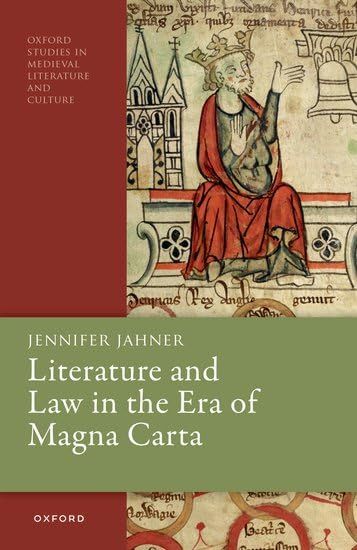
Literature and Law in the Era of Magna Carta

Literature and Law in the Era of Magna Carta

Jennifer Jahner

Oxford University Press
2024
nidottu
The monograph series Oxford Studies in Medieval Literature and Culture showcases the plurilingual and multicultural quality of medieval literature and actively seeks to promote research that not only focuses on the array of subjects medievalists now pursue in literature, theology, and philosophy, in social, political, jurisprudential, and intellectual history, the history of art, and the history of science but also that combines these subjects productively. It offers innovativeand interdisciplinary studies of every kind, including but not limited to manuscript and book history, linguistics and literature, post-colonial and global studies, the digital humanities and media studies, performance studies, the history of affect and the emotion, the theory and history of sexuality, ecocriticism and environmental studies, theories of the lyric, of aesthetics, of the practices of devotion, and ideas of medievalism. Literature and Law in the Era of Magna Carta traces processes of literary training and experimentation across the early history of the English common law, from its beginnings in the reign of Henry II to its tumultuous consolidations under the reigns of John and Henry III. The period from the mid-twelfth through the thirteenth centuries witnessed an outpouring of innovative legal writing in England, from Magna Carta to the scores of statute books that preserved its provisions. An era of civil war and imperial fracture, it also proved a time of intensive self-definition, as communities both lay and ecclesiastic used law to articulate collective identities. Literature and Law in the Era of Magna Carta uncovers the role that grammatical and rhetorical training played in shaping these arguments for legal self-definition. Beginning with the life of Archbishop Thomas Becket, the book interweaves the histories of literary pedagogy and English law, showing how foundational lessons in poetics helped generate both a language and theory of corporate autonomy. In this book, Geoffrey of Vinsauf's phenomenally popular Latin compositional handbook, the Poetria nova, finds its place against the diplomatic backdrop of the English Interdict, while Robert Grosseteste's Anglo-French devotional poem, the Château d'Amour, is situated within the landscape of property law and Jewish-Christian interactions. Exploring a shared vocabulary across legal and grammatical fields, this book argues that poetic habits of thought proved central to constructing the narratives that medieval law tells about itself and that later scholars tell about the origins of English constitutionalism.
'Gifted Children' in Britain and the World

'Gifted Children' in Britain and the World

Jennifer Crane

Oxford University Press
2025
sidottu
This is an open access title available under the terms of a CC BY-NC-ND 4.0 International licence. It is free to read on Oxford Academic and offered as a free PDF download from OUP and selected open access locations. The idea that a child is intellectually 'gifted' has a social and cultural history. This book analyses that social history at multiple scales, and makes the 'voices' of the 'gifted' young themselves central through examination of their poetry, letters, and life-writing. In daily encounters, those labelled 'gifted' sometimes loved this label, and felt special in comparison to peers at school and siblings at home. For others, 'gifted' was a silly or embarrassing label, and many questioned the idea of separating off young people in terms of intelligence, as well as the specific forms of testing being used. Ideas of the 'gifted' child also reshaped family lives -- parents dedicated time to providing special leisure spaces for those thought of as 'gifted', running them in their own homes and taking their children significant distances to spend time with others that were also 'gifted'. Voluntary organisations were critical here, as the network through which young people and adults encountered the term, 'gifted', and lived and created it relationally, through interactions with one another. Voluntary organisations, looking to gain attention and visibility, also critically shaped the idea that the 'gifted' young were elites of 'the future', central to answering challenges of economic decline, global warfare, or humanitarian aid. The hopes placed on 'gifted' children between the 1960s and the 1990s were often sky high -- yet many 'gifted' young still felt that the community 'wasted' their talents, and did not support them. This book, then, provides new perspectives on the tensions between elitism and equality in modern Britain. It also offers vivid stories of optimism, hope, disappointment, and criticism, in which young people themselves play a central role.
The Stacked Deck

The Stacked Deck

Jennifer Ball; Lorne Tepperman

Oxford University Press, Canada
2020
nidottu
The most accessible and engaging exploration of the intersections of inequality in Canada. The second edition of The Stacked Deck examines how inequalities are experienced, perpetuated, and remedied on individual, organizational, and governmental levels. Uniquely organized around access to key resources-such as income, housing, education, nutritious food, and safety-this text is an accessible and comprehensive introduction to social inequalities.
Learning from Words

Learning from Words

Jennifer Lackey

Oxford University Press
2008
sidottu
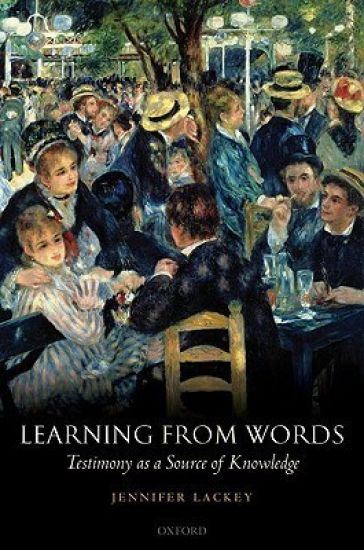
Testimony is an invaluable source of knowledge. We rely on the reports of those around us for everything from the ingredients in our food and medicine to the identity of our family members. Recent years have seen an explosion of interest in the epistemology of testimony. Despite the multitude of views offered, a single thesis is nearly universally accepted: testimonial knowledge is acquired through the process of transmission from speaker to hearer. In this book, Jennifer Lackey shows that this thesis is false and, hence, that the literature on testimony has been shaped at its core by a view that is fundamentally misguided. She then defends a detailed alternative to this conception of testimony: whereas the views currently dominant focus on the epistemic status of what speakers believe, Lackey advances a theory that instead centers on what speakers say. The upshot is that, strictly speaking, we do not learn from one another's beliefs - we learn from one another's words. Once this shift in focus is in place, Lackey goes on to argue that, though positive reasons are necessary for testimonial knowledge, testimony itself is an irreducible epistemic source. This leads to the development of a theory that gives proper credence to testimony's epistemologically dual nature: both the speaker and the hearer must make a positive epistemic contribution to testimonial knowledge. The resulting view not only reveals that testimony has the capacity to generate knowledge, but it also gives appropriate weight to our nature as both socially indebted and individually rational creatures. The approach found in this book will, then, represent a radical departure from the views currently dominating the epistemology of testimony, and thus is intended to reshape our understanding of the deep and ubiquitous reliance we have on the testimony of those around us.
Feminism

Feminism

Jennifer Mather Saul

Oxford University Press
2003
nidottu
An introduction to feminist philosophy. The chapters are organised around key issues of practical significance, such as pornography, abortion and sexual harassment. Clear arguments are provided for a variety of feminist positions, drawing upon up-to-date empirical research.
Law's Relations

Law's Relations

Jennifer Nedelsky

Oxford University Press Inc
2013
nidottu
Autonomy is one of the core concepts of legal and political thought, yet also one of the least understood. The prevailing theory of liberal individualism characterizes autonomy as independence, yet from a social perspective, this conception is glaringly inadequate. In this brilliantly innovative work, Jennifer Nedelsky claims that we must rethink our notion of autonomy, rejecting the usual vocabulary of control, boundaries, and individual rights. If we understand that we are fundamentally in relation to others, she argues, we will recognize that we become autonomous with others--with parents, teachers, employers, and the state. We should not therefore regard autonomy as merely a conceptual tool for assigning rights, but as a capacity that can be fostered or undermined throughout one's life through the relationships and the societal structures we inhabit. The political project thus should not only be to protect the individual from the state and keep the state out, but to use law to construct relations with the state that enhance autonomy. Law's Relations includes many concrete legal applications of her theory of relational autonomy, offering new insights into the debates over due process, judicial review, violence against women, and private versus public law
Citizen-Protectors

Citizen-Protectors

Jennifer Carlson

Oxford University Press Inc
2015
sidottu
From gang- and drug-related shootings to mass shootings in schools, shopping centers, and movie theatres, reports of gun crimes fill the headlines of newspapers and nightly news programs. At the same time, a different kind of headline has captured public attention: a steady surge in pro-gun sentiment among Americans. A Gallup poll conducted just a month after the Newtown school shootings found that 74% of Americans oppose a ban on hand-guns, and at least 11 million people now have licenses to carry concealed weapons as part of their everyday lives. Why do so many Americans not only own guns but also carry them? In Citizen-Protectors, Jennifer Carlson offers a compelling portrait of gun carriers, shedding light on Americans' complex relationship with guns. Delving headlong into the world of gun carriers, Carlson spent time participating in firearms training classes, attending pro-gun events, and carrying a firearm herself. Through these experiences she explores the role guns play in the lives of Americans who carry them and shows how, against a backdrop of economic insecurity and social instability, gun carrying becomes a means of being a good citizen, an idea that not only pervades the NRA's public literature and statements, but its training courses as well. A much-needed counterpoint to the rhetorical battles over gun control, Citizen-Protectors is a captivating and revealing look at gun culture in America, and is a must-read for anyone with a stake in this heated debate.
Melancholic Habits

Melancholic Habits

Jennifer Radden

Oxford University Press Inc
2017
sidottu
Jennifer Radden here provides a re-interpretation of the classic text by 17th century scholar Robert Burton, The Anatomy of Melancholy. Her new reading of Burton's essential text brings several key facets of his thought to light: the role of imagination in inciting and averting melancholy as disorder; the part played by daily habits of thought in engendering severe and incurable conditions; the multi-directional feedback loops linking feeling and thought in his model of mind; and an emphasis on symptoms and natural history in his understanding of disease. Much of Burton's account is derived from classical, medieval and renaissance writing about melancholy, yet he brought them together into something new: an account that -- while it stands in contrast to many of the assumptions of later psychology -- concurs surprisingly well with present day cognitivism. Moreover, although seventeenth century melancholy bears only a loose relationship to present day mood disorders such as depression and anxiety, on this reading the Anatomy anticipates a considerable number of findings and hypotheses associated with present day psychiatry, including its network models of depression, for example, and its emphasis on the part played by rumination and mind wandering in engendering affective disorder. Radden's new reading of a classic text should interest readers in philosophy of mind and psychiatry, clinical psychiatry and the history of medicine.
Sounding American

Sounding American

Jennifer Fleeger

Oxford University Press Inc
2014
sidottu
Sounding American: Hollywood, Opera, and Jazz tells the story of the interaction between musical form, film technology, and ideas about race, ethnicity, and the nation during the American cinema's conversion to sound. Contrary to most accepted narratives about the conversion, which tend to explain the competition between the Hollywood studios' film sound technologies in qualitative and economic terms, this book argues that the battle between disc and film sound was waged primarily in an aesthetic realm. Opera and jazz in particular, though long neglected in studies of the film score, were extremely important in defining the scope of the American soundtrack, not only during the conversion, but also once sound had been standardized. Examining studio advertisements, screenplays, scores, and the films themselves, the book concentrates on the interactions between musical form and film technology, arguing that each of the major studios appropriated opera and jazz in a unique way in order to construct its own version of an ideal American voice. The book's central question asks what the synthesis of opera and jazz during the conversion reveals about the stylistic and ideological norms of classical Hollywood cinema and the racial, ethnic, gendered, and socially stratified spaces of American musical production. Unlike much of the scholarship on film music, which gravitates toward feature film scores, Sounding American concentrates on the musical shorts of the late 1920s, showing how their representations of the stage, conservatory, ballroom, and nightclub reflected what opera and jazz meant for particular groups of Americans and demonstrating how the cinema helped to shape the racial, ethnic, and national identities attached to this music. Traditional histories of Hollywood film music have tended to concentrate on the unity of the score, a model that assumes a passive spectator. Sounding American claims that the classical Hollywood film is essentially an illustrated jazz-opera with a musical structure that encourages an active form of listening and viewing in order to make sense of what is ultimately a fragmentary text.
The Church for the World

The Church for the World

Jennifer McBride

Oxford University Press Inc
2014
nidottu
Drawing on the writings of German pastor-theologian Dietrich Bonhoeffer, Jennifer M. McBride constructs a groundbreaking theology of public witness for Protestant church communities in the United States. In contrast to the triumphal manner in which many Protestants have engaged the public sphere, The Church for the World shows how the church can offer a nontriumphal witness to the lordship of Christ through repentant activity in public life. After investigating current Christian conceptions of witness in the United States, McBride offers a new theology for repentance as public witness, based on Bonhoeffer's thought concerning Christ, the world, and the church. McBride takes up Bonhoeffer's proposal that repentance may be reinterpreted "non-religiously," expanding and challenging common understandings of the concept. Finally, she examines two church communities that exemplify ecclesial commitments and practices rooted in confession of sin and repentance. Through these communities she demonstrates that confession and repentance may be embodied in various ways yet also discerns distinguishing characteristics of a redemptive public witness. The Church for the World offers important insights about Christian particularity and public engagement in a pluralistic society as it provides a theological foundation for public witness that is simultaneously bold and humble: when its mode of being in the world is confession of sin unto repentance, the church demonstrates Christ's redemptive work and becomes a vehicle of concrete redemption.
For Peace and Money

For Peace and Money

Jennifer Siegel

Oxford University Press Inc
2015
sidottu
From the late imperial period until 1922, the British and French made private and government loans to Russia, making it the foremost international debtor country in pre-World War I Europe. To finance the modernization of industry, the construction of public works projects, railroad construction, and the development and adventures of the military-industrial complex, Russia's ministers of finance, municipal leaders, and nascent manufacturing class turned, time and time again, to foreign capital. From the forging of the Franco-Russian alliance onwards, Russia's needs were met, first and foremost, its allies and diplomatic partners in the developing Triple Entente. In the case of Russia's relationships with both France and Great Britain, an open pocketbook primed the pump, facilitating the good spirits that fostered agreement. Russia's continued access to those ready lenders ensured that the empire of the Tsars would not be tempted away from its alliance and entente partners. This web of financial and political interdependence affected both foreign policy and domestic society in all three countries. The Russian state was so heavily indebted to its western creditors, rendering those western economies almost prisoners to this debt, that the debtor nation in many ways had the upper hand; the Russian government at times was actually able to dictate policy to its French and British counterparts. Those nations' investing classes-which, in France in particular, spanned not only the upper classes but the middle, rentier class, as well-had such a vast proportion of their savings wrapped up in Russian bonds that any default would have been catastrophic for their own economies. That default came not long after the Bolshevik Revolution brought to power a government who felt no responsibility whatsoever for the debts accrued by the tsars for the purpose of oppressing Russia's workers and peasants. The ensuing effect on allied morale, the French and British economies and, ultimately, on the Anglo-French relationship, was grim and far-reaching. This book will contribute to understandings of the ways that non-governmental and sometimes transnational actors were able to influence both British and French foreign policy and Russian foreign and domestic policy. It will address the role of individual financiers and policy makers-men like Lord Revelstoke, chairman of Baring Brothers, the British and French Rothschild cousins, Edouard Noetzlin of the Banque de Paris et de Pays Bas, and Sergei Witte, Russia's authoritative finance minister during much of this age of expansion; the importance of foreign capital in late imperial Russian policy; and the particular role of British capital and financial investment in the construction and strengthening of the Anglo-Russo-French entente. It will illustrate the interrelationship of political and economic decision-making with the ideas and beliefs that inform security policy. Drawing upon both the traditional archival sources for diplomatic history-the government holdings of Great Britain, France, and Russia-and the non-governmental archival holdings of international finance-this project looks beyond the realm of high politics and state-centered decision making in the formation of foreign policy, offering insights into the forms and functions of diplomatic alliances while elucidating the connections between finance and foreign policy. It is a classic tale of money and power in the modern era-an age of economic interconnectivity and great power interdependency.
Running from Office

Running from Office

Jennifer L. Lawless; Richard L. Fox

Oxford University Press Inc
2015
sidottu
A high quality, well-functioning democracy demands that the next generation hears -- and then heeds -- a call to public service. With more than 500,000 elected positions in the United States, the political system can sustain itself and succeed only if a large number of citizens eventually put themselves forward as candidates. But Washington's dreadful performance over the past two decades has taken a toll on the young Americans who have come to know politics through this spectacle. The mean-spirited, dysfunctional political system that has come to characterize American politics turns young people off to the idea of running for office. It discourages them from aspiring, one day, to be elected leaders. It alienates them from even thinking about a career in politics. Running from Office is the first analysis of young people's political ambition, based on a national poll of over 4,000 high school and college students. In it, Jennifer L. Lawless and Richard L. Fox delve into how young people view political figures, what traits they see as necessary for political success, and how they view their own suitability to run for office. The overwhelming majority of young people have no interest whatsoever in running for office in the future. Actually, they would rather do almost anything else. And who can blame them? Most young people are not particularly tuned into politics. But when they are exposed -- at home, at school, with friends, or through the media -- they see derisive accounts of government inefficiency, ineffectiveness, and immorality. Lawless and Fox paint a political profile of the next generation that should sound alarm bells about the long-term, deeply embedded damage contemporary politics has wrought on U.S. democracy and its youngest citizens. But the message of Running from Office is not one of all gloom and doom. The young women and men Lawless and Fox surveyed and interviewed want to effect change, and they have clear ideas for how the American political system can steer a new course. Running from Office provides suggestions for ways to generate heightened levels of political ambition among today's young people, including better governance, civic education, voluntary community and national service programs, and political and media campaigns geared to mobilize young people.
Energy, the Subtle Concept

Energy, the Subtle Concept

Jennifer Coopersmith

Oxford University Press
2010
sidottu
Energy is at the heart of physics (and of huge importance to society) and yet no book exists specifically to explain it, and in simple terms. In tracking the history of energy, this book is filled with the thrill of the chase, the mystery of smoke and mirrors, and presents a fascinating human-interest story. Moreover, following the history provides a crucial aid to understanding: this book explains the intellectual revolutions required to comprehend energy, revolutions as profound as those stemming from Relativity and Quantum Theory. Texts by Descartes, Leibniz, Bernoulli, d'Alembert, Lagrange, Hamilton, Boltzmann, Clausius, Carnot and others are made accessible, and the engines of Watt and Joule are explained. Many fascinating questions are covered, including: - Why just kinetic and potential energies - is one more fundamental than the other? - What are heat, temperature and action? - What is the Hamiltonian? - What have engines to do with physics? - Why did the steam-engine evolve only in England? - Why S=klogW works and why temperature is IT. Using only a minimum of mathematics, this book explains the emergence of the modern concept of energy, in all its forms: Hamilton's mechanics and how it shaped twentieth-century physics, and the meaning of kinetic energy, potential energy, temperature, action, and entropy. It is as much an explanation of fundamental physics as a history of the fascinating discoveries that lie behind our knowledge today.
Margaret Storm Jameson

Margaret Storm Jameson

Jennifer Birkett

Oxford University Press
2009
sidottu
From her childhood in Whitby to her long old age in Cambridge, the life of Margaret Storm Jameson (1891-1986), novelist, autobiographer, and political activist, spanned almost the whole of the twentieth century. A self-styled Little Englander by nature, and European by nurture, equally at home, or out of place, in the North Yorkshire moors and seascape of her birth, metropolitan London, rural France, and the capitals of Central Europe, she wrote of country, cities and the exile from both with equal knowledge and sympathy. Out of the changing landscapes of her present, she fashioned her vision of the future. The title of her autobiography, Journey from the North, is a simultaneous evocation and erasure of nostalgia for lost commonality, and in her long life as writer and activist, President of wartime PEN (the association of Poets, Essayist, Novelists) committed to the values of freedom and social justice, she fought to reconcile the conflicting forms of emergent modernity. Her own journey is the generic experience of twentieth-century Britain, and the England she urges on her contemporaries is one that shares the life and mind of Europe. The present book traces the history of that shared experience. It recovers, through her writing, the aspirations and the disappointments of the generation of socialists that was Class 1914. The soldiers returning from the front in 1918, to unemployment and the General Strike of 1926, fight in 1940 alongside Frenchmen, and against Germans, who are victims of the same system: class conflict, nationalist rivalries, imperialist ambition, all for Jameson have the same defining economic horizon. At the end of the odyssey the stark alternatives take shape: Washington or Moscow, the madness of American capitalism, or the oppression of Stalinist Communism. Alongside the narrative of Jameson's life, and the experiences as daughter, wife, and mother that shaped her personality and her career, the book explores her concern with issues of culture and society, cultural memory, and cultural landscapes, her fascination with aesthetic form and the relation of writing to politics, her insight into the materiality of words, and her persistent probing of the nature of the writing subject. It draws on unpublished archive material and brings new research on neglected areas of cultural history into conjunction with literary-critical analyses of Jameson's novels and studies of her journalism and essays. There is an extensive Bibliography of her work.
Health and Social Justice

Health and Social Justice

Jennifer Prah Ruger

Oxford University Press
2009
sidottu
Societies make decisions and take actions that profoundly impact the distribution of health. Why and how should collective choices be made, and policies implemented, to address health inequalities under conditions of resource scarcity? How should societies conceptualize and measure health disparities, and determine whether they've been adequately addressed? Who is responsible for various aspects of this important social problem? In Health and Social Justice, Jennifer Prah Ruger elucidates principles to guide these decisions, the evidence that should inform them, and the policies necessary to build equitable and efficient health systems world-wide. This book weaves together original insights and disparate constructs to produce a foundational new theory, the health capability paradigm. Ruger's theory takes the ongoing debates about the theoretical underpinnings of national health disparities and systems in striking new directions. It shows the limitations of existing approaches (utilitarian, libertarian, Rawlsian, communitarian), and effectively balances a consequentialist focus on health outcomes and costs with a proceduralist respect for individuals' health agency. Through what Ruger calls shared health governance, it emphasizes responsibility and choice. It allows broader assessment of injustices, including attributes and conditions affecting individuals' "human flourishing," as well as societal structures within which resource distribution occurs. Addressing complex issues at the intersection of philosophy, economics, and politics in health, this fresh perspective bridges the divide between the collective and the individual, between personal freedom and social welfare, equality and efficiency, and science and economics.
Learning from Words

Learning from Words

Jennifer Lackey

Oxford University Press
2010
nidottu
Testimony is an invaluable source of knowledge. We rely on the reports of those around us for everything from the ingredients in our food and medicine to the identity of our family members. Recent years have seen an explosion of interest in the epistemology of testimony. Despite the multitude of views offered, a single thesis is nearly universally accepted: testimonial knowledge is acquired through the process of transmission from speaker to hearer. In this book, Jennifer Lackey shows that this thesis is false and, hence, that the literature on testimony has been shaped at its core by a view that is fundamentally misguided. She then defends a detailed alternative to this conception of testimony: whereas the views currently dominant focus on the epistemic status of what speakers believe, Lackey advances a theory that instead centers on what speakers say. The upshot is that, strictly speaking, we do not learn from one another's beliefs - we learn from one another's words. Once this shift in focus is in place, Lackey goes on to argue that, though positive reasons are necessary for testimonial knowledge, testimony itself is an irreducible epistemic source. This leads to the development of a theory that gives proper credence to testimony's epistemologically dual nature: both the speaker and the hearer must make a positive epistemic contribution to testimonial knowledge. The resulting view not only reveals that testimony has the capacity to generate knowledge, but it also gives appropriate weight to our nature as both socially indebted and individually rational creatures. The approach found in this book will, then, represent a radical departure from the views currently dominating the epistemology of testimony, and thus is intended to reshape our understanding of the deep and ubiquitous reliance we have on the testimony of those around us.
Simple Sentences, Substitution, and Intuitions

Simple Sentences, Substitution, and Intuitions

Jennifer M. Saul

Oxford University Press
2010
nidottu
The phenomenon of substitution failure is a longstanding focus of discussion for philosophers of language. Substitution failure occurs when a change from one co-referential name to another (e.g. from 'Superman' to 'Clark Kent') affects the truth-value of a sentence. Jennifer Saul has shown that this can occur even in the simplest of sentences. She presents the first full-length treatment of this puzzling feature of language, and explores its implications for the theory of reference and names, and for the methodology of semantics.