
Kirjahaku
Etsi kirjoja tekijän nimen, kirjan nimen tai ISBN:n perusteella.
1000 tulosta hakusanalla Joyce Rodgers

Werner Schmidt - James Joyce und die Farben des Ulysses
Dirk Teuber; Otto Jägersberg; Jurate Levina
Dr. Cantz'sche Verlagsges
2025
sidottu
India and Germany: Dynamic Partnership illustrates the unique relationship marked by centuries of friendship and cooperation between the two countries. The engagement across the ages has extended to intellectual, literary and economic levels, gaining momentum in modern times as a vibrant partnership. This engrossing narrative with colourful images captures different dimensions of the bilateral relationship, emphasizing the trade and commercial aspects in particular. It outlines the positive impact of German companies in India's development journey and also documents the growing interest of Indian companies in Germany as they gain maturity. The book touches upon the experiences of companies from both countries in each other's economies, which has benefitted both sides, as the two countries have embarked on a strategic partnership. The Confederation of Indian Industry has been playing a proactive role in strengthening and deepening exchanges with German business, offering a platform for entrepreneurs from both India and Germany to expand awareness about each other and forge new partnerships. It will continue to build on its multiple initiatives, and play an integral role in further cementing Indo-German economic engagement.
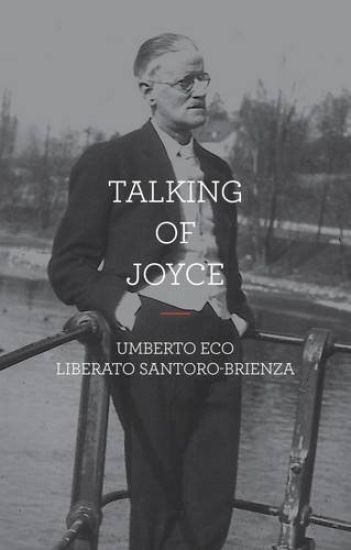
This new and expanded edition of Talking of Joyce focuses on James Joyce's cultural ancestry - aesthetic and linguistic, in particular - and his Italian influences and connections. Originally published in 1998, to great success, this new and revised edition brings original scholarship to contemporary readers and contains an insightful added essay on Joyce's aesthetic musings. In his foreword, the internationally renowned Coleridge scholar J. C. C. Mays praises the original essays by Eco and Santoro-Brienza for being both highly respectful of Joyce and for their friendly familiarity with him. Mays also notes that 'These commentaries, by Italians in English, of an author of books in English who preferred to speak Italian, are a rich and illuminating conjunction. Read these lectures for the way they are, for they brings together two worlds. Their eminent authors do not stand on dignity: they communicate directly what is important. They have different things to say, but each celebrates values which Joyce held most dear.' The addition of Santoro-Brienza's new essay also gives readers a fresh insight into Eco's unique contribution to our understanding of Joyce, Aquinas and aesthetics, and was written in honour of Eco's eightieth birthday. This volume brings to light fascinating aspects of Ireland's most famous literary figure and places him in a wider cultural context. From two renowned scholars, passionately interested in the Irish revolutionary writer, Talking of Joyce is a welcome addition to our reckoning with Joyce's legacy and is a fascinating contribution to Joyce studies.
Samuel Beckett liest James Joyce aus Fritz Mauthners "Kritik der Sprache" vor
Götz Wienold
Passagen Verlag Ges.M.B.H
2025
nidottu
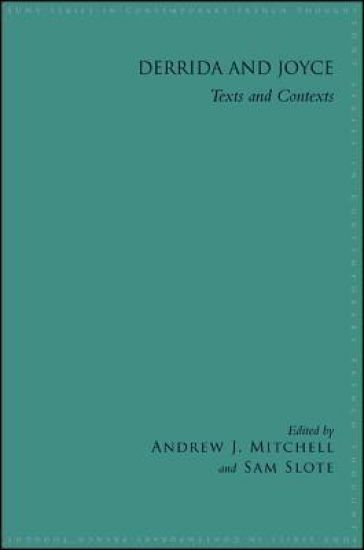
Derrida and Joyce
State University of New York Press
2014
pokkari
All of Derrida's texts on Joyce together under one cover in fresh, new translations, along with key essays covering the range of Derrida's engagement with Joyce's works. Bringing together all of Jacques Derrida's writings on James Joyce, this volume includes the first complete translation of his book Ulysses Gramophone: Two Words for Joyce as well as the first translation of the essay "The Night Watch." In Ulysses Gramophone, Derrida provides some of his most thorough reflections on affirmation and the "yes," the signature, and the role of technological mediation in all of these areas. In "The Night Watch," Derrida pursues his ruminations on writing in an explicitly feminist direction, offering profound observations on the connection between writing and matricide. Accompanying these texts are nine essays by leading scholars from across the humanities addressing Derrida's treatments of Joyce throughout his work, and two remembrances of lectures devoted to Joyce that Derrida gave in 1982 and 1984. The volume concludes with photographs of Derrida from these two events.
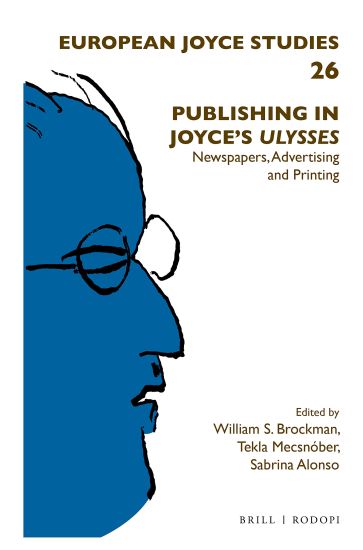
Publishing in Joyce's Ulysses
BRILL
2018
nidottu
Appearing in an era of rapid change in the printing and publishing industries, James Joyce’s Ulysses exploited and exemplified those industries to the degree that the book can be seen as a virtual museum of 1904 media. Publishing in Joyce's “Ulysses”: Newspapers, Advertising and Printing, edited by William S. Brockman, Tekla Mecsnóber and Sabrina Alonso, gathers twelve essays by Joyce scholars exploring facets of those trades that pervade the substance of the book. Essays explore the book’s incorporation of mass-market weekly magazines, contemporary advertising slogans, newspaper clippings, the “Aeolus” episode’s printing office and the varied typographic styles of successive editions of Ulysses. Placing Joyce’s work in its historical milieu, the collection offers a fresh perspective on modern print culture. Contributors are: Sabrina Alonso, Harald Beck, William S. Brockman, Elisabetta d'Erme, Judith Harrington, Matthew Hayward, Sangam MacDuff, Tekla Mecsnóber, Tamara Radak, Fritz Senn, David Spurr, Jolanta Wawrzycka.
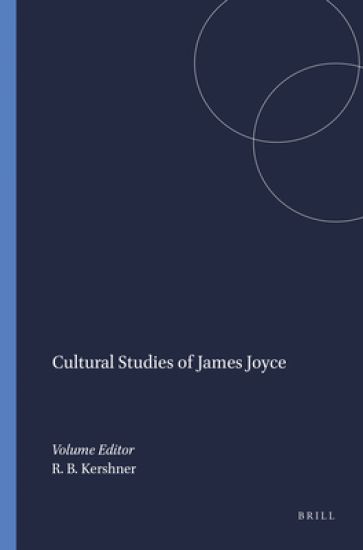
Cultural Studies of James Joyce
Editions Rodopi B.V.
2003
sidottu
The first volume to collect essays from the emergent field of cultural studies that specifically address the work of James Joyce, Cultural Studies of James Joyce includes work from both well-established Joyce scholars such as Margot Norris and Cheryl Herr and by such younger writers as Tracey Teets Schwarze and Paul Saint-Amour. Topics range over the whole field of culture, from “Nipper” the Victrola dog to the statuary of Praxitiles, from the Tank Girl comics to studies of Irish schizophrenia, from the history of University College Dublin to the political ferment over choral singing at the turn of the century. The volume should be of interest to Joyceans, to students of literature and culture in the twentieth century, and especially to those interested in the interactions of different cultural levels between the nineteenth century and our own time. An introductory survey by R. Brandon Kershner discusses the rise of cultural studies and places the issue within modern debates in literary theory.

The Business and Household Accounts of Joyce Jeffreys, Spinster of Hereford, 1638-1648
Oxford University Press
2012
sidottu
The accounts of Joyce Jeffreys offer a rare opportunity to enter the social world of the early modern spinster - her daily life, personal circumstances, social activities and family relationships are all reflected through the entries in her manuscript. The accounts also reveal extensive evidence of Joyce's business dealings, most prominently as a moneylender in and around the Hereford and Worcestershire region, but also as a farmer, market gardener, landholder, and horse and livestock dealer. The income or receipts section details loan arrangements and provides evidence of rental and other income. The expenditure or disbursements section provides a wealth of information on a range of contemporary expenses, including the cost of wages, food, drinks, clothing, textiles, medicines and medical care, the training and care of horses, and even stud fees. Further entries relate to amounts paid out in the form of gifts and gratuities, litigation fees, local and national assessments, and church dues. Joyce Jeffreys appears at the centre of a large, vibrant kinship network, in which she was an active participant. This gave her access to regional gentry affiliations, and linked her with some of the most prominent local people. Although Joyce's business dealings may have centred on the Hereford area, they reached as far as London. She travelled regularly to visit relatives and friends, to listen to lectures, and to attend social events until her health prevented her from doing so. Royalist by inclination, Joyce decided to abandon Hereford before the Parliamentary army arrived and the social as well as economic costs of the civil war are a further feature of her accounts. Published in their entirety for the first time, these accounts suggest that Joyce Jeffreys was neither as culturally or intellectually isolated as the historiography of spinsterhood would have us believe.

Song in the Works of James Joyce
Matthew J. C. Hodgart; Mabel P. Worthington
Columbia University Press
2022
sidottu
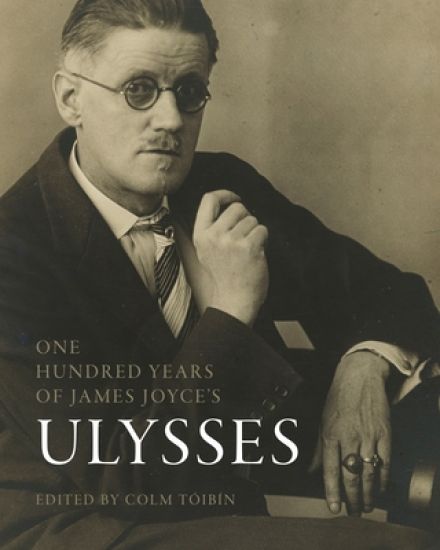
One Hundred Years of James Joyce’s “Ulysses”
Michael D. Higgins; Colin B. Bailey
Pennsylvania State University Press
2022
sidottu
Ulysses is widely regarded as the greatest novel of the twentieth century. Commemorating the 1922 publication of this modernist masterwork, One Hundred Years of James Joyce’s “Ulysses” tells the story of the writing, revising, printing, and censorship of the novel.Edited by world-renowned Irish novelist and literary critic Colm Tóibín, this book presents ten essays by preeminent Joyce scholars and by curators of his manuscripts and early editions, as well as an interview with Sean Kelly, the New York gallery owner who donated his extensive Joyce collection to The Morgan Library & Museum. Beginning with Tóibín’s expert interpretation of the Dublin context for Ulysses, the volume follows Joyce in Trieste, Zurich, and Paris from 1914 up through the novel’s publication—and the international scandal and fame that ensues. It draws on Joyce’s notebooks and letters, as well as extant manuscripts and proofs, to provide new insights into Joyce’s life, the narrative and place of Ulysses, and the printed book.Rich and illuminating, this volume is essential for scholars, fans, and readers of the novel. Along with the editor, contributors include Ronan Crowley, Maria DiBattista, Derick Dreher, Catherine Flynn, Anne Fogarty, Rick Gekoski, Joseph M. Hassett, James Maynard, and John McCourt.
Intertextual Dynamics within the Literary Group of Joyce, Lewis, Pound and Eliot
D. Brown
Palgrave Macmillan
1990
sidottu
The book examines key texts by the writers James Joyce, Wyndham Lewis, Ezra Pound and T.S. Eliot as moves within a shared group-game - that of creating a new literature for the new age. It maps a great deal of intertextual reference, allusion and influence and suggests a psychoanalytically-informed hypothesis that certain literature can be constituted a species of interpersonal groupwork. It demonstrates how the core grouping within literary modernism developed an experimental discourse through mutual rivalry and sharing. And it describes different group roles, contributions and changes of emphasis within an overall project stretching from 1914 into the 1950s.
Making Space in the Works of James Joyce
Routledge
2011
sidottu
James Joyce’s preoccupation with space—be it urban, geographic, stellar, geometrical or optical—is a central and idiosyncratic feature of his work. In Making Space in the Works of James Joyce, some of the most esteemed scholars in Joyce studies have come together to evaluate the perception and mental construction of space, as it is evoked through Joyce’s writing. The aim is to bring together several recent trends of literary research and criticism to bear on the notion of space in its most concrete sense. The essays move dialectically out of an immediate focus on the phenomenological and intra-psychic, into broader and wider meditations on the social, urban and collective. As Joyce’s formal experiments appear the response to the difficulty of enunciating truly the experience of lived space, this eventually leads us to textual and linguistic space. The final contribution evokes the space with which Joyce worked daily, that of his manuscripts—or what he called "paperspace." With essays addressing all of Joyce's major works, this volume is a critical contribution to our understanding of modernism, as well as of the relationship between space, language, and literature.
The Cambridge Companion to James Joyce
Cambridge University Press
2004
pokkari
This second edition of The Cambridge Companion to Joyce contains several revised essays, reflecting increasing emphasis on Joyce's politics, a fresh sense of the importance of his engagement with Ireland, and the changes wrought by gender studies on criticism of his work. This Companion gathers an international team of leading scholars who shed light on Joyce's work and life. The contributions are informative, stimulating and full of rich and accessible insights which will provoke thought and discussion in and out of the classroom. The Companion's reading lists and extended bibliography offer readers the necessary tools for further informed exploration of Joyce studies. This volume is designed primarily as a students' reference work (although it is organised so that it can also be read from cover to cover), and will deepen and extend the enjoyment and understanding of Joyce for the new reader.
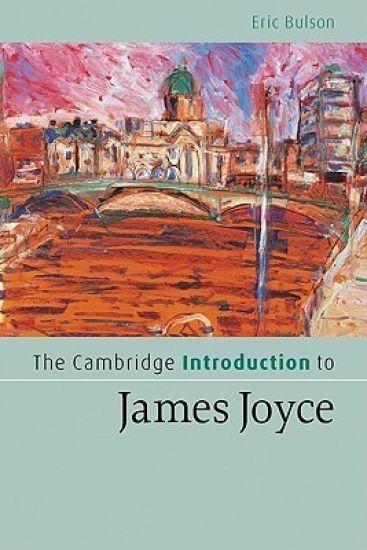
James Joyce has a reputation for being one of modern literature's most difficult writers. This introduction gives students the necessary tools they will need to get the most out of reading him. It provides the essential biographical information and situates his life and works in broader cultural, historical, and literary contexts. Students will also find detailed examinations of the major works including Ulysses and Finnegans Wake. In addition, Bulson lets students see how Joyce evolved as a writer. This introduction also provides a brief history of the critical reception of Joyce's life and works and explains what a variety of critical approaches can teach us. A guide to further reading has been included for those interested in consulting some of the more influential secondary works. This accessible and lively introduction gives students everything they will need to get started reading, understanding, and appreciating Joyce.
The Cambridge Companion to James Joyce
Cambridge University Press
2004
sidottu
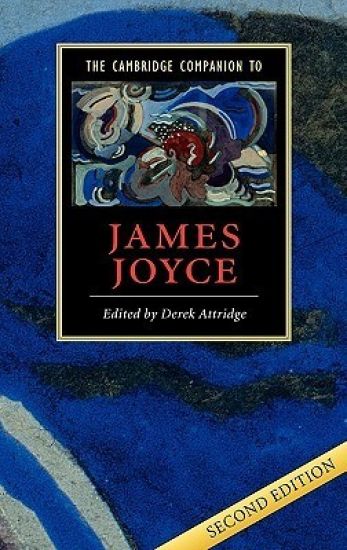
This second edition of The Cambridge Companion to Joyce contains several new and revised essays, reflecting increasing emphasis on Joyce’s politics, a fresh sense of the importance of his engagement with Ireland, and the changes wrought by gender studies on criticism of his work. This Companion gathers an international team of leading scholars who shed light on Joyce’s work and life. The contributions are informative, stimulating and full of rich and accessible insights which will provoke thought and discussion in and out of the classroom. The Companion’s reading lists and extended bibliography offer readers the necessary tools for further informed exploration of Joyce studies. This volume is designed primarily as a students’ reference work (although it is organised so that it can also be read from cover to cover), and will deepen and extend the enjoyment and understanding of Joyce for the new reader.
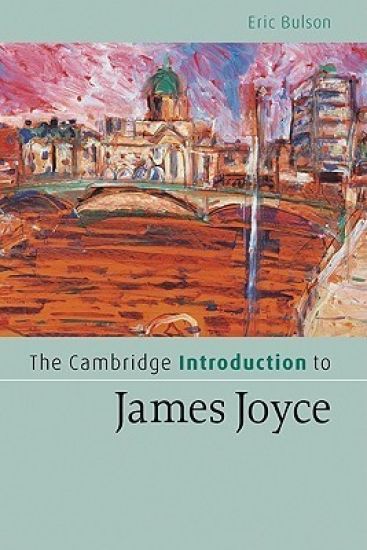
James Joyce has a reputation for being one of modern literature's most difficult writers. This introduction gives students the necessary tools they will need to get the most out of reading him. It provides the essential biographical information and situates his life and works in broader cultural, historical, and literary contexts. Students will also find detailed examinations of the major works including Ulysses and Finnegans Wake. In addition, Bulson lets students see how Joyce evolved as a writer. This introduction also provides a brief history of the critical reception of Joyce's life and works and explains what a variety of critical approaches can teach us. A guide to further reading has been included for those interested in consulting some of the more influential secondary works. This accessible and lively introduction gives students everything they will need to get started reading, understanding, and appreciating Joyce.
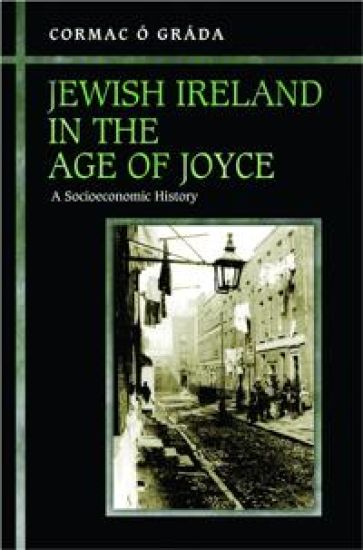
James Joyce's Leopold Bloom--the atheistic Everyman of Ulysses, son of a Hungarian Jewish father and an Irish Protestant mother--may have turned the world's literary eyes on Dublin, but those who look to him for history should think again. He could hardly have been a product of the city's bona fide Jewish community, where intermarriage with outsiders was rare and piety was pronounced. In Jewish Ireland in the Age of Joyce, a leading economic historian tells the real story of how Jewish Ireland--and Dublin's Little Jerusalem in particular--made ends meet from the 1870s, when the first Lithuanian Jewish immigrants landed in Dublin, to the late 1940s, just before the community began its dramatic decline. In 1866--the year Bloom was born--Dublin's Jewish population hardly existed, and on the eve of World War I it numbered barely three thousand. But this small group of people quickly found an economic niche in an era of depression, and developed a surprisingly vibrant web of institutions. In a richly detailed, elegantly written blend of historical, economic, and demographic analysis, Cormac O Grada examines the challenges this community faced. He asks how its patterns of child rearing, schooling, and cultural and religious behavior influenced its marital, fertility, and infant-mortality rates. He argues that the community's small size shaped its occupational profile and influenced its acculturation; it also compromised its viability in the long run. Jewish Ireland in the Age of Joyce presents a fascinating portrait of a group of people in an unlikely location who, though small in number, comprised Ireland's most resilient immigrant community until the Celtic Tiger's immigration surge of the 1990s.
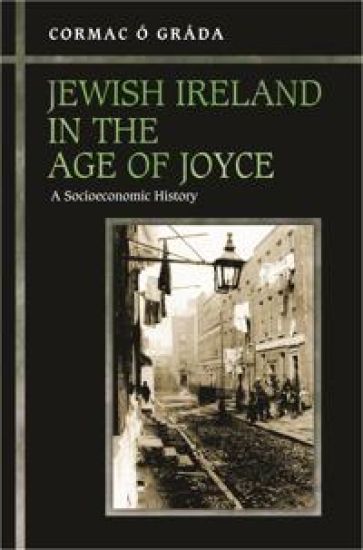
James Joyce's Leopold Bloom--the atheistic Everyman of Ulysses, son of a Hungarian Jewish father and an Irish Protestant mother--may have turned the world's literary eyes on Dublin, but those who look to him for history should think again. He could hardly have been a product of the city's bona fide Jewish community, where intermarriage with outsiders was rare and piety was pronounced. In Jewish Ireland in the Age of Joyce, a leading economic historian tells the real story of how Jewish Ireland--and Dublin's Little Jerusalem in particular--made ends meet from the 1870s, when the first Lithuanian Jewish immigrants landed in Dublin, to the late 1940s, just before the community began its dramatic decline. In 1866--the year Bloom was born--Dublin's Jewish population hardly existed, and on the eve of World War I it numbered barely three thousand. But this small group of people quickly found an economic niche in an era of depression, and developed a surprisingly vibrant web of institutions. In a richly detailed, elegantly written blend of historical, economic, and demographic analysis, Cormac O Grada examines the challenges this community faced. He asks how its patterns of child rearing, schooling, and cultural and religious behavior influenced its marital, fertility, and infant-mortality rates. He argues that the community's small size shaped its occupational profile and influenced its acculturation; it also compromised its viability in the long run. Jewish Ireland in the Age of Joyce presents a fascinating portrait of a group of people in an unlikely location who, though small in number, comprised Ireland's most resilient immigrant community until the Celtic Tiger's immigration surge of the 1990s.