Kirjojen hintavertailu. Mukana 11 627 220 kirjaa ja 12 kauppaa.

Kirjahaku

Etsi kirjoja tekijän nimen, kirjan nimen tai ISBN:n perusteella.

1000 tulosta hakusanalla Macey Watterson

Bass Cathedral

Bass Cathedral

Nathaniel Mackey

New Directions Publishing Corporation
2008
nidottu
Los Angeles, October 1982: Molimo m'Atet, formerly known as the The Mystic Horn Society, is preparing to release its new album Orphic Bend. The members of the jazz ensemble—Aunt Nancy, Djamilaa, Drennette, Lambert, N., and Penguin—are witness to a strange occurrence: while listening to their test pressing, the moment Aunt Nancy's bass solo begins a balloon emerges from the vinyl, bearing a mysterious message: I dreamt you were gone.... Through letters N. writes to a figure called Angel of Dust, the ever-mutating story unfolds, leaving no musician or listener untouched.Bass Cathedral is Mackey's fourth volume in his ongoing novel with no beginning or end, From a Broken Bottle Traces of Perfume Still Emanate. Thought balloons morph into mute-stereoptic emanations; N. encounters a master mouthpiece-maker; Drennette leaves Penguin dateless; Lambert's kicking it around with Melanie—much is abuzz but something else is happening to the ensemble. The music seems to be living them. N. suffers cowrie shell attacks and they are all stranded on an Orphic Shore. Socio-political forces are at play or has this always been the essence and accident of the music's resilience? And Hotel Didjeridoo must be resurrected, but how? Myth spins music spins thought spins sex—Mackey's post-bop boxless box set is, as the Utne Reader wrote, "Avant-garde literature you can love: an evolving multivolume novel of the jazz world that plays with language and ideas the way Thelonious Monk plays with flatted fifths."
From a Broken Bottle Traces of Perfume Still Emanate

From a Broken Bottle Traces of Perfume Still Emanate

Nathaniel Mackey

New Directions Publishing Corporation
2010
nidottu
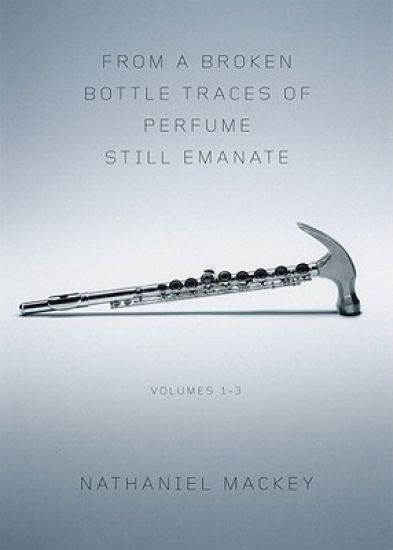
From a Broken Bottle Traces of Perfume Still Emanate: Volumes 1-3 collects the first three installments—Bedouin Hornbook, Djbot Baghostus’s Run, and Atet A.D.—of Nathaniel Mackey’s genre-defying work of fiction. A project that began over thirty years ago, From a Broken Bottle is an epistolary novel that unfolds through N.’s intricate letters to the mysterious Angel of Dust. Unexpected, profound happenings take place as N. delves into music and art and the goings-on of his transmorphic Los Angeles-based jazz ensemble, in which he is a composer and instrumentalist. This triple-set book opens in July 1978 with a dream of a haunting Archie Shepp solo, and closes in September 1982 in a parallactic studio recording session on a glass-bottomed boat borne aloft by the music. The fourth volume of Mackey’s novel, Bass Cathedral—also available from New Directions—was chosen by The New York Times as one of 100 Notable Books of 2008. But that it didn’t end there…
Nod House

Nod House

Nathaniel Mackey

New Directions Publishing Corporation
2012
nidottu
With Nathaniel Mackey’s fifth collection of poems, Nod House, we witness a confluence of music and meaning unprecedented in American poetry. Mackey’s art continues to push the envelope of what is possible to map and remap through words in sounds and sounds in words. Picking up with Nub’s disintegration at the end of his previous collection — the National Book Award–winning Splay Anthem — we follow a traveler and a tribe of travelers ensconced in myth and history as Mackey continues to weave his precisely measured music with two ongoing serial poems, Song of the Andoumboulou and Mu. The collec- tion is divided into two sections, both titled “Quag,” and it is this double-Quag (“Nub’s new colony Quag” or Qraq or Ouab’da or Quaph . . .) that the tribe is exiled in, worlds within alternate worlds where names and places are ever-shifting, and dreamlessness reigns. From the pyramids to the projects, Ivory Coast to Lone Coast, Lagos to Stick City, amidst chorusing horns and star-spar lightning, Nod House (“Nub’s / new / address”) unfolds as gorgeous eulogy, copla-cuts of deep song, the long elegiac march of “day after day of the dead.”
Blue Fasa

Blue Fasa

Nathaniel Mackey

New Directions Publishing Corporation
2015
nidottu
Nathaniel Mackey’s sixth collection of poems, Blue Fasa, carries forward what the New Yorker has described as the “mythological conception” and “descriptive daring” of his two intertwined serial poems. A long song that's one and more than one, this collection takes its title from two related black musical traditions, a West African griot epic as told by the Fasa, a clan in ancient Ghana, and trumpeter Kenny Dorham’s hard bop classic “Blue Bossa,” influenced by the emergence of Brazilian bossa nova. The book opens with the catch of the heart and the call of romance, as it follows a band of travelers, refugees from history, on their incessant migrations through time, place, and polity toward a truer sense of being and belonging.
Late Arcade

Late Arcade

Nathaniel Mackey

New Directions Publishing Corporation
2017
nidottu
Nathaniel Mackey’s Late Arcade opens in Los Angeles. A musician known only as N. writes the first of a series of letters to the enigmatic Angel of Dust. N.’s jazz sextet, Molimo m’Atet, has just rehearsed a new tune: the horn players read from The Egyptian Book of the Dead with lips clothespinned shut, while the rest of the band struts and saunters in a cosmic hymn to the sun god Ra. N. ends this breathless session by sending the Angel of Dust a cassette tape of their rehearsal. Over the next nine months, N.’s epistolary narration follows the musical goings-on of the ensemble. N. suffers from what he calls “cowrie shell at- tacks”—oil spills, N.’s memory of his mother’s melancholy musical Sundays— which all becomes the source of fresh artistic invention. Here is the newest installment of the National Book Award-winner Nathaniel Mackey’s From a Broken Bottle Traces of Perfume Still Emanate, the great American jazz novel of “exquisite rhythmic lyricism” (Bookforum).
Double Trio: Tej Bet, So's Notice, Nerve Church

Double Trio: Tej Bet, So's Notice, Nerve Church

Nathaniel Mackey

New Directions Publishing Corporation
2021
sidottu
For thirty-five years American poet Nathaniel Mackey has been writing a long poem of fugitive making like no other: two elegiac, intertwined serial poems—“Song of the Andoumboulou” and “Mu”—that follow a mysterious, migrant “we” through the rhythms and currents of the world with lyrical virtuosity and impassioned expectancy. In a note to this astonishing box set of new work, Mackey writes: “I turned sixty-five within a couple of months of beginning to write Double Trio and I was within a couple of months of turning seventy-one when I finished it.... It was a period of distress and precarity inside and outside both. During this period, a certain disposition or dispensation came upon me that I would characterize or sum up with the words all day music. It was a period during which I wanted never not to be thinking between poetry and music, poetry and the daily or the everyday, the everyday and the alter-everyday. Philosophically and technically, the work meant to be always pertaining to the relation of parts to one another and of parts to an evolving whole.” Structured in part after the last three movements of John Coltrane’s Meditations—“Love,” “Consequence,” and “Serenity”—Double Trio stretches the explorations and improvisations of free jazz into unprecedented poetic territory.
The Hero and the Perennial Journey Home in American Film

The Hero and the Perennial Journey Home in American Film

Susan Mackey-Kallis

University of Pennsylvania Press
2001
pokkari
In contemporary America, myths find expression primarily in film. What's more, many of the highest-grossing American movies of the past several decades have been rooted in one of the most fundamental mythic narratives, the hero quest. Why is the hero quest so persistently renewed and retold? In what ways does this universal myth manifest itself in American cinema? And what is the significance of the popularity of these modern myths? The Hero and the Perennial Journey Home in American Film by Susan Mackey-Kallis is an exploration of the appeal of films that recreate and reinterpret this mythic structure. She closely analyzes such films as E.T., the Star Wars trilogy, It's a Wonderful Life, The Wizard of Oz, The Lion King, Field of Dreams, The Piano, Thelma and Louise, and 2001: A Space Odyssey. Elements of the quest mythology made popular by Joseph Campbell, Homer's Odyssey, the perennial philosophy of Aldous Huxley, and Jungian psychology all contribute to the compelling interpretive framework in which Mackey-Kallis crafts her study. She argues that the purpose of the hero quest is not limited to the discovery of some boon or Holy Grail, but also involves finding oneself and finding a home in the universe. The home that is sought is simultaneously the literal home from which the hero sets out and the terminus of the personal growth he or she undergoes during the journey back. Thus the quest, Mackey-Kallis asserts, is an outward journey into the world of action and events which eventually requires a journey inward if the hero is to grow, and ultimately necessitates a journey homeward if the hero is to understand the grail and share it with the culture at large. Finally, she examines the value of mythic criticism and addresses questions about myth currently being debated in the field of communication studies.
Sarajevo Under Siege

Sarajevo Under Siege

Ivana Macek

University of Pennsylvania Press
2011
pokkari
Sarajevo Under Siege offers a richly detailed account of the lived experiences of ordinary people in this multicultural city between 1992 and 1996, during the war in the former Yugoslavia. Moving beyond the shelling, snipers, and shortages, it documents the coping strategies people adopted and the creativity with which they responded to desperate circumstances. Ivana Macek, an anthropologist who grew up in the former Yugoslavia, argues that the division of Bosnians into antagonistic ethnonational groups was the result rather than the cause of the war, a view that was not only generally assumed by Americans and Western Europeans but also deliberately promoted by Serb, Croat, and Muslim nationalist politicians. Nationalist political leaders appealed to ethnoreligious loyalties and sowed mistrust between people who had previously coexisted peacefully in Sarajevo. Normality dissolved and relationships were reconstructed as individuals tried to ascertain who could be trusted. Over time, this ethnography shows, Sarajevans shifted from the shock they felt as civilians in a city under siege into a "soldier" way of thinking, siding with one group and blaming others for the war. Eventually, they became disillusioned with these simple rationales for suffering and adopted a "deserter" stance, trying to take moral responsibility for their own choices in spite of their powerless position. The coexistence of these contradictory views reflects the confusion Sarajevans felt in the midst of a chaotic war. Macek respects the subjectivity of her informants and gives Sarajevans' own words a dignity that is not always accorded the viewpoints of ordinary citizens. Combining scholarship on political violence with firsthand observation and telling insights, this book is of vital importance to people who seek to understand the dynamics of armed conflict along ethnonational lines both within and beyond Europe.
Spoiled

Spoiled

Caitlin Macy

Random House Inc
2010
pokkari
A young woman does a good deed for her nanny, only to have it go horribly wrong. A newly married woman struggles to gain the upper hand with her self-assured cleaning woman. An anxious woman desperate for an authentic experience makes a rash decision to leave the grounds of her Moroccan luxury hotel. In this sophisticated and provocative story collection, acclaimed author Caitlin Macy turns her unsparing eye on well-heeled thirtysomething women who, despite their education and affluence, struggle to keep their footing in their relationships with their friends, spouses, and children--not to mention their help. Full of surprising, sometimes shocking insights and brimming with outrage and compassion, Spoiled is a remarkable collection from a boldly talented writer.
In Remembrance of Emmett Till

In Remembrance of Emmett Till

Darryl Mace

The University Press of Kentucky
2014
sidottu
On August 28, 1955, fourteen-year-old Chicago native Emmett Till was brutally beaten to death for allegedly flirting with a white woman at a grocery store in Money, Mississippi. Roy Bryant and J. W. Milam were acquitted of murdering Till and dumping his body in the Tallahatchie River, and later that year, an all-white grand jury chose not to indict the men on kidnapping charges. A few months later, Bryant and Milam admitted to the crime in an interview with the national media. They were never convicted.Although Till's body was mutilated, his mother ordered that his casket remain open during the funeral service so that the country could observe the results of racially motivated violence in the Deep South. Media attention focused on the lynching fanned the flames of regional tension and impelled many individuals -- including Rosa Parks -- to become vocal activists for racial equality.In this innovative study, Darryl Mace explores media coverage of Till's murder and provides a close analysis of the regional and racial perspectives that emerged. He investigates the portrayal of the trial in popular and black newspapers in Mississippi and the South, documents posttrial reactions, and examines Till's memorialization in the press to highlight the media's role in shaping regional and national opinions. Provocative and compelling, In Remembrance of Emmett Till provides a valuable new perspective on one of the sparks that ignited the civil rights movement.
Gilbert White

Gilbert White

Richard Mabey

University of Virginia Press
2007
nidottu
With more than two hundred editions, Gilbert White’s The Natural History of Selborne is one of the most published books in the English language. An environmental study of the eighteenth-century Hampshire parish where White was born and later served as curate, the book is distinguished by the author’s meticulous observations of plant and animal life-the ""minute particulars""-and his uncanny sense of their interdependence. His book is both the definitive expression of the English love for countryside and a cornerstone of all environmental writing.In this Whitbread Prize-winning biography, Richard Mabey-whom the Times has called ""Britain’s foremost nature writer""-looks at the life from which the celebrated work grew. This is not an easy task. Although White’s findings did not go unnoticed in his own time (much of the Selborne book’s contents are in fact letters to Thomas Pennant, one of the era’s leading zoologists), relatively little is known about this minor clergyman, who made twenty pounds a year and rarely ventured outside his parish. Mabey visits not only the public and private records but the environs of Selborne, which survive to this day and are remarkably unchanged. A portrait of exceptional detail emerges, and we begin to see very clearly this singular man whose superb scientific eye was complemented by a patient curiosity (he valued observing over collecting) and an emotional investment in his work that still speaks to us. White typifies the eclectic but intense engagement that has nearly vanished in our era of scientific specialization. We recognize in his work a crucial shift in the human perception of nature-as something benign rather than as an adversary.The first U.S. edition of this classic biography coincides with a new BBC documentary on Gilbert White, for which Mabey is a featured commentator. These are only the latest reminders of the fascination White’s book has exercised upon readers for two centuries.
After August

After August

Patrick Maley

University of Virginia Press
2019
sidottu
Critics have long suggested that August Wilson, who called blues "the best literature we have as black Americans," appropriated blues music for his plays. After August insists instead that Wilson's work is direct blues expression. Patrick Maley argues that Wilson was not a dramatist importing blues music into his plays; he was a bluesman, expressing a blues ethos through drama.Reading Wilson's American Century Cycle alongside the cultural history of blues music, as well as Wilson's less discussed work--his interviews, the polemic speech "The Ground on Which I Stand," and his memoir play How I Learned What I Learned--Maley shows how Wilson's plays deploy the blues technique of call-and-response, attempting to initiate a dialogue with his audience about how to be black in America.After August further contends that understanding Wilson as a bluesman demands a reinvestigation of his forebears and successors in American drama, many of whom echo his deep investment in social identity crafting. Wilson's dramaturgical pursuit of culturally sustainable black identity sheds light on Tennessee Williams's exploration of oppressive limits on masculine sexuality and Eugene O'Neill's treatment of psychologically corrosive whiteness. Today, the contemporary African American playwrights Katori Hall and Tarell Alvin McCraney repeat and revise Wilson's methods, exploring the fraught and fertile terrain of racial, gender, and sexual identity. After August makes a significant contribution to the scholarship on Wilson and his undeniable impact on American drama.
After August

After August

Patrick Maley

University of Virginia Press
2019
pokkari
Critics have long suggested that August Wilson, who called blues "the best literature we have as black Americans," appropriated blues music for his plays. After August insists instead that Wilson’s work is direct blues expression. Patrick Maley argues that Wilson was not a dramatist importing blues music into his plays; he was a bluesman, expressing a blues ethos through drama.Reading Wilson’s American Century Cycle alongside the cultural history of blues music, as well as Wilson’s less discussed work - his interviews, the polemic speech "The Ground on Which I Stand", and his memoir play How I Learned What I Learned - Maley shows how Wilson’s plays deploy the blues technique of call-and-response, attempting to initiate a dialogue with his audience about how to be black in America.After August further contends that understanding Wilson as a bluesman demands a reinvestigation of his forebears and successors in American drama, many of whom echo his deep investment in social identity crafting. Wilson’s dramaturgical pursuit of culturally sustainable black identity sheds light on Tennessee Williams’s exploration of oppressive limits on masculine sexuality and Eugene O’Neill’s treatment of psychologically corrosive whiteness. Today, the contemporary African American playwrights Katori Hall and Tarell Alvin McCraney repeat and revise Wilson’s methods, exploring the fraught and fertile terrain of racial, gender, and sexual identity. After August makes a significant contribution to the scholarship on Wilson and his undeniable impact on American drama.
Treasures from the Storeroom

Treasures from the Storeroom

Gary Macy

Liturgical Press
1999
pokkari
Do we really know about religion in the Middle Ages? Gary Macy suggests that what most people believe about the Church of the Middle Ages is actually wrong or founded on the perspective of one figure, Aquinas. Now, after two decades of research, Macy explores the truth about medieval religion and the Eucharist in Treasures from the Storeroom, an intriguing look into the forgotten areas of our Christian heritage. Using a wide range of original sources for these articles, Macy discusses such topics as theology, devotion, ecclesiology, and historical methodology.This collection of eight essays provides an important backdrop to the plenary address, The Eucharist and Popular Devotion," presented at the 1997 national convention of the Catholic Theological Society of America (CTSA), since several themes raised in that address are actually summaries of the fuller arguments presented in these articles. By presenting them here as a whole in the form of a book, Macy offers readers a clearer, more systematic look at the themes raised in that address.As comforting as it may be for today's theologians (and others) to pick and choose from the past so that history conveniently leads to their own favorite conclusions, Macy suggests that the Church's true tradition is diversity. Writing to fellow scholars, he offers Treasures from the Storeroom as a text for classroom use and as simply interesting reading.The chapters in Treasures from the Storeroom are *Introduction to The Theologies of the Eucharist in the Early Scholastic Period. A Study of the Salvific Function of the Sacrament According to the Theologians, c. 1080-c.1220, - *The Theological Fate of Beranger's Oath of 1059. Interpreting a Blunder Become Tradition, - *Reception of the Eucharist According to the Theologians: A Case of Diversity in the 13th and14th Centuries, - *Beranger's Legacy as Heresiarch, - *The 'Dogma of Transubstantiation' in the Middle Ages, - *Demythologizing 'the Church 'in the Middle Ages, - *Commentaries on the Mass During the Early Scholastic Period, - and *The Eucharist and Popular Religiosity. - Gary Macy, PhD, teaches at the University of San Diego and is widely published in the areas of medieval theology and devotion."
The Case of Peter Rabbit

The Case of Peter Rabbit

Margaret Mackey

CRC Press Inc
1998
sidottu
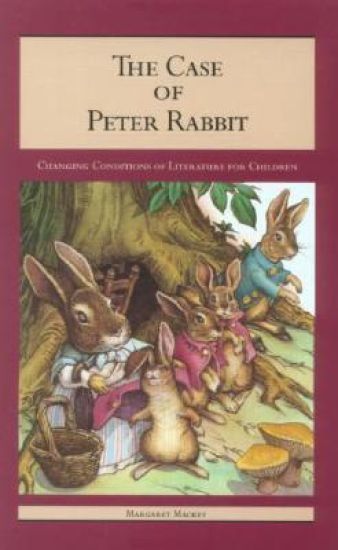
Using the example of The Tale of Peter Rabbit by Beatrix Potter to explore the impact of new media and technologies on how children learn about stories and reading, this book investigates nearly 100 re-tellings in a variety of media, some authorized by Potter's publisher Frederick Warne, some unauthorized. It looks at the implications of converging developments in children's literature: new media and technologies now readily available to children leading to new conventions and protocols of storytelling; changing commercial pressures on publishers and an emphasis on producing commodities associated with books and videos; saturation marketing which targets children and adults in different ways; and a cultural emphasis on the fragmentation, adaptation, and re-working of texts. The Tale of Peter Rabbit is now available as picture book, chapter book, board and bath book, pop-up, video (in versions that adhere to the original story and versions that deviate radically to include new adventures or Christian messages), ballet, CD-ROM, computer disc, audio tape, and filmstrip. The character of Peter Rabbit may be purchased as toy, clothing, dish, ornament, wallpaper, food, paper doll, and much else. His story and that of his author, Beatrix Potter, reappear in fragmented form in other books for children, in a murder mystery for adults, and in a graphic novel for teenagers. This book raises questions about the impact of these developments on young readers. Index. Appendix. Bibliography.
The Case of Peter Rabbit

The Case of Peter Rabbit

Margaret Mackey

CRC Press Inc
1999
nidottu
Using the example of The Tale of Peter Rabbit by Beatrix Potter to explore the impact of new media and technologies on how children learn about stories and reading, this book investigates nearly 100 re-tellings in a variety of media, some authorized by Potter's publisher Frederick Warne, some unauthorized. It looks at the implications of converging developments in children's literature: new media and technologies now readily available to children leading to new conventions and protocols of storytelling; changing commercial pressures on publishers and an emphasis on producing commodities associated with books and videos; saturation marketing which targets children and adults in different ways; and a cultural emphasis on the fragmentation, adaptation, and re-working of texts. The Tale of Peter Rabbit is now available as picture book, chapter book, board and bath book, pop-up, video (in versions that adhere to the original story and versions that deviate radically to include new adventures or Christian messages), ballet, CD-ROM, computer disc, audio tape, and filmstrip. The character of Peter Rabbit may be purchased as toy, clothing, dish, ornament, wallpaper, food, paper doll, and much else. His story and that of his author, Beatrix Potter, reappear in fragmented form in other books for children, in a murder mystery for adults, and in a graphic novel for teenagers. This book raises questions about the impact of these developments on young readers. Index. Appendix. Bibliography.
Urban Nightmares

Urban Nightmares

Steve Macek

University of Minnesota Press
2006
nidottu
For the past twenty-five years, American culture has been marked by an almost palpable sense of anxiety about the nation's inner cities. Urban America has been consistently depicted as a site of moral decay and uncontrollable violence, held in stark contrast to the allegedly moral, orderly suburbs and exurbs. In Urban Nightmares, Steve Macek documents the scope of these alarmist representations of the city, examines the ideologies that informed them, and exposes the interests they ultimately served. Macek begins by exploring the conservative analysis of the urban poverty, joblessness, and crime that became entrenched during the post-Vietnam War era. Instead of attributing these conditions to broad social and economic conditions, right-wing intellectuals, pundits, policy analysts, and politicians blamed urban problems on the urban underclass itself. This strategy was successful, Macek argues, in deflecting attention from growing income disparities and in helping to secure popular support both for reactionary social policies and the assumptions underwriting them.Turning to the media, Macek explains how Hollywood filmmakers, advertisers, and journalists validated the right-wing discourse on the urban crisis, popularizing its vocabulary. Network television news and weekly news magazines, he shows, covered the inner city and its inhabitants in ways consonant with the right's alarmist discourse. At the same time, Hollywood zealously recycled this antiurban bias in films ranging from genre thrillers like Falling Down and Judgment Night to auteurist efforts like Batman and Seven. Even advertising, Macek argues, mobilized fears of a perilous urban realm to sell products from SUVs to home alarm systems.Published during the second term of an American president whose conservative agenda has been an ongoing disaster for the poor and the working class, Urban Nightmares exposes a divisive legacy of media bias against the cities and their inhabitants and issues a wake-up call to readers to recognize that media images shape what we believe about others' (and our own) place in the real world-and the consequences of those beliefs can be devastating.Steve Macek teaches media studies, urban and suburbia studies, and speech communication at North Central College in Naperville, Illinois.
Discrepant Engagement

Discrepant Engagement

Nathaniel Mackey

The University of Alabama Press
2000
nidottu
This work addresses the poetry and prose of black writers from the US and Carribean and the so-called Black Mountain poets. It focuses on the experimental aspects of their work to show that they share an implied critique of conventional poetic practices.
Mapping Recreational Literacies

Mapping Recreational Literacies

Margaret Mackey

Peter Lang Publishing Inc
2007
nidottu
Being a fully literate adult means something different today than it did fifty years ago. Adults aged 18-34, having grown up with the technological innovations that have revolutionized the way we live and read - the Walkman, the video cassette recorder, the affordable domestic computer, the game console, the DVD, the Internet, and a variety of mobile and portable communications equipment - are the first generation to take the new world of literacy for granted. This book explores what it means to be a literate adult today, with the help of nine adults ranging in age from 19 to 36. It explores their detailed responses to a variety of particular texts: a digital game, an online poem, a picture book, a set of graphic novels. "Mapping Recreational Literacies" looks at how we make selections in the face of a plethora of textual options, and raises new questions about the importance of adult play with texts, the significance of ownership in a consumer society, and the role of reading both inside and outside of books. This book looks at the significance of these issues for professionals such as teachers and librarians who work with younger readers.