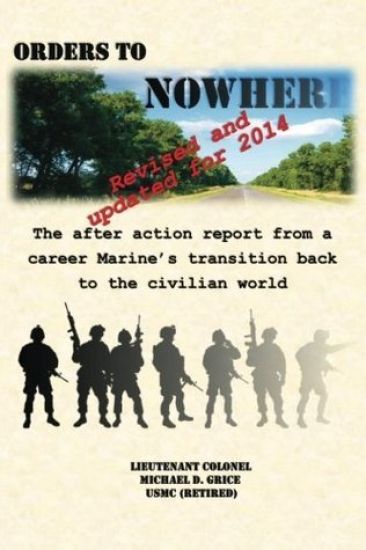
Revised and updated The third edition of "Orders to Nowhere" updates the chapter on resumes with new examples and introduces the Curriculum Vitae as a job seeking tool. New sections on personal branding and the do's and don'ts of social media. A must for every transitioning Soldier, Sailor, Airman, Marine, or Coast Guardsman "This is THE book for any person in the military who is planning to transition out or retire. There are insightful personal vignettes and countless of valuable lessons from cover to cover. This book makes more sense of the very complicated transition process than anything I have seen." -Chuck Heiser, former Marine and professional career consultant "Mike Grice has made real difference in the lives of those who serve by using his talents to put a complex undertaking into simple terms with a sense of humor and humility. I have personally benefited from ORDERS TO NOWHERE and have passed insights from it to veterans and active duty Marines who are contemplating transition." -Colonel Greg Martin USMC Orders to Nowhere is the essential insider's guide to military transition. Demystifying the uncertainty and ambiguity that surrounds getting out of the military, Orders to Nowhere is the comprehensive After Action Report of a career Marine's transition from the tightly knit military world back to civilianhood. Tens of thousands of Soldiers, Sailors, Airmen, Marines, and Coast Guardsmen transition back into the civilian world each and every year. The change from life in uniform to life beyond the military is a significant emotional event for everyone who experiences it. Hanging up your uniform for the last time isn't easy, and Orders to Nowhere was written to help explain the overwhelming process and make it easier for military members planning to get out, while they are in the midst of transition, or after they become veterans. Mike Grice is an award winning writer, retired career Marine, and intrepid explorer of the military transition process. Orders to Nowhere is the journal of his experiences, but it is also the story of every Soldier, Sailor, Airman, Marine, and Coast Guardsman who takes off the cloth of the nation and goes back to civilian life. Written during the author's adventure through the trials and tribulations of transition, Orders to Nowhere eases the pain by giving an inside look at the widely varied aspects of military to civilian transformation. Things like: -making the decision to hang up the uniform - telling your boss that you are getting out - the administration and logistics of moving on - the emotional roller coaster of transition - effects on family - transition decorum and ceremonies - the details of military retirement benefits - transition assistance classes - dealing with the Veterans Administration - VA disability claims - the Post 9/11 GI Bill - finding a job - how to dress like a professional - writing a resume and cover letter - networking - interviewing for a job - salary and benefits negotiation - adjusting to civilian life - and much, much more The book contains over 160 lessons learned and recommendations that can help anyone going through the military to civilian transition avoid making costly mistakes. The path back to "normal" life is anything but normal, and Orders to Nowhere is the traveler's guide that every member of the military and veteran needs to ease the pain of the journey. A must for every man and woman in uniform to help make transition as smooth as possible
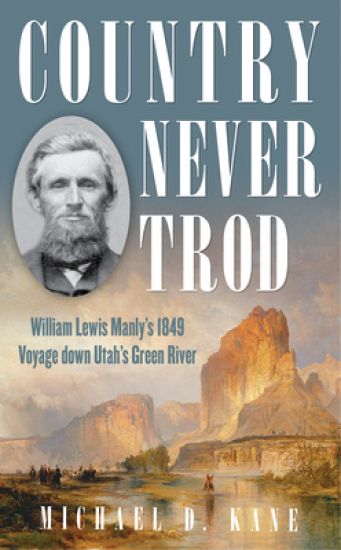
Country Never Yet Trod: William Lewis Manly’s Voyage Down the Green River, traces Manly’s little-known descent of the Green River, twenty years before John Wesley Powell’s famous first expedition, followed by his overland trek through some of the most desolate stretches of Utah. Previous scholarship has Manly floating only 292 miles to the Uinta Basin, but as he researched, Kane became convinced Manley went 150 miles further, all the way to what is now Green River, Utah. To prove it, he did all the primary research he could, and then he built his own wooden canoes and made the trip himself, tracing Manly’s footsteps and comparing notes with the earlier traveler. This book lays out Manly’s story, interspersed with Kane’s journal entries and photographs documenting his own trip.
This book introduces parabolic wave equations, their key methods of numerical solution, and applications in seismology and ocean acoustics. The parabolic equation method provides an appealing combination of accuracy and efficiency for many nonseparable wave propagation problems in geophysics. While the parabolic equation method was pioneered in the 1940s by Leontovich and Fock who applied it to radio wave propagation in the atmosphere, it thrived in the 1970s due to its usefulness in seismology and ocean acoustics. The book covers progress made following the parabolic equation’s ascendancy in geophysics. It begins with the necessary preliminaries on the elliptic wave equation and its analysis from which the parabolic wave equation is derived and introduced. Subsequently, the authors demonstrate the use of rational approximation techniques, the Padé solution in particular, to find numerical solutions to the energy-conserving parabolic equation, three-dimensionalparabolic equations, and horizontal wave equations. The rest of the book demonstrates applications to seismology, ocean acoustics, and beyond, with coverage of elastic waves, sloping interfaces and boundaries, acousto-gravity waves, and waves in poro-elastic media. Overall, it will be of use to students and researchers in wave propagation, ocean acoustics, geophysical sciences and more.
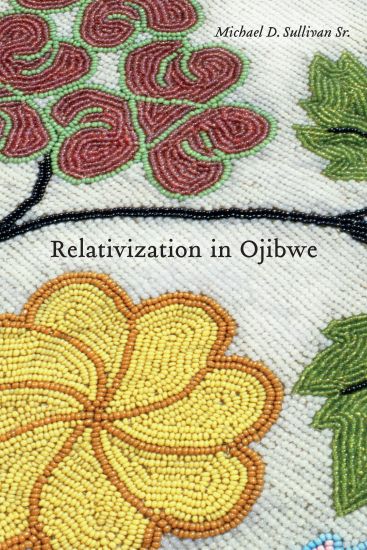
In Relativization in Ojibwe, Michael D. Sullivan Sr. compares varieties of the Ojibwe language and establishes subdialect groupings for Southwestern Ojibwe, often referred to as Chippewa, of the Algonquian family. Drawing from a vast corpus of both primary and archived sources, he presents an overview of two strategies of relative clause formation and shows that relativization appears to be an exemplary parameter for grouping Ojibwe dialect and subdialect relationships. Specifically, Sullivan targets the morphological composition of participial verbs in Algonquian parlance and categorizes the variation of their form across a number of communities. In addition to the discussion of participles and their role in relative clauses, he presents original research linking geographical distribution of participles, most likely a result of historic movements of the Ojibwe people to their present location in the northern midwestern region of North America. Following previous dialect studies concerned primarily with varieties of Ojibwe spoken in Canada, Relativization in Ojibwe presents the first study of dialect variation for varieties spoken in the United States and along the border region of Ontario and Minnesota. Starting with a classic Algonquian linguistic tradition, Sullivan then recasts the data in a modern theoretical framework, using previous theories for Algonquian languages and familiar approaches such as feature checking and the split-CP hypothesis.
In Relativization in Ojibwe, Michael D. Sullivan Sr. compares varieties of the Ojibwe language and establishes subdialect groupings for Southwestern Ojibwe, often referred to as Chippewa, of the Algonquian family. Drawing from a vast corpus of both primary and archived sources, he presents an overview of two strategies of relative clause formation and shows that relativization appears to be an exemplary parameter for grouping Ojibwe dialect and subdialect relationships. Specifically, Sullivan targets the morphological composition of participial verbs in Algonquian parlance and categorizes the variation of their form across a number of communities. In addition to the discussion of participles and their role in relative clauses, he presents original research linking geographical distribution of participles, most likely a result of historic movements of the Ojibwe people to their present location in the northern midwestern region of North America. Following previous dialect studies concerned primarily with varieties of Ojibwe spoken in Canada, Relativization in Ojibwe presents the first study of dialect variation for varieties spoken in the United States and along the border region of Ontario and Minnesota. Starting with a classic Algonquian linguistic tradition, Sullivan then recasts the data in a modern theoretical framework, using previous theories for Algonquian languages and familiar approaches such as feature checking and the split-CP hypothesis.
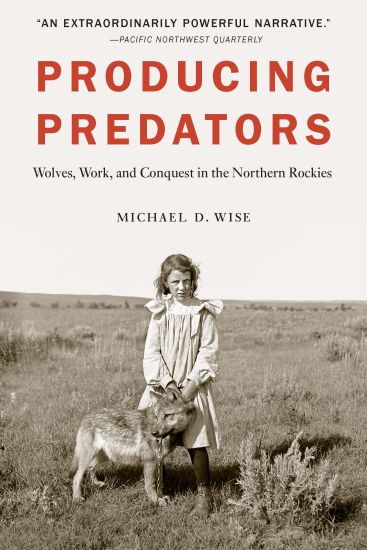
In Producing Predators Michael D. Wise argues that contestations between Native and non-Native people over hunting, labor, and the livestock industry drove the development of predator eradication programs in Montana and Alberta from the 1880s onward. The history of these antipredator programs was significant not only for their ecological effects but also for their enduring cultural legacies of colonialism in the Northern Rockies. By targeting wolves and other wild carnivores for extermination, cattle ranchers disavowed the predatory labor of raising domestic animals for slaughter, representing it instead as productive work. Meanwhile, federal agencies sought to purge the Blackfoot, Salish-Kootenai, and other indigenous peoples of their so-called predatory behaviors through campaigns of assimilation and citizenship that forcefully privatized tribal land and criminalized hunting and its related ritual practices. Despite these colonial pressures, Native communities resisted and negotiated the terms of their dispossession by representing their own patterns of work, food, and livelihood as productive. By exploring predation and production as fluid cultural logics for valuing labor rather than just a set of biological processes, Producing Predators offers a new perspective on the history of the American West and the modern history of colonialism more broadly.
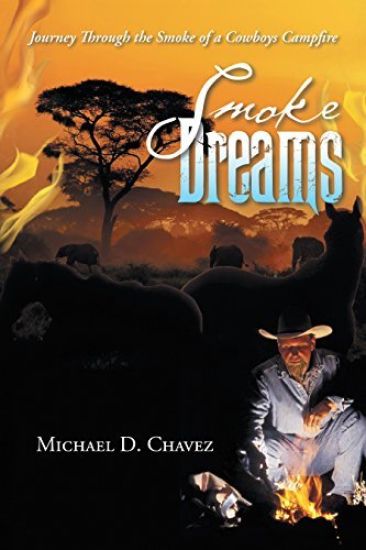
Sitting at the campfire and burning pages from a diary given to him by an aged Chinese traveler, a story of their travels appears before him in the depths of a golden and yellow fire. Mustache's travels through Northern Arizona had become legendary in the cattlemen's association. But as always, time marches on and life continues to change. But the chance encounter with a mystic blessed book given to two Chinese travelers will forever change the life of this aging cowboy.
Sitting at the campfire and burning pages from a diary given to him by an aged Chinese traveler, a story of their travels appears before him in the depths of a golden and yellow fire. Mustache's travels through Northern Arizona had become legendary in the cattlemen's association. But as always, time marches on and life continues to change. But the chance encounter with a mystic blessed book given to two Chinese travelers will forever change the life of this aging cowboy.