Kirjojen hintavertailu. Mukana 12 415 452 kirjaa ja 12 kauppaa.

Kirjahaku

Etsi kirjoja tekijän nimen, kirjan nimen tai ISBN:n perusteella.

890 tulosta hakusanalla Michaelangelo Matos

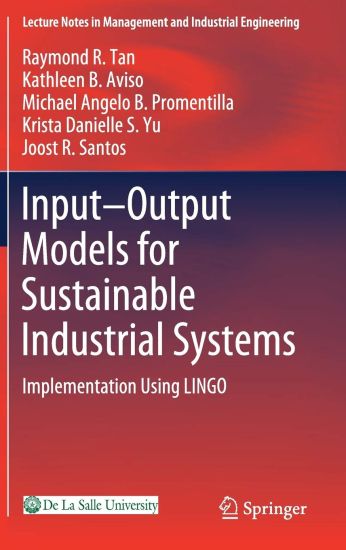
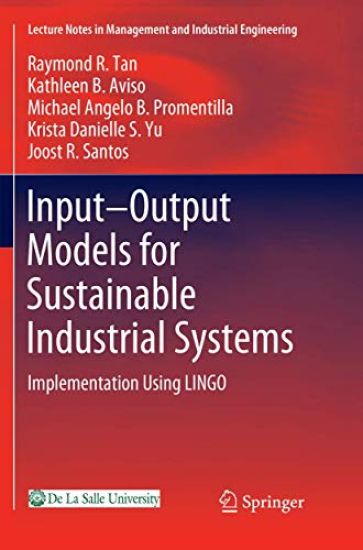
Input-Output Models for Sustainable Industrial Systems

Input-Output Models for Sustainable Industrial Systems

Raymond R. Tan; Kathleen B. Aviso; Michael Angelo B. Promentilla; Krista Danielle S. Yu; Joost R. Santos

Springer Verlag, Singapore
2018
sidottu
This book addresses the specialized topic of input–output models for sustainable industrial systems. While these models are well-established tools for economic analysis, their underlying mathematical structure is also applicable to the analysis and optimization of a wide range of systems that are characterized by linear interdependencies among their components. This means that input–output models can be used for diverse networks, such as processes within industrial plants, industrial plants in a supply chain, or departmental units within an organization. The models can also be readily extended to interactions between man-made systems and the environment, e.g. flows of natural resources and/or pollutants. Furthermore, model variants with excess degrees of freedom can be formulated to allow optimization and decision-making to be integrated within the framework. This book examines how input–output models can be applied to sustainable industrial systems. Each major variant is discussed separately in a dedicated chapter, and representative case studies and supporting LINGO code are also included.
Input-Output Models for Sustainable Industrial Systems

Input-Output Models for Sustainable Industrial Systems

Raymond R. Tan; Kathleen B. Aviso; Michael Angelo B. Promentilla; Krista Danielle S. Yu; Joost R. Santos

Springer Verlag, Singapore
2018
nidottu
This book addresses the specialized topic of input–output models for sustainable industrial systems. While these models are well-established tools for economic analysis, their underlying mathematical structure is also applicable to the analysis and optimization of a wide range of systems that are characterized by linear interdependencies among their components. This means that input–output models can be used for diverse networks, such as processes within industrial plants, industrial plants in a supply chain, or departmental units within an organization. The models can also be readily extended to interactions between man-made systems and the environment, e.g. flows of natural resources and/or pollutants. Furthermore, model variants with excess degrees of freedom can be formulated to allow optimization and decision-making to be integrated within the framework. This book examines how input–output models can be applied to sustainable industrial systems. Each major variant is discussed separately in a dedicated chapter, and representative case studies and supporting LINGO code are also included.
Michelangela and Debuts

Michelangela and Debuts

Joan Thomson Kretschmer

Joshua Tree Publishing
2019
pokkari
Enjoy the adventures of a tiny artist-spider, Michelangela, who discovers romance and herself. Searching for her place on earth, she inspires a prince who copies her intricate designs and becomes world famous. Then delight in the big-hearted heroine, Amore, who is ostracized by her family and townspeople because of her generosity and uniqueness. Follow her to one of the world's greatest cities, where she finds love and appreciation by those who see her as a "swan" rather than as an "ugly duckling." In a witty, alternative ending, a crafty lawyer markets her and enables her to become a world-renowned icon. Dr. Joan Thomson Kretschmer, Artistic Director and founder of the Lyric Chamber Music Society of New York, attended Smith College, graduated from Barnard College, and received her M.A. and Ph.D. in musicology from Columbia University, where she was a Clarence Barker Fellow. A pianist and teacher, she has been a music critic for The New York Post and has written articles about music for The New York Times and other publications. Joan is the author of Yona: Discoveries, Doorways and Musical Superpower.
Michelangelos Ganymed und die Homosexualitat in der italienischen Renaissance
Studienarbeit aus dem Jahr 2009 im Fachbereich Kunst - Bildhauerei, Skulptur, Plastik, Note: 1, Universit t Wien, Sprache: Deutsch, Abstract: Die Arbeit behandelt die Ganymed-Zeichnung von Michelangelo, die dieser Tommaso dei Cavalieri, einem guten Freund, geschenkt hat. Hierbei geht es nicht um f r die Renaissance typische, symboltr chtige Details, die es zu entschl sseln gilt. Stattdessen liegt der Fokus auf der Figurengruppe des Ganymed und seines Entf hrers in Gestalt eines Adlers. Dennoch gibt es viel zu entdecken, wobei man sich hier vor allem mit der Gedanken- und Gef hlswelt Michelangelos und auch der seiner Zeit auseinandersetzen muss. Ein wichtiger Diskurs in der Fr hen Neuzeit war der um die Liebe. Dieser hat die Kreise der Intellektuellen auch stark beeinflusst. Insofern g be es zu diesem Punkt viel zu er rtern, doch ich m chte meinen Schwerpunkt anders setzen. Unter besonderer Bezugnahme auf James Saslow werde ich die homoerotische Natur der Geschenkzeichnung, die innere Welt Michelangelos, die Sodomie und den Genderaspekt "homosexueller" M nner in der florentinischen Renaissance n her betrachten.
The Lost Michelangelos

The Lost Michelangelos

Antonio Forcellino

Polity Press
2011
sidottu
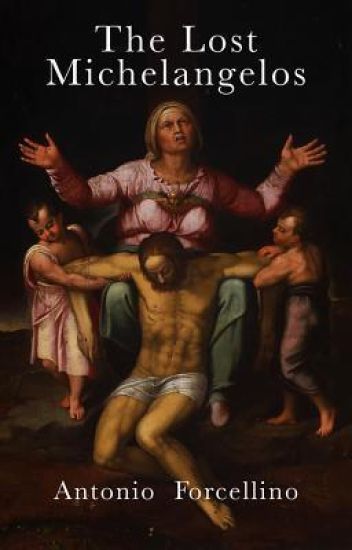
Translated by Lucinda Byatt This book tells the remarkable story of a rare discovery: the uncovering of two lost paintings by the great Renaissance artist Michelangelo. Like many stories of artistic loss, this one begins in a library in Italy, where Antonio Forcellino - a distinguished Michelangelo scholar and restorer - stumbled across some unpublished letters among the papers of Cardinal Ercole Gonzaga, son of Isabella d’Este and an extremely important figure in the Italian Renaissance. These letters comment on the paintings of Michelangelo in a way that is completely at odds with what was to become the dominant critical tradition of Michelangelo scholarship, an inconsistency that set Forcellino off on a journey that took him to Dubrovnik, Oxford, New York and Niagara Falls and culminated in the discovery of two magnificent paintings: Pieta with Mary and Two Angels, now in a private collection in America, and Cavalieri Crucifixion, now held by an educational institution in England. Through a combination of careful historical research, extensive restoration and meticulous radiographic analysis, Forcellino shows convincingly that these paintings can be traced back to the studio of Michelangelo. This extraordinary story, brilliantly retold, calls into question the received view of Michelangelo’s work and fills in a missing piece in our understanding of one of the greatest artists of all time.
Das Leben Michelangelos

Das Leben Michelangelos

Romain Rolland

Palala Press
2018
pokkari
This work has been selected by scholars as being culturally important, and is part of the knowledge base of civilization as we know it. This work was reproduced from the original artifact, and remains as true to the original work as possible. Therefore, you will see the original copyright references, library stamps (as most of these works have been housed in our most important libraries around the world), and other notations in the work.This work is in the public domain in the United States of America, and possibly other nations. Within the United States, you may freely copy and distribute this work, as no entity (individual or corporate) has a copyright on the body of the work.As a reproduction of a historical artifact, this work may contain missing or blurred pages, poor pictures, errant marks, etc. Scholars believe, and we concur, that this work is important enough to be preserved, reproduced, and made generally available to the public. We appreciate your support of the preservation process, and thank you for being an important part of keeping this knowledge alive and relevant.
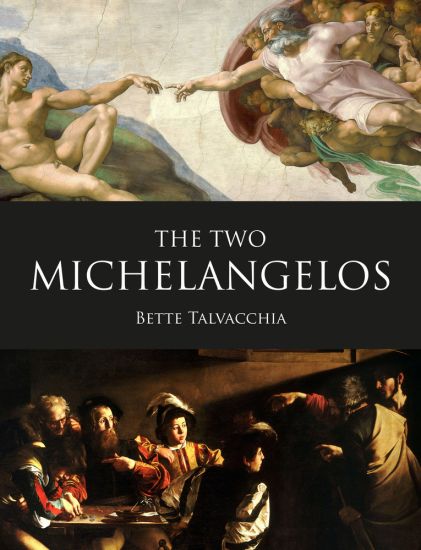
The Two Michelangelos

The Two Michelangelos

Bette Talvacchia

Lund Humphries Publishers Ltd
2021
sidottu
Through historical coincidence that almost takes on a mythical character, 'Michelangelo' was the given name not only of the Florentine sculptor, but also of the painter who grew up in Caravaggio, a provincial town in Lombardy, about 25 miles east of Milan. Michelangelo Merisi da Caravaggio, commonly called by reference to his hometown, produced revolutionary paintings whose impact was as great — at the beginning of the 1600s — as the other Michelangelo’s art had been a century earlier. In this book, author Bette Talvacchia explores the significant, but little-discussed, connection between the 'two Michelangelos'. She exposes the dynamic relationship between their work through looking at the ways in which Caravaggio creatively responded to the art of his namesake from the start of his youthful arrival in Rome. In addition, she suggests how Michelangelo’s overwhelming achievement was a model that helped to drive the young Caravaggio’s powerful ambition and shape his identity as an artist.With lucid and intelligent prose, this fascinating book sheds light on the similar 'artistic temperament' constructed in the biographies of each artist — glorifying their rebellious, anti-social behaviour and uncompromising artistic principles — examined both in its historical and contemporary configurations. Why does our culture find these two artists so compelling, and how were they seen in their time and in the intervening centuries until our own day? Linking the past to the present, Talvacchia encourages readers to appreciate more fully the individual works discussed, and to reflect upon the continuing relevance of these two artists to the culture of the present day.
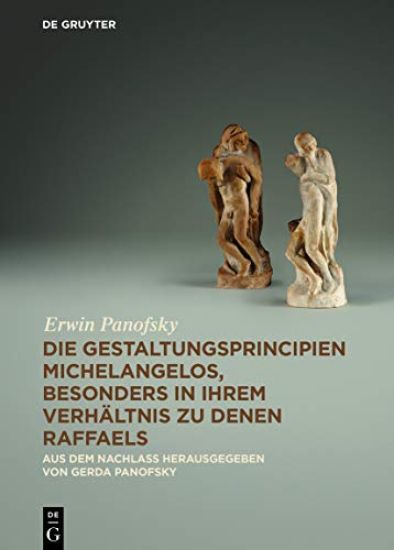
Die Gestaltungsprincipien Michelangelos, besonders in ihrem Verhältnis zu denen Raffaels
Die wiederentdeckte Habilitation Erwin Panofskys 1920 reichte Erwin Panofsky, einer der einflussreichsten Kunsthistoriker des 20. Jahrhunderts, in Hamburg seine Habilitationsschrift zu Michelangelo ein. In den folgenden Jahren arbeitete Panofsky stetig an dem Manuskript weiter, doch veröffentlicht wurde es nie. Seit seiner Emigration 1934 galt es als verschollen. Nach seiner Wiederentdeckung im Zentralinstitut für Kunstgeschichte in München im Jahr 2012 wurde das Manuskript von Panofskys Witwe, der Kunsthistorikerin Gerda Panofsky, ediert. Die Habilitation Panofskys liegt nun erstmals in gedruckter Fassung vor, ergänzt durch eine Einführung der Herausgeberin und das Faksimile des kompletten, handschriftlich korrigierten und ergänzten Manuskriptes.
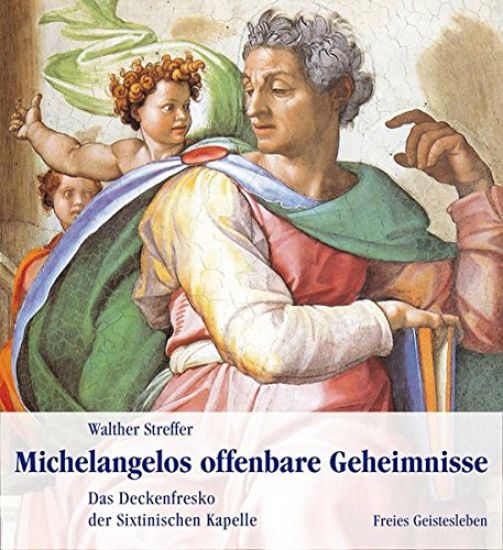
Die Bildsprache Michelangelos

Die Bildsprache Michelangelos

Edgar Wind

De Gruyter
2016
isokokoinen pokkari
1936 stellte der Kunsthistoriker und Philosoph Edgar Wind sein Manuskript zu Michelangelos Deckenfresken der Sixtinischen Kapelle fertig. Wind begriff den christlichen Erlösungsgedanken als fundamentales Thema des gesamten Raumes und erkannte ein polares Beziehungsgeflecht, welches ihm das Bildprogramm vollständig erschloss. Methodische Ansätze Aby Warburgs aufnehmend, dessen Mitarbeiter Wind in Hamburg war, analysierte er die Themenwahl Michelangelos. Obwohl fertiggestellt, wurde das Werk nie veröffentlicht. Es liegt nun erstmals in gedruckter Fassung vor, begleitet von einem ausführlichen Nachwort des Herausgebers.