Kirjojen hintavertailu. Mukana 12 049 383 kirjaa ja 12 kauppaa.

Kirjahaku

Etsi kirjoja tekijän nimen, kirjan nimen tai ISBN:n perusteella.

1000 tulosta hakusanalla Neil R. Nicholson

Intellectual Privacy

Intellectual Privacy

Neil Richards

Oxford University Press Inc
2017
nidottu
Most people believe that our rights to privacy and free speech are inevitably in conflict. Courts all over the world have struggled with how to reconcile the two for over a century, and the rise of the Internet has made this problem more urgent. We live in an age of corporate and government surveillance of our lives. And our free speech culture has created an anything-goes environment on the web, filled with hurtful and harmful expression and data flows. In Intellectual Privacy, Neil Richards offers a solution that ensures that our ideas and values keep pace with our technologies. Because of the importance of free speech to open societies, he argues that when privacy and free speech truly conflict, free speech should almost always win. But in sharp contrast to conventional wisdom, Richards argues that speech and privacy are only rarely in conflict. True invasions of privacy like peeping toms or electronic surveillance should almost never be protected as "free speech." And critically, Richards shows how most of the law we enact to protect online privacy poses no serious burden to public debate, and how protecting the privacy of our data is not censorship. A timely and provocative book on a subject that affects us all, Intellectual Privacy will radically reshape the debate about privacy and free speech in our digital age.

Conflict

Conflict

Neil D. Shortland; Laurence J. Alison; Joseph M. Moran

Oxford University Press Inc
2019
sidottu
Conflict: How Soldiers Make Impossible Decisions is about making hard choices--where all outcomes are potentially negative. The authors draw on interviews conducted with soldiers about the situations they faced and the decisions they made at war. These are vivid and sometimes distressing stories. They form the data from which the authors explore the cognitive processes associated with choice, commitment to action and (sometimes) error, as well as goal directed thinking, innovation and courage. By referring to real cases, Conflict invites readers to consider their own responses under extreme circumstances and ask themselves how they would choose between difficult options. In doing so this book will go some way to helping readers understand what it feels like when choosing between least-worst decisions.
New Urban Spaces

New Urban Spaces

Neil Brenner

Oxford University Press Inc
2019
sidottu
The urban condition is today being radically transformed. Urban restructuring is accelerating, new urban spaces are being consolidated, and new forms of urbanization are crystallizing. In New Urban Spaces, Neil Brenner argues that understanding these mutations of urban life requires not only concrete research, but new theories of urbanization. To this end, Brenner proposes an approach that breaks with inherited conceptions of the urban as a bounded settlement unit-the city or the metropolis-and explores the multiscalar constitution and periodic rescaling of the capitalist urban fabric. Drawing on critical geopolitical economy and spatialized approaches to state theory, Brenner offers a paradigmatic account of how rescaling processes are transforming inherited formations of urban space and their variegated consequences for emergent patterns and pathways of urbanization. The book also advances an understanding of critical urban theory as radically revisable: key urban concepts must be continually reinvented in relation to the relentlessly mutating worlds of urbanization they aspire to illuminate.
New Urban Spaces

New Urban Spaces

Neil Brenner

Oxford University Press Inc
2019
nidottu
The urban condition is today being radically transformed. Urban restructuring is accelerating, new urban spaces are being consolidated, and new forms of urbanization are crystallizing. In New Urban Spaces, Neil Brenner argues that understanding these mutations of urban life requires not only concrete research, but new theories of urbanization. To this end, Brenner proposes an approach that breaks with inherited conceptions of the urban as a bounded settlement unit-the city or the metropolis-and explores the multiscalar constitution and periodic rescaling of the capitalist urban fabric. Drawing on critical geopolitical economy and spatialized approaches to state theory, Brenner offers a paradigmatic account of how rescaling processes are transforming inherited formations of urban space and their variegated consequences for emergent patterns and pathways of urbanization. The book also advances an understanding of critical urban theory as radically revisable: key urban concepts must be continually reinvented in relation to the relentlessly mutating worlds of urbanization they aspire to illuminate.
Little Mogadishu: Eastleigh, Nairobi's Global Somali Hub

Little Mogadishu: Eastleigh, Nairobi's Global Somali Hub

Neil Carrier

Oxford University Press, USA
2017
nidottu
Nairobi's Eastleigh estate has undergone pro- found change over the past two decades. Previously a quiet residential zone, the arrival of vast numbers of Somali refugees catalyzed its trans- formation into 'Little Mogadishu', a global hub for Somali business. Dozens of malls and hotels have sprouted from its muddy streets, attracting thousands of shoppers. Nonetheless, despite boosting Kenya's economy, the estate and its residents are held in suspicion over alleged links to Islamic terrorism, especially after the 2013 Westgate Mall attack, while local and international media have suggested with little evidence that its economic boom owes much to capital derived from Indian Ocean piracy. In contrast to such sensationalized reporting, Little Mogadishu is based on detailed historical and ethnographic research and explores the social and historical underpinnings of this economic boom. It examines how transnational networks converged on Eastleigh in the wake of the collapse of the Somali state, attracting capital from the Somali diaspora, and bringing goods--especially clothes and electronics--from Dubai, China and elsewhere that are much in demand in East Africa. In so doing, Little Mogadishu provides a compelling case-study of the developmental impact diasporas and transnational trade can have, albeit in a country where many see this development as suspect.
From Maimonides to Microsoft

From Maimonides to Microsoft

Neil Weinstock Netanel

Oxford University Press Inc
2018
nidottu
Jewish copyright law is a rich body of jurisprudence that developed in parallel with modern copyright laws and the book privileges that preceded them. Jewish copyright law owes its origins to a reprinting ban that the Rome rabbinic court issued for three books of Hebrew grammar in 1518. It continues to be applied today, notably in a rabbinic ruling outlawing pirated software, issued at Microsoft's request. In From Maimonides to Microsoft, Professor Netanel traces the historical development of Jewish copyright law by comparing rabbinic reprinting bans with secular and papal book privileges and by relaying the stories of dramatic disputes among publishers of books of Jewish learning and liturgy. He describes each dispute in its historical context and examines the rabbinic rulings that sought to resolve it. Remarkably, the rabbinic reprinting bans and copyright rulings address some of the same issues that animate copyright jurisprudence today: Is copyright a property right or just a right to receive fair compensation? How long should copyrights last? What purposes does copyright serve? While Jewish copyright law has borrowed from its secular law counterpart at key junctures, it fashions strikingly different answers to those key questions. The story of Jewish copyright law also intertwines with the history of the Jewish book trade and with steadfast efforts of rabbinic leaders to maintain their authority to regulate that trade in the face of the dramatic erosion of Jewish communal autonomy in the eighteenth and nineteenth centuries. This book will thus be of considerable interest to students of Jewish law and history, as well as copyright scholars and practitioners.
Why Delegate?

Why Delegate?

Neil J. Mitchell

Oxford University Press Inc
2021
nidottu
Why Delegate? moves beyond the standard economic accounts of delegation to offer a fresh take on a wide variety of issues and shows how essential the act of delegating is to our society. From mundane tasks like choosing a plumber to weightier ones like running a country, the world turns on delegation. We delegate particular tasks to people we believe have more expertise than we do. When it is successful, delegation improves efficiency, expands the range of responsible actors, and even increases happiness. When delegation fails, though, it brings conflict, corruption, and an absence of accountability. In Why Delegate?, Neil J. Mitchell investigates the incentives to delegate and the risks we take in doing so. He demonstrates how a new, modified understanding of the simple structure of the delegation relationship-the principal-agent relationship, as economists have described it-simplifies a myriad of important and seemingly disparate problems in private and public life. Using real-world case studies including child abuse in the Catholic Church, the Volkswagen pollution scandal, and FIFA corruption, Mitchell illustrates the broad functionality of delegation logic and the wide range of incentives at work in these relationships. Diverse examples reveal the opportunism of both the leaders and the led and show how accepted accounts of the principal-agent relationship are incomplete. By drawing on multidisciplinary research to address complex questions of motivation, control, responsibility, and accountability, the book builds a broader, more useful logic of delegation. Why Delegate? moves beyond the standard economic accounts of delegation to offer a fresh take on a wide variety of issues and shows how essential the act of delegating is to our society. Mitchell's comprehensive account of the contexts, causes, and effects of delegation develops a new way to understand both the theory and practice of this critical relationship.
Why Privacy Matters

Why Privacy Matters

Neil Richards

Oxford University Press Inc
2022
sidottu
A much-needed corrective on what privacy is, why it matters, and how we can protect in an age when so many believe that the concept is dead. Everywhere we look, companies and governments are spying on us--seeking information about us and everyone we know. Ad networks monitor our web-surfing to send us "more relevant" ads. The NSA screens our communications for signs of radicalism. Schools track students' emails to stop school shootings. Cameras guard every street corner and traffic light, and drones fly in our skies. Databases of human information are assembled for purposes of "training" artificial intelligence programs designed to predict everything from traffic patterns to the location of undocumented migrants. We're even tracking ourselves, using personal electronics like Apple watches, Fitbits, and other gadgets that have made the "quantified self" a realistic possibility. As Facebook's Mark Zuckerberg once put it, "the Age of Privacy is over." But Zuckerberg and others who say "privacy is dead" are wrong. In Why Privacy Matters, Neil Richards explains that privacy isn't dead, but rather up for grabs. Richards shows how the fight for privacy is a fight for power that will determine what our future will look like, and whether it will remain fair and free. If we want to build a digital society that is consistent with our hard-won social values--fairness, freedom, and sustainability--then we must make a meaningful commitment to privacy. Privacy matters because good privacy rules can promote the essential human values of identity, power, freedom, and trust. If we want to preserve our commitments to these precious yet fragile values, we will need privacy rules. After detailing why privacy remains so important, Richards considers strategies that can help us protect it privacy from the forces that are working to undermine it. Pithy and forceful, this is essential reading for anyone interested in a topic that sits at the center of so many current problems.
Common: The Development of Literary Culture in Sixteenth-Century England
This volume explores the development of literary culture in sixteenth-century England as a whole and seeks to explain the relationship between the Reformation and the literary renaissance of the Elizabethan period. Its central theme is the 'common' in its double sense of something shared and something base, and it argues that making common the work of God is at the heart of the English Reformation just as making common the literature of antiquity and of early modern Europe is at the heart of the English Renaissance. Its central question is 'why was the Renaissance in England so late?' That question is addressed in terms of the relationship between Humanism and Protestantism and the tensions between democracy and the imagination which persist throughout the century. Part One establishes a social dimension for literary culture in the period by exploring the associations of 'commonwealth' and related terms. It addresses the role of Greek in the period before and during the Reformation in disturbing the old binary of elite Latin and common English. It also argues that the Reformation principle of making common is coupled with a hostility towards fiction, which has the effect of closing down the humanist renaissance of the earlier decades. Part Two presents translation as the link between Reformation and Renaissance, and the final part discusses the Elizabethan literary renaissance and deals in turn with poetry, short prose fiction, and the drama written for the common stage.
Contract Law in Practice Pack

Contract Law in Practice Pack

Neil Andrews

Oxford University Press
2021
muu
Companion website: www.oup.com/clp1 This new work contains the most current analysis of the English law of contract. Contract Law in Practice enables easy access to the essence of judgements, and includes clear explanations of the law, especially where the law is unsatisfactory, undecided, or lacks certainty. Written by Neil Andrews--an experienced author--his highly valuable book is essential for all commercial lawyers and anyone interested in this fundamental area of the law. Contract Law in Practice Pack includes a digital version available on PC, Mac, Android devices, iPad, or iPhone to ensure that you have access to the latest research on the law of contract wherever you are. With precise links to cases and important passages of the leading judgements, the analysis is founded in the words of the judgments themselves, enabling clear interpretation of their impact on the shape of the law and easy access to judicial discussion. The coverage is comprehensive, and emphasis is made upon interpreting and elucidating difficult or undecided topics. Substantial references to further reading throughout enable easy research for the reader. The author identifies six key principles of contract law: freedom of contract; objectivity; the contractual bond principle; estoppel; good faith and fair dealing; and the compensation principle. These principles support the analytical rigour of Contract Law in Practice and provide the framework in which the author clarifies difficult aspects of the law.
The Logic of Number

The Logic of Number

Neil Tennant

Oxford University Press
2022
sidottu
In The Logic of Number, Neil Tennant defines and develops his Natural Logicist account of the foundations of the natural, rational, and real numbers. Based on the logical system free Core Logic, the central method is to formulate rules of natural deduction governing variable-binding number-abstraction operators and other logico-mathematical expressions such as zero and successor. These enable 'single-barreled' abstraction, in contrast with the 'double-barreled' abstraction effected by principles such as Frege's Basic Law V, or Hume's Principle. Natural Logicism imposes upon its account of the numbers four conditions of adequacy: First, one must show how it is that the various kinds of number are applicable in our wider thought and talk about the world. This is achieved by deriving all instances of three respective schemas: Schema N for the naturals, Schema Q for the rationals, and Schema R for the reals. These provide truth-conditions for statements deploying terms referring to numbers of the kind in question. Second, one must show how it is that the naturals sit among the rationals as themselves again, and the rationals likewise among the reals. Third, one should reveal enough of the metaphysical nature of the numbers to be able to derive the mathematician's basic laws governing them. Fourth, one should be able to demonstrate that there are uncountably many reals. Natural Logicism is realistic about the limits of logicism when it comes to treating the real numbers, for which, Tennant argues, one needs recourse to geometric intuition for deeper starting-points, beyond which logic alone will then deliver the sought results, with absolute formal rigor. The resulting program enables one to delimit, in a principled way, those parts of number theory that are produced by the Kantian understanding alone, and those parts that depend on recourse to (very simple) a priori geometric intuitions.
Constitutional and Administrative Law

Constitutional and Administrative Law

Neil Parpworth

Oxford University Press
2022
nidottu
Constitutional and Administrative Law guides readers through the key principles of public law, examining significant cases and recent developments along the way. The book's broad coverage is presented in a concise and easy-to-read format, while chapter summaries and self-test questions help reinforce knowledge. Highly praised by students and lecturers alike, Constitutional and Administrative Law is a must for undergraduates of all levels. Digital formats and resources The twelfth edition is available for students and institutions to purchase in a variety of formats, and is supported by online resources. · The e-book offers a mobile experience and convenient access along with functionality tools, navigation features, and links that offer extra learning support: www.oxfordtextbooks.co.uk/ebooks · The online resources include: bi-annual updates on the latest key developments in public law, and self-test questions on key topics, with feedback, providing an opportunity for students to test and consolidate their learning.
After Yeats and Joyce

After Yeats and Joyce

Neil Corcoran

Oxford University Press
1997
nidottu
Irish literature after Yeats and Joyce, from the 1920s onwards, includes texts which have been the subject of much contention. For a start how should Irish literature be defined: as works which have been written in Irish or as works written in Englsih by the Irish? It is a period in which ideas of Ireland--of people, community, and nation--have been both created and reflected, and in which conceptions of a distinct Irish identity have been articulated, defended, and challenged; a period which has its origins in a time of intense political turmoil. `after Yeats and Joyce' also suggests the immense influence of these two writers on the style, stances, and preoccupations of twentieth-century Irish literature. Neil Corcoran focuses his chapter on various themes such as `the Big House', the rural and provincial, with reference to authors from Kinsella and Beckett to William Trevor, Seamus Heaney, and Mary Lavin, providing a lucid and far-reaching introduction to modern Irish writing.
Bad Beliefs

Bad Beliefs

Neil Levy

Oxford University Press
2021
sidottu
This is an open access title available under the terms of a CC BY-NC-ND 4.0 International licence. It is free to read at Oxford Scholarship Online and offered as a free PDF download from OUP and selected open access locations. Bad beliefs - beliefs that blatantly conflict with easily available evidence - are common. Large minorities of people hold that vaccines are dangerous or accept bizarre conspiracy theories, for instance. The prevalence of bad beliefs may be politically and socially important, for instance blocking effective action on climate change. Explaining why people accept bad beliefs and what can be done to make them more responsive to evidence is therefore an important project. A common view is that bad beliefs are largely explained by widespread irrationality. This book argues that ordinary people are rational agents, and their beliefs are the result of their rational response to the evidence they're presented with. We thought they were responding badly to evidence, because we focused on the first-order evidence alone: the evidence that directly bears on the truth of claims. We neglected the higher-order evidence, in particular evidence about who can be trusted and what sources are reliable. Once we recognize how ubiquitous higher-order evidence is, we can see that belief formation is by and large rational. The book argues that we should tackle bad belief by focusing as much on the higher-order evidence as the first-order evidence. The epistemic environment gives us higher-order evidence for beliefs, and we need to carefully manage that environment. The book argues that such management need not be paternalistic: once we recognize that managing the epistemic environment consists in management of evidence, we should recognize that such management is respectful of epistemic autonomy.
Contract Law in Practice

Contract Law in Practice

Neil Andrews

Oxford University Press
2021
sidottu
This new work contains the most current analysis of the English law of contract. Contract Law in Practice enables easy access to the essence of judgements, and includes clear explanations of the law, especially where the law is unsatisfactory, undecided, or lacks certainty. Written by Neil Andrews--an experienced author--this highly valuable book is essential for all commercial lawyers and anyone interested in this fundamental area of the law. With precise links to cases and important passages of the leading judgements, the analysis is founded in the words of the judgments themselves, enabling clear interpretation of their impact on the shape of the law and easy access to judicial discussion. The coverage is comprehensive, and emphasis is made upon interpreting and elucidating difficult or undecided topics. Substantial references to further reading throughout enable easy research for the reader. The author identifies six key principles of contract law: freedom of contract; objectivity; the contractual bond principle; estoppel; good faith and fair dealing; and the compensation principle. These principles support the analytical rigour of Contract Law in Practice and provide the framework in which the author clarifies difficult aspects of the law.
The Enabling State

The Enabling State

Neil Gilbert; Barbara Gilbert

Oxford University Press Inc
1990
sidottu
Studies of the welfare state have formed an important part of public policy research in America since the Second World War. The Enabling State reconsiders the scope of social welfare transfers, how they are delivered, and whom they benefit. In addition to presenting an analysis of direct public expenditures, the authors examine how welfare benefits are derived from the full range of modern social transfers, including tax expenditures, credit subsidies, and those induced by regulatory activity. The work also provides an account of the effect of the `commercialization of social welfare', that is, increased public reliance on private enterprise and market-orientated projects for its welfare provisions.
The Dodgers Move West

The Dodgers Move West

Neil Sullivan

Oxford University Press Inc
1989
nidottu
For many New Yorkers, the removal of the Brooklyn Dodgers--perhaps the most popular baseball team of all time--to Los Angeles in 1957 remains one of the most traumatic events since World War II. Neil J. Sullivan's controversial reassessment of a story that has reached almost mythic proportions in its many retellings shifts responsibility for the move onto the local governmental maneuverings that occurred on both sides of the continent. Conventional wisdom has it that Dodgers owner Walter O'Malley cold-heartedly abandoned the devoted Brooklyn fans for the easy money of Los Angeles. Sullivan argues that O'Malley had, in fact, wanted to stay in Brooklyn, hoping to build a new stadium with his own money. Situated in an increasingly unsafe neighborhood and without parking facilities, Ebbets Field had become obsolete. Yet an uncooperative New York City administration, led by Robert Moses, blocked O'Malley's plan to use the ideal site at the Atlantic Avenue Long Island Railroad terminal. A political battle over the Dodgers' move also erupted in Los Angeles. Mayor Poulson's suggestion to use Chavez Ravine as the new stadium site triggered opposition from residents concerned about a giveaway. Eventually a telethon campaign that enlisted the help of celebrities such as Groucho Marx, George Burns, and Ronald Reagan enabled the approval of the deal. Set against a backdrop of sporting passion and rivalry, and appearing over thirty years after the Dodgers' last season in Brooklyn, this engrossing book offers new insights into the power struggles existing in the nation's two largest cities.
Copyright's Paradox

Copyright's Paradox

Neil Weinstock Netanel

Oxford University Press Inc
2008
sidottu
The United States Supreme Court famously labeled copyright "the engine of free expression" because it provides a vital economic incentive for much of the literature, commentary, music, art, and film that makes up our public discourse. Yet today's greatly expanded copyright law often does the opposite--it can be used to quash news reporting, political commentary, church dissent, historical scholarship, cultural critique, and artistic expression. In Copyright's Paradox, Neil Weinstock Netanel explores the tensions between copyright law and free speech concerns, revealing how copyright law can impose unacceptable burdens on speech. Netanel provides concrete illustrations of how copyright often prevents speakers from effectively conveying their message, tracing this conflict across both traditional and digital media and considering current controversies such as the YouTube and MySpace copyright infringements, Hip-hop music and digital sampling, and the Google Book Search litigation. The author juxtaposes the dramatic expansion of copyright holders' proprietary control against the individual's newly found ability to digitally cut, paste, edit, remix, and distribute sound recordings, movies, TV programs, graphics, and texts the world over. He tests whether, in light of these developments and others, copyright still serves as a vital engine of free expression and he assesses how copyright does--and does not--burden speech. Taking First Amendment values as his lodestar, Netanel argues that copyright should be limited to how it can best promote robust debate and expressive diversity, and he presents a blueprint for how that can be accomplished. Copyright and free speech will always stand in some tension. But there are ways in which copyright can continue to serve as an engine of free expression while leaving ample room for speakers to build on copyrighted works to convey their message, express their personal commitments, and fashion new art. This book shows us how.
Transformation of the Welfare State

Transformation of the Welfare State

Neil Gilbert

Oxford University Press Inc
2004
nidottu
Since the early 1970s, debate has raged over the "crisis of the welfare state." As the United States successfully exported its bootstrap brand of capitalism and an ever-broadening range of public activity came to be viewed through the prism of profit and loss, social welfare policies were closely scrutinized worldwide. Welfare was no longer seen as a means to remedy the inherent flaws of capitalism, but rather was recast as part of the very problem it was designed to solve. At the same time, the glaring systemic deficiencies of extant welfare systems-and the psychological toll of welfare dependency--became increasingly apparent, even to welfare's supporters. How much has really changed in the world of welfare? A great deal, according to Neil Gilbert, one of our most deeply engaged and thoughtful analysts of social welfare policy. In this panoramic inquiry, Gilbert spans the globe to assess, in provocative yet dispassionate fashion, what welfare looks like in a free market world. From Sweden to the U.S., Gilbert finds a fundamental transformation in the welfare state--a turn away from broad-based entitlements and automatic benefits to a new, "enabling" approach defined by policies designed to promote privatization and labor force participation. He provides tangible evidence of how these new systems promote work and responsibility over protection and how they thicken the glue of civil society by diluting the pervasive role of government. Translating the new language of solidarity, activation, and social inclusion that has accompanied these changes, Gilbert reveals that these shifts have had surprisingly broad-based support. Traditional welfare supporters on the left are silently implementing reforms long associated with the policy agenda of the Right. Gilbert concludes with policy recommendations intended to temper the harder, unforgiving edges of this new social protection mentality with pragmatic assistance for those left behind. Illuminating a fundamental shift in the design of modern welfare systems, this landmark work is a must-read for anyone concerned with social policy today.
Nature's New Deal

Nature's New Deal

Neil M. Maher

Oxford University Press Inc
2007
sidottu
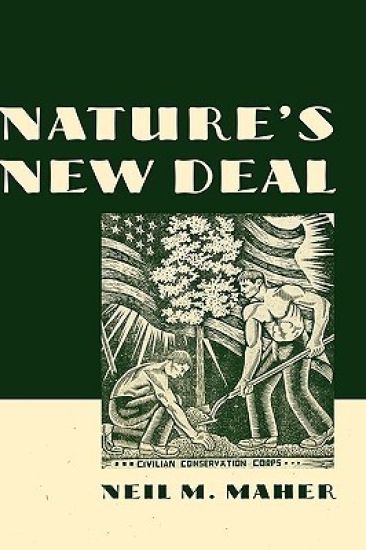
The Great Depression coincided with a wave of natural disasters, including the Dust Bowl and devastating floods of the Ohio and Mississippi rivers. Recovering from these calamities--and preventing their reoccurrence--was a major goal of the New Deal. In Nature's New Deal, Neil M. Maher examines the history of one of Franklin D. Roosevelt's boldest and most successful experiments, the Civilian Conservation Corps, describing it as a turning point both in national politics and in the emergence of modern environmentalism. Indeed, Roosevelt addressed both the economic and environmental crises by putting Americans to work at conserving natural resources, through the Soil Conservation Service, the Tennessee Valley Authority, and the Civilian Conservation Corps (or CCC). The CCC created public landscapes--natural terrain altered by federal work projects--that helped environmentalism blossom after World War II, Maher notes. Millions of Americans devoted themselves to a new vision of conservation, one that went beyond the old model of simply maximizing the efficient use of natural resources, to include the promotion of human health through outdoor recreation, wilderness preservation, and ecological balance. And yet, as Maher explores the rise and development of the CCC, he also shows how the critique of its campgrounds, picnic areas, hiking trails, and motor roads frames the debate over environmentalism to this day. From the colorful life at CCC camps, to political discussions in the White House and the philosophical debates dating back to John Muir and Frederick Law Olmsted, Nature's New Deal captures a key moment in the emergence of modern environmentalism.