

Kirjahaku
Etsi kirjoja tekijän nimen, kirjan nimen tai ISBN:n perusteella.
1000 tulosta hakusanalla Netta Syrett
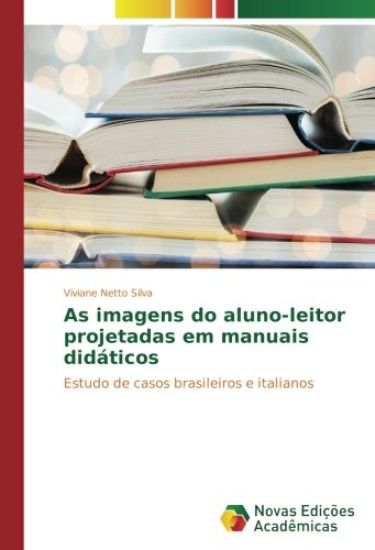
As imagens do aluno-leitor projetadas em manuais didáticos
Viviane Netto Silva
Novas Edições Acadêmicas
2017
nidottu







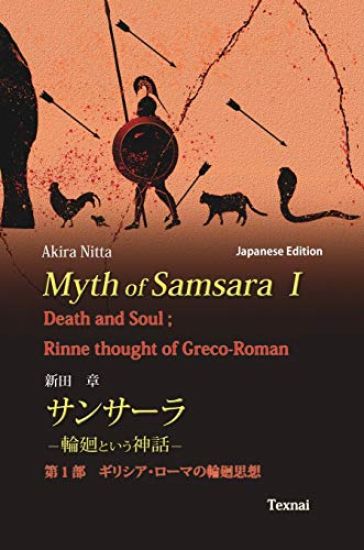
Myth of Samsara I (Japanese Edition): Death and Soul; Rinne thought of Greco-Roman
Akira Nitta
Texnai Inc.
2020
sidottu
When we face to unbearable sufferings such as death of immediate family, disease, war or natural disasters such as a big earthquake and tsunami, we often ask ourselves why the God or Buddha afflicts us so much. To this fundamental question, the Monotheism such as Judaism, Christianity, Islam have advocated the apocalyptic retribution referee theory and the Polytheism such as Hindu, Buddhism and Confucianism have advocated the Reincarnation theory. The author thinks here that those theories are both based on Retributive justice theory and asks if the Retributive justice theory might be a Fallacy because the reality of this world is often too brutal. Then the author tries to dismantle the Retributive justice theory in this series of books. However, the author also thinks that the Retributive justice theory is rooted in the structure of human existence, so dismounting of the Retributive justice theory means a denial of human itself. However, fortunately, there were a couple of peoples who got over the Retributive justice theory. The goal of this series of books is to pursue the things they tried to say to us. The volume I is on Death and Soul, and the Rinne thought of Greco-Roman.
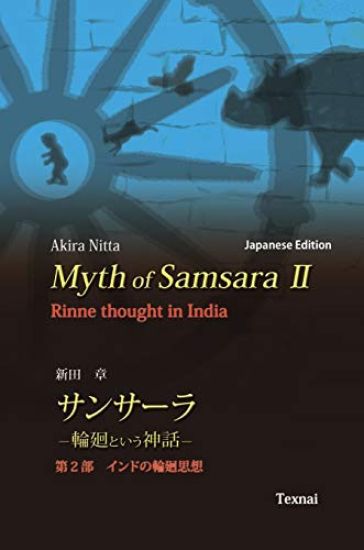
When we face to unbearable sufferings such as death of immediate family, disease, war or natural disasters such as a big earthquake and tsunami, we often ask ourselves why the God or Buddha afflicts us so much. To this fundamental question, the Monotheism such as Judaism, Christianity, Islam have advocated the apocalyptic retribution referee theory and the Polytheism such as Hindu, Buddhism and Confucianism have advocated the Reincarnation theory. The author thinks here that those theories are both based on Retributive justice theory and asks if the Retributive justice theory might be a Fallacy because the reality of this world is often too brutal. Then the author tries to dismantle the Retributive justice theory in this series of books. However, the author also thinks that the Retributive justice theory is rooted in the structure of human existence, so dismounting of the Retributive justice theory means a denial of human itself. However, fortunately, there were a couple of peoples who got over the Retributive justice theory. The goal of this series of books is to pursue the things they tried to say to us. The volume II is on the Rinne thought in India.
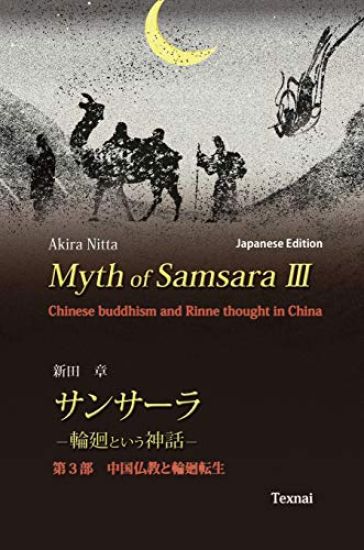
Myth of Samsara III (Japanese Edition): Chinese Buddhism and Rinne thought in China
Akira Nitta
Texnai Inc.
2020
sidottu
When we face to unbearable sufferings such as death of immediate family, disease, war or natural disasters such as a big earthquake and tsunami, we often ask ourselves why the God or Buddha afflicts us so much. To this fundamental question, the Monotheism such as Judaism, Christianity, Islam have advocated the apocalyptic retribution referee theory and the Polytheism such as Hindu, Buddhism and Confucianism have advocated the Reincarnation theory. The author thinks here that those theories are both based on Retributive justice theory and asks if the Retributive justice theory might be a Fallacy because the reality of this world is often too brutal. Then the author tries to dismantle the Retributive justice theory in this series of books. However, the author also thinks that the Retributive justice theory is rooted in the structure of human existence, so dismounting of the Retributive justice theory means a denial of human itself. However, fortunately, there were a couple of peoples who got over the Retributive justice theory. The goal of this series of books is to pursue the things they tried to say to us. The volume III is on Chinese Buddhism and the Rinne thought in China.
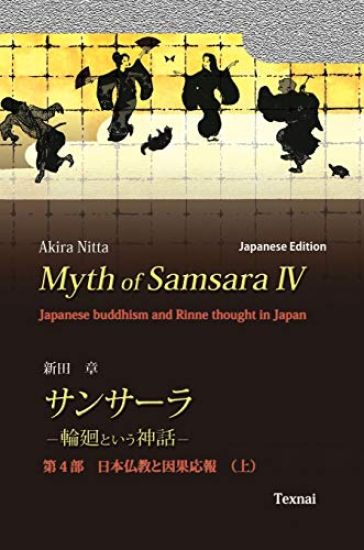
Myth of Samsara IV (Japanese Edition): Japanese Buddhism and Rinne thought in Japan
Akira Nitta
Texnai Inc.
2020
sidottu
In this book, we deal with the relationship between Japanese Buddhism and the theory of Karmic Retribution. This book consists of 2 chapters. In chapter 1 "Japanese gods and buddhas", we discuss the problem of so-called "syncretization of Shintoism with Buddhism". This syncretization doesn't mean, however, the unification of these two established religions, but the double process in which a foreign religion Buddhism, on the one hand, has developed into Japanese Buddhism in contact with an ancient Japanese faith in native gods and the gods-faith has also been, on the other hand, formed into Shintoism in contact with Buddhism. Consequently Japanese Buddhism was supposed to have a unique feature. In chapter 2 "Japanese Buddhism", we discuss this feature. We can summarize it in an idea that every living thing including humans has already realized itself by nature, in short, every living thing is born Buddha-natured. This idea is common to almost all the Japanese Buddhist sects. Many other ordinary Buddhists in the world, however, have firm faith of the traditional idea of karmic retribution. Our question is this: Are these two ideas compatible or not?
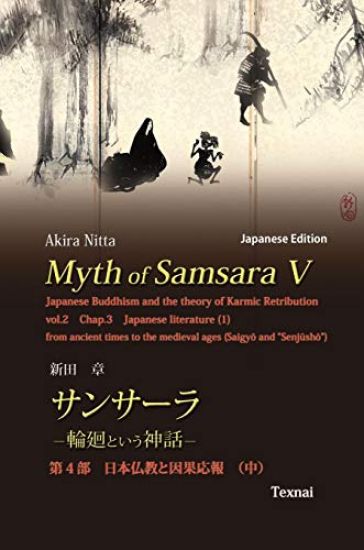
Myth of Samsara V (Japanese Edition): Japanese Buddhism and the theory of Karmic Retribution Vol.2
Akira Nitta
Texnai Inc.
2020
sidottu
In this chapter we discuss how the idea of Karmic Retribution deviated from its Indian or Chinese form in the Japanese literature from ancient times to the first half of the Middle ages. Buddhism's ultimate goal lay originally in everyone's becoming a Buddha (an awakened one) or in his attainment of the sublime state of Nirvana by overcoming Samsara or Karmic Retribution. However, the sort of Karmic Retribution expressed in "Buddhistic tales" in Japanese Ancient (Nara and Heian Period) had already been all-too-Japanese, that is "this world-centered". These tales didn't tell ordinary people that they should become Buddhas, but that they should wish to live comfortably both in this world and in the other world. Naturally, the true object of salvation here were only good people. This is called the theory of "Zennin Shohki". In the early Middle ages, however, Shinnran began to preach the theory of "Akunin Shohki" (evil people as the true object of salvation) . This isn't so much a special form of Karmic Retribution as the transcending of itself. Therefore, we can call it "causal simultaneity" or "the same time of cause and effect". This is one of the highest teachings attainded by Japanese Buddhism, and it is also characteristic of the literary works in the Middle ages, for example, Kamo-no-Chohmei's collection of Buddhistic tales "Hosshinshu" and his essay "Hohjoki", Saigyoh-Hohshi's collction of waka (31-syllable poems) and his quite unique waka-theory, a collection of Buddhistic tales "Senjuhsho" and Kenkoh-Hohshi's very popular essay "Tsurezuregusa" etc. Then, how was the Retribution-theory in diaries and fictional tales in Heian Period such as "Murasaki Shikibu Diary", "Sarashina Diary", "The Tale of the Bamboo Cutter", "The Tale of Genji" and especially "The Tale of Hamamatsu-Chuhnagon" ? A key word in understanding these works is "Sukuse" which means "fate that is determined from the previous life". Moreover, we find that "Mukoku" (which means "Revelation in a dream") and "Takusen" (which means "Revelation by a specter or a ghost or a soul") play a large role in these works. What kind of relationship do the words specific to the Heian literature have with the development of the Japanese Karmic Retribution-theory ? (to be continued)

Prostoj, posledovatelnyj, nagljadnyj i neobremenitelnyj put izuchenija fiziki! Shkolnitsa Otokha naveschaet v bolnitse svoego odnoklassnika Kouki i po ego prosbe prinosit emu knigi po fizike. Blagodarja ljuboznatelnomu Kouki ona uvlekaetsja zadachami, kotorye vykhodjat za ramki shkolnoj programmy. Vmeste druzja nakhodjat otvety na voprosy o tom, kakogo razmera dolzhno byt zerkalo po sravneniju s otrazhaemym obektom i kak sozdat iskusstvennuju radugu, obsuzhdajut prirodu voln, effekt rezonansa i effekt Doplera, interferentsiju i difraktsiju voln.Manga vkljuchaet laboratornye raboty, a takzhe dopolnitelnyj material, orientirovannyj na izuchenie bolee slozhnykh tem: printsip superpozitsii, reshenie volnovogo uravnenija, vyvedenie formuly skorosti zvuka.manga napisana dlja shkolnikov i studentov, interesujuschikhsja sovremennoj fizikoj.Perevodchik: Plekhanova S. L.Redaktor: Petrovicheva M. E.Khudozhnik: Fukamori Aki
Mapeamento da Educação Médica a Distância (EMaD) no Brasil
Cecília Neta Alves Pegado Gomes; Gustavo H. Araújo Freire
Novas Edições Acadêmicas
2019
nidottu


Biomasa residual agrícola en ZNI del Pacífico colombiano
Daniel Neuta; Fabián Valderrama
Editorial Academica Espanola
2020
pokkari
Los usos potenciales de la biomasa como fuente alternativa de energ a y sus posibles rutas tecnol gicas de aprovechamiento, exigen que se profundice en el conocimiento de los aspectos espec ficos relacionados con su oferta, composici n y potencial energ tico. Teniendo en cuenta las propiedades calor ficas de la biomasa, como lo indica La Secretaria de energ a de Argentina, en su documento Energ a Biomasa que: "el poder calor fico de la biomasa puede oscilar entre los 3000 - 3500 Kcal/ Kg (12552 - 14644 KJ/ Kg) para los residuos ligno - celul sicos (desechos de olote de ma z o de bagazo de ca a), 2000 - 2500 Kcal/Kg (8368 - 10460 KJ/ Kg) para los residuos urbanos y finalmente 10000 Kcal/Kg (41840 KJ/ Kg) para los combustibles l quidos provenientes de cultivos energ ticos", A partir de la informaci n recolectada es posible establecer la importancia del potencial energ tico para suplir la demanda de las regi n del pacifico colombiano, ya que es la regi n que cuenta con m s municipios o zonas que no tienen acceso al sistema interconectado el ctrico dentro de la geograf a colombiana. Seg n lo indicado en "El informe de operaci n del SIN y administraci n de mercado de 2017".
Kartierung der medizinischen Fernausbildung (DME) in Brasilien
Cecília Neta Alves Pegado Gomes; Gustavo H Araújo Freire
Verlag Unser Wissen
2023
pokkari
Mapping of Distance Medical Education (DME) in Brazil
Cecília Neta Alves Pegado Gomes; Gustavo H Araújo Freire
Our Knowledge Publishing
2023
pokkari