Kirjahaku
Etsi kirjoja tekijän nimen, kirjan nimen tai ISBN:n perusteella.
1000 tulosta hakusanalla Robert D. Lesslie
Updated after two decades, this new edition combines a father/son author team that spans more than 75 years in the petroleum industry. R. ""Dobie"" Langenkamp offers a fresh set of terms and phrases introduced to the industry over the past 20 years, and still includes many historical references from the early days of the industry.
A practical guide to anger management focuses on changing the underlying motivations and beliefs of the heart that drive angry behavior, offering Christ-centered ways to handle anger and see the fruit of thorough and lasting change. Original.
Robert Brown helps us see that a 'thermally comfortable microclimate' is the very foundation of well-designed and well-used outdoor places. Brown argues that as we try to minimise human-induced changes to the climate and reduce our dependence on fossil fuels - as some areas become warmer, some cooler, some wetter, and some drier, and all become more expensive to regulate - good microclimate design will become increasingly important. In the future, according to Brown, all designers will need to understand climatic issues and be able to respond to their challenges. Brown describes the effects that climate has on outdoor spaces - using vivid illustrations and examples - while providing practical tools that can be used in everyday design practice. The heart of the book is Brown's own design process, as he provides useful guidelines that lead designers clearly through the complexity of climate data, precedents, site assessment, microclimate modification, communication, design, and evaluation. Brown strikes an ideal balance of technical information, anecdotes, examples, and illustrations to keep the book engaging and accessible. His emphasis throughout is on creating microclimates that attend to the comfort, health, and well-being of people, animals, and plants. "Design with Microclimate" is a vital resource for students and practitioners of landscape architecture, architecture, planning, and urban design.
Videofluoroscopy: A Multidisciplinary Team Approach is a timely volume that helps to meet the growing need for multidisciplinary team knowledge of the videofluoroscopic swallowing study (VFSS). Clinicians increasingly rely on the objective examination of swallowing to create a baseline as part of the patient's diagnosis and treatment. Much of the current literature focuses on the speech and language therapist working alongside a radiologist. However, the radiologist is increasingly no longer involved in the investigation, highlighting the need to amplify the multidisciplinary team knowledge of the procedure. Increasing demand for new and established diagnostic and interventional procedures has encouraged innovative models of service delivery, resulting in an extended range of health professionals crossing the traditional practice boundaries. In particular, the radiographers who complete the examination, along with the speech and language therapists, need to learn more about the swallowing function. Likewise, it is essential that speech and language therapists increase their knowledge base on the radiographic aspects of the examination.Authored by numerous highly regarded scholars, Videofluoroscopy: A Multidisciplinary Team Approach serves as a crucial resource to help all members of the videofluoroscopy service team acquire the knowledge and skills they require. The book is divided into two parts: Part One provides an overview of swallowing and an introduction to the VFSS. Part Two covers various clinical indications for VFSS, including stroke, neuromuscular conditions, pediatric disorders, learning disabilities, dementia, and head and neck cancers.
Qoheleth
Robert D. Holmstedt; John A. Cook; Phillip S. Marshall
Baylor University Press
2017
nidottu
In this volume, Robert D. Holmstedt, John A. Cook, and Phillip S. Marshall provide a foundational analysis of the Hebrew text of Qoheleth. Distinguished by the detailed yet comprehensive attention paid to the Hebrew text, Qoheleth is a convenient pedagogical and reference tool that explains the form and syntax of the biblical text, offers guidance for deciding between competing semantic analyses, engages important text-critical debates, and addresses questions relating to the Hebrew text that are frequently overlooked or ignored by standard commentaries. Beyond serving as a succinct and accessible analytic key, Qoheleth also reflects the most recent advances in scholarship on Hebrew grammar and linguistics. By filling the gap between popular and technical commentaries, the handbook becomes an indispensable tool for anyone committed to a deep reading of the biblical text.
Cognitive Therapy Techniques for Children and Adolescents
Robert D. Friedberg; Jessica M. McClure; Jolene Hillwig Garcia
Guilford Publications
2009
sidottu
Providing a wealth of practical interventions and activities--all organized within a state-of-the-art modular framework--this invaluable book helps child clinicians expand their cognitive-behavioral therapy (CBT) toolkits. Going beyond the basics, the authors provide effective ways to engage hard-to-reach clients, address challenging problems, and target particular cognitive and behavioral skills. Fun and productive games, crafts, and other activities are described in step-by-step detail. More than 30 reproducible forms and handouts can be downloaded and printed in a convenient 8 1/2" x 11" size. See also the authors' authoritative introduction to CBT with young patients, Clinical Practice of Cognitive Therapy with Children and Adolescents, Second Edition: The Nuts and Bolts.
Analisis Tecnico de Las Tendencias de Acciones / Technical Analysis of Stock Trends (Spanish Edition)
Robert D Edwards; John Magee
www.bnpublishing.com
2010
pokkari
Technical Analysis of Stock Trends
Robert D Edwards; John Magee
WWW.Snowballpublishing.com
2009
pokkari
Writing was the central passion of Emerson’s life. While his thoughts on the craft are well developed in “The Poet,” “The American Scholar,” Nature, “Goethe,” and “Persian Poetry,” less well known are the many pages in his private journals devoted to the relationship between writing and reading. Here, for the first time, is the Concord Sage’s energetic, exuberant, and unconventional advice on the idea of writing, focused and distilled by the preeminent Emerson biographer at work today.Emerson advised that “the way to write is to throw your body at the mark when your arrows are spent.” First We Read, Then We Write contains numerous such surprises—from “every word we speak is million-faced” to “talent alone cannot make a writer”—but it is no mere collection of aphorisms and exhortations. Instead, in Robert Richardson’s hands, the biographical and historical context in which Emerson worked becomes clear. Emerson’s advice grew from his personal experience; in practically every moment of his adult life he was either preparing to write, trying to write, or writing. Richardson shows us an Emerson who is no granite bust but instead is a fully fleshed, creative person disarmingly willing to confront his own failures. Emerson urges his readers to try anything—strategies, tricks, makeshifts—speaking not only of the nuts and bolts of writing but also of the grain and sinew of his determination. Whether a writer by trade or a novice, every reader will find something to treasure in this volume. Fearlessly wrestling with “the birthing stage of art,” Emerson’s counsel on being a reader and writer will be read and reread for years to come.
“The Tao produced the One; The One produced the Two; The Two produced the Three; The Three produced the Ten Thousand Things.” Lao Tzu, 42nd Verse of the Tao Te ChingIf you had the knowledge and tools to make serious and lasting changes in your life, would you do it? If you had the chance to start over, change everything you needed to change in order to live the visions of your dreams, would you? Is it going to take a near death experience to motivate you into making the necessary changes in your life, or will you accept the challenges contained here and master your own personal expansion?The world is going through great transformation and human beings all over the globe are realizing that they are living in a time of incredible human potential and growth. Now is your time, right now, to be a valuable part of this movement."Expansion Mastery" offers you a chance at creating the life you know in your heart you were meant to experience. A life of real happiness, a sense of living “Heaven on Earth” by understanding your position between Heaven and Earth. The essence of this ancient spiritual concept of “Heaven, Earth and Being” is presented to you with clarity to achieve ultimate expansion.Can you rise up and actually participate in your life? Can you change your attitude from “just getting through another day” to fully engage your life with enthusiasm, purpose and presence? It’s no longer a question of can you---it’s a question of will you!
Understanding Statistics As A Language
Robert D. Andrews; Larry A. Standridge
Hope House Press
2010
nidottu
Written in Persian in the eleventh century, Omar Khayyam's quatrains, known as "rubai," were written individually for an audience at court, and explored the meanings of life, love, and friendship. They were almost completely unknown in the West until Edward FitzGerald--himself a relatively obscure critic--translated and organized some one hundred of them into a unified whole that he called "The Rubaiyat of Omar Khayyam," which he published anonymously in 1859. Ignored initially, it soon became a sensation--and FitzGerald with it, his work now translated into seventy languages--and one of the most-read works of literature of all time.Deftly and eloquently recounting in turn the life stories of Khayyam and FitzGerald, linking them over the span of eight centuries, acclaimed biographer Robert Richardson has crafted the story of the legendary "Rubaiyat" itself, illuminating a literary classic and reinforcing its place in the canon of great world literature.
Houston Cougars in the 1960s
Robert D Jacobus; Wade Phillips; James Kirby Martin
Texas A M University Press
2015
sidottu
On January 20, 1968, the University of Houston Cougars upset the UCLA Bruins, ending a 47-game winning streak. Billed as the “Game of the Century,” the defeat of the UCLA hoopsters was witnessed by 52,693 fans and a national television audience—the first-ever regular-season game broadcast nationally.But the game would never have happened if Houston coach Guy Lewis had not recruited two young black men from Louisiana in 1964: Don Chaney and Elvin Hayes. Despite facing hostility both at home and on the road, Chaney and Hayes led the Cougars basketball team to 32 straight victories.Similarly in Cougar football, coach Bill Yeoman recruited Warren McVea in 1964, and by 1967 McVea had helped the Houston gridiron program lead the nation in total offense.Houston Cougars in the 1960s features the first-person accounts of the players, the coaches, and others involved in the integration of collegiate athletics in Houston, telling the gripping story of the visionary coaches, the courageous athletes, and the committed supporters who blazed a trail not only for athletic success but also for racial equality in 1960s Houston.
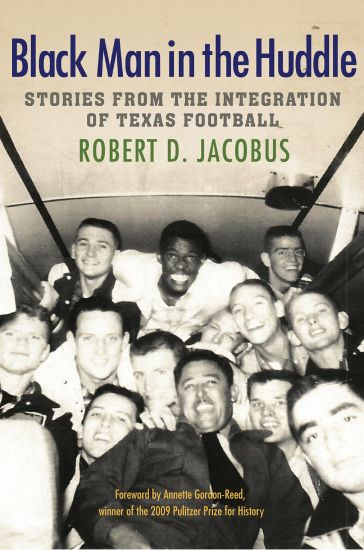
Black Man in the Huddle
Robert D. Jacobus; Annette Gordon-Reed
Texas A M University Press
2019
sidottu
What was it like for young black men growing up in a totally segregated environment and transitioning to an integrated one?" asks author Robert Jacobus in the preface to this collection of interviews. How did they get involved in sports? How did the facilities, both academic and athletic, compare to the white schools? What colleges recruited them out of high school? Searching for the answers to these and other questions, Jacobus interviewed some 250 former players, former coaches, and others who were personally involved in the racial integration of Texas public school and college athletic programs. Starting with Ben Kelly, the first African American to play for a college team in the former Confederacy when he walked on at then San Angelo College, and continuing with great players such as Jerry Levias, Ken Houston, Mel Renfro, Bubba Smith, and more, the players tell their stories in their own words. Each story is as varied as the players themselves. Some strongly uphold the necessity of integration for progress in society. Others, while understanding the need for integration, nevertheless mourn the passing of their segregated schools, remembering fondly the close-knit communities forged by the difficulties faced by both students and teachers. Interlaced with historical context and abundantly illustrated, the first-person accounts presented in Black Man in the Huddle form an important and lasting record of the thoughts, struggles, successes, and experiences of young men on the front lines of desegregation in Texas schools and athletic programs. By capturing these stories, Jacobus widens our perspective on the interactions between sport and American society during the momentous 1950s, '60s, and '70s.