Kirjojen hintavertailu. Mukana 11 425 274 kirjaa ja 12 kauppaa.

Kirjahaku

Etsi kirjoja tekijän nimen, kirjan nimen tai ISBN:n perusteella.

1000 tulosta hakusanalla STEWART

There and Back

There and Back

Stewart Gordon

Oxford University Press
2018
sidottu
Throughout human history, routes concentrated, funnelled, and mixed human experience. On them moved books, scrolls, and art, in addition to armies, ambassadorial entourages, slaves, brides, and pilgrims. The interaction of people on routes generated surprising innovations in ideas, religions, art, technology, and cuisine. Common themes appear repeatedly, such as slavery, piracy, government taxation and control, medicinal plants, military expeditions, the interaction of competing religions, processing of goods along the way, and networks of credit, trust, and information that often spanned continents. This book is divided into four seconds, each concentrating on a type of route: river, pilgrimage, tribute, and trade. The arrangement is based on cognitive geography, rather than technological or physical similarities. For instance, the Rhine is not a river route because there is water flowing between two banks, but because of the songs and fairy tales about it and its long history as a political boundary. Pilgrimage routes are grounded in shared expectations and experiences, just as routes of imperial tribute rest primarily on the expectations of local officials, transporters, and military guards. Trade routes foreground the expectations of professional traders. Each route is 'travelled' through the memoir of a real traveller, pulling away to address larger issues, but never losing the engagement of the human story. The geographic reach is worldwide with chapters, for example, on the Grand Canal of China and the Inca road system; they also have considerable historical depth, from the ancient Nile to the Erie Canal and the modern Hajj.
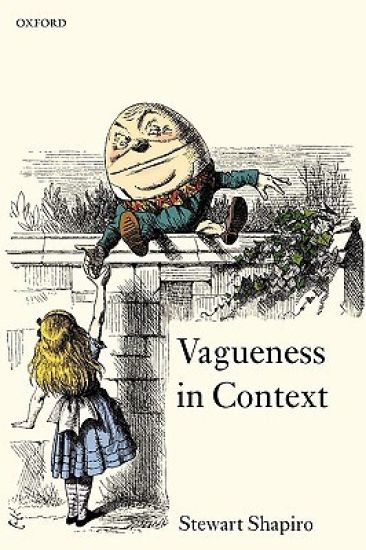
Vagueness in Context

Vagueness in Context

Stewart Shapiro

Oxford University Press
2008
nidottu
Stewart Shapiro's aim in Vagueness in Context is to develop both a philosophical and a formal, model-theoretic account of the meaning, function, and logic of vague terms in an idealized version of a natural language like English. It is a commonplace that the extensions of vague terms vary with such contextual factors as the comparison class and paradigm cases. A person can be tall with respect to male accountants and not tall (even short) with respect to professional basketball players. The main feature of Shapiro's account is that the extensions (and anti-extensions) of vague terms also vary in the course of a conversation, even after the external contextual features, such as the comparison class, are fixed. A central thesis is that in some cases, a competent speaker of the language can go either way in the borderline area of a vague predicate without sinning against the meaning of the words and the non-linguistic facts. Shapiro calls this open texture, borrowing the term from Friedrich Waismann. The formal model theory has a similar structure to the supervaluationist approach, employing the notion of a sharpening of a base interpretation. In line with the philosophical account, however, the notion of super-truth does not play a central role in the development of validity. The ultimate goal of the technical aspects of the work is to delimit a plausible notion of logical consequence, and to explore what happens with the sorites paradox. Later chapters deal with what passes for higher-order vagueness - vagueness in the notions of 'determinacy' and 'borderline' - and with vague singular terms, or objects. In each case, the philosophical picture is developed by extending and modifying the original account. This is followed with modifications to the model theory and the central meta-theorems. As Shapiro sees it, vagueness is a linguistic phenomenon, due to the kinds of languages that humans speak. But vagueness is also due to the world we find ourselves in, as we try to communicate features of it to each other. Vagueness is also due to the kinds of beings we are. There is no need to blame the phenomenon on any one of those aspects.
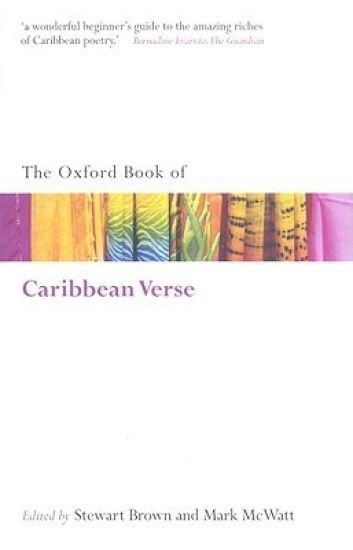
The Oxford Book of Caribbean Verse

The Oxford Book of Caribbean Verse

Stewart Brown; Mark McWatt

Oxford University Press
2009
nidottu
The Caribbean has produced one of the most vigorous and exciting bodies of poetry of the last one hundred year. The Oxford Book of Caribbean Verse is the only contemporary anthology to present the best of the English-language poetry of the region alongside selections from the poetry of both the French and Spanish Caribbean. Featuring a range of established poets from Derek Walcott to Jesus Cos Causse, Olive Senior to Aimé Césaire, as well as exciting new voices, this is a rich and challenging book.
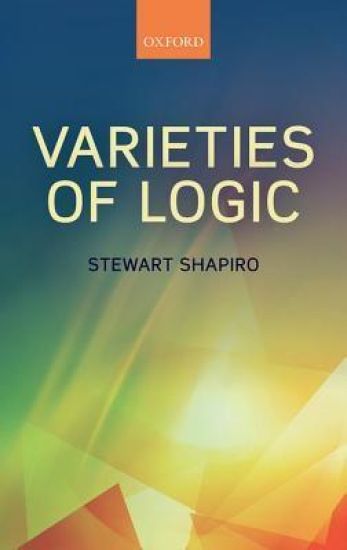
Varieties of Logic

Varieties of Logic

Stewart Shapiro

Oxford University Press
2014
sidottu
Logical pluralism is the view that different logics are equally appropriate, or equally correct. Logical relativism is a pluralism according to which validity and logical consequence are relative to something. In Varieties of Logic, Stewart Shapiro develops several ways in which one can be a pluralist or relativist about logic. One of these is an extended argument that words and phrases like 'valid' and 'logical consequence' are polysemous or, perhaps better, are cluster concepts. The notions can be sharpened in various ways. This explains away the 'debates' in the literature between inferentialists and advocates of a truth-conditional, model-theoretic approach, and between those who advocate higher-order logic and those who insist that logic is first-order. A significant kind of pluralism flows from an orientation toward mathematics that emerged toward the end of the nineteenth century, and continues to dominate the field today. The theme is that consistency is the only legitimate criterion for a theory. Logical pluralism arises when one considers a number of interesting and important mathematical theories that invoke a non-classical logic, and are rendered inconsistent, and trivial, if classical logic is imposed. So validity is relative to a theory or structure. The perspective raises a host of important questions about meaning. The most significant of these concern the semantic content of logical terminology, words like 'or', 'not', and 'for all', as they occur in rigorous mathematical deduction. Does the intuitionistic 'not', for example, have the same meaning as its classical counterpart? Shapiro examines the major arguments on the issue, on both sides, and finds them all wanting. He then articulates and defends a thesis that the question of meaning-shift is itself context-sensitive and, indeed, interest-relative. He relates the issue to some prominent considerations concerning open texture, vagueness, and verbal disputes. Logic is ubiquitous. Whenever there is deductive reasoning, there is logic. So there are questions about logical pluralism that are analogous to standard questions about global relativism. The most pressing of these concerns foundational studies, wherein one compares theories, sometimes with different logics, and where one figures out what follows from what in a given logic. Shapiro shows that the issues are not problematic, and that is usually easy to keep track of the logic being used and the one mentioned.
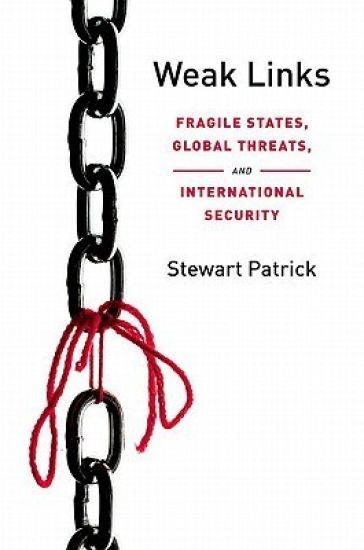
Weak Links

Weak Links

Stewart Patrick

Oxford University Press Inc
2011
sidottu
Conventional wisdom holds that weak and failing states are the source of the world's most pressing security threats. After all, the 9/11 attacks originated in an impoverished, war-ravaged country, and transnational crime appears to flourish in weakly governed states. However, our assumptions about the threats posed by failing states are based on anecdotal arguments, not on a systematic analysis of the connections between state failure and transnational security threats. Analyzing terrorism, transnational crime, WMDs, pandemic diseases, and energy insecurity, Stewart Patrick shows that while some global threats do emerge in fragile states, most of their weaknesses create misery only for their own citizenry. Moreover, many threats originate farther up the chain, in wealthier and more stable countries like Russia and Venezuela. Weak Links will force policymakers to rethink what they assume about state failure and transnational insecurity.
Weak Links

Weak Links

Stewart Patrick

Oxford University Press Inc
2011
nidottu
Conventional wisdom holds that weak and failing states are the source of the world's most pressing security threats. After all, the 9/11 attacks originated in an impoverished, war-ravaged country, and transnational crime appears to flourish in weakly governed states. However, our assumptions about the threats posed by failing states are based on anecdotal arguments, not on a systematic analysis of the connections between state failure and transnational security threats. Analyzing terrorism, transnational crime, WMDs, pandemic diseases, and energy insecurity, Stewart Patrick shows that while some global threats do emerge in fragile states, most of their weaknesses create misery only for their own citizenry. Moreover, many threats originate farther up the chain, in wealthier and more stable countries like Russia and Venezuela. Weak Links will force policymakers to rethink what they assume about state failure and transnational insecurity.
Planning Your Piano Success

Planning Your Piano Success

Stewart Gordon

Oxford University Press Inc
2014
sidottu
Young pianists pursuing a professional career face a barrage of questions, choices, and challenges. In this book, experienced teacher and performer Stewart Gordon offers a new and practical way to approach them by helping readers to plan strategically and build a secure and successful career from the ground up. For decades, Gordon has guided young pianists through the details of how to prepare musically, navigate their college years, and forge a career that will provide a livelihood. In this guide to beginning that musical career, Gordon has assembled the wisdom of decades of teaching: a fundamental body of information emerging pianists will rely on as they work toward their goals. His advice, focused on both mental and practical work, will enhance both motivation and security. Carefully balancing aspiration with reality and inspiration with organization, Gordon creates a blueprint for transforming dreams into achievement, and illustrates his points with examples drawn from the lives of famous musicians. The book also addresses many practical matters, such as developing keyboard technique, acquiring reading and memorizing skills, building repertoire, and balancing the demands of being a musician with living a full life. This volume is a valuable resource for both young pianists and their parents.
Planning Your Piano Success

Planning Your Piano Success

Stewart Gordon

Oxford University Press Inc
2014
nidottu
Young pianists pursuing a professional career face a barrage of questions, choices, and challenges. In this book, experienced teacher and performer Stewart Gordon offers a new and practical way to approach them by helping readers to plan strategically and build a secure and successful career from the ground up. For decades, Gordon has guided young pianists through the details of how to prepare musically, navigate their college years, and forge a career that will provide a livelihood. In this guide to beginning that musical career, Gordon has assembled the wisdom of decades of teaching: a fundamental body of information emerging pianists will rely on as they work toward their goals. His advice, focused on both mental and practical work, will enhance both motivation and security. Carefully balancing aspiration with reality and inspiration with organization, Gordon creates a blueprint for transforming dreams into achievement, and illustrates his points with examples drawn from the lives of famous musicians. The book also addresses many practical matters, such as developing keyboard technique, acquiring reading and memorizing skills, building repertoire, and balancing the demands of being a musician with living a full life. This volume is a valuable resource for both young pianists and their parents.
Exploration

Exploration

Stewart A. Weaver

Oxford University Press Inc
2015
nidottu
For as long as there have been civilizations, there has been the urge to venture outside of them, either in search of other civilizations or in search of novelty. Exploration: A Very Short Introduction surveys this quintessential human impulse, tracing it from pre-history to the present, from east to west around the globe, and from the depths of volcanoes to the expanses of space. Stewart Weaver arranges the history of world explorations into thematic chapters, each of which isolates the distinctive qualities and characteristics of exploration in a particular era, period, or place. He introduces the reader to the definition of exploration; to the Polynesians crossing vast seas on their canoes and other early explorers; through Columbus and the European discovery of the Americas. James Cook and the place of exploration in the Enlightenment form the subject of a chapter. So too do the natural histories and explorations of Alexander von Humboldt in South America and Lewis and Clark in North America. The book's final chapters chart exploration through imperial expansion and into new frontiers, guiding the reader through exploration in Africa and Central Asia, the race to the North and South Poles, and today's efforts in space and deep sea exploration. But what accounts for this urge? Through this unique survey of the history of exploration, Weaver clearly shows how the impulse to explore is also the foundation of the globalized world we inhabit today. Exploration combines a narration of explorers' daring feats with a wide-lens examination of what it fundamentally means to explore. As Weaver shows us, the act of exploration in the largest possible global context is the natural history of the earth itself. ABOUT THE SERIES: The Very Short Introductions series from Oxford University Press contains hundreds of titles in almost every subject area. These pocket-sized books are the perfect way to get ahead in a new subject quickly. Our expert authors combine facts, analysis, perspective, new ideas, and enthusiasm to make interesting and challenging topics highly readable.
Friends of the Unrighteous Mammon

Friends of the Unrighteous Mammon

Stewart Davenport

University of Chicago Press
2008
sidottu
What did Protestants in America think about capitalism when capitalism was first something to be thought about? The Bible told antebellum Christians that they could not serve both God and mammon, but in the midst of the market revolution most of them simultaneously held on to their faith while working furiously to make a place for themselves in a changing economic landscape. In "Friends of the Unrighteous Mammon", Stewart Davenport explores this paradoxical partnership of transcendent religious values and earthly, pragmatic objectives, ultimately concluding that religious and ethical commitments, rather than political or social forces, shaped responses to market capitalism in the northern states in the antebellum period.Drawing on diverse primary sources, Davenport identifies three distinct Christian responses to market capitalism: assurance from clerical economists who believed in the righteousness of economic development; opposition from contrarians who resisted the changes around them; and adaptation by the pastoral moralists who modified their faith to meet the ethical challenges of the changing economy. Delving into the minds of antebellum Christians as they considered themselves, their God, and their developing American economy, "Friends of the Unrighteous Mammon" is an ambitious intellectual history of an important development in American religious and economic life.
Rhetorical Memory

Rhetorical Memory

Stewart Whittemore

University of Chicago Press
2015
sidottu
Institutions have regimes-policies that typically come from the top down and are meant to align the efforts of workers with the goals and mission of an institution. Institutions also have practices-day-to-day behaviors performed by individual workers attempting to interpret the institution's missives. Taken as a whole, these form a company's memory regime, and they have a significant effect on how employees analyze, mix, translate, sort, filter, and repurpose everyday information in order to meet the demands of their jobs, their customers, their colleagues, and themselves. In Rhetorical Memory, Stewart Whittemore demonstrates that strategies we use to manage information-techniques often acquired through trial and error, rarely studied, and generally invisible to us-are as important to our success as the end products of our work. First, he situates information management within the larger field of rhetoric, showing that both are tied to purpose, audience, and situation. He then dives into an engaging and tightly focused workplace study, presenting three cases from a team of technical communicators making use of organizational memory during their everyday work. By examining which techniques succeed and which fail, Whittemore illuminates the challenges faced by technical communicators. He concludes with a number of practical strategies to better organize information, that will help employees, managers, and anyone else suffering from information overload.
Digital Creature Rigging

Digital Creature Rigging

Stewart Jones

Focal Press
2012
nidottu
Get an inside look at the creation of production-ready creature rigs for film, TV and video games. Garner strategies and techniques for creating creatures of all types, and make them ready for easy automatic use in many different types of media (transmedia): film, TV, games - one rig for all. You will move step by step from idea, to concept, and finally to completion through a proven production-pipeline. "Digital Creature Rigging" gives you the practical, hands-on approaches to rigging you need, with a theoretical look at 12 rigging principles, and plenty of tips, tricks and techniques to get you up and running quickly. This is the definitive guide to creating believe production-ready creature rigs with 3ds Max.The companion web site has all scene files, scripts, tutorials from the book.
Crusade

Crusade

Stewart Binns

Penguin Books Ltd
2012
pokkari
1072 - England is firmly under the heel of its new Norman rulers. The few survivors of the English resistance look to Edgar the Atheling, the rightful heir to the English throne, to overthrow William the Conqueror. Years of intrigue and vicious civil war follow: brother against brother, family against family, friend against friend.In the face of chaos and death, Edgar and his allies form a secret brotherhood, pledging to fight for justice and freedom wherever they are denied. But soon they are called to fight for an even greater cause: the plight of the Holy Land. Embarking on the epic First Crusade to recapture Jerusalem, together they will participate in some of the cruellest battles the world has ever known, the savage Siege of Antioch and the brutal Fall of Jerusalem, and together they will fight to the death.
That Hamlet on the Hill: Remembering a Former Life in Somerset
Stratton-on-the-Fosse, as the name suggests, is built on the old Roman Fosse Road running through the Mendip Hills. The beautiful city of Bath is 19kms to the North, with Shepton Mallet 10kms to the South, Frome 17kms to the East, and Wells, which is the smallest city in England, 16kms to its West.The author has not lived there for over 45 years, but through photographs, anecdotes and personal recollections has attempted to document what life was like in the 1950 s to the 1970 s, not only in the village, but in the Midsomer Norton/Radstock areas, and farther afield. The famous Downside School and Abbey, St Vigors, St Benedicts and Somervale Schools, Clarks Shoe Factory, local sportspersons and personalities, and the Somerset and Dorset Railway are some of the topics detailed and fondly remembered.
The Bunuel Martini and Other Poems

The Bunuel Martini and Other Poems

Stewart Bartlam

Lulu.com
2018
pokkari
A first collection of poems by Stewart Bartlam, revealing his quirky take on the world, familiar to followers of his http: //stewartstanzas.wordpress.com poetry blog. Here are poems on a wide range of subjects, including the delights and dangers of alcohol, second-hand bookshops, tobacconists, Chopin, seagulls, cathedrals, and noisy neighbours. These are poems that are, at times, humorous, nostalgic, philosophical, emotional. Forty-eight glimpses of life, seen through the eyes of the poet.
A Festival of Violence

A Festival of Violence

Stewart E Tolnay; E M Beck

University of Illinois Press
1995
nidottu
This finely detailed statistical study of lynching in ten southern states shows that economic and status concerns were at the heart of that violent practice. Stewart Tolnay and E. M. Beck empirically test competing explanations of the causes of lynching, using U.S. Census and historical voting data and a newly constructed inventory of southern lynch victims. Among their surprising findings: lynching responded to fluctuations in the price of cotton, decreasing in frequency when prices rose and increasing when they fell.
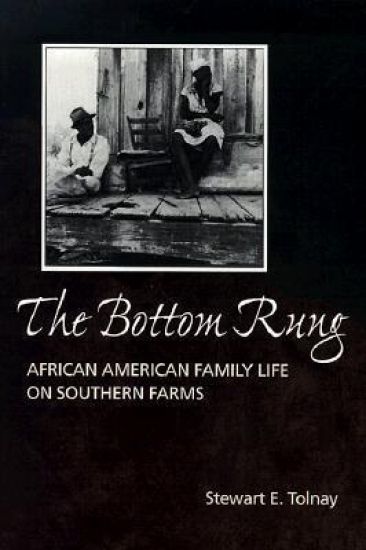
The Bottom Rung

The Bottom Rung

Stewart E. Tolnay

University of Illinois Press
1998
nidottu
The Bottom Rung presents an in-depth investigation of a population that is becoming extinct in American society: the black farmer. Tracing patterns of marriage and childbearing among both whites and blacks during the first decades of this century, Stewart Tolnay pursues questions about how black southern farm families were formed and dissolved, how they educated their children or put them to work in the fields, and how they migrated in search of opportunity. Further, he considers the possible legacy of these experiences for family life in contemporary urban environments. Making revealing and innovative use of public records from the early part of the twentieth century, Tolnay challenges the widely held idea that southern migrants to northern cities carried with them a dysfunctional family culture. He demonstrates the powerful impact of economic conditions on family life and views patterns of marriage and childbearing as responsive to prevailing social, economic, and political conditions. In a provocative extension of this perspective, Tolnay argues that current high levels of single-parenthood among urban African American families likewise reflect rational responses to the socio-economic environment and government policies. By placing post-World War II demographic developments in a wider historical perspective, The Bottom Rung sheds new light on recent discussions of the difficulties faced by the modern black urban family. The text is enhanced by Dorothea Lange's and Russell Lee's poignant photographs.
Durable Goods

Durable Goods

Stewart W. Herman

University of Notre Dame Press
1998
nidottu
Perhaps no other aspect of business ethics is today more germane to Christian belief and practice than the quality of relationship between management and employees. Here the raw forces of the global market and the more subtle currents of power relations within corporations have tangible impacts upon millions of lives. How can managers and employees work together toward an atmosphere of mutual trust and fairness? For people of faith, what does it mean to covenant under conditions of recurrent labor conflict? What moral claims are evident in the long struggle by management to run their enterprises as they see fit, as opposed by the efforts of employees to achieve a collective voice through unions? By melding the biblical account of covenant with a social-scientific understanding of organizations, Stewart W. Herman presents a groundbreaking theory. Herman examines the strategies and tactics which management and employees have used to control each other. He explores the deep historical roots and complexities of the management-employee relationship in the US, taking into account the initiatives and responses of both sides during the past two hundred years. As this narrative unfolds, the rudiments of a covenant become evident, not in a steady evolution, but in a turbulent intertwining of achievement with failure. The author tracks the development of two enduring goods which have emerged tentatively in this history: the enlarged freedom both management and employees have gained by seeking cooperation from each other, and the respect they have internalized for the moral principles central to the action of each other. Genuine cooperation requires that the moral claims of both sides must receive impartial consideration. To achieve such fairness, this book sets aside both the easy optimism of managerial ideology and the pessimism of disillusioned employees and takes an unsparing look at labor-management history in light of the long covenanting experience narrated in the Bible. In both histories, genuine cooperation emerges from a passionate dialectic between ideal possibilities and realistic human limitations. This shared struggle engages the will and spirit-and the creativity and insight-of both managers and employees. In Durable Goods, the disciplines of biblical theology, organization theory and labor history cross-fertilize to produce a rich harvest of insight about the nature and costs of genuine cooperation between management and employees. Those who teach in the fields of business and Christian ethics as well as business and labor leaders will find here a lucid guide for discerning the possibilities and limits upon covenantal cooperation in the employment relation.