
Kirjahaku
Etsi kirjoja tekijän nimen, kirjan nimen tai ISBN:n perusteella.
1000 tulosta hakusanalla Theodore Besterman
This book, "The Life And Poems Of Theodore Winthrop", by Laura Winthrop Johnson, is a replication of a book originally published before 1884. It has been restored by human beings, page by page, so that you may enjoy it in a form as close to the original as possible. This book was created using print-on-demand technology. Thank you for supporting classic literature.
The Mesopotamian School & Theodore of Mopsuestia
Fr. Andrew Younan
Diocese of St. Peter the Apostle for Chaldeans Assyrians
2009
pokkari
Two theses are presented in this book. First, that there is an overarching "School of Thought" in Mesopotamia, consistent in its basic tenets, from ancient times to the late middle ages, and that this "Mesopotamian School" is fundamentally realistic as opposed to idealistic. Second, that the Christology of Theodore of Mopsuestia, as read as an expression of this School, is orthodox by the Chalcedonian standard. Included in the Appendices are complete translations of Mar Narsai's 16th and 35th Metrical Sermons, on human nature and the Trinity, respectively, as well as of his "Dialogue Between the Watcher & Mary."
A poet's tradition provides him with a sense of community that may be regarded as a necessary condition for poetry. Jenijoy La Belle, who studied with Roethke, here describes the cultural tradition that he defined and created for himself. In so doing, she demonstrates how an understanding of Roethke's sources and the influences on his work is essential for its interpretation. The author considers the sources of Roethke's poetry and the influence on him of a wide circle of poets including T. S. Eliot, Yeats, Whitman, Wordsworth, Smart, Donne, Sir John Davies, and Dante. In addition, she traces the changes in Roethke's response to his literary past as he moves from his early lyrics to his final sequences. His imitation of selected poets began as a conscious effort but later became a basic component of his imaginative faculties, encompassing an historical attitude and a psychological state. Originally published in 1976. The Princeton Legacy Library uses the latest print-on-demand technology to again make available previously out-of-print books from the distinguished backlist of Princeton University Press. These editions preserve the original texts of these important books while presenting them in durable paperback and hardcover editions. The goal of the Princeton Legacy Library is to vastly increase access to the rich scholarly heritage found in the thousands of books published by Princeton University Press since its founding in 1905.
A poet's tradition provides him with a sense of community that may be regarded as a necessary condition for poetry. Jenijoy La Belle, who studied with Roethke, here describes the cultural tradition that he defined and created for himself. In so doing, she demonstrates how an understanding of Roethke's sources and the influences on his work is essential for its interpretation. The author considers the sources of Roethke's poetry and the influence on him of a wide circle of poets including T. S. Eliot, Yeats, Whitman, Wordsworth, Smart, Donne, Sir John Davies, and Dante. In addition, she traces the changes in Roethke's response to his literary past as he moves from his early lyrics to his final sequences. His imitation of selected poets began as a conscious effort but later became a basic component of his imaginative faculties, encompassing an historical attitude and a psychological state. Originally published in 1976. The Princeton Legacy Library uses the latest print-on-demand technology to again make available previously out-of-print books from the distinguished backlist of Princeton University Press. These editions preserve the original texts of these important books while presenting them in durable paperback and hardcover editions. The goal of the Princeton Legacy Library is to vastly increase access to the rich scholarly heritage found in the thousands of books published by Princeton University Press since its founding in 1905.
First published in 1991, The Presidency of Theodore Roosevelt has won acclaim as a lucid and thorough narrative of Roosevelt's two terms in the White House. Reviewers praised the depth of Lewis L. Gould's research, his comprehensive coverage of major aspects of Roosevelt's tenure, and the persuasiveness of his conclusions about his subject's personalized presidency. Writing in Reviews in American History, Willard Gatewood called the book essential reading for all who wish to understand the complex, charismatic, and perennially fascinating political figure that was Theodore Roosevelt. Long considered the standard work on its subject, Gould's book is a trusted source that newcomers to Roosevelt's years in the White House and experts in the field could consult with confidence in its research and historical judgments. It has also become an essential adoption for courses on the era, effectively engaging undergraduates and graduate students who have praised the author for his clarity and evenhandedness. Responding to frequent suggestions that the book be brought up-to-date to incorporate the excellent studies of Roosevelt's presidency that have appeared since 1991, Gould has provided a new edition that he believes will reintroduce a new generation of readers to the fun and importance of an ebullient, lively chief executive. In this revised and expanded edition, Gould has built on the sterling qualities of the first edition and added new information and analysis based on continuing research and a command of the literature on Theodore Roosevelt's presidency published during the last two decades. He has tightened the prose and added numerous references to the latest scholarship on this most engaging of presidents. Interested readers will find new discussions of the origins of Roosevelt's creation of the Tongass Forest in Alaska, his treatment of a dissenting federal employee named Rebecca Taylor who took her grievance to the Supreme Court, the recent controversy over Roosevelt's relationship with Japan, the dispute over whether the president issued a warning to Germany about Venezuela in 1902-1903, and the important role of a little-known conservative senator named Winthrop Murray Crane. With these and other changes, the updated version of Gould's text provides an even more compelling narrative that broadens the already fascinating story of Roosevelt in power with new insights and perceptive conclusions.
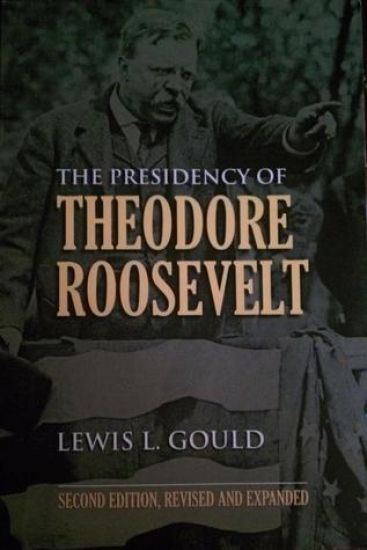
First published in 1991, The Presidency of Theodore Roosevelt has won acclaim as a lucid and thorough narrative of Roosevelt's two terms in the White House. Reviewers praised the depth of Lewis L. Gould's research, his comprehensive coverage of major aspects of Roosevelt's tenure, and the persuasiveness of his conclusions about his subject's personalized presidency. Writing in Reviews in American History, Willard Gatewood called the book "essential reading for all who wish to understand the complex, charismatic, and perennially fascinating political figure that was Theodore Roosevelt."Long considered the standard work on its subject, Gould's book is a trusted source that newcomers to Roosevelt's years in the White House and experts in the field could consult with confidence in its research and historical judgments. It has also become an essential adoption for courses on the era, effectively engaging undergraduates and graduate students who have praised the author for his clarity and evenhandedness. Responding to frequent suggestions that the book be brought up-to-date to incorporate the excellent studies of Roosevelt's presidency that have appeared since 1991, Gould has provided a new edition that he believes "will reintroduce a new generation of readers to the fun and importance of an ebullient, lively chief executive."In this revised and expanded edition, Gould has built on the sterling qualities of the first edition and added new information and analysis based on continuing research and a command of the literature on Theodore Roosevelt's presidency published during the last two decades. He has tightened the prose and added numerous references to the latest scholarship on this most engaging of presidents. Interested readers will find new discussions of the origins of Roosevelt's creation of the Tongass Forest in Alaska, his treatment of a dissenting federal employee named Rebecca Taylor who took her grievance to the Supreme Court, the recent controversy over Roosevelt's relationship with Japan, the dispute over whether the president issued a warning to Germany about Venezuela in 1902-1903, and the important role of a little-known conservative senator named Winthrop Murray Crane.With these and other changes, the updated version of Gould's text provides an even more compelling narrative that broadens the already fascinating story of Roosevelt in power with new insights and perceptive conclusions.
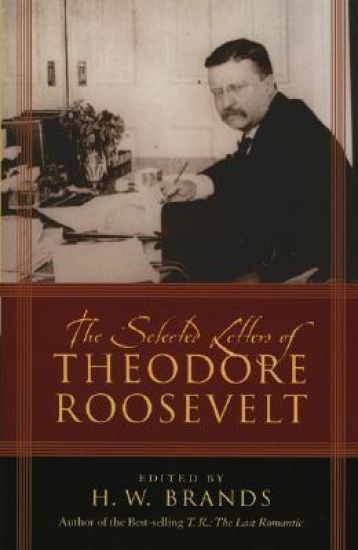
The Selected Letters of Theodore Roosevelt
Rowman Littlefield Publishers
2007
pokkari
Theodore Roosevelt (1857–1919) was the most literary of American Presidents, writing scores of books, including Through the Brazilian Wilderness and African Game Trails. He was also the most active of American writers. In little more than six decades, Roosevelt was, among many of his activities, a rancher, historian, reformer, New York City Police Commissioner, renowned hunter, New York State Governor, conservationist, Vice President of the United States, and 26th President of the United States. What is less known is that Roosevelt was also one of the great epistolary writers, penning more than 100,000 letters. This collection brings together over 1,000 of Roosevelt's most engaging and revealing letters, ones that fully illuminate the private man and the public figure. Herein, Roosevelt corresponds with family, friends, colleagues, and political opponents. He discusses private matters, politics, military strategy, conservation, diplomacy, higher education, women's rights, literature, and football. The list of addresses is formidable, including: Jefferson Davis, Francis Parkman, Frederick Jackson Turner, John Muir, Andrew Carnegie, Jane Addams, Henry Ford, Franklin Delano Roosevelt, John J. Pershing, Woodrow Wilson, Rudyard Kipling, and Oliver Wendell Holmes. The Selected Letters of Theodore Roosevelt, superbly edited by H. W. Brands, allows Roosevelt to speak in his own inimitable voice. These letters capture the verve and sheer joy of life that was Roosevelt's signature.
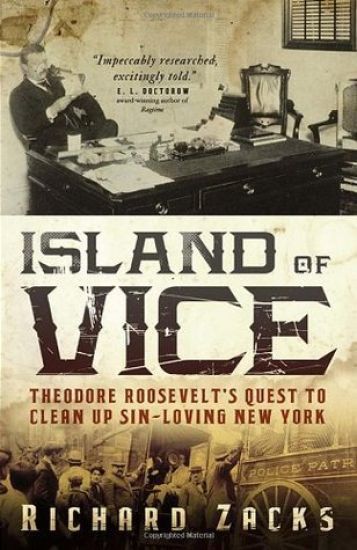
Island of Vice: Theodore Roosevelt's Quest to Clean Up Sin-Loving New York
Richard Zacks
ANCHOR BOOKS
2012
nidottu
In the 1890s, young cocksure Theodore Roosevelt, years before the White House, was appointed police commissioner of corrupt, pleasure-loving New York, then teeming with 40,000 prostitutes, illegal casinos and all-night dance halls. The Harvard-educated Roosevelt, with a reformer's zeal, tried to wipe out the city's vice and corruption. He went head-to-head with Tammany Hall, took midnight rambles looking for derelict cops, banned barroom drinking on Sundays and tried to convince 2 million New Yorkers to enjoy wholesome family fun. The city rebelled big time; cartoonists lampooned him on the front page; his own political party abandoned him but Roosevelt never backed down. Island of Vice delivers a rollicking narrative history of Roosevelt's embattled tenure, pitting the seedy against the saintly, and the city against its would-be savior.


The Novels of Theodore Dreiser was first published in 1976. Minnesota Archive Editions uses digital technology to make long-unavailable books once again accessible, and are published unaltered from the original University of Minnesota Press editions.Relying heavily on the manuscripts and letters in the Dreiser Collection of the University of Pennsylvania Library, Professor Pizer seeks to establish the facts of the sources and composition of each of Dreiser's eight novels and to study the themes and form of the completed works. In this study he relates what can be discovered about the factual reality of a novel to its imaginative reality. His interpretation of the novels avoids the suggestion that there is a single overriding theme or direction in Dreiser's work and emphasizes that Dreiser deserves examination primarily on the basis of the individuality and worth of each of his novels. A separate chapter is devoted to each of the novels: Sister Carrie, Jennie Gerhardt, The "Genius," The Financier, The Titan, An American Tragedy, The Bulwark, and The Stoic.
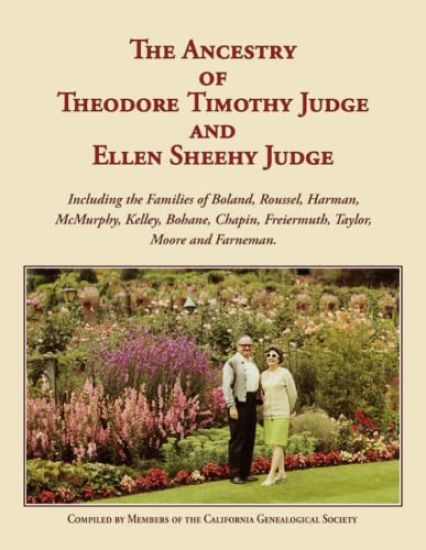
The Ancestry of Theodore Timothy Judge and Ellen Sheehy Judge
California Genealogical Society
2010
pokkari
Theodore Timothy "Ted" Judge died in Cupertino, California, June 11, 2008. Although neither he nor his late wife Ellen Sheehy Judge left descendants, they shared a mutual interest in family history which they had enthusiastically pursued over the years. In his will, Ted left legacies to numerous charities and institutions, including the Bancroft Library at the University of California at Berkeley, where he had spent many hours as a student. Among his bequests was the requirement that the Bancroft Library, in conjunction with the administrators of his estate, arrange for the publication of a book of Judge and Sheehy genealogy to be distributed to Ted and Ellen's cousins. This book includes the families of Boland, Roussel, Harman, McMurphy, Kelley, Bohane, Chapin, Freiermuth, Taylor, Moore and Farneman.