Alexandra Garbarini; Paul Jaskot; Brad Prager; Dana Smith; Marion Kaplan; Kaelber Lutz; Kubátová Hana; Martin Dean; Jan Grabowski; Simone Gigliotti; Pedro Correa Martín-Arroyo; Jonathan Druker; Gershon Greenberg; Lissa Skitolsky; Dorota Glowacka
The social history of the genocide, its representation in postwar culture, and new theoretical approaches stand at the forefront of current research in a range of disciplines. Analyses at the most intimate scale—of the individual or of a particular locale— are juxtaposed with those that turn to broader studies of the war or postwar order. Complementing these different scales are theoretical investigations that address individual agency, moral judgment, and the construction of meaning and memory in the study of the victims of the Holocaust and in our understanding of society as a whole. Together they mark the contemporary scholarly landscape of Holocaust studies, which includes history as well as film and literary studies, philosophy, and religious studies (among other disciplines). Each of the volume's three sections contributes to understanding the Holocaust and postwar ramifications of the genocide by focusing on: 1) the history of specific communities of both victims and perpetrators; 2) postwar cultural representations; and 3) new theoretical understandings of each. The essays in this volume thus represent new interests in the field that contribute to building integrated histories of the Holocaust.

The story of Henning Kronstam, one of the greatest dancers of 20th-century ballet, is a testament of professional achievement and personal victory. Overcoming illness, family disapproval and his own private torments, Kronstam dominated one of the world's most renowned companies, the Royal Danish Ballet, for nearly 30 years - beginning in 1956 when he created the role of Romeo at the age of 20 in Frederick Ashton's ""Romeo and Juliet"", until a new generation, trained by him, took the stage. In 1979, Kronstam organized and directed the Bournonville Fesival, introducing the world to the rarely performed works of August Bournonville, the Danes' master choreographer. Alexandra Tomalonis has documented Kronstam's major roles as recounted in his own workds, revealing the man behind the dancer. Kronstam's range streched from classical ballet to modern dance; his greatest roles included Bournonville's James; Balanchine's Apollo; Petit's Cyrano; and the Old Clown in Murray Louis's ""Hoopla"". His refusal to substitute ""flash"" for style won him the admiration of his peers, and to many he remains a beacon of artistic integrity. In the writing of this book, the author conducted 200 hours of interviews with Kronstam and talked to over 100 dancers and choreographers, including many who worked with him. She observed classes and rehearsals at the Royal Danish Ballet over a ten-year period and, as such provides the story of the dance company in addition to a biography of the man. The photographs showcase Kronstam's refined classical technique and dramatic range and the theatrical traditions of the Royal Danish Ballet.
In a world now filled with more people who are overweight than underweight, public health and medical perspectives paint obesity as a catastrophic epidemic that threatens to overwhelm health systems and undermine life expectancies globally. In many societies, being obese also creates profound personal suffering because it is so culturally stigmatized. Yet despite loud messages about the health and social costs of being obese, weight gain is a seemingly universal aspect of the modern human condition.Grounded in a holistic anthropological approach and using a range of ethnographic and ecological case studies, Obesity shows that the human tendency to become and stay fat makes perfect sense in terms of evolved human inclinations and the physical and social realities of modern life. Drawing on her own fieldwork in the rural United States, Mexico, and the Pacific Islands over the last two decades, Alexandra A. Brewis addresses such critical questions as why obesity is defined as a problem and why some groups are so much more at risk than others. She suggests innovative ways that anthropology and other social sciences can use community-based research to address the serious public health and social justice concerns provoked by the global spread of obesity.
Winner of the 2019 Outstanding Book Award - ASC DCCSJ?Trapped in a Vice explores the consequences of a juvenile justice system that is aimed at promoting change in the lives of young people, yet ultimately relies upon tools and strategies that enmesh them in a system that they struggle to move beyond. The system, rather than the crimes themselves, is the vice. Trapped in a Vice explores the lives of the young people and adults in the criminal justice system, revealing the ways that they struggle to manage the expectations of that system; these stories from the ground level of the justice system demonstrate the complex exchange of policy and practice.
With global debt, labor, and environmental crises on the rise, the precarious position of people in the Global South has become a significant force moving people across countries, continents, and around the world. Through a comparative study of contemporary trans-Atlantic immigrant narratives in French, Spanish, and English, Alexandra Perisic offers an account of a multilingual Atlantic under neoliberalism. More specifically, Precarious Crossings: Immigration, Neoliberalism, and the Atlantic examines how contemporary authors from the Caribbean, Sub-Saharan Africa, and Latin America-including Roberto Bola o, Giannina Braschi, Maryse Cond , Fatou Diome, Marie Ndiaye, and Caryl Phillips, among others-have reconceptualized the Atlantic from a triangular space into a multipolar one, introducing new destinations for contemporary immigrants and establishing new Atlantic connections. Perisic argues that in traveling beyond the postcolonial route that connects former colonizer and former colonized, these authors also shift their focus from cultural difference and national belonging to precarity-a condition characterized by a lack of economic and social stability and protection-as a shared characteristic under global neoliberalization. She demonstrates how contemporary Atlantic narratives reveal the contradictions inherent in neoliberalism as an ideology-thereby showing how they further participate in Atlantic literary and cultural dialogues and push against literary conventions of various genre as they explore the complexities of a globalized Atlantic.
While narrative fracturing, multiplicity, and experimentalism are commonly associated with modernist and postmodern texts, they have largely been understudied in Victorian literature. Narrative Bonds: Multiple Narrators in the Victorian Novel focuses on the centrality of these elements and address the proliferation of multiple narrators in Victorian novels. In Narrative Bonds, Alexandra Valint explores the ways in which the Victorian multi-narrator form moves toward the unity of vision across characters and provides inclusivity in an era of expanding democratic rights and a growing middle class. Integrating narrative theory, gothic theory, and disability studies with analyses of works by Charles Dickens, Robert Louis Stevenson, Wilkie Collins, Emily Bront , and Bram Stoker, this comprehensive and illuminating study illustrates the significance and impact of the multi-narrator structure in Victorian novels.
With global debt, labor, and environmental crises on the rise, the precarious position of people in the Global South has become a significant force moving people across countries, continents, and around the world. Through a comparative study of contemporary trans-Atlantic immigrant narratives in French, Spanish, and English, Alexandra Perisic offers an account of a multilingual Atlantic under neoliberalism. More specifically, Precarious Crossings: Immigration, Neoliberalism, and the Atlantic examines how contemporary authors from the Caribbean, Sub-Saharan Africa, and Latin America-including Roberto Bola o, Giannina Braschi, Maryse Cond , Fatou Diome, Marie Ndiaye, and Caryl Phillips, among others-have reconceptualized the Atlantic from a triangular space into a multipolar one, introducing new destinations for contemporary immigrants and establishing new Atlantic connections. Perisic argues that in traveling beyond the postcolonial route that connects former colonizer and former colonized, these authors also shift their focus from cultural difference and national belonging to precarity-a condition characterized by a lack of economic and social stability and protection-as a shared characteristic under global neoliberalization. She demonstrates how contemporary Atlantic narratives reveal the contradictions inherent in neoliberalism as an ideology-thereby showing how they further participate in Atlantic literary and cultural dialogues and push against literary conventions of various genre as they explore the complexities of a globalized Atlantic.
As women entered the field of cultural production in unprecedented numbers in nineteenth-century France and Britain, they gradually forged a place for themselves, however tenuous, in artistic movements and exhibitions, in academies and salons, and finally in the public imagination. Portraits of the Artist as a Young Woman: Painting and the Novel in France and Britain, 1800-1860 focuses on a decisive period in that process of professional self-invention and maps out the concrete and symbolic roles played by women painters, real and fictional, in the construction of female artistic identity in the aesthetic and the public spheres. Alexandra K. Wettlaufer examines the diverse and complex ways canonical and non-canonical women painters and novelists-including Anne Bront , Sydney Owenson, Margaret Gillies, Marceline Desbordes-Valmore, George Sand, and Hortense Haudebourt-Lescot-figured and brought forth the radical image of a female subject representing the world. Wettlaufer brings to light a rich and nearly forgotten culture of women's artistic production, allowing us to understand the nineteenth-century in more complex and nuanced ways across the borders of gender, genre, and nation. In her close readings of paintings by women and novels about women painting, she charts the political and cultural resonances of this artistic self-representation, tracing its evolution through themes of "The Studio" (Part I), "Cosmopolitan Visions" (Part II), and "The Portrait" (Part III). By pairing painting and literature in a single study that also considers works from two distinct but closely related cultures, Portraits of the Artist as a Young Woman locates the interpretation of these works in the dialogic context in which they were created and consumed, highlighting aesthetic and political intersections between nineteenth-century British and French art, literature, and feminism that are too often elided by the disciplinary boundaries of scholarship.
2010 Honorable Mention, Silver Gavel Award, American Bar Association Uncovers the powerful and problematic practice of snitching to reveal disturbing truths about how American justice works Albert Burrell spent thirteen years on death row for a murder he did not commit. Atlanta police killed 92-year-old Kathryn Johnston during a misguided raid on her home. After being released by Chicago prosecutors, Darryl Moore—drug dealer, hit man, and rapist—returned home to rape an eleven-year-old girl. Such tragedies are consequences of snitching—police and prosecutors offering deals to criminal offenders in exchange for information. Although it is nearly invisible to the public, criminal snitching has invaded the American legal system in risky and sometimes shocking ways. Snitching is the first comprehensive analysis of this powerful and problematic practice, in which informant deals generate unreliable evidence, allow criminals to escape punishment, endanger the innocent, compromise the integrity of police work, and exacerbate tension between police and poor urban residents. Driven by dozens of real-life stories and debacles, the book exposes the social destruction that snitching can cause in high-crime African American neighborhoods, and how using criminal informants renders our entire penal process more secretive and less fair. Natapoff also uncovers the far-reaching legal, political, and cultural significance of snitching: from the war on drugs to hip hop music, from the FBI’s mishandling of its murderous mafia informants to the new surge in white collar and terrorism informing. She explains how existing law functions and proposes new reforms. By delving into the secretive world of criminal informants, Snitching reveals deep and often disturbing truths about the way American justice really works.
First published in 2005. The Victorian and Edwardian music hall ballet has been a neglected facet of dance historiography, falling prey principally to the misguided assumption that any ballet not performed at the Opera House or 'legitimate' theatre necessarily meant it was of low cultural and artistic merit. Here Alexandra Carter identifies the traditional marginalization of the working class female participants in ballet historiography, and moves on to reinstate the 'lost' period of the music hall ballet and to apply a critical account of that period. Carter examines the working conditions of the dancers, the identities and professional lives of the ballet girls and the ways in which the ballet of the music hall embodied the sexual psyche of the period, particularly in its representations of the ballet girl and the ballerina. By drawing on newspapers, journals, theatre programmes, contemporary fiction, poetry and autobiography, Carter firmly locates the period in its social, economic and artistic context. The book culminates in the argument that there are direct links between the music hall ballet and what has been termed the 'birth' of British ballet in the 1930s; a link so long ignored by dance historians. This work will appeal not only to those interested in nineteenth century studies, but also to those working in the fields of dance studies, gender studies, cultural studies and the performing arts.
This book examines tax transparency as part of multinational enterprises’ corporate social responsibility (CSR). It considers revelations like the Panama and Paradise Papers that shed light on corporations’ tax practices and the growing public dissatisfaction, resulting in legislative projects, such as the Organisation for Economic Co-operation and Development (OECD) base erosion and profit shifting. Tax transparency is defined as companies’ voluntary disclosure of numerical tax data (e.g. taxes paid by country) and other tax-related information (e.g. tax policies). It is set apart from tax avoidance and tax evasion to clarify the often-blurred concepts.In this book, tax transparency is placed in a historical context and possible drivers and hindering factors to tax transparency are investigated. Tax transparency is discussed in the light of socio-economic theories (stakeholder, legitimacy, institutional theory and reputation risk management), as well as economic theories (agency theory, signalling, proprietary costs) and information overload theory. The book provides examples of tax transparency development of the largest multinational enterprises in five countries (France, Germany, UK, Finland and USA) in six years, 2012–2017, a period featuring increased media coverage of tax matters and legislative movement in the OECD and the European Union. The future of tax transparency is discussed in light of quality characteristics, assurance of information and potential use of artificial intelligence.Companies’ managers and tax and CSR specialists benefit from the book by gaining insight into how to design transparent, high-quality tax reporting. Assurance professionals can use information about the quality criteria of tax transparency. Regulators can track historical development and see examples of voluntary tax transparency in companies’ reporting. Scholars and students obtain theoretical framework for analysing the tax transparency phenomenon and the ability to distinguish between the concepts of tax transparency, planning, avoidance and evasion.
Delving into the law and meaning of international organizations, this book addresses the laws relating to international organizations, their undertakings, and the ways in which specific international organizations function and interact with one another.Assuming little background knowledge of international law, the book brings together key issues in international law and the history of international organizations in a cohesive manner, providing readers with a clear understanding of international organizations' law in context. It addresses topics such as: organization functions and structure membership and membership powers the rights of international organizations dispute settlement in international organizations termination of an international organizationWritten in an accessible and engaging way, this book is ideal reading for students new to the Law of International Organizations and as a reference for those active in fields impacted by international organizations.
Can Germany and Japan do more militarily to uphold the international order?Since the end of World War II, Germany and Japan have been the most reluctant of all major U.S. allies to take on military responsibilities. Given their histories, this reluctance certainly is understandable. But because of their size and economic importance, Germany and Japan are the most important U.S. allies in Europe and in East Asia, respectively, and their long-term reluctance to share the defense burden has become a perennial source of frustration for Washington.The potential security roles of Germany and Japan are becoming increasingly important given the uncertainty, indeed volatility, of today's international environment. Under President Trump, friction among allies over burden-sharing is more intense than ever before. Meanwhile, the security environments in Europe and Asia have deteriorated because of the resurgence of a belligerent Russia under Vladimir Putin, the steady rise of an increasingly assertive China, and North Korea's worrisome acquisition of nuclear weapons.Partly in response to these developments, Germany and Japan in recent years have boosted their security efforts, mainly by increasing defense spending and taking on a somewhat broader range of military missions. Even so, because of their cultures of anti-militarism resistance remains strong in both countries to rebuilding the military and assuming more responsibility for sustaining regional or even global peace.In Reluctant Warriors, a team of noted international experts critically examines how and why Germany and Japan have modified their military postures since 1990 so far, and assesses how far the countries still have to go?and why. The contributors also highlight the risks the United States takes if it makes too simplistic a demand for the two countries to ?do more.
Legends and rising stars of feminist film and video tell their stories.Alexandra Juhasz asked twenty-one women to tell their stories-women whose names make up a who is (and who will be) who of independent and experimental film and video. What emerged in the resulting conversations is a compelling (and previously underdocumented) history of feminism and feminist film and video, from its origins in the fifties and sixties to its apex in the seventies, to today. Women of Vision is a companion piece to Juhasz’s 1998 documentary of the same name. The book presents the complete interviews, allowing readers to hear directly the voices of these articulate, passionate women in an interactive remembering of feminist media history. Juhasz’s introduction provides a historical, theoretical, and aesthetic context for the interviews. These subjects have all shaped late twentieth-century film and video in fundamental ways, either as artists, producers, distributors, critics, or scholars, and they all believe that media are the most powerful tools for effecting change. Yet they are a very diverse group, with widely varying personal and professional backgrounds. By presenting their interviews together, Juhasz shows the differences among those involved in feminist media, but also the connections among them, and the way in which the field has been enriched by their sharing of knowledge and power. In the end, Juhasz not only records these women’s careers, she broadens our understanding of feminism and shows how feminist history and documentary are made.Interviewees: Pearl Bowser; Margaret Caples; Michelle Citron; Megan Cunningham; Cheryl Dunye; Vanalyne Green; Barbara Hammer; Kate Horsfield; Carol Leigh; Susan Mogul; Juanita Mohammed; Frances Negrón-Muntaner; Eve Oishi; Constance Penley; Wendy Quinn; Julia Reichert; Carolee Schneemann; Valerie Soe; Victoria Vesna; and Yvonne Welbon.
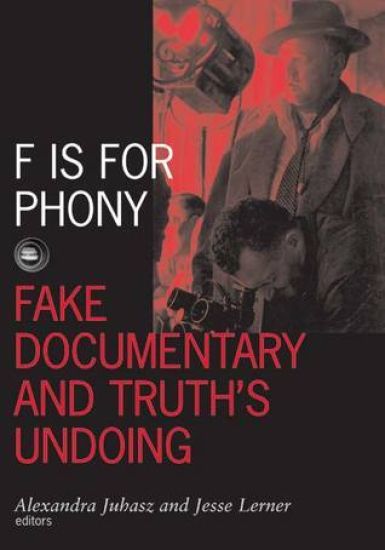
Fake documentaries mimic documentary genre expectations, unraveling the documentary’s authority and dismantling understandings of identity, history, and nation. The interdisciplinary essays in F Is for Phony discuss a broad scope of works and explore issues raised by “fake docs” such as the fiction/documentary divide, the ethics of reality-based manipulation, and whether documentariness derives from form or reception. Defining the borderline between fact and fiction, the contributors reveal what fake documentaries imply and usually make explicit: that many documentaries lie to tell the truth, and that the truth is relative. Contributors: Steve Anderson, Catherine L. Benamou, Mitchell W. Block, Luis Buñuel, Marlon Fuentes, Craig Hight, Charlie Keil, Alisa Lebow, Eve Oishi, Robert F. Reid-Pharr, Gregorio C. Rocha, Jane Roscoe, Catherine Russell, Elisabeth Subrin. Alexandra Juhasz is professor of media studies at Pitzer College. She is author of Women of Vision: Histories in Feminist Film and Video (Minnesota, 2001). Jesse Lerner is associate professor of media studies at Pitzer College.
Alberto Calderon was one of the leading mathematicians of the twentieth century. His fundamental, pioneering work reshaped the landscape of mathematical analysis. This volume presents a wide selection from some of Calderon's most influential papers. They range from singular integrals to partial differential equations, from interpolation theory to Cauchy integrals on Lipschitz curves, from inverse problems to ergodic theory. The depth, originality, and historical impact of these works are vividly illustrated by the accompanying commentaries by some of today's leading figures in analysis. In addition, two biographical chapters preface the volume. They discuss Alberto Calderon's early life and his mathematical career.