Kirjojen hintavertailu. Mukana 11 627 220 kirjaa ja 12 kauppaa.

Kirjahaku

Etsi kirjoja tekijän nimen, kirjan nimen tai ISBN:n perusteella.

1000 tulosta hakusanalla Barry Ray

The Populist Temptation

The Populist Temptation

Barry Eichengreen

Oxford University Press Inc
2020
nidottu
Populism, on both the right and the left, has spread like wildfire throughout Europe and the United States and is making inroads in other parts of the world. In simplest terms, populism is a political ideology that vilifies elites, minorities and foreigners while lionizing "the people." It reached its apogee in the U.S. with the election of Donald Trump but has been a force in Europe since the Great Recession and the refugee crisis. We now see the rise of leaders with populist tendencies everywhere from Brazil to Turkey. In The Populist Temptation, Barry Eichengreen places this global resurgence of populism in its historical context. Populists have always thrived, he observes, in times of poor economic performance. Populism feeds on rising inequality, which augments the ranks of those left behind and fans dissatisfaction with the economic status quo. It responds to rapid economic change that heightens insecurity. These economic developments, Eichengreen shows, give rise to populist reactions when they highlight the divergent interests of the people and the elite. Banking and financial crises are a case in point: the financiers who are the precipitating agents of such crises are card-carrying members of the elite, and are seen as profiting at the expense of the people. But populism is also a protest against the declining influence of the traditions, beliefs and community of once-dominant groups. It is a reaction against the challenge posed by immigrants and minorities to the people as a homogeneous, well-defined entity. Populists capitalizing on these feelings appeal to a glorious, mythologized past grounded in the collective traditions of that once-dominant majority. They invoke nationalism and criticize politicians who embrace diversity, open borders and equal rights. Populism has particular appeal, Eichengreen shows, when these identity politics and economic grievances come together. There is no magic solution to these concerns, but Eichengreen points to a starting place: strengthening welfare state policies that make for greater equality of opportunity and social cohesion. Comparing Europe with the United States, he shows that America's patchwork welfare state is less well equipped to deal with the fallout from globalization and technical change and the growing distance between social groups. This reality will be hard to change, since America's limited welfare state reflects the country's historically-rooted suspicion of big government. It is therefore in the United States, Eichengreen concludes, where the siren song of populism is most alluring--and dangerous.

Climate Change and Public Health

Climate Change and Public Health

Barry Levy; Jonathan Patz

Oxford University Press Inc
2015
nidottu
Climate change is causing, and will increasingly cause, a wide range of adverse health effects, including heat-related disorders, infectious diseases, respiratory and allergic disorders, malnutrition, mental health problems, and violence. The scientific bases for the associations between climate change and health problems are evolving as are the strategies for adapting to climate change and mitigating the greenhouse gases, which are its primary cause. Orchestrating and coordinating contributions from more than 75 selected public health specialists and environmental scientists, the editors have developed a concise and comprehensive book that represents a core curriculum on climate change and public health, including key strategies for adaptation and mitigation. Written primarily for students and mid-career professionals in public health and environmental sciences, the book clearly describes concepts and their application to the health impacts of climate change. Chapters are supplemented with case studies, graphs, tables and photographs. The book's organization in 15 chapters makes it an ideal textbook for graduate and undergraduate courses in public health, environmental sciences, public policy, and other fields.
The Political History of American Food Aid

The Political History of American Food Aid

Barry Riley

Oxford University Press Inc
2017
sidottu
American food aid to foreigners long has been the most visible-and most popular-means of providing humanitarian aid to millions of hungry people confronted by war, terrorism and natural cataclysms and the resulting threat-often the reality-of famine and death. The book investigates the little-known, not-well-understood and often highly-contentious political processes which have converted American agricultural production into tools of U.S. government policy. In The Political History of American Food Aid, Barry Riley explores the influences of humanitarian, domestic agricultural policy, foreign policy, and national security goals that have created the uneasy relationship between benevolent instincts and the realpolitik of national interests. He traces how food aid has been used from the earliest days of the republic in widely differing circumstances: as a response to hunger, a weapon to confront the expansion of bolshevism after World War I and communism after World War II, a method for balancing disputes between Israel and Egypt, a channel for disposing of food surpluses, a signal of support to friendly governments, and a means for securing the votes of farming constituents or the political support of agriculture sector lobbyists, commodity traders, transporters and shippers. Riley's broad sweep provides a profound understanding of the complex factors influencing American food aid policy and a foundation for examining its historical relationship with relief, economic development, food security and its possible future in a world confronting the effects of global climate change.
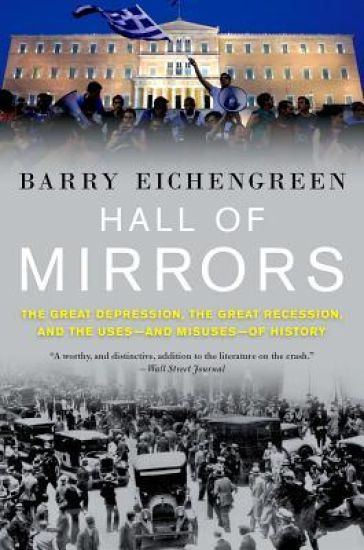
Hall of Mirrors

Hall of Mirrors

Barry Eichengreen

Oxford University Press Inc
2016
nidottu
The two great financial crises of the past century are the Great Depression of the 1930s and the Great Recession, which began in 2008. Both occurred against the backdrop of sharp credit booms, dubious banking practices, and a fragile and unstable global financial system. When markets went into cardiac arrest in 2008, policymakers invoked the lessons of the Great Depression in attempting to avert the worst. While their response prevented a financial collapse and catastrophic depression like that of the 1930s, unemployment in the U.S. and Europe still rose to excruciating high levels. Pain and suffering were widespread. The question, given this, is why didn't policymakers do better? Hall of Mirrors, Barry Eichengreen's monumental twinned history of the two crises, provides the farthest-reaching answer to this question to date. Alternating back and forth between the two crises and between North America and Europe, Eichengreen shows how fear of another Depression following the collapse of Lehman Brothers shaped policy responses on both continents, with both positive and negative results. Since bank failures were a prominent feature of the Great Depression, policymakers moved quickly to strengthen troubled banks. But because derivatives markets were not important in the 1930s, they missed problems in the so-called shadow banking system. Having done too little to support spending in the 1930s, governments also ramped up public spending this time around. But the response was indiscriminate and quickly came back to haunt overly indebted governments, particularly in Southern Europe. Moreover, because politicians overpromised, and because their measures failed to stave off a major recession, a backlash quickly developed against activist governments and central banks. Policymakers then prematurely succumbed to the temptation to return to normal policies before normal conditions had returned. The result has been a grindingly slow recovery in the United States and endless recession in Europe. Hall of Mirrors is both a major work of economic history and an essential exploration of how we avoided making only some of the same mistakes twice. It shows not just how the "lessons" of Great Depression history continue to shape society's response to contemporary economic problems, but also how the experience of the Great Recession will permanently change how we think about the Great Depression.
Seeing Depression Through A Cultural Lens

Seeing Depression Through A Cultural Lens

Barry S. Fogel; Xiaoling Jiang

OXFORD UNIVERSITY PRESS INC
2025
sidottu
Seeing Depression Through a Cultural Lens, the collaborative work of a clinical neuroscientist and a scholar of comparative culture, examines the effects of cultural identity on the epidemiology, phenomenology, and narratives of depression, the bipolar spectrum, and suicide. Culture is associated with emotional communication style, 'idioms of distress,' the conception of depression and of bipolar disorders, and how people with mood disorders might be stigmatized. It is linked to structural factors--environmental, social, and economic circumstances--that create or mitigate the risk of depression, sometimes precipitate episodes of illness, and facilitate or impede treatment. Culture shapes depressed people's willingness to disclose or acknowledge their condition and to seek care, their relationships with clinicians, and their acceptance or rejection of specific treatments. Cultural context is essential to understanding suicide. It underlies people's motives for suicide, factors that promote or prevent suicide, the social acceptability of death by suicide, and availability of lethal means of self-harm. Cultural identity is always intersectional, comprising elements related to race and ethnicity; gender; age, generation, and life stage; education; social class; occupation; migrant or minority status; region of residence; and religious belief and practice. This book explores the implications of each of these dimensions using salient concepts from the social sciences, memorable narratives from literature, film, and the clinic, and quantitative findings from epidemiology and psychometrics. It offers readers a framework for culturally aware assessment and management of depression, bipolarity, and suicidal risk in diverse individuals and populations.
The Populist Temptation

The Populist Temptation

Barry Eichengreen

Oxford University Press Inc
2018
sidottu
In the last few years, populism -- of the right, left, and center varieties -- has spread like wildfire throughout the world. The impulse reached its apogee in the United States with the election of Trump, but it was a force in Europe ever since the Great Recession sent the European economy into a prolonged tailspin. In the simplest terms, populism is a political ideology that vilifies economic and political elites and instead lionizes 'the people.' The people, populists of all stripes contend, need to retake power from the unaccountable elites who have left them powerless. And typically, populists' distrust of elites shades into a catchall distrust of trained experts because of their perceived distance from and contempt for 'the people.' Another signature element of populist movements is faith in a savior who can not only speak directly to the people, but also serve as a vessel for the plain people's hopes and dreams. Going back to the 1890s, a series of such saviors have come and gone in the US alone, from William Jennings Bryan to Huey Long to -- finally -- Donald Trump. In The Populist Temptation, the eminent economic historian Barry Eichengreen focuses on the global resurgence of populism today and places it in a deep context. Alternating between the present and earlier populist waves from modern history, he argues that populists tend to thrive most in the wake of economic downturns, when it is easy to convince the masses of elite malfeasance. Yet while there is more than a grain of truth that bankers, financiers, and 'bought' politicians are responsible for the mess, populists' own solutions tend to be simplistic and economically counterproductive. Moreover, by arguing that the ordinary people are at the mercy of extra-national forces beyond their control -- international capital, immigrants, cosmopolitan globalists -- populists often degenerate into demagoguery and xenophobia. There is no one solution to addressing the concerns that populists raise, but Eichengreen argues that there is an obvious place to start: shoring up and improving the welfare state so that it is better able to act as a buffer for those who suffer most during economic slumps. For example, America's patchwork welfare state was not well equipped to deal with the economic fallout that attended globalization and the decline of manufacturing in America, and that played no small part in Trump's victory. Lucidly explaining both the appeals and dangers of populism across history, this book is essential reading for anyone seeking to understand not just the populist phenomenon, but more generally the lasting political fallout that follows in the wake of major economic crises.
Cultural and Linguistic Considerations in Forensic Mental Health Assessment

Cultural and Linguistic Considerations in Forensic Mental Health Assessment

Barry Rosenfeld; Alicia Nijdam-Jones

OXFORD UNIVERSITY PRESS INC
2026
nidottu
As English-speaking societies become increasingly diverse, clinical psychologists are often called upon to work with individuals from a wide range of ethnic, cultural, linguistic, and religious backgrounds. These intersecting identities shape an individual's lived experience and can significantly impact the accuracy of psychological evaluations. It is therefore critical for clinicians to account for cultural differences, particularly in forensic mental health assessment, due to the disproportionate number of individuals from diverse backgrounds who come into contact with the legal system and the weighty consequences which can stem from forensic evaluation. Cultural and Linguistic Considerations in Forensic Mental Health Assessment summarizes the emerging psychological research and legal and mental health practice guidelines surrounding work with diverse populations, particularly as these issues pertain to forensic mental health evaluations. It focuses on the evaluation of individuals whose cultural, linguistic, or community experiences differ from those of the evaluator--an increasingly common reality in clinical practice. The book provides clinicians and trainees with a foundation for conducting culturally informed and context sensitive assessments and guides researchers by identifying gaps, methodological challenges, and future directions in the study of cross-cultural forensic mental health assessment. Ultimately, the authors call for more accurate, equitable, and culturally responsive evaluations for those who are historically overrepresented, yet often underserved, within forensic systems.
The Celts

The Celts

Barry Cunliffe

Oxford University Press
2003
nidottu
Savage and bloodthirsty, or civilized and peaceable? The Celts have long been a subject of enormous fascination, speculation, and misunderstanding. From the ancient Romans to the present day, their real nature has been obscured by a tangled web of preconceived ideas and stereotypes. Barry Cunliffe seeks to reveal this fascinating people for the first time, using an impressive range of evidence, and exploring subjects such as trade, migration, and the evolution of Celtic traditions. Along the way, he exposes the way in which society's needs have shaped our visions of the Celts, and examines such colourful characters as St Patrick, Cú Chulainn, and Boudica. ABOUT THE SERIES: The Very Short Introductions series from Oxford University Press contains hundreds of titles in almost every subject area. These pocket-sized books are the perfect way to get ahead in a new subject quickly. Our expert authors combine facts, analysis, perspective, new ideas, and enthusiasm to make interesting and challenging topics highly readable.
European Architecture 1750-1890

European Architecture 1750-1890

Barry Bergdoll

Oxford University Press
2000
nidottu
This comprehensive examination of eighteenth and nineteenth-century architecture explores its extreme diversity within the context of tremendous social, economic and political upheaval. Bergdolls offers a penetrating analysis of the very ways issues of style functioned to make architecture one of the most vitally experimental of art forms in a period of sweeping political, social, and economic change. Never before had the functional requirements and expressive capacities of architecture been tested so thoroughly and with such diversity of invention. Bergdoll traces this experimentation in a broad range of contexts, focusing in particular on the relation of architectural design to new theories of history, new categories of scientific inquiry, and the broadening audience for architecture in this period of transformation. Unlike traditional surveys with long lists of buildings and architects, the themes are elucidated by in-depth coverage of key buildings which in turn are situated in both their local and European context.
Facing the Sea of Sand

Facing the Sea of Sand

Barry Cunliffe

Oxford University Press
2023
sidottu
Northern Africa is dominated by the Sahara Desert, stretching across the continent from the Atlantic Ocean to the Red Sea. This book is about the people who lived around the edges of the Desert and the different ways in which they responded to its challenges, establishing networks of communication across its expanse. But the Sahara has not always been a desert. From about 9000 BC the region began to enjoy a warm, humid period allowing vegetation to flourish and wild animals to move in. Humans soon followed practising pastoral economies but with the onset of harsher conditions once more around 3000 BC the desert reclaimed its own. Since then fluctuations in climate have continued to affect the lives of people living around the desert fringes. The communities occupying the North African Coast and in the Nile Valley have come under the influence of the states dominating the Near East and the Mediterranean but those living in in the Sahel to the south of the desert have developed their own distinctive cultures. The book tells the story of the growing links between the two worlds, showing that Africa played a crucial part in the development of the Old World before it was drawn into the story of the New World.
Golden Fetters: The Gold Standard and the Great Depression, 1919-1939
This book offers a reassessment of the international monetary problems that led to the global economic crisis of the 1930s. It explores the connections between the gold standard--the framework regulating international monetary affairs until 1931--and the Great Depression that broke out in 1929. Eichengreen shows how economic policies, in conjunction with the imbalances created by World War I, gave rise to the global crisis of the 1930s. He demonstrates that the gold standard fundamentally constrained the economic policies that were pursued and that it was largely responsible for creating the unstable economic environment on which those policies acted. The book also provides a valuable perspective on the economic policies of the post-World War II period and their consequences.
The Politics of National Security

The Politics of National Security

Barry M. Blechman

Oxford University Press Inc
1992
nidottu
Over the past twenty years, controversy has raged over the greatly expanded role of Congress in the formulation of US national defence policy. Barry Blechman, who served as Assistant Director to the US Arms Control and Disarmament Agency and as a consultant to the Pentagon and numerous congressional committees, here analyses this fundamental shift in US policy-making. Based in part on interviews with Congress members and their staff, the book explains how and why these changes came about and what their consequences have been for the defence of American interests.
Bad Kids

Bad Kids

Barry C. Feld

Oxford University Press Inc
1999
sidottu
Written by a leading scholar of juvenile justice, this book examines the social and legal changes that have transformed the juvenile court in the last three decades from a nominally rehabilitative welfare agency into a scaled-down criminal court for young offenders. It explores the complex relationship between race and youth crime to explain both the Supreme Court decisions to provide delinquents with procedural justice and the more recent political impetus to "get tough" on young offenders. This provocative book will be necessary reading for criminal and juvenile justice scholars, sociologists, legislators, and juvenile justice personnel.
Bad Kids

Bad Kids

Barry C. Feld

Oxford University Press Inc
1999
nidottu
Within the past three decades, social and legal changes have transformed the juvenile court from a nominally rehabilitative welfare agency into a second-class criminal court for young offenders. Recent efforts to "toughen" juvenile justice policies have resulted in increasingly harsh sanctions that fall disproportionately on minority youths. In this provocative new book, Barry Feld examines what went wrong with the juvenile court and proposes an alternative model for youth crime control and child welfare. The Progressive reformers who created the juvenile court a century ago saw children as relatively blameless and innocent. But recent decades of rising crime rates associated with urban decay have strained this tolerant view of young offenders. Feld relates the 1967 Supreme Court decision In re Gault to the broader social and legal changes associated with the civil rights movement and the Warren Court's "Due Process Revolution." Although gault mandated more elaborate procedural safeguards in delinquency hearings, ironically, those protections legitimated the imposition of more punitive sanctions. Since Gault, Feld argues, three decades of judicial, legislative, and administrative reforms have conducted a form of "criminological triage." At the "soft end," reforms have shifted noncriminal status offenders, primarily female and white, out of the juvenile justice system into a "hidden system" made up of private sector mental health and chemical dependency facilities. At the "hard end," states transfer increasing numbers of young offenders, disproportionately minorities, to criminal court for prosecution as adults. Meanwhile, juvenile courts punish more severely those delinquents-again disproportionately minorities-who remain within the increasingly criminalized juvenile justice system. Feld attributes the current state of affairs to a conceptual flaw inherent in the juvenile court. The juvenile justice system attempts to combine social welfare and social control functions in one organization, but inevitably fulfills both missions badly because of the inherent and irreconcilable contradictions between them. Progressive reformers situated the juvenile court on a number of cultural, legal, and criminological fault lines, where the ideas of child and adult, determinism and free will, immature and responsible, treatment and punishment collide. The past three decades have witnessed a shift from the former to the latter of these binary pairs in response to the racial transformation of cities, the increase in serious youth crime, and the erosion of the rehabilitative assumptions of the juvenile court. The solution, Feld argues, is to uncouple social welfare from criminal social control. States could try all offenders in one integrated criminal justice system with appropriate modifications to accommodate the youthfulness of younger defendants: a graduated, age-culpability sentencing system, separate youth correctional facilities, and the like. Formally recognizing youthfulness as a mitigating factor would provide youths with greater protections and justice than they currently receive in either the juvenile or criminal justice systems. At the same time such a strategy would enable public policies to address directly the social welfare needs of all young people.
Golden Fetters

Golden Fetters

Barry Eichengreen

Oxford University Press Inc
1996
nidottu
This book is a reassessment of the international monetary crises of the post-World War I period that led to the Great Depression of the 1930s. It also analyses the responses of the world economic powers to the Depression and how new monetary policies set the stage for the watershed post-World War II system established at Bretton Woods. It offers new theories of what effect the Great Depression had on the collapse of the world monetary system, and what effect the collapse had on deepening and prolonging the Depression, by exploring the link between global economic crisis and the the gold standard (the framework for international monetary affairs until 1931). The events described had a profound effect upon twentieth-century history: the Depression abetted the rise of Hitler and the demise of the gold standard is a historical cause of inflation.
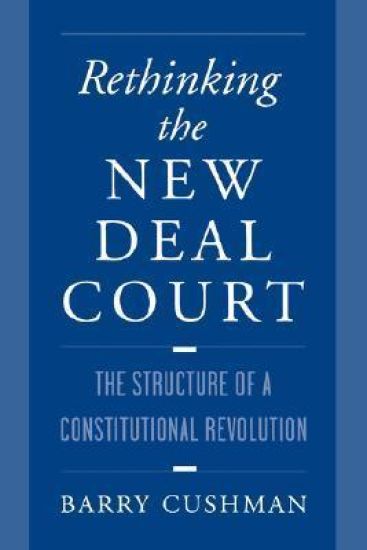
Rethinking the New Deal Court

Rethinking the New Deal Court

Barry Cushman

Oxford University Press Inc
1998
sidottu
Rethinking the New Deal Court challenges the prevailing account of the New Deal era Supreme Court, which holds that in the spring of 1937 the Court suddenly abandoned jurisprudential positions it had staked out in such areas as substantive due process and commerce clause doctrine. In this view, the impetus for such a dramatic reversal was provided by external political pressures manifested in FDR's landslide victory in the 1936 election, and by the subsequent Court-packing crisis. Author Barry Cushman, by contrast, discounts the role that political pressure played in securing this "constitutional revolution." Instead, he reorients study of the New Deal Court by focusing attention on the internal dynamics of doctrinal development and the role of New Dealers in seizing opportunities presented by doctrinal change. Recasting this central story in American constitutional development as a chapter in the history of ideas rather than simply an episode in the history of politics, Cushman offers a thoroughly researched and carefully argued study that recharacterizes the mechanics by which laissez-faire constitutionalism unraveled and finally collapsed during FDR's reign. Identifying previously unseen connections between various lines of doctrine, Cushman charts the manner in which Nebbia v. New York's abandonment of the distinction between public and private enterprise hastened the demise of the doctrinal structure in which that distinction had played a central role.
Rethinking the New Deal Court

Rethinking the New Deal Court

Barry Cushman

Oxford University Press Inc
1999
nidottu
Rethinking the New Deal Court challenges the prevailing account of the New Deal era Supreme Court, which holds that in the spring of 1937 the Court suddenly abandoned jurisprudential positions it had staked out in such areas as substantive due process and commerce clause doctrine. In this view, the impetus for such a dramatic reversal was provided by external political pressures manifested in FDR's landslide victory in the 1936 election, and by the subsequent Court-packing crisis. Author Barry Cushman, by contrast, discounts the role that political pressure played in securing this "constitutional revolution." Instead, he reorients study of the New Deal Court by focusing attention on the internal dynamics of doctrinal development and the role of New Dealers in seizing opportunities presented by doctrinal change. Recasting this central story in American constitutional development as a chapter in the history of ideas rather than simply an episode in the history of politics, Cushman offers a thoroughly researched and carefully argued study that recharacterizes the mechanics by which laissez-faire constitutionalism unraveled and finally collapsed during FDR's reign. Identifying previously unseen connections between various lines of doctrine, Cushman charts the manner in which Nebbia v. New York's abandonment of the distinction between public and private enterprise hastened the demise of the doctrinal structure in which that distinction had played a central role.
The Quest for Reality

The Quest for Reality

Barry Stroud

Oxford University Press Inc
2002
nidottu
We say "the grass is green" or "lemons are yellow" to state what everyone knows. But are the things we see around us really colored, or do they only look that way because of the effects of light rays on our eyes and brains? Is color somehow "unreal" or "subjective" and dependent on our human perceptions and the conditions under which we see things? Distinguished scholar Barry Stroud investigates these and related questions in The Quest for Reality. In this long-awaited book, he examines what a person would have to do and believe in order to reach the conclusion that everyone's perceptions and beliefs about the color of things are "illusions" and do not accurately represent the way things are in the world as it is independently of us. Arguing that no such conclusion could be consistently reached, Stroud finds that the conditions of a successful unmasking of color cannot all be fulfilled. The discussion extends beyond color to present a serious challenge to many other philosophical attempts to discover the way things really are. A model of subtle, elegant, and rigorous philosophical writing, this study will attract a wide audience from all areas of philosophy.