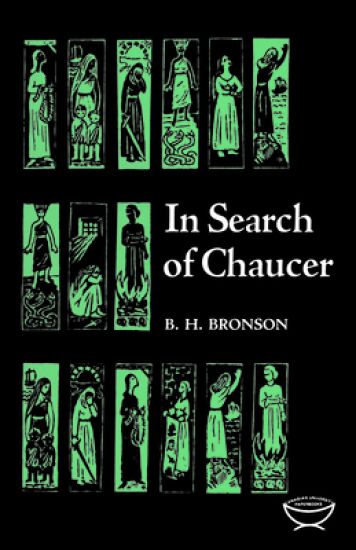
In this volume, Professor Bronson is primarily interested in the three worlds which appear in Chaucer's poetry: the dream world; the world of the mundane existence and waking observation; and the world of imagined life through reading. A study of these worlds raises questions about the kind of truth which resides in each, the literary values which can be extracted from them, their essentail relation to one another, and the perennial problem of appearance and reality. Professor Bronson is also concerned with the general critical approach to Chaucer's writings. He feels that many recent Chaucerian scholars have been misled by their application of critical disciplines nourished on the metaphysical poets to a poet who deliberately practised a style capable of being followed by a moderately attentive ear. The fact that Chaucer's poetry was composed for oral delivery has received no more than lip service from critics; yet Chaucer's relation to his audience is obviously of the greatest importance in understanding his poems. It behooves us, therefore, to clarify our thoughts as to the kind of techniques we may fittingly apply. Professor Bronson suggests that a less sophisticated way of looking at the subject might yield better results. Professor Bronson's book is a form of introduction to this new view of Chaucer; it is not a complete guide but an explanatory visit to each sphere of Chaucer's world, skilfully evocative of the people of the dream legends, the pilgrimage, the literary heroes and heroines of the Middle Ages, whom Chaucer brought into his poetry. This book is decorated with drawings in the manner of woodcuts taken from the three worlds of Chaucer's poetry. The Alexander Lectures for 1958-59.
Laparoscopic surgery, both free-hand and robotic-assisted, has proved to be a transformational technology with a major impact on urologic oncology. While academic urologists today vigorously debate whether a procedure done laparoscopically yields better outcomes than the comparable open procedure, urologic surgeons are voting with their feet: they are performing more and more laparoscopic surgeries every year. The overwhelming interest in lapa- scopic surgery is apparent at every urological meeting, but it is perhaps most evident in urologic training programs. Young urologists clearly understand that they must learn minimally invasive techniques if they are to be compe- tive in practice, particularly in the field of oncology. Regardless of the outcome of this debate, the development of laparoscopic surgery has wrought a major resurgence of interest in the importance of sur- cal technique. A decade ago, surgeons themselves seemed bored by presen- tions or publications that described a surgical technique. There was a general sense that it had all been worked out long ago. That attitude seems oddly out of place today, when our literature and our meetings are filled with intense debates about the differences between surgical approaches and the importance of technique. We now know, for example, that with regard to all important outcomes of major cancer, the skill and experience of the surgeon have a p- found impact on the results of surgery. We know that there is a learning curve, sometimes remarkably prolonged, for crucial outcomes such as cancer control after prostatectomy.