Kirjahaku
Etsi kirjoja tekijän nimen, kirjan nimen tai ISBN:n perusteella.
1000 tulosta hakusanalla Eb Corbin

In honor of the 150th anniversary of W. E. B. Du Bois's birth in Great Barrington, Massachusetts, the University of Massachusetts Library has prepared a new edition of Du Bois's classic, The Souls of Black Folk. Originally published in 1903, Souls introduced a number of now-canonical terms into the American conversation about race, among them double-consciousness, and it sounded the ominous warning that ""the problem of the Twentieth Century is the problem of the color-line."" In a new introduction, Shawn Leigh Alexander outlines the historical context of this critical work and provides rare documents from the special collections archive at the Du Bois Library at the University of Massachusetts Amherst.Unlike Du Bois's more scholarly work, Souls blends narrative and autobiographical essays, and it continues to reach a wide domestic and international readership. This moving homage to black life and culture and its sharp economic and historical critique are more important than ever, resonating with today's unequivocal demand that Black Lives Matter in the twenty-first century.

W. E. B. Du Bois's groundbreaking social study of black Americans living in Philadelphia at the end of the 1800s remains an outstanding and thorough example of sociology.Using knowledge gained from research of black neighborhoods during his time at the University of Pennsylvania, Du Bois was determined to create an all-embracing profile of urban black American society. Some three years of intensive research, interviews, and statistical gathering went into The Philadelphia Negro; it revealed endemic social prejudices and the abject poverty which many black Americans endured. The area studied was the Seventh Ward - a borough of Philadelphia which included the impoverished black ghetto, the striving middle-classes, and even affluent whites.For Du Bois, the root causes of the social divide were ingrained negative perceptions towards black Americans, such as the notion that black workers are innately dishonest or indolent. Incidents of racial discrimination, whereby blacks in a line of business or seeking employ are turned aside on the basis of skin color, are numerous. More positively, the author unearthed multiple appraisals from those who had employed black workers - some only as a last resort - who became very impressed at their employee's diligence, ability and passion.Spanning the education, recreation, work, housing and environment conditions, and much more besides, The Philadelphia Negro remains a landmark text of sociology.

Book synopsis: An upbeat account of a mother's journey parenting twins with different disabilities. It is a tale of advocacy outlining the strategies used when working with doctors, teachers and neighbors. It describes how a mother explored options available to her family, looking for the right "fit" and how as a family they worked on the life skills that helped her son and daughter become independent. The importance of communities and the role they play in supporting an individual is explained. The balance between safety and individual autonomy is explored. The lessons shared are instructive to parents of children with and without disabilities.Autobiography: Mrs. Fickenscher is the parent of twins. An educator for over 30 years, she served in many capacities from classroom teacher to central office administrator. She has been active in promoting opportunities for individuals with developmental disabilities. When first retired, she worked with a non-profit dedicated to creating intentional communities that support adults with developmental differences as they move into their own places. She is active in her church and community. In her spare time, she travels to places on her bucket list.

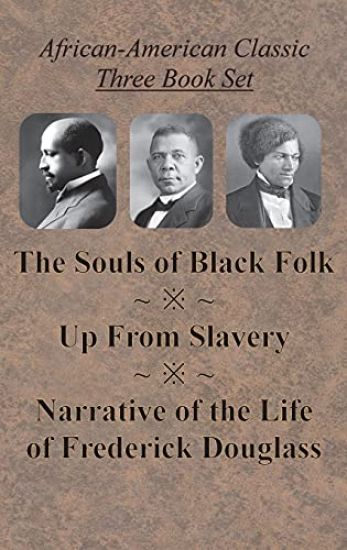
African-American Classic Three Book Set - The Souls of Black Folk, Up From Slavery, and Narrative of the Life of Frederick Douglass
W E B Du Bois; Booker T Washington; Frederick Douglass
Chump Change
1903
sidottu
Complete African-American Classic Three Book Set, includes The Souls of Black Folk, Up From Slavery, and Narrative of the Life of Frederick Douglass. The foundational civil rights works on race relations in America, the slave narratives, in their own voices. This is their story in one volume. From The Souls of Black Folk: "Herein lie buried many things which if read with patience may show the strange meaning of being black here at the dawning of the Twentieth Century.... I have sought here to sketch, in vague, uncertain outline, the spiritual world in which ten thousand thousand Americans live and strive." From Up From Slavery: "I have begun everything with the idea that I could succeed, and I never had much patience with the multitudes of people who are always ready to explain why one cannot succeed." From the 1845 text Narrative of the Life of Frederick Douglass: "My mother was named Harriet Bailey." "My father was a white man." "I have had two masters." "...my escape from slavery." All students of thought should get this historic set. This edition is provided in a slim volume with full text at an affordable price. TABLE OF CONTENTSTHE SOULS OF BLACK FOLK 3UP FROM SLAVERY 91NARRATIVE OF THE LIFE OF FREDERICK DOUGLASS 181
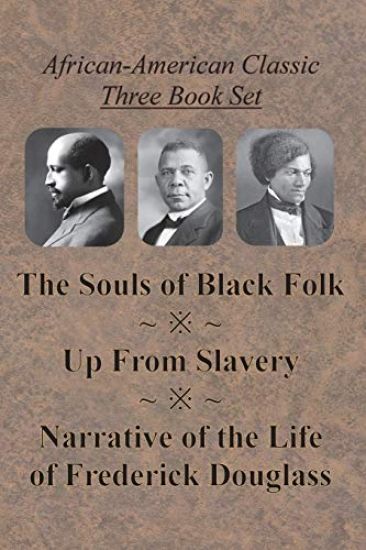
African-American Classic Three Book Set - The Souls of Black Folk, Up From Slavery, and Narrative of the Life of Frederick Douglass
W E B Du Bois; Booker T Washington; Frederick Douglass
Chump Change
1903
pokkari
Complete African-American Classic Three Book Set, includes The Souls of Black Folk, Up From Slavery, and Narrative of the Life of Frederick Douglass. The foundational civil rights works on race relations in America, the slave narratives, in their own voices. This is their story in one volume.From The Souls of Black Folk: "Herein lie buried many things which if read with patience may show the strange meaning of being black here at the dawning of the Twentieth Century.... I have sought here to sketch, in vague, uncertain outline, the spiritual world in which ten thousand thousand Americans live and strive."From Up From Slavery: "I have begun everything with the idea that I could succeed, and I never had much patience with the multitudes of people who are always ready to explain why one cannot succeed."From the 1845 text Narrative of the Life of Frederick Douglass: "My mother was named Harriet Bailey." "My father was a white man." "I have had two masters." "...my escape from slavery."All students of thought should get this historic set. This edition is provided in a slim volume with full text at an affordable price. TABLE OF CONTENTSTHE SOULS OF BLACK FOLK 3UP FROM SLAVERY 91NARRATIVE OF THE LIFE OF FREDERICK DOUGLASS 181

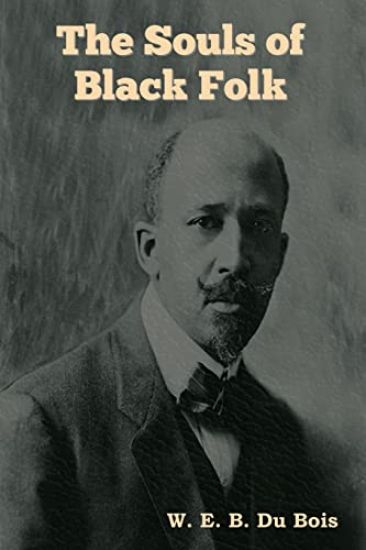
The Souls of Black Folk is a classic work of American literature by W. E. B. Du Bois. It is a seminal work in the history of sociology, and a cornerstone of African-American literary history.The book, published in 1903, contains several essays on race, some of which had been previously published in Atlantic Monthly magazine. Du Bois drew from his own experiences to develop this groundbreaking work on being African American in American society. Outside of its notable place in African-American history, The Souls of Black Folk also holds an important place in social science as one of the early works to deal with sociology. BIO: William Edward Burghardt Du Bois (February 23, 1868 - August 27, 1963) was an American civil rights activist, Pan-Africanist, sociologist, historian, author, and editor. Historian David Levering Lewis wrote, "In the course of his long, turbulent career, W. E. B. Du Bois attempted virtually every possible solution to the problem of twentieth-century racism- scholarship, propaganda, integration, national self-determination, human rights, cultural and economic separatism, politics, international communism, expatriation, third world solidarity."The first African-American graduate of Harvard University, where he earned his Ph.D in History, Du Bois later became a professor of history and economics at Atlanta University. He became the head of the National Association for the Advancement of Colored People (NAACP) in 1910, becoming founder and editor of the NAACP's journal The Crisis. Du Bois rose to national attention in his opposition of Booker T. Washington's ideas of social integration between whites and blacks, campaigning instead for increased political representation for blacks in order to guarantee civil rights, and the formation of a Black elite that would work for the progress of the African American race.

For as long as I can remember, I always wanted to be a pilot, and when I first saw F-80 fighter jets making practice gunnery passes on a firefighting training tower in Anchorage, Alaska, I knew I had to become a fighter pilot. This experience happened when I was 12 years of age and during the period of the Korean War. Seventeen years later I was invited to join the Oregon Air National and informed that I was going to become a fighter pilot in the 123rd Fighter Interceptor Squadron, in Portland, Oregon. The squadron is known as the "Redhawks,"My journey in this chapter of my life began in Miles City, Montana, the place of my birth. Miles City bills itself as "The Cow Capital of the West", holds an annual bucking horse sale in May of each year, and was the only American city in the contiguous United States to be bombed during World War II. That feat was accomplished by our own U.S. Army Air Corps. On both sides of my family, my grandparents were ranchers and farmers, and the hired workers on the ranch were trustees from the Miles City jail, reform school teenagers, and German POWs. I spent summers in the country and rode a full-size horse at the age of five. I didn't ride a bicycle, however, until the age of eight when my family moved west to Portland, Oregon.Circumstances in my life, extending into early adulthood, generated a host of highly unusual real-life stories, ranging from the humorous to the tragic, several of which were woven into the fabric of then-current events that made their mark in history. The interesting people I came into contact with during these events contributed significantly to the richness of the experiences.A divorce and remarriages by both of my parents sent my already active early life into a tumultuous spin. In eight grades of schooling, I attended six different elementary schools in three different states plus the Territory of Alaska. Although we were settled for my years in high school and college, those disruptive moves created a restlessness within me that made it a challenge at times to remain focused on my studies. My selection as the University's Air Force ROTC Drill Team Commander and the program's Flight Indoctrination Program in which I received my Private Pilot License, imbued me with the direction and confidence I needed to successfully complete Air Force pilot training which I did in South Georgia.My first assignment after pilot training was as a T-33 jet pilot training instructor in Texas. The T-33 was the trainer version of the Korean War vintage F-80. In meeting my "need for speed", I later converted as an instructor into the supersonic T-38 trainer. After four years of instructing basic flight training, I was reassigned to Korea as a Forward Air Controller and became the Air Division's T-33 flight program manager. When I completed this overseas tour, at the height of the Air War in Vietnam, I resigned from the Air Force and joined the Oregon Air National Guard. This started a new chapter in my life.

For as long as I can remember, I always wanted to be a pilot, and when I first saw F-80 fighter jets making practice gunnery passes on a firefighting training tower in Anchorage, Alaska, I knew I had to become a fighter pilot. This experience happened when I was 12 years of age and during the period of the Korean War. Seventeen years later I was invited to join the Oregon Air National and informed that I was going to become a fighter pilot in the 123rd Fighter Interceptor Squadron, in Portland, Oregon. The squadron is known as the "Redhawks,"My journey in this chapter of my life began in Miles City, Montana, the place of my birth. Miles City bills itself as "The Cow Capital of the West", holds an annual bucking horse sale in May of each year, and was the only American city in the contiguous United States to be bombed during World War II. That feat was accomplished by our own U.S. Army Air Corps. On both sides of my family, my grandparents were ranchers and farmers, and the hired workers on the ranch were trustees from the Miles City jail, reform school teenagers, and German POWs. I spent summers in the country and rode a full-size horse at the age of five. I didn't ride a bicycle, however, until the age of eight when my family moved west to Portland, Oregon.Circumstances in my life, extending into early adulthood, generated a host of highly unusual real-life stories, ranging from the humorous to the tragic, several of which were woven into the fabric of then-current events that made their mark in history. The interesting people I came into contact with during these events contributed significantly to the richness of the experiences.A divorce and remarriages by both of my parents sent my already active early life into a tumultuous spin. In eight grades of schooling, I attended six different elementary schools in three different states plus the Territory of Alaska. Although we were settled for my years in high school and college, those disruptive moves created a restlessness within me that made it a challenge at times to remain focused on my studies. My selection as the University's Air Force ROTC Drill Team Commander and the program's Flight Indoctrination Program in which I received my Private Pilot License, imbued me with the direction and confidence I needed to successfully complete Air Force pilot training which I did in South Georgia.My first assignment after pilot training was as a T-33 jet pilot training instructor in Texas. The T-33 was the trainer version of the Korean War vintage F-80. In meeting my "need for speed", I later converted as an instructor into the supersonic T-38 trainer. After four years of instructing basic flight training, I was reassigned to Korea as a Forward Air Controller and became the Air Division's T-33 flight program manager. When I completed this overseas tour, at the height of the Air War in Vietnam, I resigned from the Air Force and joined the Oregon Air National Guard. This started a new chapter in my life.
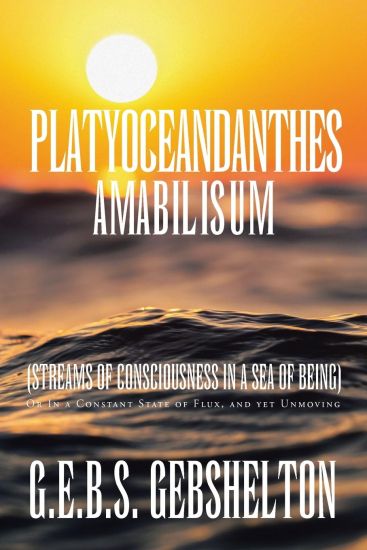
Platyoceandanthes amabilisum (Streams of Consciousness in a Sea of Being)
G E B S Gebshelton
Archway Publishing
2023
pokkari
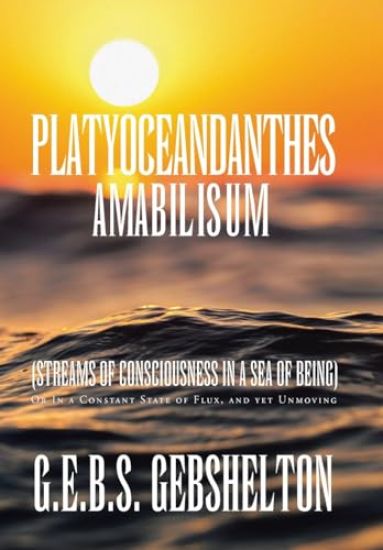
Platyoceandanthes amabilisum (Streams of Consciousness in a Sea of Being)
G E B S Gebshelton
Archway Publishing
2023
sidottu
The author utilizes metaphor, simile and the occasional reference to make one ponder and self-reflect. Through the use of streams of conscious, he encourages self-hypnosis or creative visualization that allows us to imagine our capabilities or to see our possibilities before making changes in our lives. Stressing the importance of remaining child-like when appropriate, allowing whimsey and daydreaming to stay an active exercise in our lives, the author stresses the importance of seeing what we are looking at, like a visual artist, but with word usage. A repeated theme places us on a cruise ship, staring out to where the sea meets the sky. By allowing ourselves to look outside of ourselves, we try to find meaning in our lives. Another repeated theme is that of defining or characterizing entities in ways to establish order and place expectations so that we conform or behave in ways as others would expect us to perform or behave. The author would encourage us to challenge such defining and characterizations, in order to develop a stronger sense of who we are. Bonus writings relating to changes imposed upon us by Covid and other World events, should seem meaningful to all of us, and likely in very different ways. Do you think we have learned anything from our Covid experiences? Would the author's use of metaphor improve how we see ourselves, and our places in other people's lives? Spotting a sea serpent along the voyage would add even more self-awareness and insight.

Families with a dark past, who now must ingest poison to survive are outcasts in their home city. In the beginning they were ostracised, threatened to be forced into the deadly and magical woods with the rest of the monsters. They decided they would prove themselves of value to the people of Khaizville, they would appeal to the interests they kept hidden away in their closets. In order to ensure that they would not be hidden away in turn. Although they are tolerated in the present day, the past clings to them in the form of curses. Now the clock is ticking as something has caused their curses to contort and an old enemy is knocking on their doors.
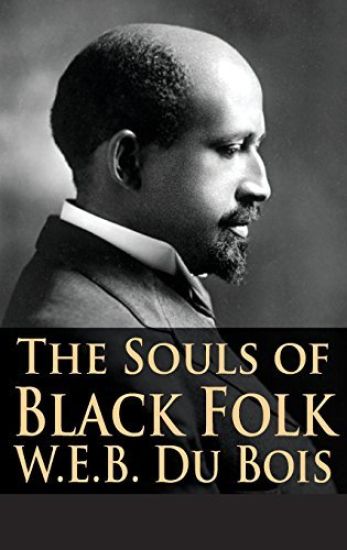
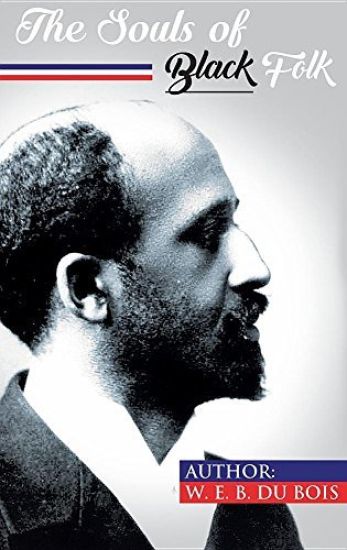
The Souls of Black Folk
W E B Du Bois; William Edward Burghardt Du Bois
www.bnpublishing.com
2016
sidottu