Newport, Rhode Island, was the summer playground of the Gilded Age for the Astors, Belmonts and Vanderbilts. They built lavish villas designed by the best Beaux Arts-style architects of the time, including Richard Morris Hunt, Charles McKim and Robert Swain Peabody. America's elite delighted in referring to these grand retreats as "summer cottages," where they would play tennis and polo and sail their yachts along the shores of the Ocean State. The coachman had an important role as the discreet outdoor butler for Gilded Age gentlemen--not only was he in charge of the horses, but he also acted as a travel advisor and connoisseur of entertainment venues. From the driver's seat, author and guide Edward Morris provides a diverse collection of biographical sketches that reveal the outrageous and opulent lives of some of America's leading entrepreneurs.
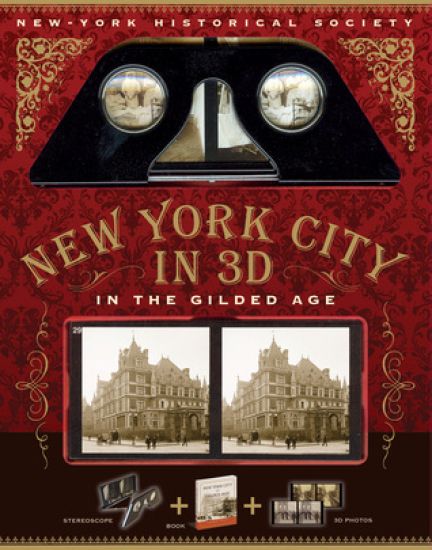
Be transported to New York during the Gilded Age and experience daily life in one of the world's most vibrant cities through mesmerizing, contemporary 3D photography and exciting tales of the time.Black Dog & Leventhal has partnered with the New-York Historical Society to present New York in the Gilded Age as it's never been viewed before. This innovative package includes a sturdy metal stereoscopic viewer and 50 stereoscopic photographs of turn-of-the-century New York. The package also includes a 128-page paperback that provides a brief history of the stereograph craze and an overview of the city's evolution during that time.Mark Twain coined the term the 'Gilded Age' for this period of extravagance, experienced most dramatically in New York City from the late 1860s to 1910. More than half of the millionaires in the United States lived in the city. Previously unimaginable sums of money were made and spent, while poor immigrants were packed in tenements. The gap between the rich and the poor was wide, yet wealth was flaunted at every opportunity, from showy parties to lavish clothing and richly furnished mansions. The period also saw great innovations for all, including the New York City subway system, electric lighting, and the first urban ambulance service. New York City in 3D in the Gilded Age encapsulates a city determinedly positioned at the forefront of culture, politics, and innovation and includes vivid firsthand accounts from writers, politicians, and residents during this period.Detailed descriptions of the scenes depicted in each stereographic photograph are included on the back of the photo.
In the tradition of Matthew Desmond's Evicted, a longtime housing activist presents a vivid and myth-breaking account of why homelessness endures in contemporary America... Millions of people are affected by homelessness, but media pundits and politicians see homelessness as a social work problem, or a matter of personal pathology, or some peculiar subspecies of urban poverty. Informed by the author's own front-line experiences from more than two decades working as an advocate for homeless people in New York City and his work with housing activists across the country. Placeless: Homelessness in the New Gilded Age presents an alternative and innovative, wide-angle view of homelessness and displacement in New York and elsewhere. A tour of the geography of homelessness in New York City, where some 100,000 people a night sleep in the city's shelter system, Markee visits certain city landmarks where homeless New Yorkers struggle to survive: armories once built to quarter militias who put down worker uprisings a train tunnel underneath Riverside Parka grim intake center where infants, children, and families were forced to sleep on office floorsa former psychiatric wing of Bellevue Hospital now sheltering hundreds of homeless men each nighta Manhattan park surrounded by luxury condos where the police routinely harassed homeless street-dwellersBlending historical analysis, urban theory, and the latest policy research, Markee considers homelessness in America as a tragic yet inevitable consequence of economic shifts inaugurated in the Reagan era, worsening inequality and housing affordability, systemic racism, and neoliberal government policies. At a moment where tabloids and politicians use homelessness as an excuse to whip up fear, Placeless is a powerful and moving account of a social problem whose solution is entirely possible.
Extraordinary voyages, fantastic inventions, and challenging questions about technology, race, gender, the future, and the meaning of the United States of America. The period between the Civil War and the Great War - dubbed the "Gilded Age" by Mark Twain - was the crucible of modern America and few genres were as suited to grapple with its troubles and opportunities as speculative fiction. This volume features rarely reprinted stories by such authors as Mark Twain and fellow humorist Ellis Parker Butler, pioneering feminist author Charlotte Perkins Gilman, African American activist Sutton E. Griggs, science writer Garrett P. Serviss (the Neil deGrasse Tyson of his day), Jack London, dime novelist Edward S. Ellis, and John Jacob Astor IV, the richest man to die aboard the Titanic. "Science Fiction of America's Gilded Age" also includes a new introduction by editor C.W. Gross, creator and writer of "Voyages Extraordinaires: Scientific Romances in a Bygone Age," (http: //voyagesextraordinaires.blogspot.com/) the preeminent weblog dedicated to Victorian-Edwardian science fiction, horror, fantasy, history, and retro-futurism.
The Horatio Alger myth has worked itself deeply into American culture. Even those who have never read one of his stories and many who could not identify him have come to believe that honest, industrious adolescents can easily rise from poverty to respectability. That conviction has reinforced notions of capitalism and the Protestant work ethic. It has also strengthened a sense of naïve optimism that in America things will always get better. The two stories here, one of which violates convention by featuring a heroine rather than a hero, invite a close examination of how Alger’s fictional protagonists win out. Readers will discover that the often used phrase rags-to-riches does not describe the career of the typical Alger hero, whose progress is rather from adversity to a solid and respectable place in society. A critical introduction examines the ratio of reality to sentimentality in Alger’s work. And since the author intended the stories to be not time-bound but applicable and determinative in all circumstances, the tales invite speculation as to how relevant they are to the changed economic and social circumstances of later times.
Her royal duty may protect her, but all that glitters is not gold.Kolfinna has survived the Eventyrslot ruins and won her illustrious position with the Royal Guard, but she soon discovers her new life may not be all it's cut out to be. With the Hunter's Association gaining influence and more enemies trying to take her status away, she's one mistake away from losing her position-and her life.The looming threat of the hunters isn't her only problem-strange and powerful monsters are encroaching on the border, and when Bl r approaches her with a request from the military to investigate, Kolfinna realizes this is the opportunity she needs to prove her loyalty and keep her position.But the monsters at the border are more vicious and ancient than anyone could have imagined, and the secrets bordering the fae lands may uncover a devastating truth that will change Kolfinna's life forever.
Wagnerism dominated American cultural and intellectual life of the late nineteenth century. The central apostle was the conductor Anton Seidl, a prot g and surrogate son of the composer. Seidl arrived in the US in 1885. His life's mission became the propagation of Wagner in the US. In this capacity, his influence was immense - greater than Toscanini or Bernstein in decades to come. His early death, in1898, preceded the advent of broadcasts and recordings. In The Disciple, Seidl is remembered as a man beset by hidden sorrow. In a sense, he never recuperated from Wagner's death in 1882 - Seidl was then 32 years old. The impact of the Wagner personality was indelible - and not only on Seidl. The larger picture: the late Gilded Age marked the apex of classical music in the US. Seidl and Antonin Dvorak (also in The Disciple) were the most prominent, most influential personalities. Not much later came Gustav Mahler (1908-1911) - and The Disciple is in fact a prequel to Horowitz's acclaimed The Marriage: The Mahlers in New York. Both books argue that historical fiction can become an indispensable tool for cultural history. The principal secondary character of the novel is Laura Langford, who as founder of the Seidl Society became the most important concert impresario in Brooklyn. The Seidl Society presented Seidl in concert fourteen times a week at Coney Island's Brighton Beach resort. On Wagner Nights, the 3,000-seat music pavilion would fill to capacity. In winter, the Society presented Seidl in concert at the Brooklyn Academy of Music. This story is very little known. In fact, most American Wagnerites were women for whom Wagner afforded a necessary opportunity for emotional release.
They are sworn enemies...Theodore Prescott the Third, one of Manhattan's Rogues of Millionaire Row, has really done it this time. The only way to survive his most recent, unspeakably outrageous scandal is marry someone respectable. Someone sensible. Someone like Daisy Swann. Of all the girls in Gilded Age Manhattan, it had to be her.Pretending to be lovers...Daisy Swann has plans and they do not involve a loveless marriage with anyone. But when a devastating family secret threatens to destroy her standing in society, suddenly a fake engagement with Theo is just the thing to make all her dreams come true.And now it's time to kiss and make up...Daisy Swann aspires to sell cosmetics that she has created, but this brainy scientist needs a smooth talking charmer's flair for words and eye for beauty to make it a success. Before long, Daisy and Theo are trading kisses. And secrets. And discovering that despite appearances, they might be the perfect couple after all.
SOMOS MUJERES O SOMOS DEMONIOS? ELLA PODR A SER LA CLAVE PARA SALVAR EL IMPERIO. O SU MAYOR AMENAZA. Han pasado seis meses desde que Deka liber a las diosas y descubri su identidad y la de sus compa eras, pero la verdadera batalla solo acaba de empezar. Una temible fuerza oscura, siniestra e inclemente amenaza a la humanidad y a las alaki. Deka deber hacerle frente, pero a n no ha logrado recuperar sus poderes, por lo que su arma m s mort fera podr a ser ella misma. ENGLISH DESCRIPTION INSTANT NEW YORK TIMES BESTSELLER NAMED ONE OF THE BEST BOOKS OF THE YEAR BY TEEN VOGUE Sixteen-year-old Deka lives in fear and anticipation of the blood ceremony that will determine whether she will become a member of her village. Already different from everyone else because of her unnatural intuition, Deka prays for red blood so she can finally feel like she belongs. But on the day of the ceremony, her blood runs gold, the color of impurity-and Deka knows she will face a consequence worse than death. Then a mysterious woman comes to her with a choice: stay in the village and submit to her fate, or leave to fight for the emperor in an army of girls just like her. They are called alaki-near-immortals with rare gifts. And they are the only ones who can stop the empire's greatest threat. Knowing the dangers that lie ahead yet yearning for acceptance, Deka decides to leave the only life she's ever known. But as she journeys to the capital to train for the biggest battle of her life, she will discover that the great walled city holds many surprises. Nothing and no one are quite what they seem to be-not even Deka herself. A dark feminist tale spun with blood and gold. Must read -Dhonielle Clayton, New York Times bestselling author of The Belles
L'imperatore Tiberio, cinque anni dopo la crocefissione di Ges , invia in Giudea un "procurator" per imporre una strategia di controllo delle manifestazioni d'intolleranza dottrinarie verso le comunit dei seguaci del Cristo e per indagare sulla sua morte. Il "procurator", interrogando i personaggi che ne hanno avuto parte, ricostruisce quella drammatica successione di eventi identificati con "Passione di Cristo". Vengono cos analizzate, in incalzante successione, fasi della vita pubblica di Ges e ricostruite le circostanze della cattura, il processo davanti al prefetto romano Pilato e davanti al Sinedrio, le fasi del martirio e lo sconcerto del sepolcro vuoto. La parte teologica ed i fondamenti della dottrina del Cristo sono affidati al commento del dotto Nicodemo. E mentre a Roma divampava la prima persecuzione dei cristiani al di fuori della Palestina, qui, i conflitti settari facevano esplodere la prima guerra giudaico-romana con la distruzione del Tempio di Gerusalemme.