Kirjojen hintavertailu. Mukana 12 595 353 kirjaa ja 12 kauppaa.

Kirjahaku

Etsi kirjoja tekijän nimen, kirjan nimen tai ISBN:n perusteella.

1000 tulosta hakusanalla J. J. Stephens

The Interior West

The Interior West

Stephen J. Pyne

University of Arizona Press
2018
nidottu
Its fires help give to the Interior West a peculiar character, fundamental both to its natural and human histories. While a general aridity unites the region, defined here as the states of Nevada, Utah, and western Colorado, its fires illuminate the ways its various parts show profoundly different landscapes, biotas, and human settlement experiences.In this book, fire historian Stephen J. Pyne explains the relevance of the region to the national fire scene. The Interior West offered the first scientific inquiry into landscape fire in the United States, including a map of Utah burns published in 1878 as part of John Wesley Powell’s arid lands report. Then its significance faded and by the 20th century, the region had become the hole in the national donut of fire management. Pyne discusses the region’s more recent return to prominence due to fires along its front ranges; to invasive species, both exotics like cheatgrass and unleashed natives like mountain pine beetle; and to its fatality fires, notably at South Canyon in 1994.The Interior West shows the variety of fire issues in the region and their significance to the country overall through thoughtful framing and lively essays.
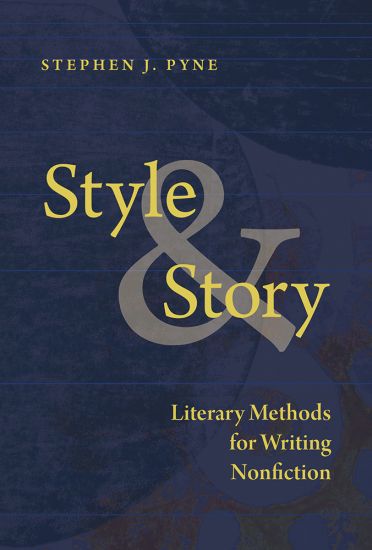
Style and Story

Style and Story

Stephen J. Pyne

University of Arizona Press
2018
nidottu
There are two basic rules for writing nonfiction, says historian and award-winning author Stephen J. Pyne. Rule 1: You can't make stuff up. Rule 2: You can't leave out known stuff that affects our understanding. Follow these rules, and you are writing nonfiction. Writing for different audiences and genres will require further guidelines. But all readers expect that style and story (or more broadly, theme) will complement one another. Style and Story is for those who wish to craft nonfiction texts that do more than simply relay facts and arguments. Pyne explains how writers can employ literary tools and strategies to have art and craft add value to their theme. With advice gleaned from nearly a dozen years of teaching writing to graduate students, Pyne offers pragmatic guidance on how to create powerful nonfiction, whether for an academic or popular audience. Each chapter offers samples that span genres, showcasing the best kinds of nonfiction writing. Pyne analyzes these examples that will help writers understand how they can improve their nonfiction through their choice of voice, words, structure, metaphors, and narrative. Pyne builds on his previous guide, Voice and Vision, expanding the range of topics to include openings and closings, humor and satire, historical writing, setting scenes, writing about technical matters and deep details, long and short narration, reading for craft, and thoughts on writing generally. He also includes in this volume a set of exercises to practice writing techniques. Style and Story will be treasured by anyone, whether novice or expert, who seeks guidance to improve the power of their nonfiction writing.
Here and There

Here and There

Stephen J. Pyne

University of Arizona Press
2018
nidottu
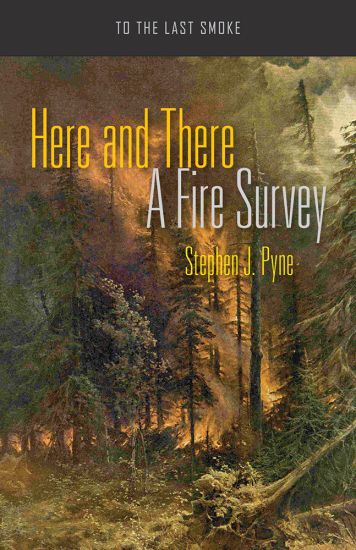
Fire is special. Even among the ancient elements, fire is different because it alone is a reaction. It synthesizes its surroundings; it takes its character from its context. It varies by place, by culture, and by time. It has no single expression. There is no single way to understand it. The latest book in the To the Last Smoke series, Here and There explores how singular moments create prisms by which to understand fire. In this collection of essays, historian and renowned fire expert Stephen J. Pyne offers his reflections on national and global wildland fire management, explains how fire policy has changed within the United States and how it differs from other countries, muses on the next wave of fire research, explains the history of one of the most famous fire paintings of all time, and distills the long saga of fire on Earth and its role in underwriting an Anthropocene that might equally be called a Pyrocene. Presented through a mixture of journalism, history, and literary imagination, Here and There moves the discussion of fire beyond the usual formations of science and policy within a national narrative to one of thoughtful interpretation, analysis, and commentary. Centered on the unique complexities of fire management in a global world, Here and There offers a punctuation point to our understanding of wildfire.
Slopovers

Slopovers

Stephen J. Pyne

University of Arizona Press
2019
nidottu
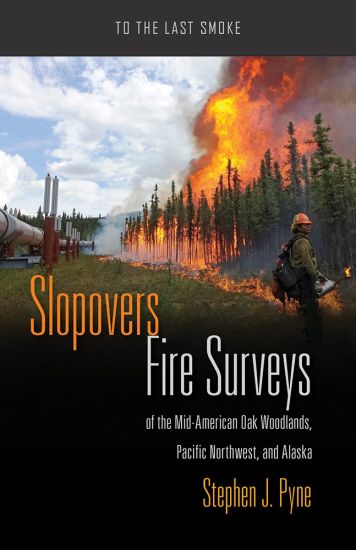
America is not simply a federation of states but a confederation of regions. Some have always held national attention, some just for a time. Slopovers examines three regions that once dominated the national narrative and may now be returning to prominence.The Mid-American oak woodlands were the scene of vigorous settlement in the late eighteenth and early nineteenth centuries and thus the scene of changing fire practices. The debate over the origin of the prairies—by climate or fire—foreshadowed the more recent debate about fire in oak and hickory hardwoods. In both cases, today's thinking points to the critical role of fire.The Pacific Northwest was the great pivot between laissez-faire logging and state-sponsored conservation and the fires that would accompany each. Then fire faded as an environmental issue. But it has returned over the past decade like an avenging angel, forcing the region to again consider the defining dialectic between axe and flame.And Alaska—Alaska is different, as everyone says. It came late to wildland fire protection, then managed an extraordinary transfiguration into the most successful American region to restore something like the historic fire regime. But Alaska is also a petrostate, and climate change may be making it the vanguard of what the Anthropocene will mean for American fire overall.Slopovers collates surveys of these three regions into the national narrative. With a unique mixture of journalism, history, and literary imagination, renowned fire expert Stephen J. Pyne shows how culture and nature, fire from nature and fire from people, interact to shape our world with three case studies in public policy and the challenging questions they pose about the future we will share with fire.
The Northeast

The Northeast

Stephen J. Pyne

University of Arizona Press
2019
nidottu
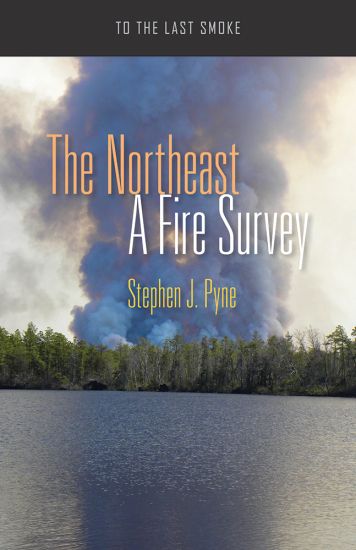
Repeatedly, if paradoxically, the Northeast has led national developments in fire. Its intellectuals argued for model preserves in the Adirondacks and at Yellowstone, oversaw the first mapping of the American fire scene for the 1880 census, staffed the 1896 National Academy of Sciences forest commission that laid down guidelines for the national forests, and spearheaded legislation that allowed those reserves to expand by purchase. It trained the leaders who staffed those protected areas and produced most of America's first environmentalists.The Northeast has its roster of great fires, beginning with dark days in the late 18th century, followed by a chronicle of conflagrations continuing as late as 1903 and 1908, with a shocking after-tremor in 1947. It hosted the nation's first forestry schools. It organized the first interstate (and international) fire compact. And it was the Northeast that pioneered the transition to the true Big Burn—industrial combustion—as America went from burning living landscapes to burning lithic ones.In this new book in the To the Last Smoke series, renowned fire expert Stephen J. Pyne narrates this history and explains how fire is returning to a place not usually thought of in America's fire scene. He examines what changes in climate and land use mean for wildfire, what fire ecology means for cultural landscapes, and what experiments are underway to reintroduce fire to habitats that need it. The region's great fires have gone; its influence on the national scene has not.The Northeast: A Fire Survey samples the historic and contemporary significance of the region and explains how it fits into a national cartography and narrative of fire.Included in this volume:How the region shaped America's understanding and policy toward fireHow fire fits into the region today and what that means for the country overallWhat changes in climate, land use, and institutions may mean for northeastern fire, both wild and tame
To the Last Smoke

To the Last Smoke

Stephen J. Pyne

University of Arizona Press
2020
nidottu
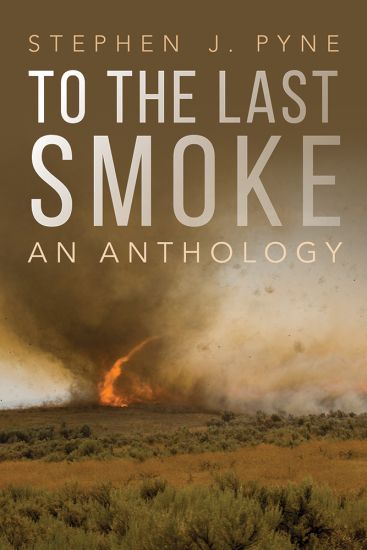
From boreal Alaska to subtropical Florida, from the chaparral of California to the pitch pine of New Jersey, America boasts nearly a billion burnable acres. In nine previous volumes, Stephen J. Pyne has explored the fascinating variety of flame region by region. In To the Last Smoke: An Anthology he selects a sampling of the best from each.To the Last Smoke offers a unique and sweeping view of the nation's fire scene by distilling observations on Florida, California, the Northern Rockies, the Great Plains, the Southwest, the Interior West, the Northeast, Alaska, the oak woodlands, and the Pacific Northwest into a single, readable volume. The anthology functions as a color-commentary companion to the play-by-play narrative offered in Pyne's Between Two Fires: A Fire History of Contemporary America. The series is Pyne's way of 'keeping with it to the end,' encompassing the directive from his rookie season to stay with every fire 'to the last smoke.'
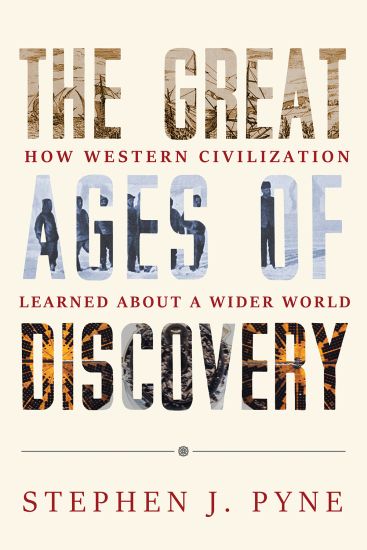
The Great Ages of Discovery

The Great Ages of Discovery

Stephen J. Pyne

University of Arizona Press
2021
sidottu
For more than 600 years, Western civilization has relied on exploration to learn about a wider world and universe. The Great Ages of Discovery details the different eras of Western exploration in terms of its locations, its intellectual contexts, the characteristic moral conflicts that underwrote encounters, and the grand gestures that distill an age into its essence. Historian and MacArthur Fellow Stephen J. Pyne identifies three great ages of discovery in his fascinating new book. The first age of discovery ranged from the early 15th to the early 18th century, sketched out the contours of the globe, aligned with the Renaissance, and had for its grandest expression the circumnavigation of the world ocean. The second age launched in the latter half of the 18th century, spanning into the early 20th century, carrying the Enlightenment along with it, pairing especially with settler societies, and had as its prize achievement the crossing of a continent. The third age began after World War II, and, pivoting from Antarctica, pushed into the deep oceans and interplanetary space. Its grand gesture is Voyager's passage across the solar system. Each age had in common a galvanic rivalry: Spain and Portugal in the first age, Britain and France-followed by others-in the second, and the USSR and USA in the third. With a deep and passionate knowledge of the history of Western exploration, Pyne takes us on a journey across hundreds of years of geographic trekking. The Great Ages of Discovery is an interpretive companion to what became Western civilization's quest narrative, with the triumphs and tragedies that grand journey brought, the legacies of which are still very much with us.
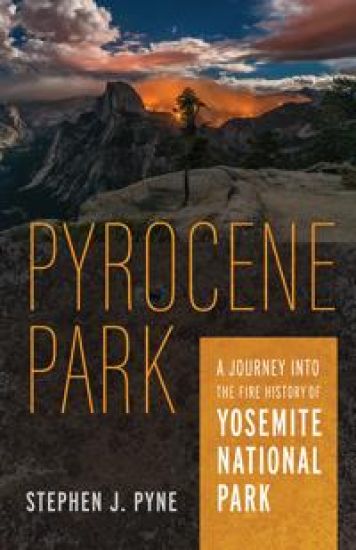
Pyrocene Park

Pyrocene Park

Stephen J. Pyne

University of Arizona Press
2023
nidottu
Its monumental rocks, etched by glaciers during the last Ice Age, have made Yosemite National Park a crown jewel of the national park system and a world-celebrated destination. Yet, more and more, fire rather than ice is shaping this storied landscape. In the last decade, fire has blasted into public attention. California’s blazes have captured national and global media interest with their drama and urgency. Expand the realm of fire to include the burning of fossil fuels, and the fire story also subsumes climate change. Renowned fire historian Stephen J. Pyne argues that the relationship between fire and humans has become a defining feature of our epoch, and he reveals how Yosemite offers a cameo of how we have replaced an ice age with a fire age: the Pyrocene. Organized around a backcountry trek to a 50-year experiment in restoring fire, Pyrocene Park describes the 150-year history of fire suppression and management that has led us, in part, to where the park is today. But there is more. Yosemite’s fire story is America’s, and the Earth’s, as it shifts from an ice-informed world to a fire-informed one. Pyrocene Park distills that epic story into a sharp miniature. Flush with people, ideas, fires, and controversy, Pyrocene Park is a compelling and accessible window into the American fire scene and the future it promises.
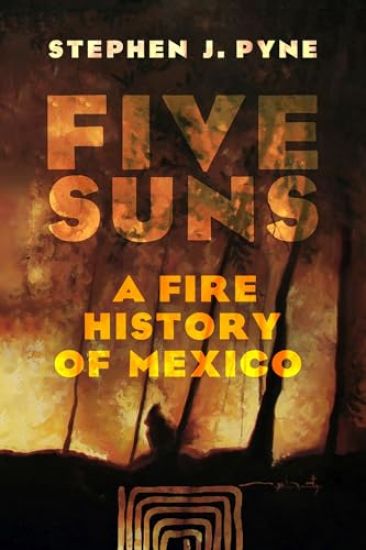
Five Suns

Five Suns

Stephen J. Pyne

University of Arizona Press
2024
sidottu
A climate defined by wet and dry seasons, a mostly mountainous terrain, a biota prone to disturbances, a human geography characterized by a diversity of peoples all of whom rely on burning in one form or another: Mexico has ideal circumstances for fire, and those fires provide a unique perspective on its complex history. Narrating Mexico’s evolution of fire through five eras, historian Stephen J. Pyne describes the pre-human, pre-Hispanic, colonial, industrializing (1880–1980), and contemporary (1980–2015) fire biography of this diverse and dynamic country. Creatively deploying the Aztec New Fire Ceremony and the “five suns” that it birthed, Pyne addresses the question, “Why does fire appear in Mexico the way it does?” Five Suns tells the saga through a pyric prism. Mexico has become one of the top ten “firepowers” in the world today through its fire suppression capabilities, fire research, and industrial combustion, but also by those continuing customary practices that have become increasingly significant to a world that suffers too much combustion and too little fire.Five Suns completes a North American fire-history trilogy written by Pyne over the past 40 years, complementing his histories of Canada and the United States.
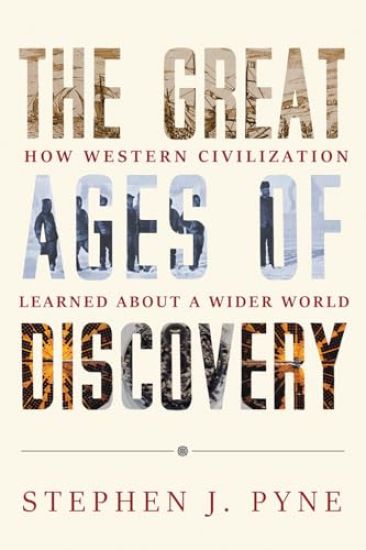
The Great Ages of Discovery

The Great Ages of Discovery

Stephen J. Pyne

University of Arizona Press
2025
nidottu
For more than 600 years, Western civilization has relied on exploration to learn about a wider world and universe. The Great Ages of Discovery details the different eras of Western exploration in terms of its locations, its intellectual contexts, the characteristic moral conflicts that underwrote encounters, and the grand gestures that distill an age into its essence. Historian and MacArthur Fellow Stephen J. Pyne identifies three great ages of discovery in his fascinating new book. The first age of discovery ranged from the early 15th to the early 18th century, sketched out the contours of the globe, aligned with the Renaissance, and had for its grandest expression the circumnavigation of the world ocean. The second age launched in the latter half of the 18th century, spanning into the early 20th century, carrying the Enlightenment along with it, pairing especially with settler societies, and had as its prize achievement the crossing of a continent. The third age began after World War II, and, pivoting from Antarctica, pushed into the deep oceans and interplanetary space. Its grand gesture is Voyager's passage across the solar system. Each age had in common a galvanic rivalry: Spain and Portugal in the first age, Britain and France - followed by others - in the second, and the USSR and USA in the third. With a deep and passionate knowledge of the history of Western exploration, Pyne takes us on a journey across hundreds of years of geographic trekking. The Great Ages of Discovery is an interpretive companion to what became Western civilization's quest narrative, with the triumphs and tragedies that grand journey brought, the legacies of which are still very much with us.
Globalization and Empire

Globalization and Empire

Stephen J. Hartnett; Laura Ann Stengrim

The University of Alabama Press
2009
nidottu
In this careful and comprehensive study of the United States' war on Iraq, Hartnett and Stengrim offer a critique of the Bush administration's arguments for waging war, an examination of the foreign policy principles driving the war, an analysis of the economic dilemmas of globalization, and an expose of the inner workings of the reconstruction of Iraq.
Colombia and the United States

Colombia and the United States

Stephen J. Randall

University of Georgia Press
1992
pokkari
Strategically located at the gateway to the South American continent, Colombia has long been a key player in shaping the United States' involvement with its Latin American neighbors. In this book Stephen J. Randall examines the course of U.S.-Colombian relations over two centuries, taking into account the broad spectrum of political, social, cultural, and economic contacts that have figured in the interaction.A leader in the movement for independence from Spain in the early nineteenth century, Colombia shared with the United States the aspiration of becoming a leader for the entire hemisphere. Its early efforts in this direction—notably its initiation in the 1820s of the first Pan-American Conference—soon languished, however, as the unequal growth between the two countries took its toll. By the turn of the century, after years of destructive civil war, Colombia had slipped far behind its northern neighbor militarily, economically, and politically. The United States, meanwhile, had emerged as a great power, and the first major manifestation of the two countries' divergence came with the U.S.-supported secession of Panama in 1903—an event that deeply shocked Colombians and tainted their view of the United States for subsequent generations.During the twentieth century, Randall explains, a tension in Colombian politics and culture has persisted between those who advocate an independent, even antagonistic, stance toward the United State
Canada and the United States

Canada and the United States

John Herd Thompson; Stephen J. Randall

University of Georgia Press
2002
nidottu
From the American Revolution to NAFTA to the Helms-Burton Act and beyond, Canada and the United States offers a current, thoughtful assessment of relations between the two countries. Distilling a mass of detail concerning cultural, economic, and political developments of mutual importance during the past two centuries, this survey enables readers to grasp quickly the essence of the shared experience of these two countries.
Canada and the United States

Canada and the United States

John Herd Thompson; Stephen J. Randall

University of Georgia Press
2008
pokkari
The United States and Canada have the world’s largest trading relationship and the longest shared border. Spanning the period from the American Revolution to post-9/11 debates over shared security, Canada and the United States offers a current, thoughtful assessment of relations between the two countries. Distilling a mass of detail concerning cultural, economic, and political developments of mutual importance over more than two centuries, this survey enables readers to grasp quickly the essence of the shared experience of these two countries.This edition of Canada and the United States has been extensively rewritten and updated throughout to reflect new scholarly arguments, emphases, and discoveries. In addition, there is new material on such topics as energy, the environment, cultural and economic integration, the wars in Iraq and Afghanistan, border security, missile defense, and the second administration of George W. Bush.
Colombia and the United States

Colombia and the United States

Stephen J. Randall

University of Georgia Press
2017
sidottu
Strategically located at the gateway to the South American continent, Colombia has long been a key player in shaping the United States' involvement with its Latin American neighbors. In this book Stephen J. Randall examines the course of U.S.-Colombian relations over two centuries, taking into account the broad spectrum of political, social, cultural, and economic contacts that have figured in the interaction.A leader in the movement for independence from Spain in the early nineteenth century, Colombia shared with the United States the aspiration of becoming a leader for the entire hemisphere. Its early efforts in this direction—notably its initiation in the 1820s of the first Pan-American Conference—soon languished, however, as the unequal growth between the two countries took its toll. By the turn of the century, after years of destructive civil war, Colombia had slipped far behind its northern neighbor militarily, economically, and politically. The United States, meanwhile, had emerged as a great power, and the first major manifestation of the two countries' divergence came with the U.S.-supported secession of Panama in 1903—an event that deeply shocked Colombians and tainted their view of the United States for subsequent generations.During the twentieth century, Randall explains, a tension in Colombian politics and culture has persisted between those who advocate an independent, even antagonistic, stance toward the United State
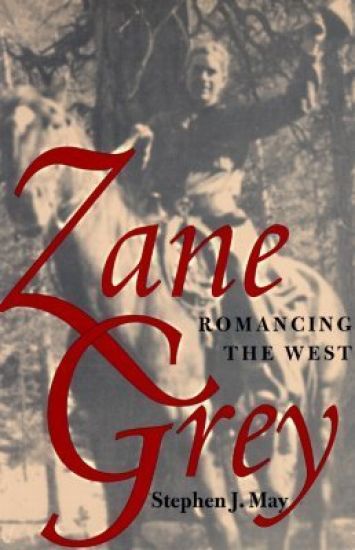
Zane Grey

Zane Grey

Stephen J. May

Ohio University Press
2005
sidottu
One of the century's most enduring American writers, Zane Grey left a legacy to our national consciousness that far outstrips the literary contribution of his often predictable plots and recurring themes. How did Grey capture the attention of millions of readers and promote the Western fantasy that continues to occupy many of the world's leisure hours? This study assesses the Zane Grey phenomenon by examining Grey's romantic novels in the context of his life and era. Grey, whose roots were in Zanesville, Ohio, was the son of a dentist and practiced dentistry himself in his early adulthood. He threw over that life for one of adventure, traveling throughout the world in search of excitement, a course that ultimately led him to become one of America's most popular authors. But he also was dogged by depression and inertia that affected his ability and will to work. In Zane Grey: Romancing the West, author Stephen J. May traces the career of Grey by analyzing the development of his novels and popularity and the degree to which that shaped his world. The book also investigates Grey's personal life—from his fling with Hollywood to his passion for deep-sea fishing—illuminating the literature that shaped America's vision of itself through one of its most enduring and cherished myths.
Zane Grey

Zane Grey

Stephen J. May

Ohio University Press
2005
pokkari
One of the century's most enduring American writers, Zane Grey left a legacy to our national consciousness that far outstrips the literary contribution of his often predictable plots and recurring themes. How did Grey capture the attention of millions of readers and promote the Western fantasy that continues to occupy many of the world's leisure hours? This study assesses the Zane Grey phenomenon by examining Grey's romantic novels in the context of his life and era. Grey, whose roots were in Zanesville, Ohio, was the son of a dentist and practiced dentistry himself in his early adulthood. He threw over that life for one of adventure, traveling throughout the world in search of excitement, a course that ultimately led him to become one of America's most popular authors. But he also was dogged by depression and inertia that affected his ability and will to work. In Zane Grey: Romancing the West, author Stephen J. May traces the career of Grey by analyzing the development of his novels and popularity and the degree to which that shaped his world. The book also investigates Grey's personal life—from his fling with Hollywood to his passion for deep-sea fishing—illuminating the literature that shaped America's vision of itself through one of its most enduring and cherished myths.
Maverick Heart

Maverick Heart

Stephen J. May

Ohio University Press
2000
sidottu
In 1927, at the peak of his career, Zane Grey bought a three-masted schooner, which he sailed to the Galapagos Islands, later journeying to Tahiti, New Zealand, Australia, and Fiji. As colorful as his characters were, so too was their creator. A consummate explorer, Zane Grey toured the world, was an acclaimed expert on salt- and freshwater fishing, and incorporated the sights and sounds he witnessed into his writings. As a companion to his biographical work of Grey's literary life, Zane Grey: Romancing the West, author Stephen J. May now gives as a remarkable look into another aspect of Grey's existence, the side little known but central to the measure of the man. Maverick Heart makes use of Grey's own memoirs and letters to give an enlightening portrait of this larger-than-life American character and a telling insight into one of the key shapers of the cultural heritage of our country.