Kirjojen hintavertailu. Mukana 12 016 292 kirjaa ja 12 kauppaa.

Kirjahaku

Etsi kirjoja tekijän nimen, kirjan nimen tai ISBN:n perusteella.

1000 tulosta hakusanalla Kevin van Whye

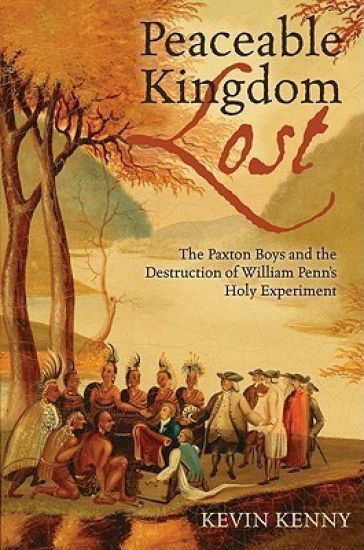
Peaceable Kingdom Lost

Peaceable Kingdom Lost

Kevin Kenny

Oxford University Press Inc
2009
sidottu
William Penn established Pennsylvania in 1682 as a "holy experiment" in which Europeans and Indians could live together in harmony. In this book, historian Kevin Kenny explains how this Peaceable Kingdom--benevolent, Quaker, pacifist--gradually disintegrated in the eighteenth century, with disastrous consequences for Native Americans. Kenny recounts how rapacious frontier settlers, most of them of Ulster extraction, began to encroach on Indian land as squatters, while William Penn's sons cast off their father's Quaker heritage and turned instead to fraud, intimidation, and eventually violence during the French and Indian War. In 1763, a group of frontier settlers known as the Paxton Boys exterminated the last twenty Conestogas, descendants of Indians who had lived peacefully since the 1690s on land donated by William Penn near Lancaster. Invoking the principle of "right of conquest," the Paxton Boys claimed after the massacres that the Conestogas' land was rightfully theirs. They set out for Philadelphia, threatening to sack the city unless their grievances were met. A delegation led by Benjamin Franklin met them and what followed was a war of words, with Quakers doing battle against Anglican and Presbyterian champions of the Paxton Boys. The killers were never prosecuted and the Pennsylvania frontier descended into anarchy in the late 1760s, with Indians the principal victims. The new order heralded by the Conestoga massacres was consummated during the American Revolution with the destruction of the Iroquois confederacy. At the end of the Revolutionary War, the United States confiscated the lands of Britain's Indian allies, basing its claim on the principle of "right of conquest." Based on extensive research in eighteenth-century primary sources, this engaging history offers an eye-opening look at how colonists--at first, the backwoods Paxton Boys but later the U.S. government--expropriated Native American lands, ending forever the dream of colonists and Indians living together in peace.
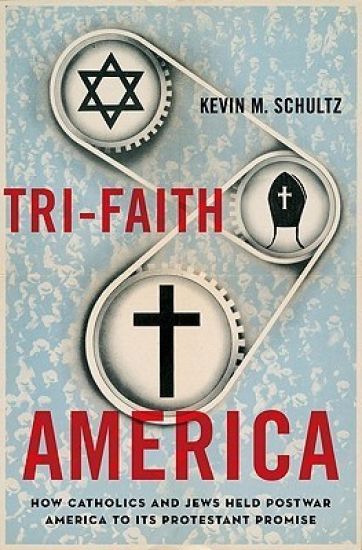
Tri-Faith America

Tri-Faith America

Kevin M. Schultz

Oxford University Press Inc
2011
sidottu
President Franklin D. Roosevelt put it bluntly, if privately, in 1942--the United States was "a Protestant country," he said, "and the Catholics and Jews are here under sufferance." In Tri-Faith America, Kevin Schultz explains how the United States left behind this idea that it was "a Protestant nation" and embraced the notion that Protestants, Catholics, and Jews were "Americans all." Schultz describes how the tri-faith idea surfaced after World War I, promoted by public relations campaigns, interfaith organizations, and the government to the extent that by the end of World War II, the idea was becoming widely accepted--particularly in the armed forces, fraternities, neighborhoods, social organizations, and schools. During the Cold War, the public religiosity spurred by the fight against godless communism led to widespread embrace of tri-faith America. Equally important, Schultz shows how Catholics and Jews in the post-World War II era used tri-faith rhetoric to challenge the nation's established moral authority. Indeed, as Americans began vigorously debating the merits of pluralism, they initiated a social and political climate that would pave the way toward the civil rights movement.
Music, Criticism, and the Challenge of History

Music, Criticism, and the Challenge of History

Kevin Karnes

Oxford University Press Inc
2008
sidottu
More than a century after Guido Adler's appointment to the first chair in musicology at the University of Vienna, Music, Criticism, and the Challenge of History provides a first look at the discipline in this earliest period, and at the ideological dilemmas and methodological anxieties that characterized it upon its institutionalization. Author Kevin Karnes contends that some of the most vital questions surrounding musicology's disciplinary identities today-the relationship between musicology and criticism, the role of the subject in analysis and the narration of history, and the responsibilities of the scholar to the listening public-originate in these conflicted and largely forgotten beginnings. Karnes lays bare the nature of music study in the late nineteenth century through insightful readings of long-overlooked contributions by three of musicology's foremost pioneers-Adler, Eduard Hanslick, and Heinrich Schenker. Shaped as much by the skeptical pronouncements of the likes of Nietzsche and Wagner as it was by progressivist ideologies of scientific positivism, the new discipline comprised an array of oft-contested and intensely personal visions of music study, its value, and its future. Karnes introduces readers to a Hanslick who rejected the call of positivist scholarship and dedicated himself to penning an avowedly subjective history of Viennese musical life. He argues that Schenker's analytical experiments had roots in a Wagner-inspired search for a critical alternative to Adler's style-obsessed scholarship. And he illuminates Adler's determined response to Nietzsche's warnings about the vitality of artistic and cultural life in an increasingly scientific age. Through sophisticated and meticulous presentation, Music, Criticism, and the Challenge of History demonstrates that the new discipline of musicology was inextricably tied in with the cultural discourse of its time.
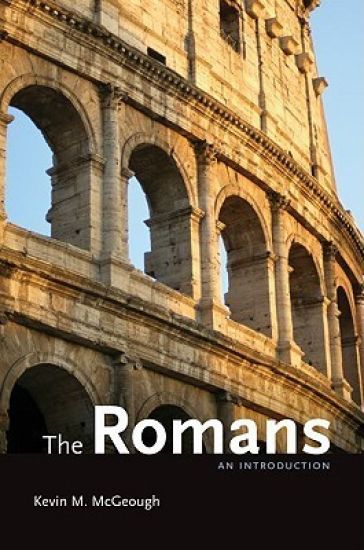
The Romans

The Romans

Kevin M McGeough

Oxford University Press Inc
2009
nidottu
The Romans provides an accessible introduction to the history, society, and scholarship of one of the most captivating and enduring civilizations in human history. From the establishment of the monarchy and the Republican era to the decline of the Empire, this comprehensive volume examines every aspect of Roman culture from both historical and archaeological perspectives. In addition to surveying the well-estbalished subjects of Roman history, author Kevin McGeough discusses the latest events in the archaeological investigation of Rome, such as the recent excavations at the Temple of Castor and Pollux in the Roman Forum and the controversial identification of an ossuary thought by some to hold the body of James, the brother of Jesus. The text is accompanied by carefully chosen illustrations, maps, a glossary, and chronology. Throughout, general readers and students will gain a vivid understanding of Roman civilization and of why it still captures our imagination today.
A Model Discipline

A Model Discipline

Kevin A. Clarke; David M. Primo

Oxford University Press Inc
2012
sidottu
Political science is an intensely quantitative discipline, and models are central. Political scientists use models--formal and informal, statistical and qualitative--to investigate and illuminate causal mechanisms, generate comparative data, and understand the conditions under which certain outcomes are expected to occur. But even though the use of models has grown dramatically in the discipline, there is very little understanding among political scientists of the role or function that models play in the scientific enterprise more generally. Moreover, theoretical models and empirical models have traditionally been treated as separate (hence the division between theorists and empiricists). Today, however, the emphasis is on using models to generate testable predictions that serve as hypotheses for subsequent data analysis. But how do we justify and rationalize the method? Why test predictions from a deductive, and thus truth-preserving, system? David Primo and Kevin Clarke tackle these central questions in this novel work of methodology. They argue that the lack of a suitable justification for model testing is not the only reason to revisit the role of models in political science. Most importantly, they contend that models should be seen as 'objects' and thus neither true nor false. Rather, they should be evaluated in the same fashion as models are evaluated in the physical sciences--good models are useful for particular purposes. Nothing more, nothing less. Divided into two parts, the book first establishes that no social scientific endeavor is philosophy-free. The second part focuses on different types of models, and closes with a framework for integrating theoretical and statistical models.
A Model Discipline

A Model Discipline

Kevin A. Clarke; David M. Primo

Oxford University Press Inc
2012
nidottu
Political science is an intensely quantitative discipline, and models are central. Political scientists use models--formal and informal, statistical and qualitative--to investigate and illuminate causal mechanisms, generate comparative data, and understand the conditions under which certain outcomes are expected to occur. But even though the use of models has grown dramatically in the discipline, there is very little understanding among political scientists of the role or function that models play in the scientific enterprise more generally. Moreover, theoretical models and empirical models have traditionally been treated as separate (hence the division between theorists and empiricists). Today, however, the emphasis is on using models to generate testable predictions that serve as hypotheses for subsequent data analysis. But how do we justify and rationalize the method? Why test predictions from a deductive, and thus truth-preserving, system? David Primo and Kevin Clarke tackle these central questions in this novel work of methodology. They argue that the lack of a suitable justification for model testing is not the only reason to revisit the role of models in political science. Most importantly, they contend that models should be seen as 'objects' and thus neither true nor false. Rather, they should be evaluated in the same fashion as models are evaluated in the physical sciences--good models are useful for particular purposes. Nothing more, nothing less. Divided into two parts, the book first establishes that no social scientific endeavor is philosophy-free. The second part focuses on different types of models, and closes with a framework for integrating theoretical and statistical models.
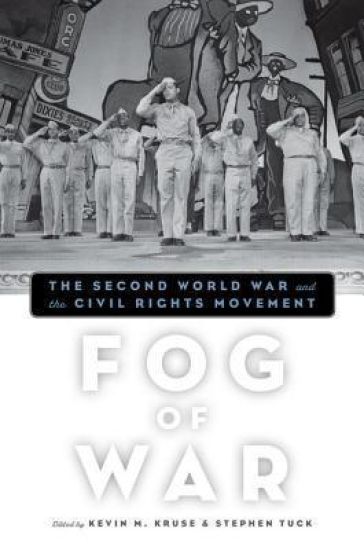
Fog of War

Fog of War

Kevin M. Kruse; Stephen Tuck

Oxford University Press Inc
2012
nidottu
This collection is a timely reconsideration of the intersection between two of the dominant events of twentieth-century American history, the upheaval wrought by the Second World War and the social revolution brought about by the African American struggle for equality. Scholars from a wide range of fields explore the impact of war on the longer history of African American protest from many angles: from black veterans to white segregationists, from the rural South to northern cities, from popular culture to federal politics, and from the American confrontations to international connections. It is well known that World War II gave rise to human rights rhetoric, discredited a racist regime abroad, and provided new opportunities for African Americans to fight, work, and demand equality at home. It would be all too easy to assume that the war was a key stepping stone to the modern civil rights movement. But the authors show that in reality the momentum for civil rights was not so clear cut, with activists facing setbacks as well as successes and their opponents finding ways to establish more rigid defenses for segregation. While the war set the scene for a mass movement, it also narrowed some of the options for black activists.
Fog of War

Fog of War

Kevin M. Kruse; Stephen Tuck

Oxford University Press Inc
2012
sidottu
This collection is a timely reconsideration of the intersection between two of the dominant events of twentieth-century American history, the upheaval wrought by the Second World War and the social revolution brought about by the African American struggle for equality. Scholars from a wide range of fields explore the impact of war on the longer history of African American protest from many angles: from black veterans to white segregationists, from the rural South to northern cities, from popular culture to federal politics, and from the American confrontations to international connections. It is well known that World War II gave rise to human rights rhetoric, discredited a racist regime abroad, and provided new opportunities for African Americans to fight, work, and demand equality at home. It would be all too easy to assume that the war was a key stepping stone to the modern civil rights movement. But the authors show that in reality the momentum for civil rights was not so clear cut, with activists facing setbacks as well as successes and their opponents finding ways to establish more rigid defenses for segregation. While the war set the scene for a mass movement, it also narrowed some of the options for black activists.
USMLE Step 2 Triage

USMLE Step 2 Triage

Kevin Schwechten

Oxford University Press Inc
2010
nidottu
Step 2 Clinical Knowledge is one of the hardest exams you'll take in your medical training, and it's very important to do well! Preparation is the key that separates successful candidates from the rest. USMLE Step 2 Triage provides a thorough yet high-yield review for the exam, covering a gamut of frequently tested specialties and subspecialties with emphasis on pertinent principles of clinical science and patient-centered skills. Consistently organized, each topic is structured to provide the material in a manageable format, divided into several sections: "Symptoms," "Diagnosis," "Treatment," and "Take Home Points." USMLE Step 2 Triage is geared to facilitate the most comprehensive and efficient preparation for the exam; it is packed with tables and figures, and features 100 full color images. Written by the author of the popular USMLE Step 3 Triage and the USMLE Step 2 Clinical Skills Triage, this book will help deliver the best results for any student studying for the Step 2 Clinical Knowledge exam.
USMLE Step 2 Clinical Skills Triage

USMLE Step 2 Clinical Skills Triage

Kevin Schwechten

Oxford University Press Inc
2010
nidottu
USMLE Step 2 Clinical Skills Triage is the indispensable preparation book for the Step 2 Clinical Skills exam, presenting 40 high-yield patient-encounter cases that simulate the examination experience. Cases are organized for straightforward learning: a sample dialogue that mimics actual doctor-patient communication is followed by guidelines on performing the physical exam, ending the case, writing the patient note, and outlining the differential diagnosis. Comprehensive yet succinct, the cases address almost all possible exam scenarios, including telephone cases and "difficult patient" encounters. Each case contains detailed and relevant information on presenting complaints and conditions, with pertinent points highlighted and boxed for easy review. Written by the author of the popular USMLE Step 3 Triage, this book is optimal for either individual or group study and for any student interested in reviewing how to practice applying medical knowledge and patient-centered skills.
The Elephant in the Brain

The Elephant in the Brain

Kevin Simler; Robin Hanson

Oxford University Press Inc
2021
nidottu
Human beings are primates, and primates are political animals. Our brains, therefore, are designed not just to hunt and gather, but also to help us get ahead socially, often via deception and self-deception. But while we may be self-interested schemers, we benefit by pretending otherwise. The less we know about our own ugly motives, the better - and thus we don't like to talk or even think about the extent of our selfishness. This is "the elephant in the brain." Such an introspective taboo makes it hard for us to think clearly about our nature and the explanations for our behavior. The aim of this book, then, is to confront our hidden motives directly - to track down the darker, unexamined corners of our psyches and blast them with floodlights. Then, once everything is clearly visible, we can work to better understand ourselves: Why do we laugh? Why are artists sexy? Why do we brag about travel? Why do we prefer to speak rather than listen? Our unconscious motives drive more than just our private behavior; they also infect our venerated social institutions such as Art, School, Charity, Medicine, Politics, and Religion. In fact, these institutions are in many ways designed to accommodate our hidden motives, to serve covert agendas alongside their "official" ones. The existence of big hidden motives can upend the usual political debates, leading one to question the legitimacy of these social institutions, and of standard policies designed to favor or discourage them. You won't see yourself - or the world - the same after confronting the elephant in the brain.
Undaunted Mind

Undaunted Mind

Kevin J. Hayes

OXFORD UNIVERSITY PRESS INC
2025
sidottu
An exploration of the mind of one of America's most beloved Founding Fathers and most brilliant minds, through the books he read and his social circles in the United States and Europe. Arguably the most intellectual, creative, cosmopolitan, and curious of the Founding Fathers, Benjamin Franklin is the only top-tier Founder not to have served as president. Despite not becoming the Chief Executive, Franklin played an active role in American politics and served the aspiring and young United States in the key European capitals. His prodigious reading and appetite for learning are epic. As he did in works about Thomas Jefferson and George Washington, Kevin J. Hayes interprets the life and mind of Franklin through what he read. Undaunted Mind tells the story of the development of Franklin's intellect, starting with the earliest books he read as a child before examining his formal schooling and his independent study after his father pulled him from school. As an apprentice in his brother's printing house, Franklin's intellectual life developed through his contact with the Couranteers, the group of his brother's friends who contributed to his newspaper, and through his attention to his brother's excellent office library. After Franklin ran away to Philadelphia, he developed a new group of friends, all of whom loved reading. In many ways, the story of Franklin's intellectual odyssey is the story of the friends he made along the way. His time in London in his late teens introduced him to several important intellectuals who encouraged him to develop his mind. After returning to Philadelphia from London, he and some friends formed the Junto, a club for mutual improvement that made reading and writing important activities. With other members of the Junto, he formed the Library Company of Philadelphia, the first subscription library in colonial America. His role as a printer put him in contact with the best eighteenth-century American writing and kept a steady flow of imported books coming from Britain. He became a scientist, assembling a great scientific library, which helped his electrical research. An educational reformer, Franklin founded the Philadelphia Academy, which would become the University of Pennsylvania. As agent for the Pennsylvania Assembly, Franklin lived in London for many years, where he befriended some of Britain's greatest minds. Different concentrations of books in his library reveal Franklin's interests in travel and exploration, warfare, and slavery. His time in Paris toward the end of his life gave Franklin another great intellectual experience, but he ultimately returned home to live the last five years of his life in Philadelphia, where he imparted his knowledge and experience to a new generation of Americans. In this gripping work, Benjamin Franklin is given a biography as rich and complex as his own intellectual life by master literary historian Kevin J. Hayes.
The Problem of Immigration in a Slaveholding Republic

The Problem of Immigration in a Slaveholding Republic

Kevin Kenny

OXFORD UNIVERSITY PRESS INC
2023
sidottu
A powerful analysis of how regulation of the movement of enslaved and free black people produced a national immigration policy in the period between the American Revolution and the end of Reconstruction. Today the United States considers immigration a federal matter. Yet, despite America's reputation as a "nation of immigrants," the Constitution is silent on the admission, exclusion, and expulsion of foreigners. Before the Civil War, the federal government played virtually no role in regulating immigration, and states set their own terms for regulating the movement of immigrants, free blacks, and enslaved people. Insisting that it was their right and their obligation to protect the public health and safety, states passed their own laws prohibiting the arrival of foreign convicts, requiring shipmasters to post bonds or pay taxes for passengers who might become public charges, ordering the deportation of immigrant paupers, quarantining passengers who carried contagious diseases, excluding or expelling free blacks, and imprisoning black sailors. To the extent that these laws affected foreigners, they comprised the immigration policy of the United States. Offering an original interpretation of nineteenth-century America, The Problem of Immigration in a Slaveholding Republic argues that the existence, abolition, and legacies of slavery were central to the emergence of a national immigration policy. In the century after the American Revolution, states controlled mobility within and across their borders and set their own rules for community membership. Throughout the antebellum era, defenders of slavery feared that, if Congress gained control over immigration, it could also regulate the movement of free black people and the interstate slave trade. The Civil War and the abolition of slavery removed the political and constitutional obstacles to a national immigration policy, which was first directed at Chinese immigrants. Admission remained the norm for Europeans, but Chinese laborers were excluded through techniques of registration, punishment, and deportation first used against free black people in the antebellum South. To justify these measures, the Supreme Court ruled that immigration authority was inherent in national sovereignty and required no constitutional justification. The federal government continues to control admissions and exclusions today, while some states monitor and punish immigrants, and others offer sanctuary and refuse to act as agents of federal law enforcement. By revealing the tangled origins of border control, incarceration, and deportation, distinguished historian Kevin Kenny sheds light on the history of race and belonging in America, as well as the ongoing tensions between state and federal authority over immigration.
Augustine on Memory

Augustine on Memory

Kevin G. Grove

OXFORD UNIVERSITY PRESS INC
2021
sidottu
Augustine of Hippo, indisputably one of the most important figures for the study of memory, is credited with establishing memory as the inner source of selfhood and locus of the search for God. Yet, those who study memory in Augustine have never before taken into account his preaching. His sermons are the sources of memory's greatest development for Augustine. In Augustine's preaching, especially on the Psalms, the interior gives way to communal exterior. Both the self and search for God are re-established in a shared Christological identity and the communal labors of remembering and forgetting. This book opens with Augustine's early works and Confessions as the beginning of memory and concludes with Augustine's Trinity and preaching on Psalm 50 as the end of memory. The heart of the book, the work of memory, sets forth how ongoing remembering and forgetting in Christ are for Augustine are foundational to the life of grace. To that end, Augustine and his congregants go leaping in memory together, keep festival with abiding traces, and become forgetful runners like St. Paul. Remembering and forgetting in Christ, the ongoing work of memory, prove for Augustine to be actions of reconciliation of the distended experiences of human life-of praising and groaning, labouring and resting, solitude and communion. Augustine on Memory presents this new communal and Christological paradigm not only for Augustinian studies, but also for theologians, philosophers, ethicists, and interdisciplinary scholars of memory.
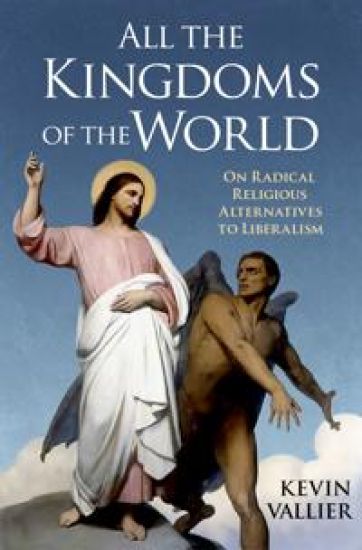
All the Kingdoms of the World

All the Kingdoms of the World

Kevin Vallier

OXFORD UNIVERSITY PRESS INC
2023
sidottu
A fresh assessment of Catholic integralism and other new and radical religious alternatives to liberal democracy. According to a common narrative, the twentieth century spelled the end of faith-infused political movements. Their ideologies, like Catholic integralism, would soon be forgotten. Humans were finally learning to keep religion out of politics. Or were we? In the twenty-first century, nations as diverse as Russia, India, Poland, and Turkey have seen a revival of religious politics, and many religious movements in other countries have proved similarly resilient. A new generation of political theologians passionately reformulate ancient religious doctrines to revolutionize modern political life. They insist that states recognize the true religion, and they reject modern liberal ideals of universal religious freedom and church-state separation. In this book, philosopher Kevin Vallier explores these new doctrines, not as lurid oddities but as though they might be true. The anti-liberal doctrine known as Catholic integralism serves as Vallier's test case. Yet his approach naturally extends to similar ideologies within Chinese Confucianism and Sunni Islam. Vallier treats anti-liberal thinkers with the respect that liberals seldom afford them and offers more moderate skeptics of liberalism a clear account of the alternatives. Many liberals, by contrast, will find these doctrines frightening and strange but of enduring interest. Vallier invites all his readers on a unique intellectual adventure, encouraging them to explore unfamiliar ideals through the lenses of theology, philosophy, politics, economics, and history.
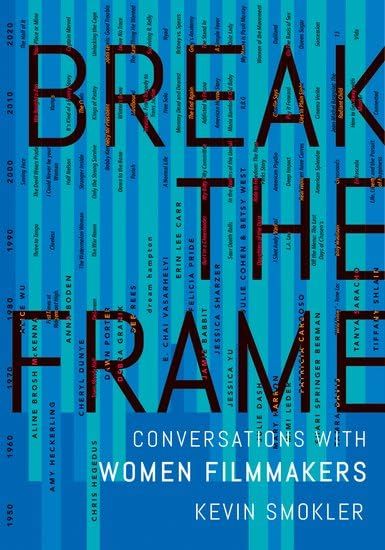
Break the Frame

Break the Frame

Kevin Smokler

OXFORD UNIVERSITY PRESS INC
2025
sidottu
A diverse group of women filmmakers speak for themselves about their careers and their work In the twenty-first century alone, women filmmakers have succeeded at directing every size, genre, and style of motion picture. Their movies have won Oscars (Free Solo), made actors into household names (Jennifer Lawrence in Winter's Bone), received induction into the Library of Congress's National Film Registry (Real Women Have Curves), and become worldwide box office phenomena (Captain Marvel, Deep Impact). Nevertheless in 2023, the year of Barbie, women directed only 12% of the top 250 movies in America. demonstrating how far moviemaking remains from gender parity. When women filmmakers succeed, they do so against these odds. Break the Frame is a collection of 24 career-spanning interviews with America's celebrated, reigning, and rising women filmmakers. Each conversation considers the director's complete filmography as a map of their evolving artistry and evidence of their unassailable contributions to a historically misogynist industry. Author Kevin Smokler listens as women filmmakers speak to the struggle and triumphs of developing and directing movies that are shaping how the film business sees women in the director's chair, and how their audiences see themselves and each other. This book is both an opportunity and invitation to devote one's time, admiration and enthusiasm to movies directed by women.
Dispatches from the AIDS Pandemic

Dispatches from the AIDS Pandemic

Kevin M. De Cock; Harold W. Jaffe; James W. Curran

OXFORD UNIVERSITY PRESS INC
2023
sidottu
Dispatches from the AIDS Pandemic is a unique firsthand account from three public health leaders of CDC's early response to AIDS. Drawing in part on interviews from the CDC's AIDS oral history project, the authors trace the evolution of AIDS from newly recognized disease to pandemic. The first section outlines the earliest days of the epidemic within the United States and the initial prevention strategies. The second section expands the borders of the response to Africa and Thailand, where CDC conducted its first international work on AIDS. The final section closes with an overview of the scientific and public health advancements that followed and the historic community activism that spurred essential funding and partnerships for the development of life-saving interventions. Authentic and insightful, Dispatches from the AIDS Pandemic provides an authoritative account of an epidemic and its central role in the expansion of global public health.
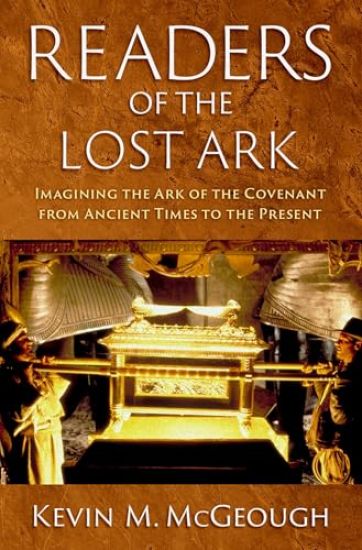
Readers of the Lost Ark

Readers of the Lost Ark

Kevin M. McGeough

OXFORD UNIVERSITY PRESS INC
2025
sidottu
The sacred chest said to have been built by the Israelites to house the stone tablets on which the Ten Commandments were written, the Ark of the Covenant has long captured the popular imagination. According to the Bible, the Israelites carried it with them as they wandered in the wilderness and entered the promised land. After the Temple of Solomon was built, the Ark was kept in an inner sanctum where God made his divine presence felt to the Israelites. The Hebrew Bible is unclear about what happened to the Ark after the destruction of the temple and offers vague accounts of its function. Despite (or because of) this ambiguity, the Ark continues to hold an important place in Jewish and Christian tradition, even in its absence, and has led to much popular speculation. Widely imagined and re-imagined, it is perhaps today best known in popular culture as the object sought by Indiana Jones in the 1981 film Raiders of the Lost Ark. In Readers of the Lost Ark Kevin McGeough explores the different ways people have interpreted and made sense of the Ark from ancient times to the present, in biblical literature, theological discourse, art, popular film, travel souvenirs, toys, faith-healing events, and alternative histories. The book recounts stories of people who have sought to find the Ark of the Covenant and examines how the Ark takes on new meanings in Europe, North America, East Asia, Ethiopia, and the modern Middle East.
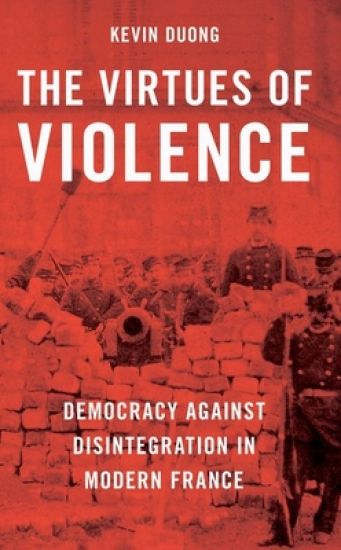
The Virtues of Violence

The Virtues of Violence

Kevin Duong

OXFORD UNIVERSITY PRESS INC
2022
nidottu
If democracy liberates individuals from their inherited bonds, what can reunite them into a sovereign people? In The Virtues of Violence, Kevin Duong argues that one particular answer captivated modern French thinkers: popular violence as social regeneration. In this tradition of political theory, the people's violence was not a sign of anarchy or disorder. Instead, it manifested a redemptive power capable of binding and repairing a society on the cusp of social disintegration. This was not a fringe view of French democracy at the time, but central to its momentous development. Duong analyzes the recurring role of the people's redemptive violence across four historical moments: the French Revolution, the imperial conquest of Algeria, the Paris Commune, and the years leading up to World War I. Bringing together democratic theory and intellectual history, he reveals how political thinkers across the spectrum proclaimed that violence by the people could repair the social fabric, even as they experienced democratization as social disintegration. The path from an anarchic multitude to an organized democratic society required the virtuous expression of violence by the people--not its prohibition. Duong's book urges us to reject accounts that view redemptive violence as an antidemocratic pathology. It challenges the long-held view that popular violence is a sign of anarchy or disorder. As shocking and unsettling as redemptive violence could be, it appealed to thinkers across the spectrum, because it answered a fundamental dilemma of political modernity: how to replace the severed bonds of the old regime with a superior democratic social bond. The Virtues of Violence argues we do not properly understand modern democracy unless we can understand why popular redemptive violence could be invoked on its behalf.
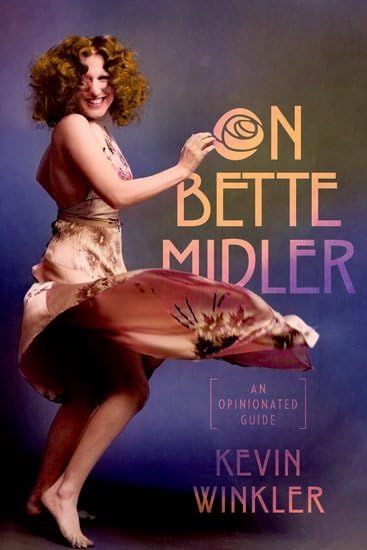
On Bette Midler

On Bette Midler

Kevin Winkler

OXFORD UNIVERSITY PRESS INC
2024
sidottu
Bette Midler today is a beloved legacy star, best known for her comic witch in Disney's Hocus Pocus (1993) and its 2022 sequel. She has also gained prominence for sentimental, anthemic ballads like "Wind Beneath My Wings," her initiation of green space projects in New York City, and tussling with Donald Trump on Twitter. Her profile is that of an articulate, civic-minded matriarch enjoying thoroughly mainstream stardom. But more than fifty years earlier she emerged from the steam of the subterranean Continental Baths as the Divine Miss M, the bawdy, campy, fearless alter ego she created in front of an audience of towel-clad gay men who came to the baths seeking not just sex, but a sense of community and safety from an often-harrowing outside world. "I was able to take chances on that stage that I could not have taken anywhere else," she later wrote. "Ironically, I was freed from fear by people who, at the time, were ruled by fear. And for that I will always be grateful." Overnight, Bette Midler became a much-loved icon of the gay community. The Divine Miss M coalesced gay, Jewish, feminist, and show business sensibilities into an outrageously funny and emotionally compelling persona that travelled with surprising ease from the cultural margins to the entertainment mainstream. Her embrace by mom-and-pop audiences, rock fans and critics, and the guardians of middle-of-the-road show business demonstrates just how deeply the tastes and sensibilities of her original audience have been absorbed into popular culture. On Bette Midler: An Opinionated Guide traces the early development of Midler's performing ethos from New York's downtown experimental theater scene and examines her impact across media, with chapters on the soaring highs (and occasional cringe-worthy lows) of her stage work, movies, recordings, and television appearances, and considers her influence as an environmental activist and social media presence. On Bette Midler features performance analysis and deeply researched background information, all of it supporting informed--and divinely opinionated--consideration of Midler the artist. It judges her work by the highest standards: those she established for herself.