

Kirjahaku
Etsi kirjoja tekijän nimen, kirjan nimen tai ISBN:n perusteella.
1000 tulosta hakusanalla Michael D Butler


A Powerful Tool for the Analysis and Design of Complex Structural ElementsFinite-Element Modelling of Structural Concrete: Short-Term Static and Dynamic Loading Conditions presents a finite-element model of structural concrete under short-term loading, covering the whole range of short-term loading conditions, from static (monotonic and cyclic) to dynamic (seismic and impact) cases. Experimental data on the behavior of concrete at both the material and structural levels reveal the unavoidable development of triaxial stress conditions prior to failure which dictate the collapse and ductility of structural concrete members. Moreover, and in contrast with generally accepted tenets, it can be shown that the post-peak behavior of concrete as a material is realistically described by a complete and immediate loss of load-carrying capacity. Hence rational analysis and design of concrete components in accordance with the currently prevailing limit-state philosophy requires the use of triaxial material data consistent with the notion of a fully brittle material, and this approach is implemented in the book by outlining a finite-element method for the prediction of the strength, deformation, and cracking patterns of arbitrary structural concrete forms. Presents a Unified Approach to Structural ModelingNumerous examples are given that show both the unifying generality of this proposed approach and the reliability of the ensuing numerical procedure for which the sole input is the specified uniaxial cylinder compressive strength of concrete and the yield stress of the steel. This not only offers a better understanding of the phenomenology of structural concrete behavior but also illustrates, by means of suitable examples, the type of revision required for improving design methods in terms of both safety and economy.This book: Highlights the significance of valid experimental information on the behavior of concrete under triaxial stress conditions for interpreting structural behaviorDescribes the techniques used for obtaining valid test data and modeling concrete behaviorDiscusses the modeling of steel properties as well as the interaction between concrete and steelPresents numerical techniques for incorporating the material models into nonlinear finite-element analysis for the case of short-term static loadingProvides numerical techniques adopted for extending the use of the numerical analysis scheme for the solution of dynamic problemsPredicts the response of a wide range of structural-concrete configurations to seismic and impact excitationsUsing relevant case studies throughout, Finite-Element Modelling of Structural Concrete: Short-Term Static and Dynamic Loading Conditions focuses on the realistic modeling of structural concrete on the basis of existing and reliable material data and aids in the research and study of structural concrete and concrete materials.
In business, driving value is a key strategy and typically starts at the top of an organization. In today’s digital age, driving software value is also an important, and often overlooked, key strategy. Executives, and the corporate board, need to expect the highest level of business value from the software the organization is developing, buying, and selling. In today’s digital transformation marketplace, it is imperative that organizations start driving business value from software development initiatives.For many years, the cost of software development challenged organizations with questions such as: How do we allocate software development costs?Should these costs be considered an overhead expense?Are we getting the most value possible for our investment? A fundamental problem has been built into these questions – the focus on cost. In almost every other part of the organization, maximizing profit or, in the case of a not-for-profit, maximizing the funds available, provides a clear focus with metrics to determine success or failure. In theory, simply aligning software spending with the maximizing profit goals should be sufficient to avoid any questions about value for money. Unfortunately, this alignment hasn’t turned out to be so simple, and the questions persist, particularly at the strategic or application portfolio level. In this book, Michael D.S. Harris describes how a software business value culture—one where all stakeholders, including technology and business—have a clear understanding of the goals and expected business value from software development. The book shows readers how they can transform software development from a cost or profit center to a business value center. Only a culture of software as a value center enables an organization to constantly maximize business value flow through software development. If your organization is starting to ask how it can change software from a cost-center to a value-center, this book is for you.

Guarded Prognosis: A Doctor and His Patients Talk About Chronic Disease and How to Cope With It
Michael D. Lockshin
Createspace Independent Publishing Platform
2014
nidottu

A Catalog Of Errors: true-life tales of truly epic catastrophe
Michael D. Collins; Michael David Collins
Createspace Independent Publishing Platform
2014
nidottu

The Enchanter Speaks...: Poems about Life, Love, Politics and Free-Thought
Michael D. Jones
Createspace Independent Publishing Platform
2014
nidottu
This book contains forty poems. Some are evocative images of life. Some are whimsical and humorous. Some are political satire. Some celebrate the author's escape from religion. If you have doubts that corporations are really people, or that your future can be foretold by the stars, you might enjoy this author's incisive wit.
Understanding Rationalization And How It Limits Life
Michael D. Coe
Createspace Independent Publishing Platform
2014
nidottu

Leisure Time: Crosswords Vol. 1
Michael D. Broeker
Createspace Independent Publishing Platform
2014
nidottu
Michael Dolce, author of Zero the Clown & a Lovely Garden of Flowering Weeds returns. In this, his second volume of poetry, Dolce touches upon the ultimate universal themes. What is the difference between love and lust? What does it mean to relate sexually and romantically with others? Are we defined by ourselves or by our relationships? Is monogamy a noble aspiration or a miserable myth? He tackles these questions with a tactless vulnerability and a mischievously na ve heart. He inspires as he offends. He shakes and restores faith. While he may become maudlin, it's never overwhelmingly so. And the honesty, sometimes brutal honesty, ensures the collection never gets sappy. Dolce plays wildly between love/romance/longing and reality/heartbreak. There's cynicism without delving into self-pity. There's hope without stupidity. It makes for a perfect anthology of contemporary love poems.

The Evolution of the Flubb
Michael D. Fortescue
Createspace Independent Publishing Platform
2014
nidottu
The Flubb is a strange being who's driven by a restless wanderlust and a ceaseless hunger for storing words in his ample belly. Evolving from a transparent figure that materializes from nothingness, the Flubb somehow manages to rise to the dizzying heights of assistant lexicographer, his naive good nature carrying him through as he learns the wicked ways of the world. Along the way, he passes through a ridiculous variety of jobs-including porridge chef, zookeeper, and a brief stint as the archbishop of Canterbury-for many of which he is particularly unsuited. He embarks on a worldwide cruise, and an infatuation with the woman whose face appears on the ten-pence coin leads to hilarity at Buckingham Palace. These experiences, along with his introduction to the ways in which correct diction can make all the difference, make for an unforgettable novel that will leave readers giggling long after the last page. The first book in the Adventures of the Flubb trilogy, The Evolution of the Flubb is a rollicking journey full of adventure, fun, and delightfully wonderful wordplay.


Lockewood/The Wolves Of Lockewood
Michael D. Grover
Createspace Independent Publishing Platform
2014
nidottu

Superstitions are commonplace in the modern world. Mostly, however, they evoke innocuous images of people reading their horoscopes or avoiding black cats. Certain religious practices might also come to mind—praying to St. Christopher or lighting candles for the dead. Benign as they might seem today, such practices were not always perceived that way. In medieval Europe superstitions were considered serious offenses, violations of essential precepts of Christian doctrine or immutable natural laws. But how and why did this come to be? In Fearful Spirits, Reasoned Follies, Michael D. Bailey explores the thorny concept of superstition as it was understood and debated in the Middle Ages. Bailey begins by tracing Christian thinking about superstition from the patristic period through the early and high Middle Ages. He then turns to the later Middle Ages, a period that witnessed an outpouring of writings devoted to superstition—tracts and treatises with titles such as De superstitionibus and Contra vitia superstitionum. Most were written by theologians and other academics based in Europe's universities and courts, men who were increasingly anxious about the proliferation of suspect beliefs and practices, from elite ritual magic to common healing charms, from astrological divination to the observance of signs and omens. As Bailey shows, however, authorities were far more sophisticated in their reasoning than one might suspect, using accusations of superstition in a calculated way to control the boundaries of legitimate religion and acceptable science. This in turn would lay the conceptual groundwork for future discussions of religion, science, and magic in the early modern world. Indeed, by revealing the extent to which early modern thinkers took up old questions about the operation of natural properties and forces using the vocabulary of science rather than of belief, Bailey exposes the powerful but in many ways false dichotomy between the "superstitious" Middle Ages and "rational" European modernity.

Burning Bodies interrogates the ideas that the authors of historical and theological texts in the medieval West associated with the burning alive of Christian heretics. Michael Barbezat traces these instances from the eleventh century until the advent of the internal crusades of the thirteenth century, depicting the exclusionary fires of hell and judicial execution, the purifying fire of post-mortem purgation, and the unifying fire of God's love that medieval authors used to describe processes of social inclusion and exclusion. Burning Bodies analyses how the accounts of burning heretics alive referenced, affirmed, and elaborated upon wider discourses of community and eschatology. Descriptions of burning supposed heretics alive were profoundly related to ideas of a redemptive Christian community based upon a divine, unifying love, and medieval understandings of what these burnings could have meant to contemporaries cannot be fully appreciated outside of this discourse of communal love. For them, human communities were bodies on fire. Medieval theologians and academics often described the corporate identity of the Christian world as a body joined together by the love of God. This love was like a fire, melting individuals together into one whole. Those who did not spiritually burn with God's love were destined to burn literally in the fires of Hell or Purgatory, and the fires of execution were often described as an earthly extension of these fires. Through this analysis, Barbezat demonstrates how presentations of heresy, and to some extent actual responses to perceived heretics, were shaped by long-standing images of biblical commentary and exegesis. He finds that this imagery is more than a literary curiosity; it is, in fact, a formative historical agent.

"WE GOTTA GET OUT OF THIS PLACE" Volume 3
Michael D. Lazares
Createspace Independent Publishing Platform
2015
nidottu

The Advent Anthology Omnibus
Michael D. Young
Createspace Independent Publishing Platform
2014
nidottu
This Omnibus contains the three volumes of the Advent Anthologies series including: Sing We Now of Christmas (Vol 1) Carol of the Tales (Vol 2) Angels from Their Realms of Story (Vol 3) Each volume contains 25 holiday-themed short stories with each based on a Christmas carol or song.
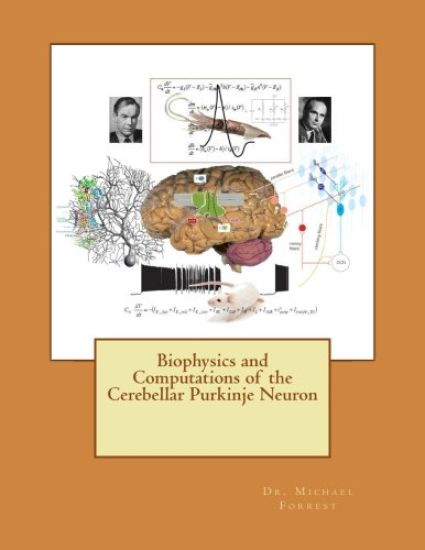
Biophysics and Computations of the Cerebellar Purkinje Neuron
Michael D. Forrest
Createspace Independent Publishing Platform
2014
nidottu
Neuroscience is the scientific study of the nervous system. Its aim is to understand how the nervous system works, discover what goes wrong in its diseased/injured states and to develop treatments to fix these pathological states. Computational Neuroscience is the use of computers to analyse and model electrical recordings from the brain, in order to elucidate how the brain computes. It is instrumental to present efforts to try and crack the "neural code" i.e. to decode the, as yet largely unknown, cipher that specifies how information is encoded in the electrical and chemical signals of the nervous system; a "holy grail" of modern science. This book suggests that the sodium-potassium pump may not simply be a homeostatic, "housekeeping" molecule for ionic gradients; but might be a computation element in the cerebellum and the brain. This concept runs contrary to conventional, entrenched viewpoints on brain function. Artificial Intelligence (AI) research typically builds on the fiction that neurons are simple linear threshold units, and that the immense computational power of the brain comes from having a great many of them. This book challenges this assumption, showing that the non-linear biophysics of synapses, dendrites, ion pumps, ion exchangers, intracellular ion dynamics and voltage-dependent ion currents intersect to permit the cerebellar Purkinje neuron to perform complex computations upon its inputs. This book will please those curious about brain computation, especially the computational capability of single neurons, and presents both computational and experimental approaches to neuroscience. Much of its content is new, primary research.
Everything Bankers have Learned from the Financial Crisis: Collected wisdoms since the Financial Apocalypse
Michael D. McFinn
Createspace Independent Publishing Platform
2014
nidottu
Fiercely frank and brilliantly insightful, 'Everything Bankers Learned from The Financial Crisis' amasses learning's from banking professionals across the globe to bring readers the most extensive source of collective financial wisdom ever accumulated. Global financial markets became dislodged in the summer of 2007, when a number of global financial institutions suspended redemptions in investment vehicles linked to US mortgage debt and derivatives. This was to signal the start of a financial meltdown that would send shockwaves across the globe and cause an estimated financial loss of over $15 trillion... and counting. From mortgage-backed securities and credit default swaps to housing market bubbles and regulatory failures, this book documents and analyses the concentrated knowledge acquired by bankers from the worst financial meltdown to-date. Chapters cover learnings such as: -How to avoid systemic derivatives risk and over-leveraging pitfalls -How to self-regulate and manage miss-selling -How to manage product complexity and 'black swan' scenarios -How to manage term deposits, 'cash isn't trash' -How to learn from and avoid past mistakes You got it This book has 160 empty pages. As history has taught us, the financial markets rarely learn from past mistakes. The pages serve as a solid reminder of this truth, and as such makes for an excellent and amusing gift for any banking professional.