Kirjojen hintavertailu. Mukana 11 342 296 kirjaa ja 12 kauppaa.

Kirjahaku

Etsi kirjoja tekijän nimen, kirjan nimen tai ISBN:n perusteella.

1000 tulosta hakusanalla Michael J. Perry

The Creolizing Subject

The Creolizing Subject

Michael J. Monahan

Fordham University Press
2011
sidottu
How does our understanding of the reality (or lack thereof ) of race as a category of being affect our understanding of racism as a social phenomenon, and vice versa? How should we envision the aims and methods of our struggles against racism? Traditionally, the Western political and philosophical tradition held that true social justice points toward a raceless future—that racial categories are themselves inherently racist, and a sincere advocacy for social justice requires a commitment to the elimination or abolition of race altogether. This book focuses on the underlying assumptions that inform this view of race and racism, arguing that it is ultimately bound up in a "politics of purity"—an understanding of human agency, and reality itself, as requiring all-or-nothing categories with clear and unambiguous boundaries. Racism, being organized around a conception of whiteness as the purest manifestation of the human, thus demands a constant policing of the boundaries among racial categories. Drawing upon a close engagement with historical treatments of the development of racial categories and identities, the book argues that races should be understood not as clear and distinct categories of being but rather as ambiguous and indeterminate (yet importantly real) processes of social negotiation. As one of its central examples, it lays out the case of the Irish in seventeenth-century Barbados, who occasionally united with black slaves to fight white supremacy—and did so as white people, not as nonwhites who later became white when they capitulated to white supremacy. Against the politics of purity, Monahan calls for the emergence of a "creolizing subjectivity" that would place such ambiguity at the center of our understanding of race. The Creolizing Subject takes seriously the way in which racial categories, in all of their variety and ambiguity, situate and condition our identity, while emphasizing our capacity, as agents, to engage in the ongoing contestation and negotiation of the meaning and significance of those very categories.
The Creolizing Subject

The Creolizing Subject

Michael J. Monahan

Fordham University Press
2011
pokkari
How does our understanding of the reality (or lack thereof ) of race as a category of being affect our understanding of racism as a social phenomenon, and vice versa? How should we envision the aims and methods of our struggles against racism? Traditionally, the Western political and philosophical tradition held that true social justice points toward a raceless future—that racial categories are themselves inherently racist, and a sincere advocacy for social justice requires a commitment to the elimination or abolition of race altogether. This book focuses on the underlying assumptions that inform this view of race and racism, arguing that it is ultimately bound up in a "politics of purity"—an understanding of human agency, and reality itself, as requiring all-or-nothing categories with clear and unambiguous boundaries. Racism, being organized around a conception of whiteness as the purest manifestation of the human, thus demands a constant policing of the boundaries among racial categories. Drawing upon a close engagement with historical treatments of the development of racial categories and identities, the book argues that races should be understood not as clear and distinct categories of being but rather as ambiguous and indeterminate (yet importantly real) processes of social negotiation. As one of its central examples, it lays out the case of the Irish in seventeenth-century Barbados, who occasionally united with black slaves to fight white supremacy—and did so as white people, not as nonwhites who later became white when they capitulated to white supremacy. Against the politics of purity, Monahan calls for the emergence of a "creolizing subjectivity" that would place such ambiguity at the center of our understanding of race. The Creolizing Subject takes seriously the way in which racial categories, in all of their variety and ambiguity, situate and condition our identity, while emphasizing our capacity, as agents, to engage in the ongoing contestation and negotiation of the meaning and significance of those very categories.
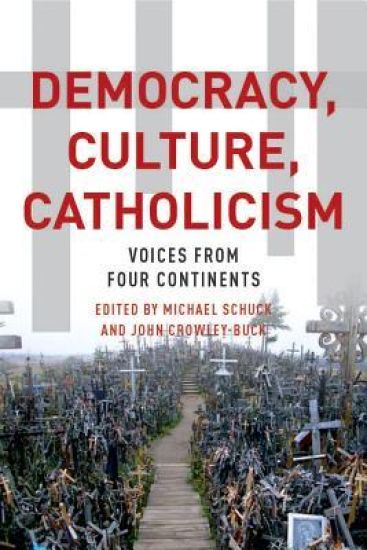
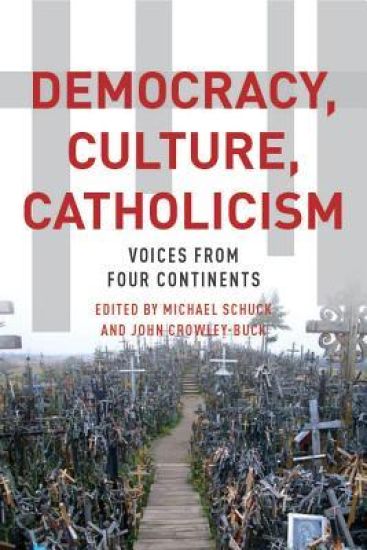
Democracy, Culture, Catholicism

Democracy, Culture, Catholicism

Michael J. Schuck; John Crowley-Buck

Fordham University Press
2015
sidottu
Compiling scholarly essays from a unique three-year Democracy, Culture and Catholicism International Research Project, Democracy, Culture, Catholicism richly articulates the diverse and dynamic interplay of democracy, culture, and Catholicism in the contemporary world. The twenty-five essays from four extremely diverse cultures—those of Indonesia, Lithuania, Peru, and the United States—explore the relationship between democracy and Catholicism from several perspectives, including historical and cultural analysis, political theory and conflict resolution, social movements and Catholic social thought.
Democracy, Culture, Catholicism

Democracy, Culture, Catholicism

Michael J. Schuck; John Crowley-Buck

Fordham University Press
2015
pokkari
Compiling scholarly essays from a unique three-year Democracy, Culture and Catholicism International Research Project, Democracy, Culture, Catholicism richly articulates the diverse and dynamic interplay of democracy, culture, and Catholicism in the contemporary world. The twenty-five essays from four extremely diverse cultures—those of Indonesia, Lithuania, Peru, and the United States—explore the relationship between democracy and Catholicism from several perspectives, including historical and cultural analysis, political theory and conflict resolution, social movements and Catholic social thought.
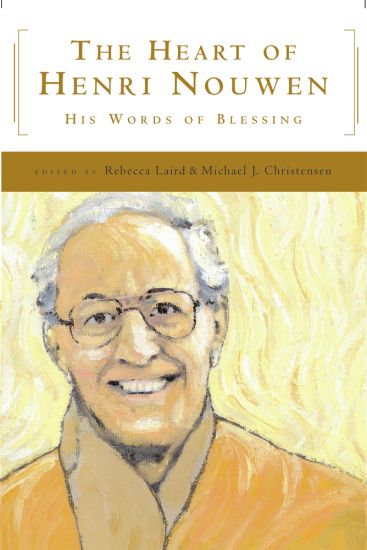
Heart of Henri Nouwen

Heart of Henri Nouwen

Michael J. Christensen; Rebecca J. Laird

Crossroad Publishing Co ,U.S.
2017
nidottu
To commemorate the 70th anniversary of Nouwen's birth, Crossroad issued this anthology of the best of Henri Nouwen from our list. This volume focuses on the three themes that were closest to his own heart: hope in suffering, a personal relationship with God, and living for others.
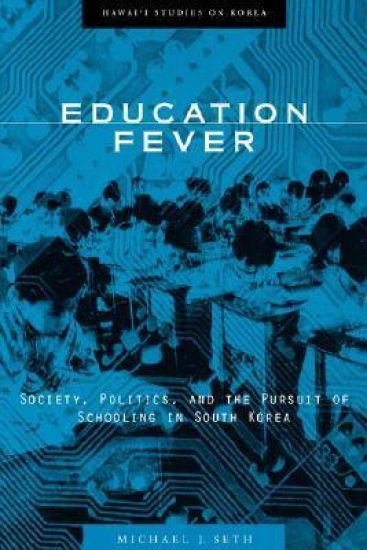
Education Fever

Education Fever

Michael J. Seth

University of Hawai'i Press
2002
sidottu
In the half century after 1945, South Korea went from an impoverished, largely rural nation ruled by a succession of authoritarian regimes to a prosperous, democratic industrial society. No less impressive was the country's transformation from a nation where a majority of the population had no formal education to one with some of the world's highest rates of literacy, high school graduates, and university students. Drawing on their premodern and colonial heritages as well as American education concepts, South Koreans have been largely successful in creating a schooling system that is comprehensive, uniform in standard, and universal. The key to understanding this educational transformation is South Korean society's striking, nearly universal preoccupation with schooling - what Korean's themselves call their ""education fever."" This volume explains how Koreans' concern for achieving as much formal education as possible appeared immediately before 1945 and quickly embraced every sector of society. Through interviews with teachers, officials, parents, and students and an examination of a wide range of written materials in both Korean and English, Michael Seth explores the reasons for this social demand for education and how it has shaped nearly every aspect of South Korean society. He also looks at the many problems of the Korean educational system: the focus on entrance examinations, which has tended to reduce education to test preparation; the overheated competition to enter prestige schools; the enormous financial burden placed on families for costly private tutoring; the inflexibility created by an emphasis on uniformity of standards; and the misuse of education by successive governments for political purposes.
Critical Thinking for Addiction Professionals

Critical Thinking for Addiction Professionals

Michael J. Taleff

Springer Publishing Co Inc
2006
nidottu
Learn to Think Critically and Make Better DecisionsAddiction professionals make decisions everyday that impact peoples lives. Sometimes these decisions are solid, and sometimes they are the result of flawed thinking, which often results from myths and generalizations that are perpetuated in the field. Thinking flaws are common not just in counselors, but in supervisors, administrators, and presenters, and can lead to potentially negative outcomes both for clients and for programs. In this easy-to-read guide--the first to bring together critical thinking and addiction work--critical thinking expert and addiction professional Dr. Michael J. Taleff offers readers the tools they need to think critically and make better decisions. Readers learn:To evaluate their critical thinking abilitiesThe characteristics of a critical thinking professionalWhat drives bad thinking in addiction workHow to recognize and avoid thinking fallaciesThe ethics and consequences of using critical thinkingDr. Taleff has provided an insightful analysis of the kinds of thinking errors often made by counselors. The text should be required reading in all areas of health and human services. The concepts and discussion are as valuable to experienced helpers as they are to novices." -Gregory Blevins, Ph.D., Professor, Governors State University
Advanced Ethics for Addiction Professionals

Advanced Ethics for Addiction Professionals

Michael J. Taleff

Springer Publishing Co Inc
2009
nidottu
The aspects of the book related to the philosophy of science and cognitive science (inductive and deductive reasoning, biases, and heuristics) are distilled in reasonable and useful ways. I recommend this book to those addiction professionals who want to create their own framework for ethical decision making. --PsycCRITIQUES Ethical decision-making is required in many of the difficult situations faced by addiction professionals. In this guide, Michael Taleff describes how to integrate critical thinking with ethical decision-making. This is a guide not on "what to do" when confronted with difficult ethical dilemmas, but on how to think about what to do. The author presents common ethical dilemmas that addiction professionals face in their daily work--such as boundary issues, confidentiality, dual relationships, and more--and asks readers to consider their own responses to these dilemmas. The book then shows readers how to apply new models of ethical thinking to practice. Key features: Presents an ethical self-exam to encourage critical thinking about one's own decision-making method Introduces a variety of models such as the social contract theory, existentialist theory, and ethical egoism Discusses how biases, emotional reactions, and fallacies can weaken ethical decision-making Presents an introductory "Ethics Judgment Kit," a simple, practical decision-making procedure for students This book demonstrates how critical thinking skills can impact and improve the process of ethical decision-making."
Capitalism, Politics, and Railroads in Jacksonian New England

Capitalism, Politics, and Railroads in Jacksonian New England

Michael J. Connolly

University of Missouri Press
2003
sidottu
In this engaging new study, Michael J. Connolly seeks to understand the interrelationships among political change, economic interests, and railroad development in northern New England prior to the Civil War. He analyzes the political thought of the region as it involved the growth of party confrontations - among the Radical Democrats in New Hampshire, the Whigs and Conservative Democrats in New Hampshire, and the Whigs in Essex County, Massachusetts - and the rise of voting activity. An assortment of antebellum demographic data on the various railroad lines is made clear by the maps in the book. New England was an older region with settled patterns of political economy, and innovations like the railroad forced antebellum citizens to alter their patterns of life. Jacksonian Democrats debated among themselves the wisdom of railroad technology, its influence on political power, and its effect on regional economies, remaining skeptical about how this invention would improve their lives. They voiced serious concern that railroads would shrink private rights against the government and destroy the existing ""liberal capitalist"" economy, all the while making northern New Englanders the minions of business interests far away in Boston and Canada. These concerns separated them from the Whigs. Whigs remained ebullient over how railroads would transform their political and economic lives, improve the lot of every New Englander in the long run, and rescue a dying region from social oblivion. They believed that danger came in not developing railroads. Whigs were willing to extend public power to a remarkable extent: bridges were destroyed, courthouses demolished, land and buildings taken to make way for railroads. Less sophisticated in economic understanding than the Jacksonians, Whigs never worried over ""illiberal capitalism""; they welcomed it. The great consensus between Jacksonians and Whigs was capitalism. No one opposed markets. The antebellum conflict was not about whether America should be a market society, but about what shape those markets should take; not about whether government should have power over private rights, but about to what extent states could impose on private citizens. At the center of this debate was the railroad. Providing an excellent view of the economics of railroad development and how it affected the factory and farm world of northern New England, Capitalism, Politics, and Railroads in Jacksonian New England makes a major contribution to our full understanding of the coming of the Civil War.
Protecting Yellowstone

Protecting Yellowstone

Michael J. Yochim

University of New Mexico Press
2015
nidottu
Yellowstone National Park looks like a pristine western landscape populated by wild bison, grizzly bears, and wolves. But the bison do not always range freely, snowmobile noise intrudes upon the park’s winter silence, and some tourist villages are located in prime grizzly bear habitat. These and other issues—including fires and the New World Mine—were the center of a policy-making controversy involving federal politicians and interested stakeholders.Yet outcomes of the controversies varied considerably, depending on politics, science, how well park managers allied themselves with external interests, and public thinking about the effects of park proposals on their access and economies.In Protecting Yellowstone Michael Yochim examines the primary influences upon contemporary national park policy making and considers how those influences shaped or constrained the final policy. In addition, Yochim considers how park managers may best work within the contemporary policy-making context to preserve national parks.
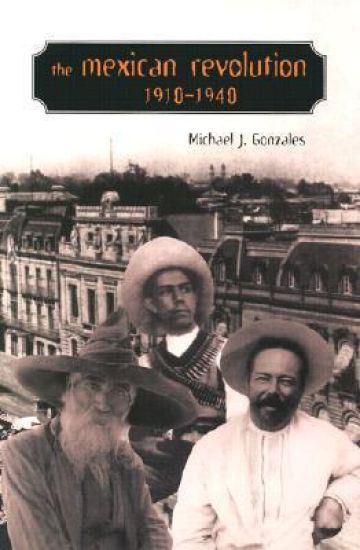
The Mexican Revolution, 1910-1940

The Mexican Revolution, 1910-1940

Michael J. Gonzales

University of New Mexico Press
2002
nidottu
This judicious history of modern Mexico's revolutionary era will help all readers, and in particular students, understand the first great social uprising of the twentieth century. In 1911, land-hungry peasants united with discontented political elites to overthrow General Porfirio Diaz, who had ruled Mexico for three decades. Gonzales offers a path-breaking overview of the revolution from its origins in the Diaz dictatorship through the presidency of radical General Lazaro Cardenas (1934-1940) drawn from archival sources and a vast secondary literature. His interpretation balances accounts of agrarian insurgencies, shifting revolutionary alliances, counterrevolutions, and foreign interventions to delineate the triumphs and failures of revolutionary leaders such as Francisco I. Madero, Pancho Villa, Emiliano Zapata, Alvaro Obregon, and Venustiano Carranza. What emerges is a clear understanding of the tangled events of the period and a fuller appreciation of the efforts of revolutionary presidents after 1916 to reinvent Mexico amid the limitations imposed by a war-torn countryside, a hostile international environment, and the resistance of the Catholic Church and large landowners.
Requiem for America's Best Idea

Requiem for America's Best Idea

Michael J. Yochim; William R. Lowry

UNIVERSITY OF NEW MEXICO PRESS
2022
sidottu
In his enthusiastic explorations and fervent writing, Michael J. Yochim "was to Yellowstone what Muir was to Yosemite. . . . Other times, his writing is like that of Edward Abbey, full of passion for the natural world and anger at those who are abusing it," writes foreword contributor William R. Lowry. In 2013 Yochim was diagnosed with ALS (Lou Gehrig's disease). While fighting the disease, he wrote Requiem for America's Best Idea. The book establishes a unique parallel between Yochim's personal struggle with a terminal illness and the impact climate change is having on the national parks--the treasured wilderness that he loved and to which he dedicated his life.Yochim explains how climate change is already impacting the vegetation, wildlife, and the natural conditions in Olympic, Grand Canyon, Glacier, Yellowstone, and Yosemite National Parks. A poignant and thought-provoking work, Requiem for America's Best Idea investigates the interactions between people and nature and the world that can inspire and destroy them.
Hispano Bastion

Hispano Bastion

Michael J. Alarid

UNIVERSITY OF NEW MEXICO PRESS
2022
sidottu
In this groundbreaking study, historian Michael J. Alarid examines New Mexico's transition from Spanish to Mexican to US control during the nineteenth century and illuminates how emerging class differences played a crucial role in the regime change. After Mexico won independence from Spain in 1821, trade between Mexico and the United States attracted wealthy Hispanos into a new market economy and increased trade along El Camino Real, turning it into a burgeoning exchange route. As landowning Hispanos benefited from the Santa Fe trade, traditional relationships between wealthy and poor nuevomexicanos--whom Alarid calls patrónes and vecinos--started to shift. Far from being displaced by US colonialism, wealthy nuevomexicanos often worked in concert with new American officials after US troops marched into New Mexico in 1846, and in the process, Alarid argues, the patrónes abandoned their customary obligations to vecinos, who were now evolving into a working class. Ultimately wealthy nuevomexicanos, the book argues, succeeded in preserving New Mexico as a Hispano bastion, but they did so at the expense of poor vecinos.
Hispano Bastion

Hispano Bastion

Michael J. Alarid

UNIVERSITY OF NEW MEXICO PRESS
2024
pokkari
In this groundbreaking study, historian Michael J. Alarid examines New Mexico's transition from Spanish to Mexican to US control during the nineteenth century and illuminates how emerging class differences played a crucial role in the regime change. After Mexico won independence from Spain in 1821, trade between Mexico and the United States attracted wealthy Hispanos into a new market economy and increased trade along El Camino Real, turning it into a burgeoning exchange route. As landowning Hispanos benefited from the Santa Fe trade, traditional relationships between wealthy and poor Nuevomexicanos--whom Alarid calls patrónes and vecinos--started to shift. Far from being displaced by US colonialism, wealthy Nuevomexicanos often worked in concert with new American officials after US troops marched into New Mexico in 1846, and in the process, Alarid argues, the patrónes abandoned their customary obligations to vecinos, who were now evolving into a working class. Ultimately wealthy Nuevomexicanos, the book argues, succeeded in preserving New Mexico as a Hispano bastion, but they did so at the expense of poor vecinos.
Requiem for America's Best Idea

Requiem for America's Best Idea

Michael J. Yochim; William R. Lowry

UNIVERSITY OF NEW MEXICO PRESS
2025
nidottu
In Requiem for America's Best Idea, Michael J. Yochim explains how climate change is altering the face of America's national parks, focusing on current and projected changes to vegetation, wildlife, and the natural conditions in Olympic, Grand Canyon, Glacier, Yellowstone, and Yosemite National Parks—five of the "crown jewels" of our national park system. As Yochim guides the reader from park to park, he immerses us in each park's beauty and wonder, highlighting the resources now at risk of destruction or permanent alteration. Yochim worked for the National Park Service for nearly thirty years before being diagnosed with ALS (Lou Gehrig's disease). It was while fighting the disease that he wrote this last moving testament. Interwoven with descriptions of climate change's effects on our national parks is the heartbreaking story of how the author, a legendary hiker and backpacker, lost control of his body to the point where he was finally forced to rely on an eye-tracking machine to write.Climate change is indisputably happening around us, and our parks are changing, often irrevocably. If we don't act now, Yochim argues, future changes will be much more severe, threatening the very essence of these irreplaceable wonders. America's failure to meaningfully address the current climate crisis may well squander the vision that acclaimed western writer Wallace Stegner so memorably celebrated: "National parks are the best idea we ever had. Absolutely American, absolutely democratic, they reflect us at our best, rather than our worst."
Tangled Up in the Bible

Tangled Up in the Bible

Michael J. Gilmour

Continuum International Publishing Group Ltd.
2004
nidottu
Bob Dylan has had a profound influence on the shape of modern pop music (folk, rock, blues) and as a modern literary figure. He has also attracted enormous attention from both professional and amateur "interpreters". In this book Gilmour offers a thorough study of Dylan's reading of scriptures. He explores the ways in which Dylan transforms biblical images and concepts when he incorporates them into his literary world; it is an attempt to listen to the echoes of scripture in his published works. Gilmour closely reads Dylan's poems and songs and provides commentaries on several themes found in Dylan's work: the Sermon on the Mount and Jesus; apocalypse, justice and judgement; oppressive religion and religious irony. Through these readings, Gilmour calls attention to the various ways Dylan uses scripture both in an explicit and an implicit manner.
Comentario Bíblico Con Aplicación NVI Mateo: del Texto Bíblico a Una Aplicación Contemporánea
La mayor a de los comentarios b blicos solo son un viaje de ida: nos llevan del siglo veintiuno al siglo primero. Pero nos dejan all , dando por sentado que de alg n modo sabremos regresar por nosotros mismos. Dicho de otro modo, se centran en el significado original del pasaje, sin embargo, no se adentran en su aplicaci n a la vida contempor nea. La informaci n que ofrecen es muy valiosa, pero resulta tan solo una ayuda a medias. Los Comentarios B blicos con Aplicaci n NVI nos ayudan con las dos partes de la tarea interpretativa, es decir, tambi n nos ayudan a aplicar un mensaje de otra poca a nuestro contexto actual. Esta serie no solo nos explica lo que signific para los lectores originales, sino que nos demuestra que tambi n hay un mensaje poderoso para la iglesia de hoy. Para lograrlo analiza cada pasaje en tres partes: 1. Sentido original. 2. Construyendo puentes entre los contextos del autor b blico y el nuestro. 3. Significado contempor neo
Comentario Bíblico Con Aplicación NVI Mateo

Comentario Bíblico Con Aplicación NVI Mateo

Michael J Wilkins

Vida Publishers
2021
pokkari
Aprende la retadora pero importante tarea de transportar el mensaje antiguo de la Palabra de Dios a un contexto moderno y claro, utilizando Los Comentarios B blicos con aplicaci n NVI.Estos comentarios adem s de enfocarse en la aplicaci n de un pasaje, tambi n nos permite pensar en el proceso por el cual se desarrolla un texto en su sentido original hasta llegar a su significado contempor neo. Son verdaderos comentarios, no exposiciones populares. Siendo obras de referencia y no de literatura devocional.En cada comentario encontrar s: El significado del texto b blico en su contexto del primer siglo (Sentido Original)La conexi n entre el contexto original de la Biblia y su aplicaci n contempor neo (Construyendo Puentes)La aplicaci n de un mensaje b blico contempor neo con el mismo poder que fue escrito en el pasado.NVI Application Commentary: MatthewLearn the exciting but important task of translating the ancient message of God's Word into a clear modern context using the NIV Bible Commentaries with application.These commentaries not only focus on the application of a passage, but also allow us to think about the process by which a text develops from its original meaning to its contemporary sense. These are true commentaries, not popular expositions. Being works of reference and not devotional literature.In each commentary you will find: The meaning of the biblical text in its first century context (Original Meaning).The connection between the original context of the Bible and its contemporary application (Building Bridges).The application of a contemporary biblical message with the same power as it was written in the past.
The Feasts of Repentance

The Feasts of Repentance

Michael J. Ovey

IVP Academic
2019
nidottu
In gospel proclamation today, the critical New Testament element of repentance can be far too often ignored, minimalized, or dismissed. Yet John the Baptist, Jesus himself, and those he commissioned to spread his gospel all spoke of the urgent need to repent.Michael Ovey was convinced that a gospel without repentance quickly distorts our view of God, ourselves, and each other by undermining grace and ultimately leading to idolatry. Only when we grasp the need for true repentance as consisting of a real change--a transforming work of the Spirit of God--can we fully understand the gospel Jesus preached.In this New Studies in Biblical Theology volume, Ovey focuses first on the relevant biblical material in Luke-Acts, examining who repents and who does not, and the characters of both groups. He surveys the "feasts of repentance" of Jesus with Levi, the Pharisees, Zaccheus, and in the parable of the Lost Son. He then moves to more systematic-theological aspects of repentance, in relation to idolatry and to salvation, and finally he offers a pastoral theology for the corporate life of the people of God today, with regard to self-righteousness, hypocrisy, humility, forgiveness, and justice.Addressing key issues in biblical theology, the works comprising New Studies in Biblical Theology are creative attempts to help Christians better understand their Bibles. The NSBT series is edited by D. A. Carson, aiming to simultaneously instruct and to edify, to interact with current scholarship and to point the way ahead.