Kirjojen hintavertailu. Mukana 11 699 587 kirjaa ja 12 kauppaa.

Kirjahaku

Etsi kirjoja tekijän nimen, kirjan nimen tai ISBN:n perusteella.

1000 tulosta hakusanalla Monet Thompson

Money and Monetary Policy in Early Times
Originally published between 1920-70,The History of Civilization was a landmark in early twentieth century publishing. It was published at a formative time within the social sciences, and during a period of decisive historical discovery. The aim of the general editor, C.K. Ogden, was to summarize the most up to date findings and theories of historians, anthropologists, archaeologists and sociologists. This reprinted material is available as a set or in the following groupings: * Prehistory and Historical Ethnography Set of 12: 0-415-15611-4: £800.00 * Greek Civilization Set of 7: 0-415-15612-2: £450.00 * Roman Civilization Set of 6: 0-415-15613-0: £400.00 * Eastern Civilizations Set of 10: 0-415-15614-9: £650.00 * Judaeo-Christian Civilization Set of 4: 0-415-15615-7: £250.00 * European Civilization Set of 11: 0-415-15616-5: £700.00
Money in Islam

Money in Islam

Masudul A. Choudhury

Routledge
1997
sidottu
This volume takes a unique and challenging look at how money has operated in Islamic society and at how Islamic theoretical frameworks have influenced perceptions of money. The author draws upon historical, data and policy analysis to present a comparative study of monetary theories, including recent treatment of money by Islamic economists. Discussion also covers the nature of joint venture, stock markets, banks and financial intermediaries, price stability and international trade. This work sheds pioneering light in this area, and will be of interest to academics, graduates and researchers internationally.
Money and Growth
Allyn Young is one of the central figures in the development of American economic thought, and is one of the originators of modern endogenous growth theory. This book allows full appreciation of the full extent of Young's work because many of his most significant contributions are buried in obscure journals and unsigned articles. This volume addresses this by reprinting much of Young's lost work, as well as other selected pieces that reveal the scope of his vision which encompasses two of the grand themes of economics, growth and money. The volume includes sections on: * the socialist movement * the first world war and its aftermath * money * theories of growth
Money, Labour and Land
The cultural wealth of the classical Greek world was matched by its material wealth, and there is abundant textual and archaeological evidence for both. However, radically different theoretical and methodological approaches have been used to interpret this evidence, and conflicts continue to rage as these different starting points produce clashing views on the significance and distribution of money, labour and land.Money, Labour and Land reflects the current explosion in ideas and research by assembling case-studies from an international selection of renowned US, British and European scholars. Drawing on comparative historical and anthropological approaches, sociological, economic and cultural theory, and developments in epigraphy, legal history, numismatics and spatial archaeology, this volume will be of interest to all students and scholars of ancient economies.
Money, Enterprise and Income Distribution
Mainstream neoclassical economics tells us that money is essentially a commodity, has no other social meanings or consequences, and (therefore) exists only as a medium of exchange to lubricate/facilitate barter. This book takes the view that money is definitively a social relation between private persons or legal persons. As such, it is one of the main building blocks of the complex structure of social relations of capitalism itself.
Money, Enterprise and Income Distribution
Mainstream neoclassical economics tells us that money is essentially a commodity, has no other social meanings or consequences, and (therefore) exists only as a medium of exchange to lubricate/facilitate barter. This book takes the view that money is definitively a social relation between private persons or legal persons. As such, it is one of the main building blocks of the complex structure of social relations of capitalism itself.
Money, Macroeconomics and Keynes
This volume, along with its companion volume, Methodology, Microeconomics and Keynes is published in honour of Victoria Chick, inspired by her own contributions to knowledge in all of these areas and their interconnections. It represents both consolidation and the breaking of new ground in Keynesian monetary theory and macroeconomics by leading figures in these fields.
Money, Credit and Price Stability
Beginning with the development of credit-money theory in the twentieth century, Paul Dalziel derives a model that explains how interest rates are used by authorities to maintain price stability. His conclusions suggest ways in which the current policy framework can be improved to promote growth, without sacrificing that stability.
Money and the Market

Money and the Market

Kevin Dowd

Routledge
2000
sidottu
Kevin Dowd asserts that state intervention into financial and monetary systems has failed, and that we would be better off if financial markets were left to regulate themselves. This collection will appeal to students, researchers and policy makers in the monetary and financial area.
Money, Time and Rationality in Max Weber
This unique study into the roots of Max Weber's Political Economy, is an intriguing read and a valuable contribution to the Weberian literature. Parsons argues that Weber's analysis is highly influenced by the Austrian School of Economics and the relationship between his critique of centrally planned economies and that of Mises.
Money, Uncertainty and Time

Money, Uncertainty and Time

Giuseppe Fontana

Routledge
2008
sidottu
This excellent new book from one of the brightest young economists, Giuseppe Fontana, involves a compendium of issues surrounding uncertainty, money and time. Fontana shines a post Keynesian light onto statements and claims made by well-known neo-classical authors and as such leaves readers with an interesting and informative book to be read and re-read by all those scholars and students involved with monetary economics.
Money and Exchange

Money and Exchange

Sasan Fayazmanesh

Routledge
2006
sidottu
Whether a theoretical system is realistic or not has been a concern in economics, particularly in monetary theory, over the past century. Following John R. Hicks’ proposal that a realistic monetary theory could be constructed along an evolutionary path, starting with the workings of a real market, this volume considers whether we can look to the medieval economy as the point of departure. Drawing upon the work of Aristotle, scholastic economists, Adam Smith, Karl Marx, William Stanley Jevons, Léon Walras and many modern monetary theorists, this intriguing book provides a critical analysis of some basic theories of monetary analysis. Concentrating primarily on certain fundamental building blocks it covers:the theory and mathematical properties of barter and monetary relations the distinction between barter and monetary relations and money and non-money commodities the concept of exchange as an equation, and the notion of the exchange relation as a relation of equality.This groundbreaking study dispels some of the old myths and conjectures concerning money and exchange and opens up the way for the development of new approaches, both realistic and evolutionary, of interest to researchers and students of the history of monetary theory and economic thought.
Money Income and Employment

Money Income and Employment

Erich Schneider

Routledge
2003
sidottu
Part One of this book deals with the theory of how money is created and destroyed. Essential principles are illustrated by considering various models of banking systems. Part Two provides an account of the modern theory of income and employment. * Theory backed up with examples of the simplest to the most complicated models, for example: * The model of "a closed economy without a government" to one in which government expenditure and revenue affect the level of national income * The model in which the rate of interest and quantity of money have no effect and the model in which they are variables relevant to the determination of income
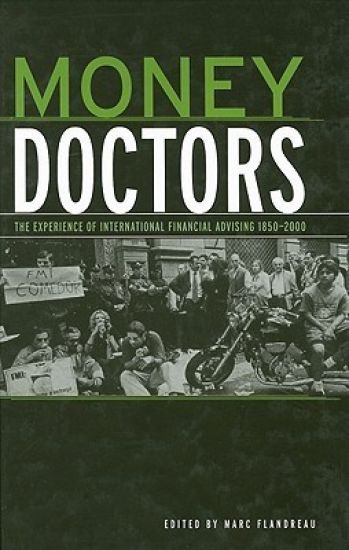
Money Doctors

Money Doctors

Routledge
2003
sidottu
The book brings together internationally respected specialists from economics, history and political science such as Harold James, Louis Pauly and Kenneth Mouré. First providing a short history of money doctors, the book then goes on to cover such themes as: *the IMF and policy advice *the Russian experience *contemporary money doctors. The book shows that there is still a long way to go before international financial advice develops into something that is truly helpful in the long term.
Money Makes Us Relatives

Money Makes Us Relatives

Jenny B. White

Routledge
2004
sidottu
In the rural immigrant community of Istanbul, poor women spend up to fifty hours a week producing goods for export, yet deny that they actually 'work'. Money Makes Us Relatives asks why Turkish society devalues women's work, concealing its existence while creating a vast pool of cheap labor for the world market. Drawing on two years of ethnographic fieldwork among family producers and pieceworkers, and using fascinating case studies throughout, Jenny B. White shows how women's paid work is viewed in terms of kinship relations of reciprocity and obligation - an extension of domestic work for the family, which is culturally valued but poorly compensated. Whilst offering the benefits of social identity and long-term security, women's work also reflects global capitalism's ability to capture local cultural norms, and to use these to lower production costs and create exploitative conditions. This fully revised second edition includes a new introduction and conclusion, updated references, comparative material on women's labor elsewhere in the world, and brand new material on Islam, globalization, gender and Turkish family life. It is an important contribution to debates about women's participation in late global capitalism.
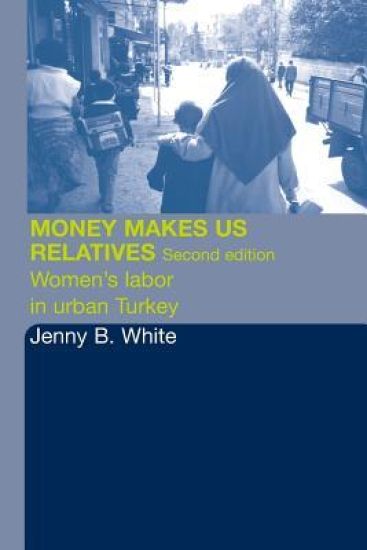
Money Makes Us Relatives

Money Makes Us Relatives

Jenny B. White

Routledge
2004
nidottu
In the rural immigrant community of Istanbul, poor women spend up to fifty hours a week producing goods for export, yet deny that they actually 'work'. Money Makes Us Relatives asks why Turkish society devalues women's work, concealing its existence while creating a vast pool of cheap labor for the world market. Drawing on two years of ethnographic fieldwork among family producers and pieceworkers, and using fascinating case studies throughout, Jenny B. White shows how women's paid work is viewed in terms of kinship relations of reciprocity and obligation - an extension of domestic work for the family, which is culturally valued but poorly compensated. Whilst offering the benefits of social identity and long-term security, women's work also reflects global capitalism's ability to capture local cultural norms, and to use these to lower production costs and create exploitative conditions. This fully revised second edition includes a new introduction and conclusion, updated references, comparative material on women's labor elsewhere in the world, and brand new material on Islam, globalization, gender and Turkish family life. It is an important contribution to debates about women's participation in late global capitalism.
Money and Payments in Theory and Practice
International in scope and written by a leading young Post-Keynesian economist, this book focuses on the working of money and payments in a multi-bank settlement system within which banks and non-bank financial institutions have been expanding their operations outside their countries of incorporation.Departing from conventionally held beliefs, Sergio Rossi sets off from a positive analysis of the logical origin of money, which is the essential principle of double-entry book-keeping through which banks record all debts and credits for further reference and settlement and provides theoretical and empirical advances in explaining money endogeneity for the investigation of contemporary domestic and international monetary issues.Showing that both money and banking have profound implications for real economic activities, this innovative work is essential reading, not only for scholars in monetary economics, but also for professionals concerned with monetary policy and payments system issues.