Kirjojen hintavertailu. Mukana 11 420 442 kirjaa ja 12 kauppaa.

Kirjahaku

Etsi kirjoja tekijän nimen, kirjan nimen tai ISBN:n perusteella.

1000 tulosta hakusanalla R Shanthi

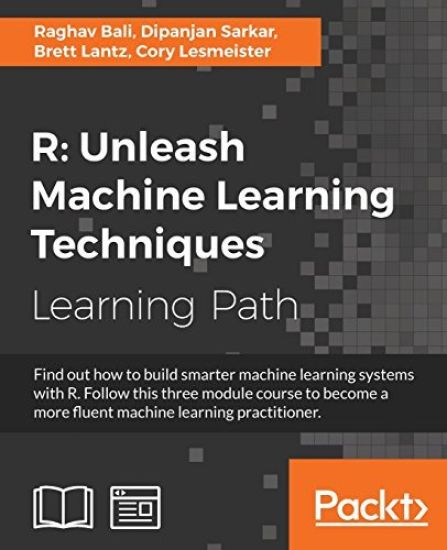
R: Unleash Machine Learning Techniques

R: Unleash Machine Learning Techniques

Raghav Bali; Dipanjan Sarkar; Brett Lantz; Cory Lesmeister

Packt Publishing Limited
2016
nidottu
Find out how to build smarter machine learning systems with R. Follow this three module course to become a more fluent machine learning practitioner. About This Book * Build your confidence with R and find out how to solve a huge range of data-related problems * Get to grips with some of the most important machine learning techniques being used by data scientists and analysts across industries today * Don't just learn - apply your knowledge by following featured practical projects covering everything from financial modeling to social media analysis Who This Book Is For Aimed for intermediate-to-advanced people (especially data scientist) who are already into the field of data science What You Will Learn * Get to grips with R techniques to clean and prepare your data for analysis, and visualize your results * Implement R machine learning algorithms from scratch and be amazed to see the algorithms in action * Solve interesting real-world problems using machine learning and R as the journey unfolds * Write reusable code and build complete machine learning systems from the ground up * Learn specialized machine learning techniques for text mining, social network data, big data, and more * Discover the different types of machine learning models and learn which is best to meet your data needs and solve your analysis problems * Evaluate and improve the performance of machine learning models * Learn specialized machine learning techniques for text mining, social network data, big data, and more In Detail R is the established language of data analysts and statisticians around the world. And you shouldn't be afraid to use it... This Learning Path will take you through the fundamentals of R and demonstrate how to use the language to solve a diverse range of challenges through machine learning. Accessible yet comprehensive, it provides you with everything you need to become more a more fluent data professional, and more confident with R. In the first module you'll get to grips with the fundamentals of R. This means you'll be taking a look at some of the details of how the language works, before seeing how to put your knowledge into practice to build some simple machine learning projects that could prove useful for a range of real world problems. For the following two modules we'll begin to investigate machine learning algorithms in more detail. To build upon the basics, you'll get to work on three different projects that will test your skills. Covering some of the most important algorithms and featuring some of the most popular R packages, they're all focused on solving real problems in different areas, ranging from finance to social media. This Learning Path has been curated from three Packt products: * R Machine Learning By Example By Raghav Bali, Dipanjan Sarkar * Machine Learning with R Learning - Second Edition By Brett Lantz * Mastering Machine Learning with R By Cory Lesmeister Style and approach This is an enticing learning path that starts from the very basics to gradually pick up pace as the story unfolds. Each concept is first defined in the larger context of things succinctly, followed by a detailed explanation of their application. Each topic is explained with the help of a project that solves a real-world problem involving hands-on work thus giving you a deep insight into the world of machine learning.

R. Crumb: Fritz the Cat (Foiled Journal)
Part of a series of exciting and luxurious Flame Tree Notebooks. Combining high-quality production with magnificent fine art, the covers are printed on foil in five colours, embossed, then foil stamped. And they're powerfully practical: a pocket at the back for receipts and scraps, two bookmarks and a solid magnetic side flap. These are perfect for personal use and make a dazzling gift. This example features R. Crumb: Fritz the Cat. One of the leading figures of the underground comix movement, R. Crumb’s work is as distinctive as it is polarizing. The eccentric social satirist first rose to prominence in the 1960s counterculture scene, going on to be one of the most prolific and influential cartoonists of the 20th century. Fritz the Cat is one of Crumb’s most iconic comic strips, appearing in Help!, Cavalier, and numerous underground publications between 1965 and 1972.
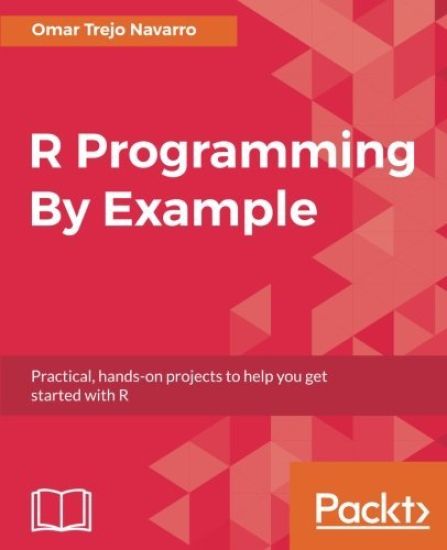
R Programming By Example

R Programming By Example

Omar Trejo Navarro

Packt Publishing Limited
2017
nidottu
This step-by-step guide demonstrates how to build simple-to-advanced applications through examples in R using modern tools. About This Book • Get a firm hold on the fundamentals of R through practical hands-on examples • Get started with good R programming fundamentals for data science • Exploit the different libraries of R to build interesting applications in R Who This Book Is For This books is for aspiring data science professionals or statisticians who would like to learn about the R programming language in a practical manner. Basic programming knowledge is assumed. What You Will Learn • Discover techniques to leverage R's features, and work with packages • Perform a descriptive analysis and work with statistical models using R • Work efficiently with objects without using loops • Create diverse visualizations to gain better understanding of the data • Understand ways to produce good visualizations and create reports for the results • Read and write data from relational databases and REST APIs, both packaged and unpackaged • Improve performance by writing better code, delegating that code to a more efficient programming language, or making it parallel In Detail R is a high-level statistical language and is widely used among statisticians and data miners to develop analytical applications. Often, data analysis people with great analytical skills lack solid programming knowledge and are unfamiliar with the correct ways to use R. Based on the version 3.4, this book will help you develop strong fundamentals when working with R by taking you through a series of full representative examples, giving you a holistic view of R. We begin with the basic installation and configuration of the R environment. As you progress through the exercises, you'll become thoroughly acquainted with R's features and its packages. With this book, you will learn about the basic concepts of R programming, work efficiently with graphs, create publication-ready and interactive 3D graphs, and gain a better understanding of the data at hand. The detailed step-by-step instructions will enable you to get a clean set of data, produce good visualizations, and create reports for the results. It also teaches you various methods to perform code profiling and performance enhancement with good programming practices, delegation, and parallelization. By the end of this book, you will know how to efficiently work with data, create quality visualizations and reports, and develop code that is modular, expressive, and maintainable. Style and Approach This is an easy-to-understand guide filled with real-world examples, giving you a holistic view of R and practical, hands-on experience.
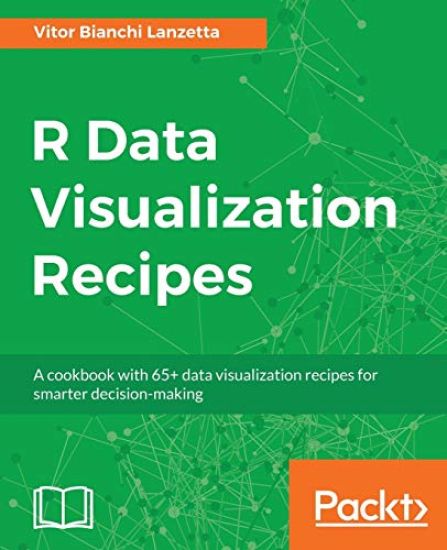
R Data Visualization Recipes

R Data Visualization Recipes

Vitor Bianchi Lanzetta

Packt Publishing Limited
2017
nidottu
Translate your data into info-graphics using popular packages in R About This Book • Use R's popular packages—such as ggplot2, ggvis, ggforce, and more—to create custom, interactive visualization solutions. • Create, design, and build interactive dashboards using Shiny • A highly practical guide to help you get to grips with the basics of data visualization techniques, and how you can implement them using R Who This Book Is For If you are looking to create custom data visualization solutions using the R programming language and are stuck somewhere in the process, this book will come to your rescue. Prior exposure to packages such as ggplot2 would be useful but not necessary. However, some R programming knowledge is required. What You Will Learn • Get to know various data visualization libraries available in R to represent data • Generate elegant codes to craft graphics using ggplot2, ggvis and plotly • Add elements, text, animation, and colors to your plot to make sense of data • Deepen your knowledge by adding bar-charts, scatterplots, and time series plots using ggplot2 • Build interactive dashboards using Shiny. • Color specific map regions based on the values of a variable in your data frame • Create high-quality journal-publishable scatterplots • Create and design various three-dimensional and multivariate plots In Detail R is an open source language for data analysis and graphics that allows users to load various packages for effective and better data interpretation. Its popularity has soared in recent years because of its powerful capabilities when it comes to turning different kinds of data into intuitive visualization solutions. This book is an update to our earlier R data visualization cookbook with 100 percent fresh content and covering all the cutting edge R data visualization tools. This book is packed with practical recipes, designed to provide you with all the guidance needed to get to grips with data visualization using R. It starts off with the basics of ggplot2, ggvis, and plotly visualization packages, along with an introduction to creating maps and customizing them, before progressively taking you through various ggplot2 extensions, such as ggforce, ggrepel, and gganimate. Using real-world datasets, you will analyze and visualize your data as histograms, bar graphs, and scatterplots, and customize your plots with various themes and coloring options. The book also covers advanced visualization aspects such as creating interactive dashboards using Shiny By the end of the book, you will be equipped with key techniques to create impressive data visualizations with professional efficiency and precision. Style and approach This book is packed with practical recipes, designed to provide you with all the guidance needed to get to grips with data visualization with R. You will learn to leverage the power of R and ggplot2 to create highly customizable data visualizations of varying complexities. The readers will then learn how to create, design, and build interactive dashboards using Shiny.
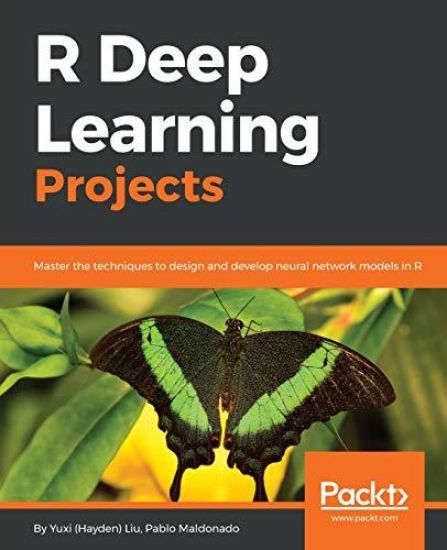
R Deep Learning Projects

R Deep Learning Projects

Yuxi (Hayden) Liu; Pablo Maldonado

Packt Publishing Limited
2018
nidottu
5 real-world projects to help you master deep learning concepts About This Book • Master the different deep learning paradigms and build real-world projects related to text generation, sentiment analysis, fraud detection, and more • Get to grips with R's impressive range of Deep Learning libraries and frameworks such as deepnet, MXNetR, Tensorflow, H2O, Keras, and text2vec • Practical projects that show you how to implement different neural networks with helpful tips, tricks, and best practices Who This Book Is For Machine learning professionals and data scientists looking to master deep learning by implementing practical projects in R will find this book a useful resource. A knowledge of R programming and the basic concepts of deep learning is required to get the best out of this book. What You Will Learn • Instrument Deep Learning models with packages such as deepnet, MXNetR, Tensorflow, H2O, Keras, and text2vec • Apply neural networks to perform handwritten digit recognition using MXNet • Get the knack of CNN models, Neural Network API, Keras, and TensorFlow for traffic sign classification • Implement credit card fraud detection with Autoencoders • Master reconstructing images using variational autoencoders • Wade through sentiment analysis from movie reviews • Run from past to future and vice versa with bidirectional Long Short-Term Memory (LSTM) networks • Understand the applications of Autoencoder Neural Networks in clustering and dimensionality reduction In Detail R is a popular programming language used by statisticians and mathematicians for statistical analysis, and is popularly used for deep learning. Deep Learning, as we all know, is one of the trending topics today, and is finding practical applications in a lot of domains. This book demonstrates end-to-end implementations of five real-world projects on popular topics in deep learning such as handwritten digit recognition, traffic light detection, fraud detection, text generation, and sentiment analysis. You'll learn how to train effective neural networks in R—including convolutional neural networks, recurrent neural networks, and LSTMs—and apply them in practical scenarios. The book also highlights how neural networks can be trained using GPU capabilities. You will use popular R libraries and packages—such as MXNetR, H2O, deepnet, and more—to implement the projects. By the end of this book, you will have a better understanding of deep learning concepts and techniques and how to use them in a practical setting. Style and approach This book's unique, learn-as-you-do approach ensures the reader builds on his understanding of deep learning progressively with each project. This book is designed in such a way that implementing each project will empower you with a unique skillset and enable you to implement the next project more confidently.
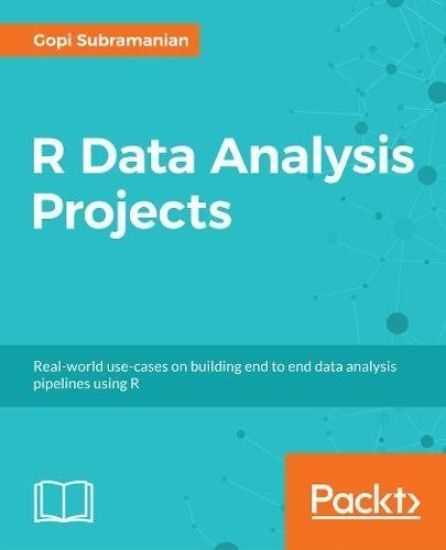
R Data Analysis Projects

R Data Analysis Projects

Gopi Subramanian

Packt Publishing Limited
2017
nidottu
Get valuable insights from your data by building data analysis systems from scratch with R. About This Book • A handy guide to take your understanding of data analysis with R to the next level • Real-world projects that focus on problems in finance, network analysis, social media, and more • From data manipulation to analysis to visualization in R, this book will teach you everything you need to know about building end-to-end data analysis pipelines using R Who This Book Is For If you are looking for a book that takes you all the way through the practical application of advanced and effective analytics methodologies in R, then this is the book for you. A fundamental understanding of R and the basic concepts of data analysis is all you need to get started with this book. What You Will Learn • Build end-to-end predictive analytics systems in R • Build an experimental design to gather your own data and conduct analysis • Build a recommender system from scratch using different approaches • Use and leverage RShiny to build reactive programming applications • Build systems for varied domains including market research, network analysis, social media analysis, and more • Explore various R Packages such as RShiny, ggplot, recommenderlab, dplyr, and find out how to use them effectively • Communicate modeling results using Shiny Dashboards • Perform multi-variate time-series analysis prediction, supplemented with sensitivity analysis and risk modeling In Detail R offers a large variety of packages and libraries for fast and accurate data analysis and visualization. As a result, it's one of the most popularly used languages by data scientists and analysts, or anyone who wants to perform data analysis. This book will demonstrate how you can put to use your existing knowledge of data analysis in R to build highly efficient, end-to-end data analysis pipelines without any hassle. You'll start by building a content-based recommendation system, followed by building a project on sentiment analysis with tweets. You'll implement time-series modeling for anomaly detection, and understand cluster analysis of streaming data. You'll work through projects on performing efficient market data research, building recommendation systems, and analyzing networks accurately, all provided with easy to follow codes. With the help of these real-world projects, you'll get a better understanding of the challenges faced when building data analysis pipelines, and see how you can overcome them without compromising on the efficiency or accuracy of your systems. The book covers some popularly used R packages such as dplyr, ggplot2, RShiny, and others, and includes tips on using them effectively. By the end of this book, you'll have a better understanding of data analysis with R, and be able to put your knowledge to practical use without any hassle. Style and approach This book takes a unique, learn-as-you-do approach, as you build on your understanding of data analysis progressively with each project. This book is designed in a way that implementing each project will empower you with a unique skill set, and enable you to implement the next project more confidently.
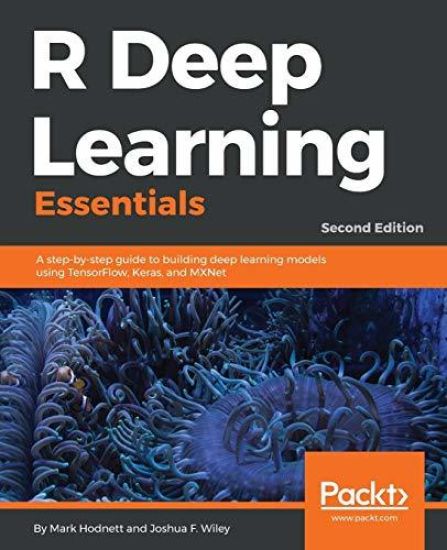
R Deep Learning Essentials

R Deep Learning Essentials

Mark Hodnett; Joshua F. Wiley

Packt Publishing Limited
2018
nidottu
Implement neural network models in R 3.5 using TensorFlow, Keras, and MXNetKey FeaturesUse R 3.5 for building deep learning models for computer vision and textApply deep learning techniques in cloud for large-scale processingBuild, train, and optimize neural network models on a range of datasetsBook DescriptionDeep learning is a powerful subset of machine learning that is very successful in domains such as computer vision and natural language processing (NLP). This second edition of R Deep Learning Essentials will open the gates for you to enter the world of neural networks by building powerful deep learning models using the R ecosystem.This book will introduce you to the basic principles of deep learning and teach you to build a neural network model from scratch. As you make your way through the book, you will explore deep learning libraries, such as Keras, MXNet, and TensorFlow, and create interesting deep learning models for a variety of tasks and problems, including structured data, computer vision, text data, anomaly detection, and recommendation systems. You’ll cover advanced topics, such as generative adversarial networks (GANs), transfer learning, and large-scale deep learning in the cloud. In the concluding chapters, you will learn about the theoretical concepts of deep learning projects, such as model optimization, overfitting, and data augmentation, together with other advanced topics.By the end of this book, you will be fully prepared and able to implement deep learning concepts in your research work or projects.What you will learnBuild shallow neural network prediction modelsPrevent models from overfitting the data to improve generalizabilityExplore techniques for finding the best hyperparameters for deep learning modelsCreate NLP models using Keras and TensorFlow in RUse deep learning for computer vision tasksImplement deep learning tasks, such as NLP, recommendation systems, and autoencodersWho this book is forThis second edition of R Deep Learning Essentials is for aspiring data scientists, data analysts, machine learning developers, and deep learning enthusiasts who are well versed in machine learning concepts and are looking to explore the deep learning paradigm using R. Fundamental understanding of the R language is necessary to get the most out of this book.
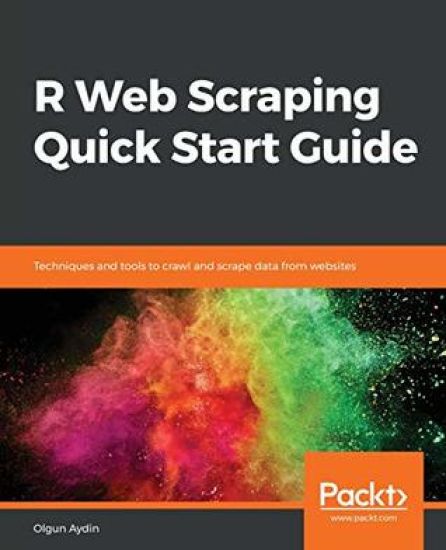
R Web Scraping Quick Start Guide

R Web Scraping Quick Start Guide

Olgun Aydin

Packt Publishing Limited
2018
nidottu
Web Scraping techniques are getting more popular, since data is as valuable as oil in 21st century. Through this book get some key knowledge about using XPath, regEX; web scraping libraries for R like rvest and RSelenium technologies. Key FeaturesTechniques, tools and frameworks for web scraping with RScrape data effortlessly from a variety of websites Learn how to selectively choose the data to scrape, and build your datasetBook DescriptionWeb scraping is a technique to extract data from websites. It simulates the behavior of a website user to turn the website itself into a web service to retrieve or introduce new data. This book gives you all you need to get started with scraping web pages using R programming.You will learn about the rules of RegEx and Xpath, key components for scraping website data. We will show you web scraping techniques, methodologies, and frameworks. With this book's guidance, you will become comfortable with the tools to write and test RegEx and XPath rules. We will focus on examples of dynamic websites for scraping data and how to implement the techniques learned. You will learn how to collect URLs and then create XPath rules for your first web scraping script using rvest library. From the data you collect, you will be able to calculate the statistics and create R plots to visualize them. Finally, you will discover how to use Selenium drivers with R for more sophisticated scraping. You will create AWS instances and use R to connect a PostgreSQL database hosted on AWS. By the end of the book, you will be sufficiently confident to create end-to-end web scraping systems using R.What you will learnWrite and create regEX rulesWrite XPath rules to query your dataLearn how web scraping methods workUse rvest to crawl web pagesStore data retrieved from the webLearn the key uses of Rselenium to scrape dataWho this book is forThis book is for R programmers who want to get started quickly with web scraping, as well as data analysts who want to learn scraping using R. Basic knowledge of R is all you need to get started with this book.
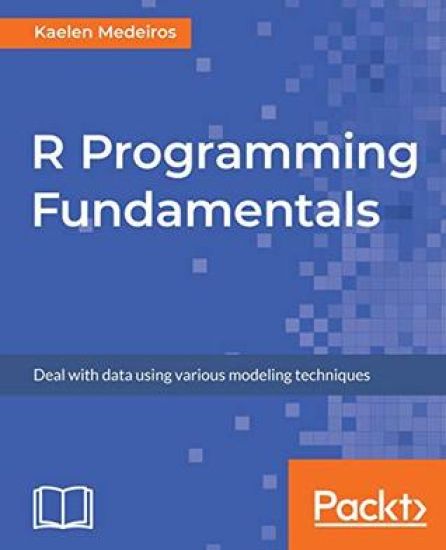
R Programming Fundamentals

R Programming Fundamentals

Kaelen Medeiros

Packt Publishing Limited
2018
nidottu
Study data analysis and visualization to successfully analyze data with RKey FeaturesGet to grips with data cleaning methodsExplore statistical concepts and programming in R, including best practicesBuild a data science project with real-world examplesBook DescriptionR Programming Fundamentals, focused on R and the R ecosystem, introduces you to the tools for working with data. To start with, you’ll understand you how to set up R and RStudio, followed by exploring R packages, functions, data structures, control flow, and loops.Once you have grasped the basics, you’ll move on to studying data visualization and graphics. You’ll learn how to build statistical and advanced plots using the powerful ggplot2 library. In addition to this, you’ll discover data management concepts such as factoring, pivoting, aggregating, merging, and dealing with missing values.By the end of this book, you’ll have completed an entire data science project of your own for your portfolio or blog.What you will learnUse basic programming concepts of R such as loading packages, arithmetic functions, data structures, and flow controlImport data to R from various formats such as CSV, Excel, and SQLClean data by handling missing values and standardizing fieldsPerform univariate and bivariate analysis using ggplot2Create statistical summary and advanced plots such as histograms, scatter plots, box plots, and interaction plotsApply data management techniques, such as factoring, pivoting, aggregating, merging, and dealing with missing values, on the example datasetsWho this book is forR Programming Fundamentals is for you if you are an analyst who wants to grow in the field of data science and explore the latest tools.
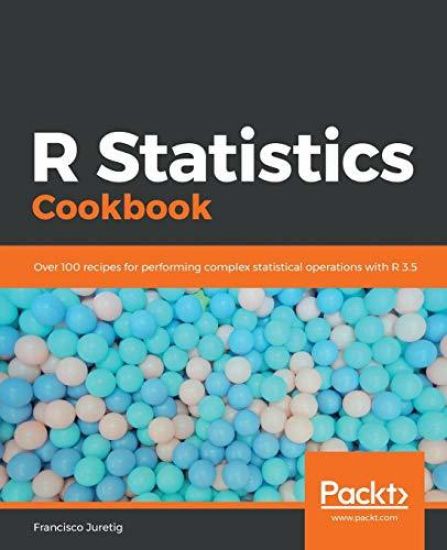
R Statistics Cookbook

R Statistics Cookbook

Francisco Juretig

Packt Publishing Limited
2019
nidottu
Solve real-world statistical problems using the most popular R packages and techniquesKey FeaturesLearn how to apply statistical methods to your everyday research with handy recipesFoster your analytical skills and interpret research across industries and business verticalsPerform t-tests, chi-squared tests, and regression analysis using modern statistical techniquesBook DescriptionR is a popular programming language for developing statistical software. This book will be a useful guide to solving common and not-so-common challenges in statistics. With this book, you'll be equipped to confidently perform essential statistical procedures across your organization with the help of cutting-edge statistical tools.You'll start by implementing data modeling, data analysis, and machine learning to solve real-world problems. You'll then understand how to work with nonparametric methods, mixed effects models, and hidden Markov models. This book contains recipes that will guide you in performing univariate and multivariate hypothesis tests, several regression techniques, and using robust techniques to minimize the impact of outliers in data.You'll also learn how to use the caret package for performing machine learning in R. Furthermore, this book will help you understand how to interpret charts and plots to get insights for better decision making.By the end of this book, you will be able to apply your skills to statistical computations using R 3.5. You will also become well-versed with a wide array of statistical techniques in R that are extensively used in the data science industry.What you will learnBecome well versed with recipes that will help you interpret plots with RFormulate advanced statistical models in R to understand its conceptsPerform Bayesian regression to predict models and input missing dataUse time series analysis for modelling and forecasting temporal dataImplement a range of regression techniques for efficient data modellingGet to grips with robust statistics and hidden Markov modelsExplore ANOVA (Analysis of Variance) and perform hypothesis testingWho this book is forIf you are a quantitative researcher, statistician, data analyst, or data scientist looking to tackle various challenges in statistics, this book is what you need! Proficiency in R programming and basic knowledge of linear algebra is necessary to follow along the recipes covered in this book.
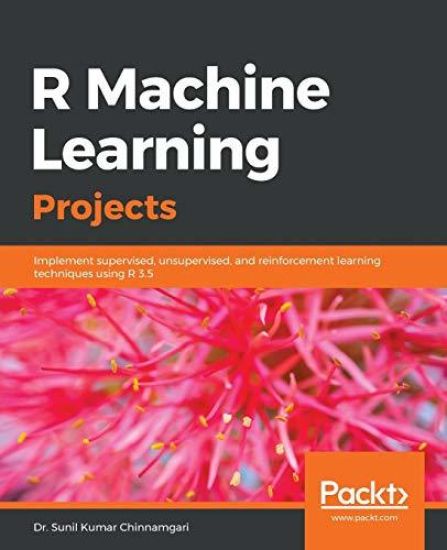
R Machine Learning Projects

R Machine Learning Projects

Dr. Sunil Kumar Chinnamgari

Packt Publishing Limited
2019
nidottu
Master a range of machine learning domains with real-world projects using TensorFlow for R, H2O, MXNet, and moreKey FeaturesMaster machine learning, deep learning, and predictive modeling concepts in R 3.5Build intelligent end-to-end projects for finance, retail, social media, and a variety of domainsImplement smart cognitive models with helpful tips and best practicesBook DescriptionR is one of the most popular languages when it comes to performing computational statistics (statistical computing) easily and exploring the mathematical side of machine learning. With this book, you will leverage the R ecosystem to build efficient machine learning applications that carry out intelligent tasks within your organization. This book will help you test your knowledge and skills, guiding you on how to build easily through to complex machine learning projects. You will first learn how to build powerful machine learning models with ensembles to predict employee attrition. Next, you’ll implement a joke recommendation engine and learn how to perform sentiment analysis on Amazon reviews. You’ll also explore different clustering techniques to segment customers using wholesale data. In addition to this, the book will get you acquainted with credit card fraud detection using autoencoders, and reinforcement learning to make predictions and win on a casino slot machine. By the end of the book, you will be equipped to confidently perform complex tasks to build research and commercial projects for automated operations.What you will learnExplore deep neural networks and various frameworks that can be used in RDevelop a joke recommendation engine to recommend jokes that match users’ tastesCreate powerful ML models with ensembles to predict employee attritionBuild autoencoders for credit card fraud detectionWork with image recognition and convolutional neural networks Make predictions for casino slot machine using reinforcement learningImplement NLP techniques for sentiment analysis and customer segmentationWho this book is forIf you’re a data analyst, data scientist, or machine learning developer who wants to master machine learning concepts using R by building real-world projects, this is the book for you. Each project will help you test your skills in implementing machine learning algorithms and techniques. A basic understanding of machine learning and working knowledge of R programming is necessary to get the most out of this book.
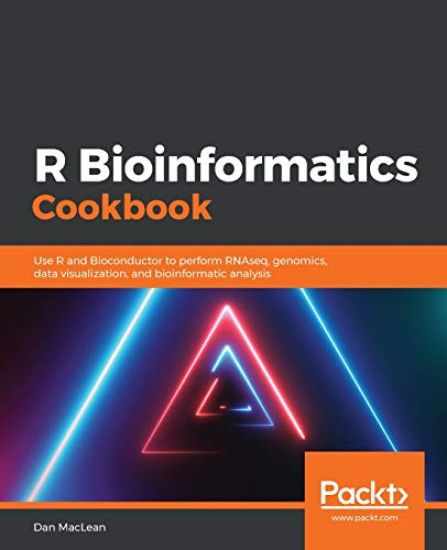
R Bioinformatics Cookbook

R Bioinformatics Cookbook

Dan MacLean

Packt Publishing Limited
2019
nidottu
Over 60 recipes to model and handle real-life biological data using modern libraries from the R ecosystem Key Features Apply modern R packages to handle biological data using real-world examples Represent biological data with advanced visualizations suitable for research and publications Handle real-world problems in bioinformatics such as next-generation sequencing, metagenomics, and automating analyses Book DescriptionHandling biological data effectively requires an in-depth knowledge of machine learning techniques and computational skills, along with an understanding of how to use tools such as edgeR and DESeq. With the R Bioinformatics Cookbook, you’ll explore all this and more, tackling common and not-so-common challenges in the bioinformatics domain using real-world examples. This book will use a recipe-based approach to show you how to perform practical research and analysis in computational biology with R. You will learn how to effectively analyze your data with the latest tools in Bioconductor, ggplot, and tidyverse. The book will guide you through the essential tools in Bioconductor to help you understand and carry out protocols in RNAseq, phylogenetics, genomics, and sequence analysis. As you progress, you will get up to speed with how machine learning techniques can be used in the bioinformatics domain. You will gradually develop key computational skills such as creating reusable workflows in R Markdown and packages for code reuse. By the end of this book, you’ll have gained a solid understanding of the most important and widely used techniques in bioinformatic analysis and the tools you need to work with real biological data.What you will learn Employ Bioconductor to determine differential expressions in RNAseq data Run SAMtools and develop pipelines to find single nucleotide polymorphisms (SNPs) and Indels Use ggplot to create and annotate a range of visualizations Query external databases with Ensembl to find functional genomics information Execute large-scale multiple sequence alignment with DECIPHER to perform comparative genomics Use d3.js and Plotly to create dynamic and interactive web graphics Use k-nearest neighbors, support vector machines and random forests to find groups and classify data Who this book is forThis book is for bioinformaticians, data analysts, researchers, and R developers who want to address intermediate-to-advanced biological and bioinformatics problems by learning through a recipe-based approach. Working knowledge of R programming language and basic knowledge of bioinformatics are prerequisites.
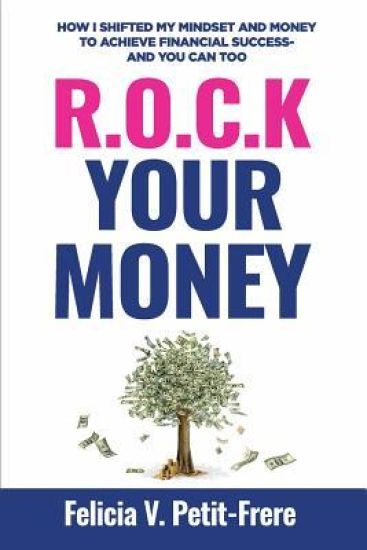
R.O.C.K. Your Money: How I Shifted My Mindset and Money to Achieve Financial Success - And You Can Too
All financial decisions carry along with them a consequence, whether it's a good or bad decision. Sometimes the result is a big financial consequence that can greatly affect you and your family for many years. As a financial coach, my job is to ensure that my clients are given the education needed to conquer any financial issue. When I was writing this book I wanted to not only reach out to my clients, I also wanted to touch the lives of other women who have never heard the sound of my voice but wish to make a well-thought-out financial decision.R.O.C.K Your Money is a guide the savvy money maker can use to create a financially fit life. This book is based on financial knowledge, research, personal experiences, and real-life lessons learned. It starts with understanding your current state and; if needed to be able to change your money mindset to create a better financial future for yourself. Your future is your responsibility, but I believe that everything starts with your mindset. If I can guide you in the right direction and equip you with the right tools you will R.O.C.K Your Money every time
Reformation Heroes. As Written by the Reverend Richard Newton, D.D., in the Year 1887 A.D., with an Extension by R. Sirius Kname in the Year 2019 A.D.
This lost and forgotten book has been respectfully resurrected by R. Sirius Kname in keeping the exact wording, spelling, and punctuation as the original source written by the Reverend Richard Newton, D.D., in the year 1887 A.D. Heroes you'll learn about are John Wycliffe, John Huss, Girolamo Savonarola, Martin Luther, Philip Melancthon, William Tyndale, John Fox, Edward the Sixth, Latimer, Ridley, Thomas Cranmer, John Knox, Ulrich Zwingli, John Calvin, William Farel, John Alasco, Admiral Coligni, Benjamin Du Plan, Gustavus Adolphus, John Milton, Marquerite de Valois, Nicholas the Lay Preacher, William the Silent, just to name a few. Original sketches included along with new ones. Also R. Sirius Kname has added five additional chapters to this book of more deserving people to be amongst these heroes, and also learn how you can simply start a Revival for Jesus today All monetary profit, if any, derived from this book will be joyfully given, by R. Sirius Kname, to the church in deserving, if any.
R.I.P.(E): Random Inspirations on Paper: (E)Vo-Lution

R.I.P.(E): Random Inspirations on Paper: (E)Vo-Lution

Queen Of Spades

Independently Published
2019
nidottu
Large Print Edition"The 'Eve'olution of a woman is not filters and Photoshop: it is the foundation of expectation's death, the mascara of cylindrical pain, the lining of various disappointment, and the lipstick of constant learning."In Random Inspirations on Paper: (E)ve-olution, R.I.P.E. for short, Queen of Spades returns-sharing her rendition of the most powerful ethylene to foster personal ripening: the pursuit of love and happiness.
R: Monogram Initial Composition Wide Ruled Notebook

R: Monogram Initial Composition Wide Ruled Notebook

Atoz Notebooks

Independently Published
2019
nidottu
Personalized Monogram Initial Notebook in size 8.5 by 11 inches and wide ruled 100 pages . Perfect for HomeworkClassroomMaking listsBirthday giftPersonalized giftGoodie Bag giftJournalAnd much more...One of a kind notebook to carry around . Also available in all letters from A to Z Pick one today for yourself or as a one of a kind gift
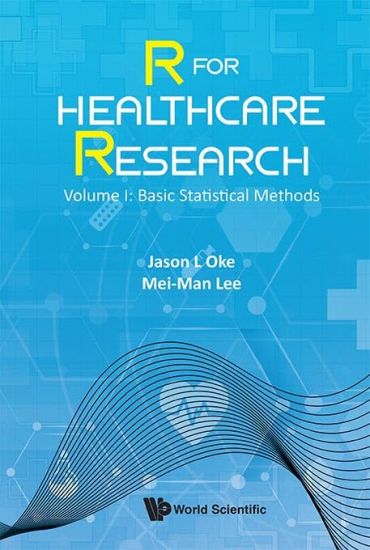
R For Healthcare Research - Volume I: Basic Statistical Methods

R For Healthcare Research - Volume I: Basic Statistical Methods

Jason Oke; Mei-man Lee

World Scientific Europe Ltd
2025
sidottu
R for Healthcare Research is intended to show healthcare professionals, researchers and students of healthcare research how to use the open-source statistical software R. It is intended both for novices and experienced users of R, guiding readers from the fundamentals of installing the software through to a careful and thorough coverage of the most widely used techniques in healthcare research and evidence-based medicine.This textbook is structured to provide readers with both a conceptual understanding of the theories, analyses and models found in healthcare research as well as to act as a practical guide for how to programme these concepts in R. Volume I covers the basics of statistics, including data types, probability and sampling, before moving on to survey common measures of disease and the most appropriate ways of displaying data. Readers will gain a solid grounding of how to conduct group comparisons, evaluate the strength of associations, and check the accuracy of their tests.Worked examples are consistently provided throughout, and each chapter concludes with exercises to familiarise readers with the topics covered. An R package hosting all of the referenced datasets accompanies this textbook.
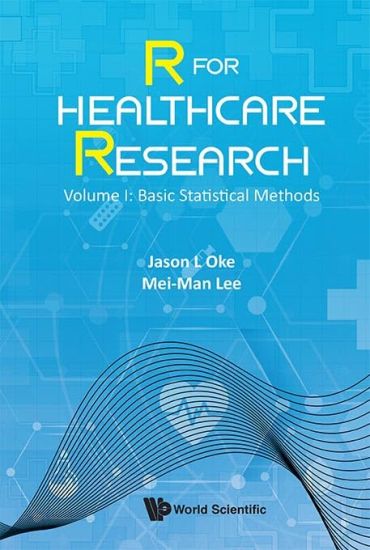
R For Healthcare Research - Volume I: Basic Statistical Methods

R For Healthcare Research - Volume I: Basic Statistical Methods

Jason Oke; Mei-man Lee

World Scientific Europe Ltd
2025
nidottu
R for Healthcare Research is intended to show healthcare professionals, researchers and students of healthcare research how to use the open-source statistical software R. It is intended both for novices and experienced users of R, guiding readers from the fundamentals of installing the software through to a careful and thorough coverage of the most widely used techniques in healthcare research and evidence-based medicine.This textbook is structured to provide readers with both a conceptual understanding of the theories, analyses and models found in healthcare research as well as to act as a practical guide for how to programme these concepts in R. Volume I covers the basics of statistics, including data types, probability and sampling, before moving on to survey common measures of disease and the most appropriate ways of displaying data. Readers will gain a solid grounding of how to conduct group comparisons, evaluate the strength of associations, and check the accuracy of their tests.Worked examples are consistently provided throughout, and each chapter concludes with exercises to familiarise readers with the topics covered. An R package hosting all of the referenced datasets accompanies this textbook.