Dr. Winfried Wilcke is a nuclear physicist and computer architect, who shares real-life stories of his (mis)adventures at work and while exploring the globe.
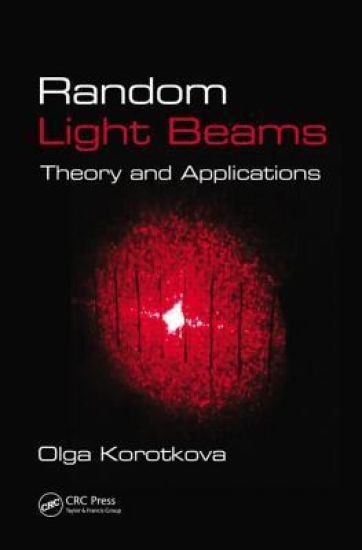
Random Light Beams: Theory and Applications contemplates the potential in harnessing random light. This book discusses light matter interactions, and concentrates on the various phenomena associated with beam-like fields. It explores natural and man-made light fields and gives an overview of recently introduced families of random light beams. It outlines mathematical tools for analysis, suggests schemes for realization, and discusses possible applications. The book introduces the essential concepts needed for a deeper understanding of the subject, discusses various classes of deterministic paraxial beams and examines random scalar beams. It highlights electromagnetic random beams and matters relating to generation, propagation in free space and various media, and discusses transmission through optical systems. It includes applications that benefit from the use of random beams, as well as the interaction of beams with deterministic optical systems.• Includes detailed mathematical description of different model sources and beams• Explores a wide range of man-made and natural media for beam interaction • Contains more than 100 illustrations on beam behavior• Offers information that is based on the scientific results of the last several years • Points to general methods for dealing with random beams, on the basis of which the readers can do independent researchIt gives examples of light propagation through the human eye, laser resonators, and negative phase materials. It discusses in detail propagation of random beams in random media, the scattering of random beams from collections of scatterers and thin random layers as well as the possible uses for these beams in imaging, tomography, and smart illumination.
The theory and applications of random dynamical systems (RDS) are at the cutting edge of research in mathematics and economics, particularly in modeling the long-run evolution of economic systems subject to exogenous random shocks. Despite this interest, there are no books available that solely focus on RDS in finance and economics. Exploring this emerging area, Random Dynamical Systems in Finance shows how to model RDS in financial applications.Through numerous examples, the book explains how the theory of RDS can describe the asymptotic and qualitative behavior of systems of random and stochastic differential/difference equations in terms of stability, invariant manifolds, and attractors. The authors present many models of RDS and develop techniques for implementing RDS as approximations to financial models and option pricing formulas. For example, they approximate geometric Markov renewal processes in ergodic, merged, double-averaged, diffusion, normal deviation, and Poisson cases and apply the obtained results to option pricing formulas.With references at the end of each chapter, this book provides a variety of RDS for approximating financial models, presents numerous option pricing formulas for these models, and studies the stability and optimal control of RDS. The book is useful for researchers, academics, and graduate students in RDS and mathematical finance as well as practitioners working in the financial industry.