Kirjojen hintavertailu. Mukana 12 045 262 kirjaa ja 12 kauppaa.

Kirjahaku

Etsi kirjoja tekijän nimen, kirjan nimen tai ISBN:n perusteella.

1000 tulosta hakusanalla Raymond Faure

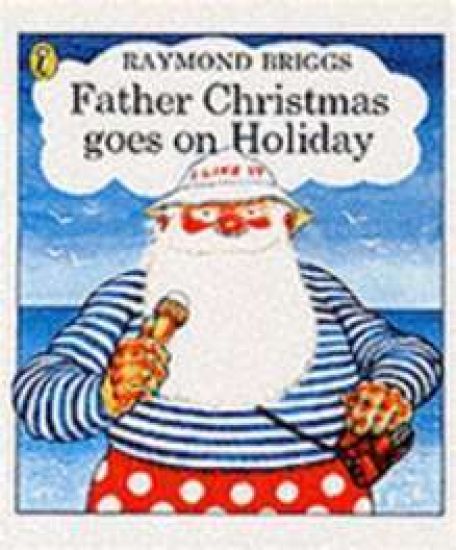
Father Christmas Goes on Holiday

Father Christmas Goes on Holiday

Raymond Briggs

Puffin Bks
1977
nidottu
A still rather grumpy Father Christmas decides to go on holiday. No-one needs a holiday more than Father Christmas, but where can such a well-known and easily recognized person go? France, Scotland and Las Vegas are his chosen destinations, but as Father Christmas discovers - there's nowhere like home.
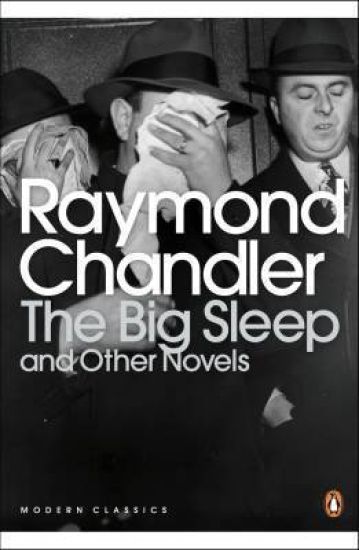
The Big Sleep and Other Novels

The Big Sleep and Other Novels

Raymond Chandler

Penguin Classics
2000
pokkari
One of the BBC's '100 Novels That Shaped Our World''Raymond Chandler invented a new way of talking about America, and America has never looked the same to us since' Paul Auster, author of The New York TrilogyRaymond Chandler was America's preeminent writer of detective fiction, and this edition of The Big Sleep and Other Novels collects three of the best novels to feature his hard-drinking, philosophising PI, Philip Marlowe.Raymond Chandler created the fast talking, trouble seeking Californian private eye Philip Marlowe for his first great novel The Big Sleep in 1939. Often imitated but never bettered, it is in Marlowe's long shadow that every fictional detective must stand - and under the influence of Raymond Chandler's addictive prose that every crime author must write. Marlowe's entanglement with the Sternwood family - and an attendant cast of colourful underworld figures - is the background to a story reflecting all the tarnished glitter of the great American Dream. The hard-boiled detective's iconic image burns just as brightly in Farewell My Lovely, on the trail of a missing nightclub crooner. And the inimitable Marlowe is able to prove that trouble really is his business in Raymond Chandler's brilliant epitaph, The Long Goodbye.'One of the greatest crime writers, who set standards that others still try to attain' Sunday Times'Chandler wrote like a slumming angel and invested the sun-blinded streets of Los Angelos with a romantic presence' Ross Macdonald, author of The Drowning Pool
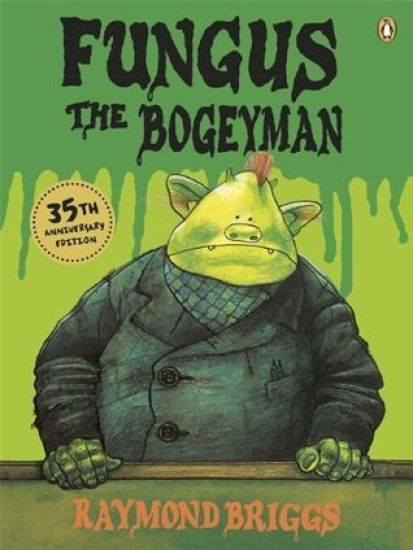
Fungus the Bogeyman

Fungus the Bogeyman

Raymond Briggs

Puffin
2012
nidottu
Experience a day in the life of a Bogeyman in this brilliantly gross picture book for older children.Life under ground in Bogeydom is full of snot, smells, slime, scum and other unspeakable things. The Bogeymen that live there revel in every kind of nastiness imaginable - especially their day-job of scaring human beings. But there's one Bogeyman who isn't so sure he wants to be part of Bogeydom after all . . .Beloved classic author Raymond Briggs has created a whole new world in this sophisticated cartoon-strip picture book for older children which will entice the most reluctant of readers into books.More classic stories from Raymond Briggs:The Snowman - a wordless picture bookFather ChristmasFather Christmas Goes on HolidayUG: Boy Genius of the Stone AgeJim and the Beanstalk
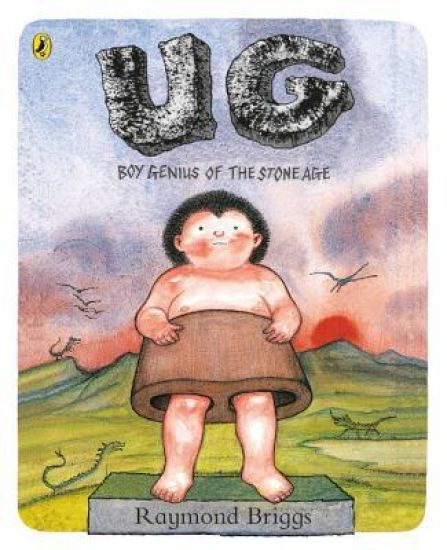
UG: Boy Genius of the Stone Age and His Search for Soft Trousers
Join curious Ug on his quest for a pair of soft trousers in this funny and touching stone-age story from creator of The Snowman, Raymond Briggs.Ug and his parents live in the Stone Age. And that means stone blankets, stone cold food, an even colder cave and, worst of all, hard stone trousers! Being an inquisitive and intelligent child, Ug suggests a series of modifications to improve the quality of family life. His ideas about heating, cooking, boats, and balls that actually bounce are initially met with a hostile reaction. But with the help of his father, who slowly comes round to his son's way of thinking, Ug comes tantalisingly close to his ultimate soft-trousered goal . . .This heartwarming and hilarious tale, told in comic strip format, is the perfect gift for a curious child learning to understand the world around them.More classic Raymond Briggs stories:Fungus the BogeymanThe Snowman - a wordless picture bookFather ChristmasFather Christmas Goes on HolidayJim and the BeanstalkThe Elephant and the Bad Baby
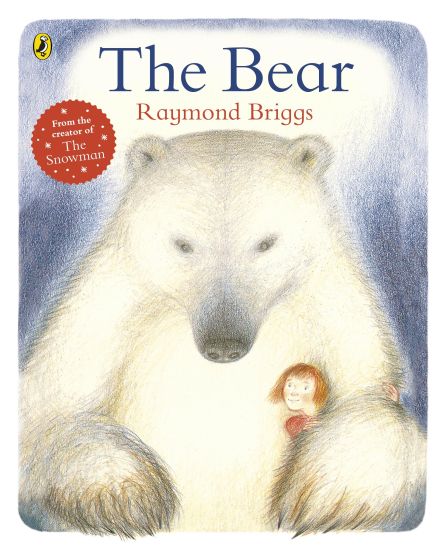
The Bear

The Bear

Raymond Briggs

Puffin
2016
nidottu
The 30th anniversary edition of this hilarious and heartwarming tale of a magical friendship between a girl and a polar bear from beloved author of The Snowman, Raymond Briggs.One night a great big, white polar bear comes to stay with Tilly. He has black hooked claws and huge yellow teeth; but his white furry coat is warm and soft and Tilly decides he's the cuddliest thing in the whole world.Tilly soon finds out that a big bear can cause big problems - he takes a LOT of looking after! When she describes the bear's latest antics to her parents they think he's a figment of her imagination - but is he?A brilliantly clever and funny tale about an unlikely friendship, from beloved children's author Raymond Briggs.More classic Raymond Briggs stories:The Snowman - a wordless picture bookFather ChristmasFather Christmas Goes on HolidayThe Elephant and the Bad BabyUG: Boy Genius of the Stone AgeJim and the BeanstalkRaymond Briggs, one of the UK's top 100 bestselling children's picture book authors of all time, Nielsen Book Scan, September 2024
Father Christmas

Father Christmas

Raymond Briggs

Puffin Books
2003
sidottu
Father Christmas awoke from his dream of summer in the sun, and there is was on the calendar, December 24th, Christmas Eve - the start of his longest night's work of the year! This book was awarded The Library Association's Kate Greenaway Medal.
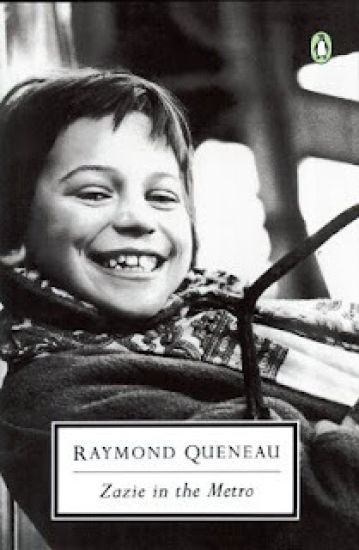
Zazie in the Metro

Zazie in the Metro

Raymond Queneau

Penguin Classics
2001
pokkari
Impish, foul-mouthed Zazie arrives in Paris from the country to stay with Gabriel, her female-impersonator uncle. All she really wants to do is ride the metro, but finding it shut because of a strike, Zazie looks for other means of amusement and is soon caught up in a comic adventure that becomes wilder and more manic by the minute. In 1960 Queneau's cult classic was made into a hugely successful film by Louis Malle. Packed full of word play and phonetic games, Zazie in the Metro remains as stylish and witty as ever.
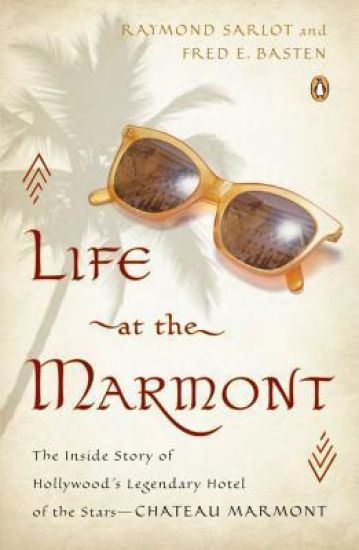
Life at the Marmont

Life at the Marmont

Raymond Sarlot; Fred E. Basten

Penguin Books Ltd
2013
pokkari
Raymond Sarlot bought the Chateau Marmont in 1975, but what was originally a business purchase became a love affair as he delved into the hotel's incredible history. From its perch overlooking the Sunset Strip, the glamorous Marmont reigned for decades as the spot for artists, writers, musicians, and actors of every stripe and remains a home-away-from-home for A-listers like Scarlett Johansson and Johnny Depp. Here, Sarlot and co-author Fred E. Basten share a wealth of scandalous and intriguing tales about them all, from the stars of Hollywood's Golden Era like Jean Harlow and Grace Kelly to idols of the sixties and seventies like Jim Morrison and John Belushi (who tragically died there in 1982). Whether your obsession is Hollywood history or celebrity gossip, Life at the Marmont has plenty of gripping, juicy stories to fascinate.
Physics For Global Scientists and Engineers, Volume 1

Physics For Global Scientists and Engineers, Volume 1

Raymond Serway; John Jewett; Kate Wilson; Anna Wilson; Wayne Rowlands

Cengage Australia
2016
nidottu
This second edition of Serway's Physics For Global Scientists and Engineers is a practical and engaging introduction for students of calculus-based physics. Students love the local and global case studies and worked examples, concise language and high-quality artwork, in two, easy-to-carry volumes. - NEW key topics in physics, such as the Higgs boson, engage students and keep them interested - NEW Maths icons highlight mathematical concepts in the text and direct students to the relevant information in the Maths Appendix - NEW Index of Symbols provides students with a quick reference for the symbols used throughout the book This volume (one) includes Mechanics, Mechanical properties of solids and fluids, Oscillations and mechanical waves, and Thermodynamics. Volume two covers Electricity and magnetism, Light and optics, and Quantum physics. Physics For Global Scientists and Engineers is compatible with WebAssign - the most powerful online homework solution for physics, maths and statistics. Engage students with immediate feedback, highly visual content and interactive questions, to develop a deeper conceptual understanding. Designed to help you to quickly and easily create assignments, save time with auto-grading and monitor your students’ progress, WebAssign can be integrated with your Learning Management System, allowing easy access for you and your students. Ask your Learning Consultant for a demo.
The Cry of the Renegade

The Cry of the Renegade

Raymond B. Craib

Oxford University Press Inc
2019
nidottu
On October 1, 1920, the city of Santiago, Chile, came to a halt as tens of thousands stopped work and their daily activities to join the funeral procession of José Domingo Gómez Rojas, a 24 year old university student and acclaimed poet. Nicknamed "the firecracker poet" for his incendiary poems, such as "The Cry of the Renegade" Gómez Rojas was a member of the University of Chile's student federation (the FECh) which had come under repeated attack for its critiques of Chile's political system and ruling parties. Government officials accused the FECh's leaders of being advocates for the destruction of the social order, subversives who had the temerity to question national policy making, and insolent youths who did not know their place. Arrested for alleged sedition as part of a five-month-long "prosecution of subversives," Gómez Rojas joined other students and workers in Santiago's prison system. He never left. After two months in police custody, he died in Santiago's asylum, quickly to be reborn as a political martyr for students and workers alike. This microhistory recovers the context within which Gómez Rojas's arrest, imprisonment, and death unfolded and the experiences of men he counted as friends, comrades, colleagues, mentors, and pupils. Fifty years before the much-heralded student movements of 1968, Raymond Craib shows, university students and workers were active political collaborators and radicalized political subjects. In interwar Chile, members of Chile's sizeable working class marched side-by-side with students from the FECh. At the same time, increasingly radicalized university students, as well as former students, workers, and worker-intellectuals, gathered together to talk, read, and find common cause. Members of what Craib calls a "capacious Left" they shared a wide-ranging interest in works of sociology and political theory, a penchant for poetry, and an eclectic embrace of anarchist, socialist, and communist principles and practices. They also shared the experience of repression, an experience that ultimately cost Gómez Rojas his life and marked an entire generation of political organizers and agitators, including future president Salvador Allende and poet Pablo Neruda.
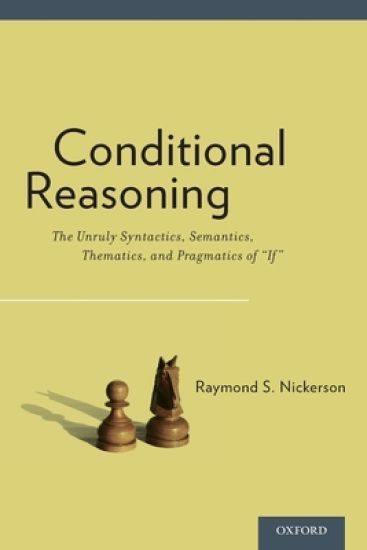
Conditional Reasoning

Conditional Reasoning

Raymond Nickerson

Oxford University Press Inc
2015
sidottu
Conditional reasoning is reasoning that involves statements of the sort If A (Antecedent) then C (Consequent). This type of reasoning is ubiquitous; everyone engages in it. Indeed, the ability to do so may be considered a defining human characteristic. Without this ability, human cognition would be greatly impoverished. "What-if" thinking could not occur. There would be no retrospective efforts to understand history by imagining how it could have taken a different course. Decisions that take possible contingencies into account could not be made; there could be no attempts to influence the future by selecting actions on the basis of their expected effects. Despite the commonness and importance of conditional reasoning and the considerable attention it has received from scholars, it remains the subject of much continuing debate. Unsettled questions, both normative and empirical, continue to be asked. What constitutes normative conditional reasoning? How do people engage in it? Does what people do match what would be expected of a rational agent with the abilities and limitations of human beings? If not, how does it deviate and how might people's ability to engage in it be improved? This book reviews the work of prominent psychologists and philosophers on conditional reasoning. It describes empirical research on how people deal with conditional arguments and on how conditional statements are used and interpreted in everyday communication. It examines philosophical and theoretical treatments of the mental processes that support conditional reasoning. Its extensive coverage of the subject makes it an ideal resource for students, teachers, and researchers with a focus on cognition across disciplines.
The Cry of the Renegade

The Cry of the Renegade

Raymond B. Craib

Oxford University Press Inc
2016
sidottu
On October 1, 1920, the city of Santiago, Chile, came to a halt as tens of thousands stopped work and their daily activities to join the funeral procession of José Domingo Gómez Rojas, a 24 year old university student and acclaimed poet. Nicknamed "the firecracker poet" for his incendiary poems, such as "The Cry of the Renegade", Gómez Rojas was a member of the University of Chile's student federation (the FECh) which had come under repeated attack for its critiques of Chile's political system and ruling parties. Government officials accused the FECh's leaders of being advocates for the destruction of the social order, subversives who had the temerity to question national policy making, and insolent youths who did not know their place. Arrested for alleged sedition as part of a five-month-long "prosecution of subversives", Gómez Rojas joined other students and workers in Santiago's prison system. He never left. After two months in police custody, he died in Santiago's asylum, quickly to be reborn as a political martyr for students and workers alike. This microhistory recovers the context within which Gómez Rojas's arrest, imprisonment, and death unfolded and the experiences of men he counted as friends, comrades, colleagues, mentors, and pupils. Fifty years before the much-heralded student movements of 1968, Raymond Craib shows, university students and workers were active political collaborators and radicalized political subjects. In interwar Chile, members of Chile's sizeable working class marched side-by-side with students from the FECh. At the same time, increasingly radicalized university students, as well as former students, workers, and worker-intellectuals, gathered together to talk, read, and find common cause. Members of what Craib calls a "capacious Left", they shared a wide-ranging interest in works of sociology and political theory, a penchant for poetry, and an eclectic embrace of anarchist, socialist, and communist principles and practices. They also shared the experience of repression, an experience that ultimately cost Gómez Rojas his life and marked an entire generation of political organizers and agitators, including future president Salvador Allende and poet Pablo Neruda.
The Use of Self

The Use of Self

Raymond Fox

Oxford University Press Inc
2011
nidottu
The finest teachers attempt to make direct connections between classroom knowledge and its application to the varieties of practice. Ray Fox emphasizes that a teacher of future practitioners must expand upon lectures and mere memorization; the interaction between teacher and student should substantially model ones that students are encouraged to employ with clients. The Use of Self presents an active, learner-centered process of professional education that emphasizes relationships and reflection in the classroom. The book shows how teachers can establish classroom environments of sharing, openness, challenge, and change. According to the author, the goal of higher education is to mold students into scientifically sophisticated, humane, and client-centered practitioners with knowledge grounded in discipline and skills anchored in art and compassion. This book will help professors accomplish this goal. Part 1 integrates conceptual knowledge with affective and experiential processes. These chapters focus on artistry and creativity in teaching. Part 2 describes methods to help students establish a sound professional identity and prepare for effective professional functioning. The author presents ways to involve students in adapting course content and direction so as to merge their styles of learning with the instructor's style of teaching, thus providing an environment conducive to shaping professional minds. Part 3 provides teaching methods and tools that promote reflection and encourage students to relate to classmates and, eventually, clients.
Conditional Reasoning

Conditional Reasoning

Raymond Nickerson

Oxford University Press Inc
2017
nidottu
Conditional reasoning is reasoning that involves statements of the sort If A (Antecedent) then C (Consequent). This type of reasoning is ubiquitous; everyone engages in it. Indeed, the ability to do so may be considered a defining human characteristic. Without this ability, human cognition would be greatly impoverished. "What-if" thinking could not occur. There would be no retrospective efforts to understand history by imagining how it could have taken a different course. Decisions that take possible contingencies into account could not be made; there could be no attempts to influence the future by selecting actions on the basis of their expected effects. Despite the commonness and importance of conditional reasoning and the considerable attention it has received from scholars, it remains the subject of much continuing debate. Unsettled questions, both normative and empirical, continue to be asked. What constitutes normative conditional reasoning? How do people engage in it? Does what people do match what would be expected of a rational agent with the abilities and limitations of human beings? If not, how does it deviate and how might people's ability to engage in it be improved? This book reviews the work of prominent psychologists and philosophers on conditional reasoning. It describes empirical research on how people deal with conditional arguments and on how conditional statements are used and interpreted in everyday communication. It examines philosophical and theoretical treatments of the mental processes that support conditional reasoning. Its extensive coverage of the subject makes it an ideal resource for students, teachers, and researchers with a focus on cognition across disciplines.
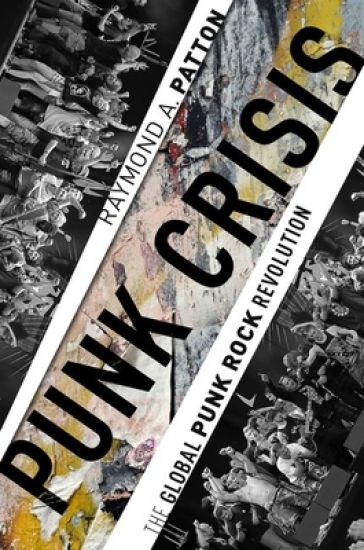
Punk Crisis

Punk Crisis

Raymond A. Patton

Oxford University Press Inc
2018
sidottu
In March 1977, John "Johnny Rotten" Lydon of the punk band the Sex Pistols looked over the Berlin wall onto the grey, militarized landscape of East Berlin, which reminded him of home in London. Lydon went up to the wall and extended his middle finger. He didn't know it at the time, but the Sex Pistols' reputation had preceded his gesture, as young people in the "Second World" busily appropriated news reports on degenerate Western culture as punk instruction manuals. Soon after, burgeoning Polish punk impresario Henryk Gajewski brought the London punk band the Raincoats to perform at his art gallery and student club-the epicenter for Warsaw's nascent punk scene. When the Raincoats returned to England, they found London erupting at the Rock Against Racism concert, which brought together 100,000 "First World" UK punks and "Third World" Caribbean immigrants who contributed their cultures of reggae and Rastafarianism. Punk had formed networks reaching across all three of the Cold War's "worlds". The first global narrative of punk, Punk Crisis examines how transnational punk movements challenged the global order of the Cold War, blurring the boundaries between East and West, North and South, communism and capitalism through performances of creative dissent. As author Raymond A. Patton argues, punk eroded the boundaries and political categories that defined the Cold War Era, replacing them with a new framework based on identity as conservative or progressive. Through this paradigm shift, punk unwittingly ushered in a new era of global neoliberalism.
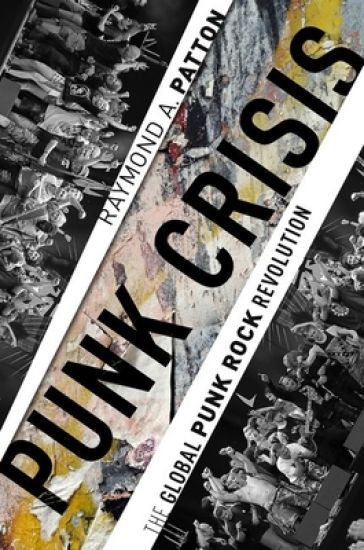
Punk Crisis

Punk Crisis

Raymond A. Patton

Oxford University Press Inc
2018
nidottu
In March 1977, John "Johnny Rotten" Lydon of the punk band the Sex Pistols looked over the Berlin wall onto the grey, militarized landscape of East Berlin, which reminded him of home in London. Lydon went up to the wall and extended his middle finger. He didn't know it at the time, but the Sex Pistols' reputation had preceded his gesture, as young people in the "Second World" busily appropriated news reports on degenerate Western culture as punk instruction manuals. Soon after, burgeoning Polish punk impresario Henryk Gajewski brought the London punk band the Raincoats to perform at his art gallery and student club-the epicenter for Warsaw's nascent punk scene. When the Raincoats returned to England, they found London erupting at the Rock Against Racism concert, which brought together 100,000 "First World" UK punks and "Third World" Caribbean immigrants who contributed their cultures of reggae and Rastafarianism. Punk had formed networks reaching across all three of the Cold War's "worlds". The first global narrative of punk, Punk Crisis examines how transnational punk movements challenged the global order of the Cold War, blurring the boundaries between East and West, North and South, communism and capitalism through performances of creative dissent. As author Raymond A. Patton argues, punk eroded the boundaries and political categories that defined the Cold War Era, replacing them with a new framework based on identity as conservative or progressive. Through this paradigm shift, punk unwittingly ushered in a new era of global neoliberalism.
Modern Spain, 1875-1980

Modern Spain, 1875-1980

Raymond Carr

Oxford University Press
2001
nidottu
The word 'liberal', as part of our political vocabulary comes from Spain. It was first used to describe a group of radical patriots cooped up in Cadiz, refugees from the French invasion of 1808. In 1812 they drew up a constitution enshrining the sovereignty of the people which struck the very basis of the old monarchy and became the model for advanced democrats from St Petersburg to Naples. Universal male suffrage was established in Spain in 1890 - earlier than Britain. The imposition of advanced liberal institutions on a conservative society, both economically and socially backward, inevitably caused tensions, and these, Raymond Carr argues, explain much of modern Spanish history. His analysis, incorporating much new research, starts at the 'September Revolution' of 1868 and goes right up to the present day. In the 1970s and 80s the country suffered less from the violent social disruption experienced in previous decades, but - as always - Spain is beset with acute regional problems which become more pressing the longer they remain unsolved.
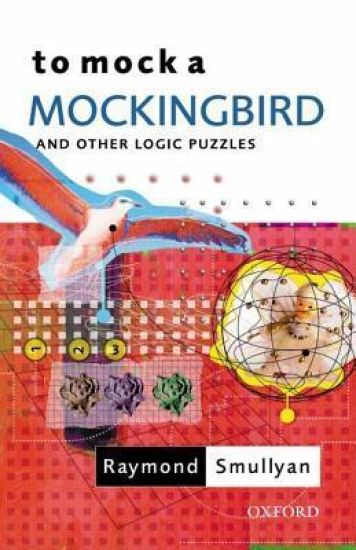
To Mock a Mockingbird: and Other Logic Puzzles

To Mock a Mockingbird: and Other Logic Puzzles

Raymond Smullyan

Oxford University Press
2000
nidottu
This is a puzzle book covering logic, philosophy, psychology, artificial intelligence, computer science and mathematics. It contains many puzzles and their solutions and aims to attract many readers in an age where computer science, logic, and mathematics are becoming increasingly important.
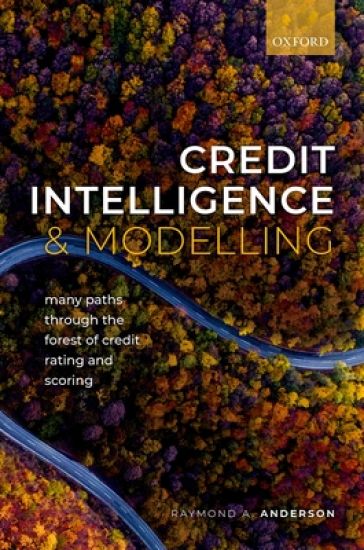
Credit Intelligence & Modelling

Credit Intelligence & Modelling

Raymond A. Anderson

Oxford University Press
2021
sidottu
Credit Intelligence and Modelling provides an indispensable explanation of the statistical models and methods used when assessing credit risk and automating decisions. Over eight modules, the book covers consumer and business lending in both the developed and developing worlds, providing the frameworks for both theory and practice. It first explores an introduction to credit risk assessment and predictive modelling, micro-histories of credit and credit scoring, as well as the processes used throughout the credit risk management cycle. Mathematical and statistical tools used to develop and assess predictive models are then considered, in addition to project management and data assembly, data preparation from sampling to reject inference, and finally model training through to implementation. Although the focus is credit risk, especially in the retail consumer and small-business segments, many concepts are common across disciplines, whether for academic research or practical use. The book assumes little prior knowledge, thus making it an indispensable desktop reference for students and practitioners alike. Credit Intelligence and Modelling expands on the success of The Credit Scoring Toolkit to cover credit rating and intelligence agencies, and the data and tools used as part of the process.