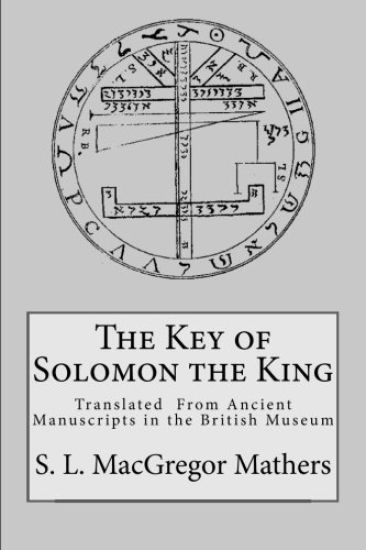
This is a trade paperback reprint edition of S.L. MacGregor Mathers' The Key of Solomon the King first published in 1888. It contains the original text, all 91 illustrations, and over 80 footnotes composed by Mathers, which detail his original research and translation of ancient manuscripts located in British Museums. Also provided by Mathers is the Order of the Pentacles of Solomon, the Ancient Fragment of the Key of Solomon, The Qabalistic Invocation of Solomon, and 15 plates full of figures, seals and charts to aid the reader in their work. Beware of other editions that do not contain all of the original material, as the the book is rendered useless without them. The work is traditionally divided into two books detailing the Key of King Solomon. Book One explains the operation of conjurations, curses, spells and other magical works. Book Two instructs the practitioner on the proper attire, purification rituals and other means of obtaining the goals of the Goetia. Between these two books is the list of plates that contain numerous illustrations and secret seals of Solomon, including the Mystical Seal of Solomon, the Pentacles of Solomon, and the Mystical Alphabet, which impart the mechanisms and requirements for the invocation of spirits and demons and other magical works or spells. Sometimes referred to as the Greater Key of Solomon, this work should not be confused with the Lesser Key of Solomon or Clavicula Salomonis Regis, or Lemegeton, which is based on similar source material and was also researched by S. L. MacGregor Mathers with the aid of Aleister Crowley. It is thought that The Greater Key of Solomon later inspired The Lesser Key as a derivative work: one with its own substantial value through the addition of various illustrations and guides such as the Magic Circle of Solomon, the 72 Seals of Solomon or King Solomon Seals, and the Pentagram of Solomon. But, although both grimoires are inspired by the same material, they are separate and distinct works. It is important to note the Solomon Key is not any one particular book. The material has been collected in various forms and published by many authors, including Armand Delatte, and L. W. de Laurence. The earliest versions of the text can be found in ancient manuscripts in different languages all dating from the 16th century or later and spread across the globe in various libraries or private collections. For example, a Hebrew edition survives in the British Library, while a Latin version is kept at the University of Wisconsin. Various French editions as well as English translations are located throughout the world. According to the mythical history of the document, King Solomon wrote the book for his son Rehoboam and commanded him to hide the book in his sepulchre upon his death. After many years, the book was discovered by a group of Babylonian philosophers repairing Solomon's tomb. None could interpret the text until one of them, Ioh Grevis, suggested that they should entreat the Lord for understanding. The Angel of the Lord appeared to him and extracted a promise that he would keep the text hidden from the unworthy and the wicked, after which he was able to read it plainly. Ioh Grevis then placed a conjuration on the book preventing the unworthy, unwise, and godless from attaining the desired effect of its practices. Scholars however believe the work and its many iterations derive from the ancient practices of Jewish Kabbalah and Arab Alchemy. After time, it is thought Greek and Roman influences were added until, finally, the work was used and molded by high Renaissance magicians. This book, as well as other King Solomon books, such as the Magical Treatise of King Solomon and the Testament of Solomon, were brought back to modern times through the labors of occult practitioners such as S. L. MacGregor Mathers and others around the turn of the last century.