Kirjojen hintavertailu. Mukana 11 244 527 kirjaa ja 12 kauppaa.

Kirjahaku

Etsi kirjoja tekijän nimen, kirjan nimen tai ISBN:n perusteella.

1000 tulosta hakusanalla Bennett Alan

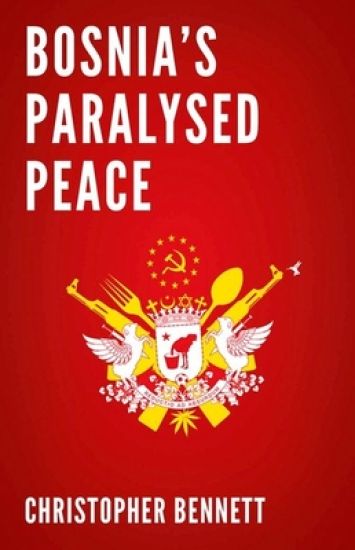
Bosnia's Paralyzed Peace

Bosnia's Paralyzed Peace

Christopher Bennett

Oxford University Press, USA
2016
nidottu
Two decades after the Dayton Peace Agreement came into force, Bosnia is not at war. However, the absence of war is not peace. Bosnia has failed to move on from conflict. Political processes are deadlocked. The country is in a state of political, social and economic paralysis. As the international community has downgraded its presence, conditions have deteriorated, irredentist agendas have resurfaced and the outlook is increasingly negative. War remains a risk because of myriad unresolved issues, zero-sum politics and incompatible positions among rival ethno-national elites.In the face of paralysis, international officials repeat the mantra that there is no alternative to Bosnia's European path and urge the country's leaders to see reason, to temper their rhetoric and to carry out internationally approved reforms -- to no avail. Despite international reluctance to recognize failure, the day will come when it is impossible to ignore the gravity of the situation. When that day arrives, the international community will have to address the shortcomings of the peace process. This, in turn, will involve opening up the Dayton settlement. Christopher Bennett presents a cautionary political history of Bosnia's disintegration, war and peace process. And he concludes by proposing a paradigm shift aimed at building ethno-national security and making the peace settlement self-sustaining.

Tales from West Africa

Tales from West Africa

Martin Bennett

Oxford University Press
2000
nidottu
This lively collection comes from West Africa, a place 'where stories grow on trees'. Here are the famous tricksters: Hare, Tortoise, and the greatest of them all - Ananse the spider. The stories are full of larger-than-life characters and situations; and include the tale of how Ananse got his thin waist, how Crocodile learnt his lesson, and how Monkey managed not to get eaten by Shark.
Preaching and Narrative in Piers Plowman

Preaching and Narrative in Piers Plowman

Alastair Bennett

Oxford University Press
2023
sidottu
William Langland's Piers Plowman was written and read during a “golden age” of English preaching. The poem describes a world where sermons took many different forms and were delivered in many different contexts, from public events in the life of the realm to pastoral instruction in the parish. It dramatises preaching as part of its allegorical action, showing how sermons shaped their listeners' understanding of the world; it also includes polemical critique of corrupt, self-interested preaching, and offers radical prescriptions for its reform. This book argues that Langland's central insight into the way that sermons moved and engaged their audiences had to do with their characteristic use of narrative. Preachers in the poem address listeners who are absorbed in the concerns of their present moment, and encourage them to new forms of social and spiritual endeavour by locating that moment in a larger, interpreted plot: the story of an individual life, or an emergent community, or of salvation history as a whole. The book employs a critical vocabulary derived from Paul Ricoeur to describe the process by which these narratives are composed, and to show how they mediate and reconfigure their listeners' experiences.
COVID-19, Law & Regulation

COVID-19, Law & Regulation

Belinda Bennett; Ian Freckelton AO KC; Gabrielle Wolf

Oxford University Press
2023
sidottu
COVID-19 is the most severe pandemic the world has experienced in a century. This book analyses major legal and regulatory responses internationally to COVID-19, and the impact the pandemic has had on human rights and freedoms, governance, the obligations of states and individuals, as well the role of the World Health Organization and other international bodies during this time. The authors examine notable legal challenges to public health measures enforced during the pandemic, such as lockdown orders, curfews, and vaccine mandates. Importantly, the book contextualizes the legal analysis by examining the broader social and economic dimensions of risks posed by the pandemic. The book considers how COVID-19 impacted the operation of the criminal justice system, civil litigation concerning negligently caused deaths and business losses arising from contractual breaches, consumer protection litigation, disciplinary regulation of health practitioners, coronial inquests and other investigations of unexpected deaths, and occupational health and safety issues. The book reflects on the role of the law in facilitating the remarkable scientific and epidemiological achievements during the pandemic, but also the challenges of ensuring the swift production and equitable distribution of treatments and vaccines. It concludes by considering the possibilities that the legal and regulatory responses to this pandemic have illuminated for effectively tackling future global health crises.
The Claims of Experience

The Claims of Experience

Nolan Bennett

Oxford University Press Inc
2021
nidottu
Why have so many figures throughout American history proclaimed their life stories when confronted by great political problems? The Claims of Experience provides a new theory for what makes autobiography political throughout the history of the United States and today. Across five chapters, Nolan Bennett examines the democratic challenges that encouraged a diverse cast of figures to bear their stories: Benjamin Franklin amid the revolutionary era, Frederick Douglass in the antebellum and abolitionist movements, Henry Adams in the Gilded Age and its anxieties of industrial change, Emma Goldman among the first Red Scare and state opposition to radical speech, and Whittaker Chambers amid the second Red Scare that initiated the anticommunist turn of modern conservatism. These historical figures made what Bennett calls a "claim of experience." By proclaiming their life stories, these authors took back authority over their experiences from prevailing political powers, and called to new community among their audiences. Their claims sought to restore to readers the power to remake and make meaning of their own lives. Whereas political theorists and activists have often seen autobiography to be too individualist or a mere documentary source of evidence, this theory reveals the democratic power that life narratives have offered those on the margins and in the mainstream. If they are successful, claims of experience summon new popular authority to surpass what their authors see as the injustices of prevailing American institutions and identity. Bennett shows through historical study and theorization how this renewed appreciation for the politics of life writing elevates these authors' distinct democratic visions while drawing common themes across them. This book offers both a method for understanding the politics of life narrative and a call to anticipate claims of experience as they appear today.
Myths and Sanctioned Ignorance in British Immigration Discourse
Nations all have stories about themselves--where they came from, what it means to be a citizen of that nation, what its values are. In Myths and Sanctioned Ignorance in British Immigration Discourse, Samuel Bennett looks at British national myths about immigration and the country's colonial history. Combining Critical Discourse Studies with decolonial and postcolonial theories, Bennett offers an in-depth, methodologically rigorous analysis of a wide range of material to show how current immigration discourses are inextricably tied to the past. The book identifies four key myths: euphemization of the Commonwealth (and erasure of Britain's colonial history); immigration as both enrichment and threat; Britain offering a safe haven for those in need; and a teleological story of "British values." Intentionally moving backwards and forwards between past and the present, and across genres, Bennett shows how the myths the UK tells itself are at once stable, deployed in different contexts, and historically rooted. Ultimately, this book argues that through these myths the migrant "Other"--and, by extension, British ethnic minorities--have been silenced and erased from the country's story which legitimises a racialised immigration policy.
Euskadi Ta Askatasuna

Euskadi Ta Askatasuna

Nell Bennett

OXFORD UNIVERSITY PRESS INC
2025
sidottu
This book uses previously untranslated and unpublished transcripts of key internal debates from the Basque separatist group Euskadi Ta Askatasuna (ETA) to unravel the puzzle behind terrorist persistence in the face of certain doom. With its unprecedented view inside a terrorist organization at crucial decision points and discussions of its future, this book highlights the competing considerations that informed ETA's decision-making process, particularly the benefits of the organization's survival for members and the loss of this that peace agreements, which often explicitly demand or hold reasonable expectation that the organization is dissolved, would entail. Bennett's detailed analysis and use of organizational theory reveals that ETA was driven by a desire to survive and expand, and the survival of their organization was ultimately more important than the nationalist movement the organization was formed to pursue.
Euskadi Ta Askatasuna

Euskadi Ta Askatasuna

Nell Bennett

OXFORD UNIVERSITY PRESS INC
2025
nidottu
This book uses previously untranslated and unpublished transcripts of key internal debates from the Basque separatist group Euskadi Ta Askatasuna (ETA) to unravel the puzzle behind terrorist persistence in the face of certain doom. With its unprecedented view inside a terrorist organization at crucial decision points and discussions of its future, this book highlights the competing considerations that informed ETA's decision-making process, particularly the benefits of the organization's survival for members and the loss of this that peace agreements, which often explicitly demand or hold reasonable expectation that the organization is dissolved, would entail. Bennett's detailed analysis and use of organizational theory reveals that ETA was driven by a desire to survive and expand, and the survival of their organization was ultimately more important than the nationalist movement the organization was formed to pursue.
The Act Itself

The Act Itself

Jonathan Bennett

Clarendon Press
1998
nidottu
The Act Itself offers a deeper understanding of what is going on in our own moral thoughts about human behaviour. Many of the descriptions of behaviour on which our moral thoughts are based are confused; others may be free of confusion, but still we are not clear in our minds about what thoughts they are. That is would hurt her, it would be disloyal, it wouldn't be done with that intention, it would be dangerous, it would involve allowing harm but not producing it--thoughts like these support our moral judgements and thus guide our lives. In so far as we do not deeply understand them, this is a kind of servitude. As Locke said, 'He is the most enslaved who is so in his understanding.' Jonathan Bennett presents conceptual analysis as a means to getting more control of our thoughts and thus of our lives.
Events and their Names

Events and their Names

Jonathan Bennett

Clarendon Press
1989
nidottu
This is a study of events and their place in our language and thought. The author discusses what kind of item an event is, how the language of events works and how these two themes are interrelated. He argues that most of the supposedly metaphysical literature on events is really about semantics of their names, and that the true metaphysic of events - known by Leibniz and rediscovered by Jaegwon Kim - has not been universally accepted because it has been obscured by a false semantic theory.
Learning from Six Philosophers: Volume 2

Learning from Six Philosophers: Volume 2

Jonathan Bennett

Clarendon Press
2001
sidottu
Jonathan Bennett engages with the thought of six great thinkers of the early modern period: Descartes, Spinoza, Leibniz, Locke, Berkeley, Hume. While not neglecting the historical setting of each, his chief focus is on the words they wrote. What problem is being tackled? How exactly is the solution meant to work? Does it succeed? If not, why not? What can we learn from its success or its failure? These questions reflect Bennett's dedication to engaging with philosophy as philosophy, not as museum exhibit, and they require a close and demanding attention to textual details; these being two features that characterize all Bennett's work on early modern philosophy. For newcomers to the early modern scene, this clearly written work is an excellent introduction to it. Those already in the know can learn how to argue with the great philosophers of the past, treating them as colleagues, antagonists, students, teachers.
Six Moments of Crisis

Six Moments of Crisis

Gill Bennett

Oxford University Press
2014
nidottu
Former Whitehall insider Gill Bennett unravels the story of six crucial British foreign policy challenges since the Second World War, from the Korean War to the Falklands conflict, offering an inside account of episodes that shaped Britain's position in the world for decades to come - and in some cases still arouse controversy to this day. Lifting the lid on the making of British foreign policy from Clement Attlee to Margaret Thatcher, Bennett reveals each decision in a way that has never been done before: telling the story from the inside out and without hindsight. The result is a book that explains not just why these controversial decisions were taken, but one that shows us how history is actually made - and also just how difficult these big decisions really were. Gill Bennett considers exactly what ministers knew at the time; how personal experience, relationships, past events and prevailing circumstance influenced the decision-making process; and how the balance of history was tipped in each case: by argument, moral imperative, obligation - or even sheer force of personality.
Navigation

Navigation

Jim Bennett

Oxford University Press
2017
nidottu
From the Bronze Age mariners of the Mediterranean to contemporary sailors using satellite-based technologies, the history of navigation at sea, the art of finding a position and setting a course, is fascinating. The scientific and technological developments that have enabled accurate measurements of position were central to exploration, trade, and the opening up of new continents, and the resulting journeys taken under their influence have had a profound influence on world history. In this Very Short Introduction Jim Bennett looks at the history of navigation, starting with the distinctive cultures of navigation that are defined geographically - the Mediterranean Sea, and the Pacific, Indian, and Atlantic Oceans. He shows how the adoption of mathematical methods, the use of instruments, the writing of textbooks and the publication of charts all combined to create a more standardised practice. Methods such as longitude-finding by chronometer and lunar distance were complemented by the routine business of recording courses and reckoning position 'by account'. Bennett also introduces the incredible array of instruments relied on by sailors, from astrolabes, sextants, and chronometers, to our more modern radio receivers, electronic equipment, and charts, and highlights the crucial role played by the individual qualities of endeavour and resourcefulness from mathematicians, scientists, and seamen in finding their way at sea. The story of navigation combines the societal, the technical, and the human, and it was vital for shaping the modern world. ABOUT THE SERIES: The Very Short Introductions series from Oxford University Press contains hundreds of titles in almost every subject area. These pocket-sized books are the perfect way to get ahead in a new subject quickly. Our expert authors combine facts, analysis, perspective, new ideas, and enthusiasm to make interesting and challenging topics highly readable.
The Zinoviev Letter

The Zinoviev Letter

Gill Bennett

Oxford University Press
2018
sidottu
This is the story of one of the most enduring conspiracy theories in British politics, an intrigue that still has resonance nearly a century after it was written: the Zinoviev Letter of 1924. Almost certainly a forgery, no original has ever been traced, and even if genuine it was probably Soviet fake news. Despite this, the Letter still haunts British politics nearly a century after it was written, the subject of major Whitehall investigations in the 1960s and 1990s, and cropping up in the media as recently as during the Referendum campaign and the 2017 general election. The Letter, encouraging the British proletariat to greater revolutionary fervour, was apparently sent by Grigori Zinoviev, head of the Bolshevik propaganda organization, to the British Communist Party in September 1924. Sent to London through British Secret Intelligence Service channels, it arrived during the general election campaign and was leaked to the press. The Letter's publication by the Daily Mail on 25 October 1924 just before the General Election humiliated the first ever British Labour government, headed by Ramsay MacDonald, when its political opponents used it to create a 'Red Scare' in the media. Labour blamed the Letter for its defeat, insisting there had been a right-wing Establishment conspiracy, and many in the Labour Party have never forgotten it. The Zinoviev Letter has long been a symbol of political dirty tricks and what we would now call fake news. But it is also a gripping historical detective story of spies and secrets, fraud and forgery, international subversion and the nascent global conflict between communism and capitalism.
God and Progress

God and Progress

Joshua Bennett

Oxford University Press
2019
sidottu
Exploring the rich relationship between historical thought and religious debate in Victorian culture, God and Progress offers a unique and authoritative account of intellectual change in nineteenth-century Britain. The volume recovers a twofold process in which the growth of progressive ideas of history transformed British Protestant traditions, as religious debate, in turn, profoundly shaped Victorian ideas of history. It adopts a remarkably wide contextual perspective, embracing believers and unbelievers, Anglicans and nonconformists, and writers from different parts of the British Isles, fully situating British debates in relation to their European and especially German Idealist surroundings. The Victorian intellectual mainstream came to terms with religious diversity, changing ethical sensibilities, and new kinds of knowledge by encouraging providential, spiritualized, and developmental understandings of human time. A secular counter-culture simultaneously disturbed this complex consensus, grounding progress in appeals to scientific advances and the retreat of metaphysics. God and Progress thus explores the ways in which divisions within British liberalism were fundamentally related to differences over the past, present, and future of religion. It also demonstrates that religious debate powered the process by which historicism acquired cultural authority in Victorian national life, and later began to lose it. The study reconstructs the ways in which theological dynamics, often relegated to the margins of nineteenth-century British intellectual history, effectively forged its leading patterns.
Making Things Up

Making Things Up

Karen Bennett

Oxford University Press
2019
nidottu
A certain kind of talk is ubiquitous among both philosophers and so-called "ordinary people": talk of one phenomenon generating or giving rise to another, or talk of one phenomenon being based in or constructed from another. For example, your computer screen is built of atoms in a complex configuration, and the picture on the screen is based in the local illumination of various individual pixels. Karen Bennett calls the family of relations invoked by such talk 'building relations'. Grounding is one currently popular such relation; so too are composition, property realization, and-controversially-causation. In chapters 2 and 3 Bennett argues that despite their differences, building relations form an interestingly unified family, and characterizes what all building relations have in common. In chapter 4 she argues that it's a mistake to think there is a strict divide between causal and noncausal determination. Chapters 5 and 6 turn to the connections between building and fundamentality. Bennett argues at length that both absolute and relative fundamentality are best understood in terms of building, and that to say that one thing is more fundamental than another is to say no more than that certain patterns of building obtain. In chapter 7 Bennett argues that facts about what builds what must be themselves built: if a builds b, there is something in virtue of which that is the case. She also argues that the answer is a itself. Finally, in chapter 8 she defends an assumption that runs throughout the rest of the book, namely that there indeed are nonfundamental, built entities. Doing so involves substantive discussion about the scope of Ockham's Razor. Bennett argues that some nonfundamentalia are among the proper subject-matter of metaphysics, and thus that metaphysics is not best understood as the study of the fundamental nature of reality.
The Zinoviev Letter

The Zinoviev Letter

Gill Bennett

Oxford University Press
2020
nidottu
This is the story of one of the most enduring conspiracy theories in British politics, an intrigue that still has resonance almost a century later: the Zinoviev Letter of 1924. Almost certainly a forgery, no original has ever been traced, and even if genuine it was probably Soviet 'fake news'. Despite this, the Letter still haunts British politics nearly a century after it was written; it was the subject of major Whitehall investigations in the 1960s and 1990s, and cropped up in the media as recently as during the Referendum campaign and the 2017 general election. The Letter, encouraging the British proletariat to greater revolutionary fervour, was apparently sent by Grigori Zinoviev, head of the Bolshevik propaganda organization, to the British Communist Party in September 1924. Sent to London through British Secret Intelligence Service channels, it arrived during the general election campaign and was leaked to the press. The Letter's publication by the Daily Mail on 25 October 1924 just before the General Election humiliated the first ever British Labour government, headed by Ramsay MacDonald, when its political opponents used it to create a 'Red Scare' in the media. Labour blamed the Letter for its defeat, insisting there had been a right-wing Establishment conspiracy, and many in the Labour Party have never forgotten it. The Zinoviev Letter has long been a symbol of political dirty tricks and what we would now call 'fake news'. But it is also a gripping historical detective story of spies and secrets, fraud and forgery, international subversion and the nascent global conflict between communism and capitalism.
A Philosophical Guide to Conditionals

A Philosophical Guide to Conditionals

Jonathan Bennett

Clarendon Press
2003
nidottu
Conditional sentences are among the most intriguing and puzzling features of language: analysis of their meaning and function has important implications for, and uses in, many areas of philosophy. Jonathan Bennett, one of the world's leading experts, distils many years' work and teaching into this Philosophical Guide to Conditionals, the fullest and most authoritative treatment of the subject. The literature on conditionals is difficult - needlessly so. Bennett's treatment is meticulously careful and luminously clear. He presents and evaluates in detail various approaches to the understanding of 'indicative' conditionals (like 'If Shakespeare didn't write Hamlet, some aristocrat did') and 'subjunctive' conditionals (like 'If rabbits had not been deliberately introduced into New Zealand, there would be none there today'); and he offers his own view, which will be recognized as a major original contribution to the subject. Journeying through this intellectual territory brings one into contact with the metaphysics of possible worlds, probability and belief-change, probability and logic, the pragmatics of conversation, determinism, ambiguity, vagueness, the law of excluded middle, facts versus events, and more. One might perhaps learn more philosophy from a thorough study of conditionals than from any other kind of work. Bennett's Guide is an ideal introduction for undergraduates with a philosophical grounding, and will also be a rich source of illumination and stimulation for graduate students and professional philosophers.