Kirjojen hintavertailu. Mukana 11 213 693 kirjaa ja 11 kauppaa.

Kirjahaku

Etsi kirjoja tekijän nimen, kirjan nimen tai ISBN:n perusteella.

1000 tulosta hakusanalla Bertram Lesser

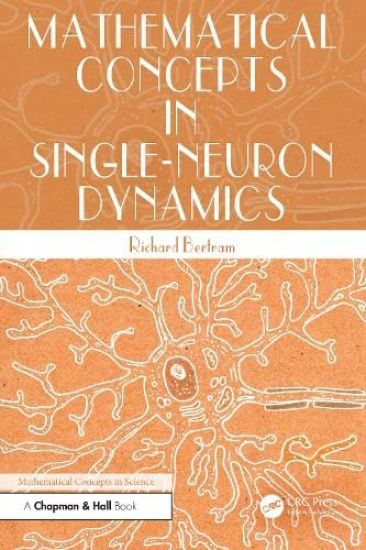
Mathematical Concepts in Single-Neuron Dynamics

Mathematical Concepts in Single-Neuron Dynamics

Richard Bertram

TAYLOR FRANCIS LTD
2026
nidottu
This book is designed as an introduction to neural dynamics through an intuitive exploration of fundamental "dynamic motifs" - the recurring dynamical concepts essential for understanding computational neuroscience. This concise, hands-on guide bridges the gap between mathematics and neuroscience, providing clear explanations of the key dynamical systems concepts that appear repeatedly in the computational/mathematical neuroscience literature. Key Features: Geometric and intuitive descriptions that minimize mathematical formality while preserving clarity Interactive "Explorations" that reinforce concepts through computer-based exercises Complete solutions to all Explorations, allowing for self-guided learning Accessible approach suitable for both experimental neuroscientists and mathematicians Focused coverage of essential concepts that serve as building blocks for understanding complex neural models This book serves as an ideal entry point into computational neuroscience for two distinct audiences: experimental neuroscientists seeking to understand computational techniques for collaboration, and mathematicians or mathematics students looking to apply their knowledge to neuroscience. Through its unique combination of concise text and hands-on exploration, readers will quickly develop the knowledge and skills needed to navigate the computational neuroscience literature with confidence.
Mathematical Concepts in Single-Neuron Dynamics

Mathematical Concepts in Single-Neuron Dynamics

Richard Bertram

TAYLOR FRANCIS LTD
2026
sidottu
This book is designed as an introduction to neural dynamics through an intuitive exploration of fundamental "dynamic motifs" - the recurring dynamical concepts essential for understanding computational neuroscience. This concise, hands-on guide bridges the gap between mathematics and neuroscience, providing clear explanations of the key dynamical systems concepts that appear repeatedly in the computational/mathematical neuroscience literature. Key Features: Geometric and intuitive descriptions that minimize mathematical formality while preserving clarity Interactive "Explorations" that reinforce concepts through computer-based exercises Complete solutions to all Explorations, allowing for self-guided learning Accessible approach suitable for both experimental neuroscientists and mathematicians Focused coverage of essential concepts that serve as building blocks for understanding complex neural models This book serves as an ideal entry point into computational neuroscience for two distinct audiences: experimental neuroscientists seeking to understand computational techniques for collaboration, and mathematicians or mathematics students looking to apply their knowledge to neuroscience. Through its unique combination of concise text and hands-on exploration, readers will quickly develop the knowledge and skills needed to navigate the computational neuroscience literature with confidence.
The Colonial Service

The Colonial Service

Anton Bertram

Cambridge University Press
2011
pokkari
Originally published in 1930, this is an account on general lines of the administrative machinery of the Crown colonies, protectorates and mandated territories of the British Empire. It will be of value to anyone with an interest in colonial history and colonial administration.
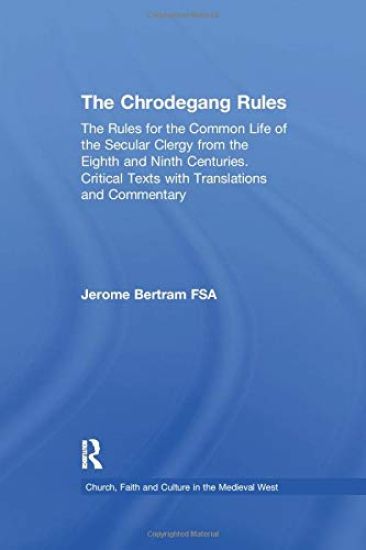
The Chrodegang Rules

The Chrodegang Rules

Jerome Bertram

Routledge
2017
nidottu
Since its earliest days, the Christian Church sought to draw up rules by which its members could live together in religious communities. Whilst those of Augustine (c.400 AD) and Benedict (c.530 AD) provided detailed guidance for monastic life, it took another two centuries for equivalent rules for secular clergy to become accepted on a wide scale. The earliest surviving set of comprehensive rules for canons are those written in the mid-eighth century by St Chrodegang (c.712-766), Bishop of Metz. Writing initially for secular clergy at Metz Cathedral, this work shows how Chrodegang's rule borrowed much from the Benedictine tradition, dealing with many of the same concerns such as the housing, feeding and disciplining of members of the community and the daily routine of the divine offices. At a time when there was no consensus on how clergy should live - whether they should marry or were eligible to own property - Chrodegang's rule provided clear guidance on such issues, and inspired reformers across Europe to consider how clergy lived and interacted with wider society. Although his work was superseded within a generation by the Rule of Aachen, Chrodegang succeeded in setting the agenda for subsequent rules for canons and as such his rule deserves to be given more weight by Church historians than has hitherto been the case. Providing the Latin texts and English translations of the three surviving versions of Chrodegang's rule, (Regula Originalis Chrodegangi, Institutio Canonicorum, Regula Longior Canonicorum) this volume provides an invaluable resource to scholars of medieval Christian communities. Substantial introductions to each text provide historical context and bibliographic details, allowing them to be understood in a much fuller way than has hitherto been possible.
Furniture, Structure, Infrastructure
Observation and analysis are types of invention. They make things apparent which perhaps were invisible. By noticing, drawing and naming something we bring it into being. On the other hand, building and making can be thought of as analytical observations, pointing out what had not been so clear before and revealing the potential for other actions yet to occur. This book is a collection of urban research and architectural projects by award-winning architects Nigel Bertram / NMBW Architecture Studio, using observation as a design tool and design as an observational method. Through this process, a position on the making of architecture and on the role of architecture within the wider urban environment is established; embracing the full messy reality of the present, finding delight in the everyday and developing sensitivity to a range of found environments. By taking pre-existing conditions seriously, each project, architectural or analytical, large or small, becomes understood as the strategic renovation of a continuing state. This method of working operates by thinking simultaneously at different scales, from furniture to structure and infrastructure, searching for combinations of what might normally be separated into different categories, moving between the many small and ad-hoc actions of individuals to wider systems of collective organisation. Thinking about the effects of small moves on the larger urban field (and vice-versa), the role of unplanned or uncontrolled events in relation to the inward focus of design; thinking about the combinatory effect of what is newly made with what is already there, for example, enables architecture and the city to be understood in relative terms - in terms of relationships. Between people, groups of people, things, and parts of things, actions and groups of actions: urban architecture is the social arrangement of activity with the physical arrangement of large and small parts of its environment. But what people do also change
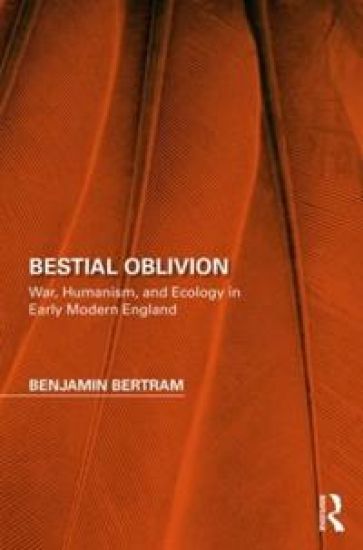
Bestial Oblivion

Bestial Oblivion

Benjamin Bertram

Routledge
2018
sidottu
Although war is a heterogeneous assemblage of the human and nonhuman, it nevertheless builds the illusion of human autonomy and singularity. Focusing on war and ecology, a neglected topic in early modern ecocriticism, Bestial Oblivion: War, Humanism, and Ecology in Early Modern England shows how warfare unsettles ideas of the human, yet ultimately contributes to, and is then perpetuated by, anthropocentrism. Bertram’s study of early modern warfare’s impact on human-animal and human-technology relationships draws upon posthumanist theory, animal studies, and the new materialisms, focusing on responses to the Anglo-Spanish War, the Italian Wars, the Wars of Religion, the colonization of Ireland, and Jacobean “peace.” The monograph examines a wide range of texts—essays, drama, military treatises, paintings, poetry, engravings, war reports, travel narratives—and authors—Erasmus, Machiavelli, Digges, Shakespeare, Marlowe, Coryate, Bacon—to show how an intricate web of perpetual war altered the perception of the physical environment as well as the ideologies and practices establishing what it meant to be human.
The Routledge Guidebook to Rousseau’s The Social Contract
Rousseau's The Social Contract is a benchmark in political philosophy and has been one of the most influential works of moral and political thought since its publication in 1762. This comprehensive and accessible guidebook introduces and assesses: Rousseau's life and the background of The Social Contract The ideas and arguments of The Social Contract Rousseau's continuing importance to politics and philosophyThe Routledge Guidebook to Rousseau’s The Social Contract will be essential reading for all students of philosophy and politics, and anyone approaching the work of Rousseau for the first time.