Kirjojen hintavertailu. Mukana 11 627 220 kirjaa ja 12 kauppaa.

Kirjahaku

Etsi kirjoja tekijän nimen, kirjan nimen tai ISBN:n perusteella.

1000 tulosta hakusanalla Carlo Gozzi

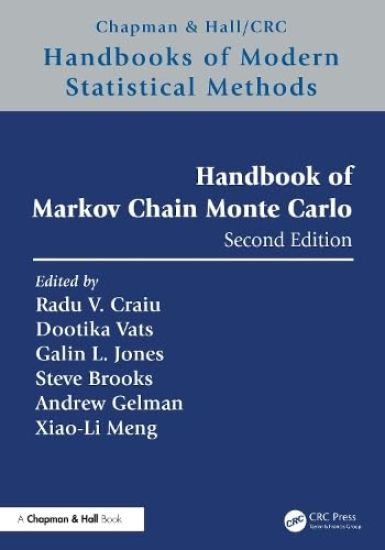
Handbook of Markov Chain Monte Carlo
This thoroughly revised and expanded second edition of the Handbook of Markov Chain Monte Carlo reflects the dramatic evolution of MCMC methods since the publication of the first edition. With the addition of two new editors, Radu V. Craiu and Dootika Vats, this comprehensive reference now offers deeper insights into the theoretical foundations and cutting-edge developments that are reshaping the field. Features: Completely restructured content with 13 updated chapters from the first edition and 10 entirely new chapters reflecting the latest methodological advances In-depth coverage of recent breakthroughs in multi-modal sampling, intractable likelihood problems, and involutive MCMC theory Comprehensive exploration of unbiased MCMC methods, control variates, and rigorous convergence bounds Practical guidance on implementing MCMC algorithms on modern hardware and software platforms Cutting-edge material on the integration of MCMC with deep learning and other machine learning approaches Authoritative treatment of theoretical foundations alongside practical implementation strategies This essential reference serves statisticians, computer scientists, physicists, data scientists, and researchers across disciplines who employ computational methods for Bayesian inference and stochastic simulation. Graduate students will find it an invaluable learning resource, while experienced practitioners will appreciate its balance of theoretical depth and practical implementation advice. Whether used as a comprehensive guide to current MCMC methodology or as a reference for specific advanced techniques, this handbook provides the definitive resource for anyone working at the intersection of Bayesian computation and modern statistical modeling.

Mean Field Simulation for Monte Carlo Integration
In the last three decades, there has been a dramatic increase in the use of interacting particle methods as a powerful tool in real-world applications of Monte Carlo simulation in computational physics, population biology, computer sciences, and statistical machine learning. Ideally suited to parallel and distributed computation, these advanced particle algorithms include nonlinear interacting jump diffusions; quantum, diffusion, and resampled Monte Carlo methods; Feynman-Kac particle models; genetic and evolutionary algorithms; sequential Monte Carlo methods; adaptive and interacting Markov chain Monte Carlo models; bootstrapping methods; ensemble Kalman filters; and interacting particle filters. Mean Field Simulation for Monte Carlo Integration presents the first comprehensive and modern mathematical treatment of mean field particle simulation models and interdisciplinary research topics, including interacting jumps and McKean-Vlasov processes, sequential Monte Carlo methodologies, genetic particle algorithms, genealogical tree-based algorithms, and quantum and diffusion Monte Carlo methods. Along with covering refined convergence analysis on nonlinear Markov chain models, the author discusses applications related to parameter estimation in hidden Markov chain models, stochastic optimization, nonlinear filtering and multiple target tracking, stochastic optimization, calibration and uncertainty propagations in numerical codes, rare event simulation, financial mathematics, and free energy and quasi-invariant measures arising in computational physics and population biology. This book shows how mean field particle simulation has revolutionized the field of Monte Carlo integration and stochastic algorithms. It will help theoretical probability researchers, applied statisticians, biologists, statistical physicists, and computer scientists work better across their own disciplinary boundaries.
A Primer for the Monte Carlo Method
The Monte Carlo method is a numerical method of solving mathematical problems through random sampling. As a universal numerical technique, the method became possible only with the advent of computers, and its application continues to expand with each new computer generation. A Primer for the Monte Carlo Method demonstrates how practical problems in science, industry, and trade can be solved using this method. The book features the main schemes of the Monte Carlo method and presents various examples of its application, including queueing, quality and reliability estimations, neutron transport, astrophysics, and numerical analysis. The only prerequisite to using the book is an understanding of elementary calculus.
From the Mill to Monte Carlo

From the Mill to Monte Carlo

Anne Fletcher

Amberley Publishing
2021
pokkari
This is the story of a man who went from Yorkshire mill worker to Monte Carlo millionaire. Amongst the men ‘who broke the bank at Monte Carlo’, Joseph Hobson Jagger is unique. He is the only one known to have devised an infallible and completely legal system to defeat the odds at roulette and win a fortune. But he was not what might be expected. He wasn’t a gentleman or an aristocrat, he wasn’t a professional gambler, he was a Yorkshire textile worker who had laboured in the Victorian mills of Bradford since childhood. What led a man like this to travel nearly a thousand miles to the exclusive world of the Riviera when most people lived and died within a few miles of where they were born? The trains that took him there were still new and dangerous, he did not speak French and had never left the north of England. His motivation was strong. Joseph, his wife and four children, the youngest of whom was only two, faced a situation so grave that their only escape seemed to be his desperate gamble on the roulette tables of Monte Carlo. Today Jagger’s legacy is felt in casinos worldwide and yet he is virtually unknown. Anne Fletcher is his great-great-great niece and in this true-life detective story she uncovers how he was able to win a fortune, what happened to his millions and why Jagger should now be regarded as the real ‘man who broke the bank at Monte Carlo’.
Handbook of Markov Chain Monte Carlo
Since their popularization in the 1990s, Markov chain Monte Carlo (MCMC) methods have revolutionized statistical computing and have had an especially profound impact on the practice of Bayesian statistics. Furthermore, MCMC methods have enabled the development and use of intricate models in an astonishing array of disciplines as diverse as fisheries science and economics. The wide-ranging practical importance of MCMC has sparked an expansive and deep investigation into fundamental Markov chain theory.The Handbook of Markov Chain Monte Carlo provides a reference for the broad audience of developers and users of MCMC methodology interested in keeping up with cutting-edge theory and applications. The first half of the book covers MCMC foundations, methodology, and algorithms. The second half considers the use of MCMC in a variety of practical applications including in educational research, astrophysics, brain imaging, ecology, and sociology.The in-depth introductory section of the book allows graduate students and practicing scientists new to MCMC to become thoroughly acquainted with the basic theory, algorithms, and applications. The book supplies detailed examples and case studies of realistic scientific problems presenting the diversity of methods used by the wide-ranging MCMC community. Those familiar with MCMC methods will find this book a useful refresher of current theory and recent developments.
Random Number Generation and Monte Carlo Methods

Random Number Generation and Monte Carlo Methods

James E. Gentle

Springer-Verlag New York Inc.
2010
nidottu
Monte Carlo simulation has become one of the most important tools in all fields of science. Simulation methodology relies on a good source of numbers that appear to be random. These "pseudorandom" numbers must pass statistical tests just as random samples would. Methods for producing pseudorandom numbers and transforming those numbers to simulate samples from various distributions are among the most important topics in statistical computing. This book surveys techniques of random number generation and the use of random numbers in Monte Carlo simulation. The book covers basic principles, as well as newer methods such as parallel random number generation, nonlinear congruential generators, quasi Monte Carlo methods, and Markov chain Monte Carlo. The best methods for generating random variates from the standard distributions are presented, but also general techniques useful in more complicated models and in novel settings are described. The emphasis throughout the book is on practical methods that work well in current computing environments. The book includes exercises and can be used as a test or supplementary text for various courses in modern statistics. It could serve as the primary test for a specialized course in statistical computing, or as a supplementary text for a course in computational statistics and other areas of modern statistics that rely on simulation. The book, which covers recent developments in the field, could also serve as a useful reference for practitioners. Although some familiarity with probability and statistics is assumed, the book is accessible to a broad audience. The second edition is approximately 50% longer than the first edition. It includes advances in methods for parallel random number generation, universal methods for generation of nonuniform variates, perfect sampling, and software for random number generation.
Mathematical Essays in honor of Gian-Carlo Rota

Mathematical Essays in honor of Gian-Carlo Rota

Bruce Sagan; Richard Stanley

Springer-Verlag New York Inc.
2011
nidottu
In April of 1996 an array of mathematicians converged on Cambridge, Massachusetts, for the Rotafest and Umbral Calculus Workshop, two con­ ferences celebrating Gian-Carlo Rota's 64th birthday. It seemed appropriate when feting one of the world's great combinatorialists to have the anniversary be a power of 2 rather than the more mundane 65. The over seventy-five par­ ticipants included Rota's doctoral students, coauthors, and other colleagues from more than a dozen countries. As a further testament to the breadth and depth of his influence, the lectures ranged over a wide variety of topics from invariant theory to algebraic topology. This volume is a collection of articles written in Rota's honor. Some of them were presented at the Rotafest and Umbral Workshop while others were written especially for this Festschrift. We will say a little about each paper and point out how they are connected with the mathematical contributions of Rota himself.
Mean Field Simulation for Monte Carlo Integration
In the last three decades, there has been a dramatic increase in the use of interacting particle methods as a powerful tool in real-world applications of Monte Carlo simulation in computational physics, population biology, computer sciences, and statistical machine learning. Ideally suited to parallel and distributed computation, these advanced particle algorithms include nonlinear interacting jump diffusions; quantum, diffusion, and resampled Monte Carlo methods; Feynman-Kac particle models; genetic and evolutionary algorithms; sequential Monte Carlo methods; adaptive and interacting Markov chain Monte Carlo models; bootstrapping methods; ensemble Kalman filters; and interacting particle filters. Mean Field Simulation for Monte Carlo Integration presents the first comprehensive and modern mathematical treatment of mean field particle simulation models and interdisciplinary research topics, including interacting jumps and McKean-Vlasov processes, sequential Monte Carlo methodologies, genetic particle algorithms, genealogical tree-based algorithms, and quantum and diffusion Monte Carlo methods. Along with covering refined convergence analysis on nonlinear Markov chain models, the author discusses applications related to parameter estimation in hidden Markov chain models, stochastic optimization, nonlinear filtering and multiple target tracking, stochastic optimization, calibration and uncertainty propagations in numerical codes, rare event simulation, financial mathematics, and free energy and quasi-invariant measures arising in computational physics and population biology. This book shows how mean field particle simulation has revolutionized the field of Monte Carlo integration and stochastic algorithms. It will help theoretical probability researchers, applied statisticians, biologists, statistical physicists, and computer scientists work better across their own disciplinary boundaries.
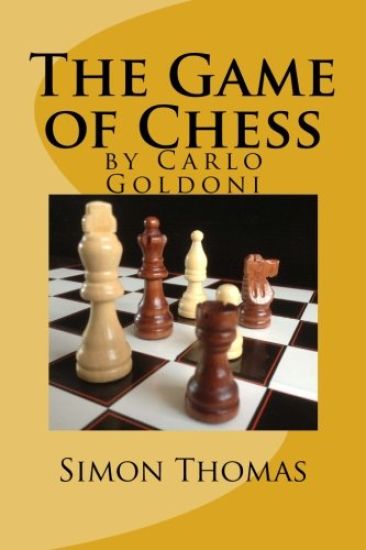
The Game of Chess: by Carlo Goldoni

The Game of Chess: by Carlo Goldoni

Simon Thomas

Createspace Independent Publishing Platform
2013
nidottu
In 2011, the National Theatre in London produced a version of The Servant of Two Masters under the title One Man, Two Guvnors. It became a smash hit on both sides of the Atlantic and introduced a whole new audience to the work of Carlo Goldoni. Goldoni (1707-1793) was one of the most prolific playwrights who ever lived, having written over 250 works during a career of nearly 50 years. He's best-known outside Italy for some of his earliest comedies, including The Servant of Two Masters and The Venetian Twins, farces based on the traditions of commedia dell'arte but we have to look to his mature works for the truly Goldonian comedy. There's a wealth of subtlety and insight in these beautifully constructed and astutely observed studies of everyday life in 18th Century Italy (and, at the end of his career, France). The Game of Chess is a translation of Carlo Goldoni's penultimate play, Le Bourru bienfaisant, written in French in 1771, when he was living in exile in Paris. Goldoni (1707-1793) idolized Moli re and desperately wanted to have a success at the Com die-Fran aise, the so-called maison de Moli re. With Le Bourru bienfaisant, he fulfilled his wish, although he was not so lucky with his final comedy, L'avare fastueux, a poorer piece, which got a less positive reception. What he did with both these two final plays was build the plot around an oxymoronic central character. The original title of the play translates as "The Beneficent Boor." The boor of the title is Monsieur G ronte, an ill-tempered old gentleman with a heart of gold, whose greatest pleasure in life is to manipulate the pieces in his chess game.