Orphelin rejet' par son p're, enfant solitaire et autodidacte g'nial, Ren' Descartes du Perron publie vingt ans son premier livre, L'Art d'escrime, Trait' sur la Mani're de Faire les Armes. S'ducteur, surnomm' le Beaux T'n'breux par les Pr'cieuses, joueur professionnel, mercenaire-espion pendant les guerres des Pays-Bas, d'Allemagne et des Alpes, il inspire Moli're pour son Don Juan. Racine puise dans son Trait' des Passions pour 'crire ses trag'dies. Je suis de ceux qui ont le plus aim' la vie, dit-il. Homme d'action et aventurier de la pens'e, il 'nonce les bases de la g'om'trie et de l'alg'bre modernes tout en participant l'atroce guerre de Trente Ans. Dans le Discours de la M'thode et sa G'om'trie, "le plus grand des math'maticiens," disait ses pairs, d'finit les fondamentaux des sciences th'oriques, math'matiques et exp'rimentales. Tous les savoirs actuels en d'coulent. Il est admir', idoltr' par ses amis savants de l'Invisible Coll'ge des Fr'res de la Rose-Croix et pers'cut' par les int'gristes religieux qui ont sans doute r'ussi le tuer. Descartes est le fondateur des temps modernes. Sa vie est le plus extraordinaire des romans d'aventure.
This self-contained book lays the foundations for a systematic understanding of potential theoretic and uniformization problems on fractal Sierpinski carpets, and proposes a theory based on the latest developments in the field of analysis on metric spaces. The first part focuses on the development of an innovative theory of harmonic functions that is suitable for Sierpinski carpets but differs from the classical approach of potential theory in metric spaces. The second part describes how this theory is utilized to prove a uniformization result for Sierpinski carpets. This book is intended for researchers in the fields of potential theory, quasiconformal geometry, geometric group theory, complex dynamics, geometric function theory and PDEs.
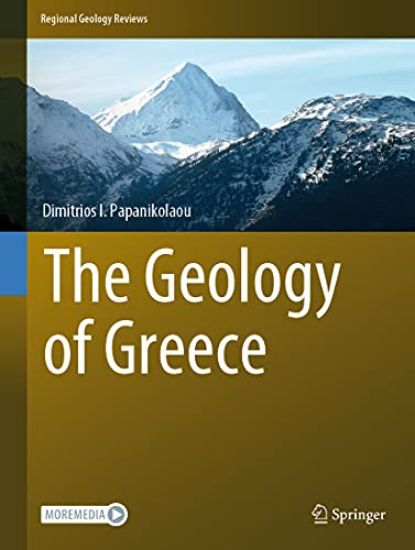
This book introduces the reader to the unique geology of Greece. This country is a natural geology laboratory that can help us understand the present-day active geodynamic processes in the Hellenic orogenic arc, including earthquakes, volcanoes, coastline changes and other processes of uplift and subsidence, as well as the intense erosion, transport and deposition of sediments. Additionally, Greece offers a remarkable geological museum, reflecting the complex history of the area over the last 300 million years. By studying the rocks of Greece, one can discover old oceanic basins, e.g. in the Northern Pindos and Othrys mountains, crystalline rocks of Palaeozoic age, old granitic and volcanic rocks, as well as other sedimentary rocks including fossils from the shallow neritic facies to pelagic and abyssal facies. The younger sediments demonstrate the continuously changing palaeogeography of Greece, with areas of lakes, high plateaus and gulfs that are transformed into new forms of islands, peninsulas or high mountains, etc. All the above subjects are included in the book, which describes the tectonic structure of the geological strata, together with the evolutionary stages of the palaeogeography and geodynamics within the broader Mediterranean context. A special characteristic of the book is the development of the orogenic model of the Hellenides with the application of the tectono-stratigraphic terrane concept in the Tethyan system.
This book introduces the reader to the unique geology of Greece. This country is a natural geology laboratory that can help us understand the present-day active geodynamic processes in the Hellenic orogenic arc, including earthquakes, volcanoes, coastline changes and other processes of uplift and subsidence, as well as the intense erosion, transport and deposition of sediments. Additionally, Greece offers a remarkable geological museum, reflecting the complex history of the area over the last 300 million years. By studying the rocks of Greece, one can discover old oceanic basins, e.g. in the Northern Pindos and Othrys mountains, crystalline rocks of Palaeozoic age, old granitic and volcanic rocks, as well as other sedimentary rocks including fossils from the shallow neritic facies to pelagic and abyssal facies. The younger sediments demonstrate the continuously changing palaeogeography of Greece, with areas of lakes, high plateaus and gulfs that are transformed into new forms of islands, peninsulas or high mountains, etc. All the above subjects are included in the book, which describes the tectonic structure of the geological strata, together with the evolutionary stages of the palaeogeography and geodynamics within the broader Mediterranean context. A special characteristic of the book is the development of the orogenic model of the Hellenides with the application of the tectono-stratigraphic terrane concept in the Tethyan system.