Kirjojen hintavertailu. Mukana 12 390 323 kirjaa ja 12 kauppaa.

Kirjahaku

Etsi kirjoja tekijän nimen, kirjan nimen tai ISBN:n perusteella.

1000 tulosta hakusanalla Ellen Phillips

The Angel in the Marketplace

The Angel in the Marketplace

Ellen Wayland-Smith

University of Chicago Press
2020
sidottu
The popular image of a mid-century ad woman is of a feisty girl beating men at their own game, a female Horatio Alger protagonist battling her way through the sexist workplace. But before the fictional rise of Peggy Olson or the real-life stories of Patricia Tierney and Jane Maas came Jean Wade Rindlaub: a female powerbroker who used her considerable success in the workplace to encourage other women--to stick to their kitchens. The Angel in the Marketplace is the story of one of America's most accomplished advertising executives. It is also the story of how advertisers like Rindlaub sold a postwar American dream of capitalism and a Christian corporate order. Rindlaub was responsible for award-winning, mega sales-generating advertisements for all things domestic, including Oneida Silverware, Betty Crocker Cake Mix, Campbell's Soup, and Chiquita Bananas. Her success largely came from embracing, rather than subverting, the cultural expectations of women. She believed her responsibility as an advertiser was not to spring women from their trap, but to make that trap more comfortable. Rindlaub wasn't just selling silverware and cakes, she was selling the virtues of free enterprise. By following the arc of Rindlaub's career from the 1920s through the 1960s, we witness how a range of cultural narratives--advertising chief among them--worked powerfully to shape women's emotional and economic behavior in support of the free market system. Alongside Rindlaub's story, Ellen Wayland-Smith provides a riveting history of how women were repeatedly sold the idea that their role as housewives was more powerful, and more patriotic, than any outside the home. And by buying into the image of morality through an unregulated market, many of these women helped fuel backlash against economic regulation and socialization efforts throughout the twentieth century. The Angel in the Marketplace is a nuanced portrayal of a complex woman, one who both shaped and reflected the complicated cultural, political, and religious forces defining femininity in America at mid-century. This compelling account of one of advertising's most fervent believers is a tale of a Mad Woman we haven't been told.

Persecution, Plague, and Fire

Persecution, Plague, and Fire

Ellen MacKay

University of Chicago Press
2011
sidottu
The theater of early modern England was a disastrous affair. The scant record of its performance demonstrates as much, for what we tend to remember today of the Shakespearean stage and its history are landmark moments of its dissolution: the burning down of the Globe, the forced closure of playhouses during outbreaks of the plague, and the abolition of the theater by its Cromwellian opponents. "Persecution, Plague, and Fire" is a study of such playhouse catastrophes and the theory of performance they convey. Ellen MacKay argues that the various disasters that afflicted the English theater during its golden age were no accident but the promised end of a practice built on disappearance and erasure - a kind of fatal performance that left nothing behind but its self-effacing poetics. Bringing together dramatic theory, performance studies, and theatrical, religious, and cultural history, MacKay reveals the period's radical take on the history and the future of the stage to show just how critical the relation was between early modern English theater and its public.
Filled with the Spirit

Filled with the Spirit

Ellen Lewin

University of Chicago Press
2018
sidottu
In 2001, a collection of open and affirming churches with predominantly African American membership and a Pentecostal style of worship formed a radically new coalition. The group, known now as the Fellowship of Affirming Ministries or TFAM, has at its core the idea of “radical inclusivity”: the powerful assertion that everyone, no matter how seemingly flawed or corrupted, has holiness within. Whether you are LGBT, have HIV/AIDS, have been in prison, abuse drugs or alcohol, are homeless, or are otherwise compromised and marginalized, TFAM tells its people, you are one of God’s creations. In Filled with the Spirit, Ellen Lewin gives us a deeply empathetic ethnography of the worship and community central to TFAM, telling the story of how the doctrine of radical inclusivity has expanded beyond those it originally sought to serve to encompass people of all races, genders, sexualities, and religious backgrounds. Lewin examines the seemingly paradoxical relationship between TFAM and traditional black churches, focusing on how congregations and individual members reclaim the worship practices of these churches and simultaneously challenge their authority. The book looks closely at how TFAM worship is legitimated and enhanced by its use of gospel music and considers the images of food and African American culture that are central to liturgical imagery, as well as how understandings of personal authenticity tie into the desire to be filled with the Holy Spirit. Throughout, Lewin takes up what has been mostly missing from our discussions of race, gender, and sexuality—close attention to spirituality and faith.
Filled with the Spirit

Filled with the Spirit

Ellen Lewin

University of Chicago Press
2018
nidottu
In 2001, a collection of open and affirming churches with predominantly African American membership and a Pentecostal style of worship formed a radically new coalition. The group, known now as the Fellowship of Affirming Ministries or TFAM, has at its core the idea of “radical inclusivity”: the powerful assertion that everyone, no matter how seemingly flawed or corrupted, has holiness within. Whether you are LGBT, have HIV/AIDS, have been in prison, abuse drugs or alcohol, are homeless, or are otherwise compromised and marginalized, TFAM tells its people, you are one of God’s creations. In Filled with the Spirit, Ellen Lewin gives us a deeply empathetic ethnography of the worship and community central to TFAM, telling the story of how the doctrine of radical inclusivity has expanded beyond those it originally sought to serve to encompass people of all races, genders, sexualities, and religious backgrounds. Lewin examines the seemingly paradoxical relationship between TFAM and traditional black churches, focusing on how congregations and individual members reclaim the worship practices of these churches and simultaneously challenge their authority. The book looks closely at how TFAM worship is legitimated and enhanced by its use of gospel music and considers the images of food and African American culture that are central to liturgical imagery, as well as how understandings of personal authenticity tie into the desire to be filled with the Holy Spirit. Throughout, Lewin takes up what has been mostly missing from our discussions of race, gender, and sexuality—close attention to spirituality and faith.
Dangerous Earth

Dangerous Earth

Ellen Prager

University of Chicago Press
2020
sidottu
The Earth is a beautiful and wondrous planet, but also frustratingly complex and, at times, violent: much of what has made it livable can also cause catastrophe. Volcanic eruptions create land and produce fertile, nutrient-rich soil, but they can also bury forests, fields, and entire towns under ash, mud, lava, and debris. The very forces that create and recycle Earth's crust also spawn destructive earthquakes and tsunamis. Water and wind bring and spread life, but in hurricanes they can leave devastation in their wake. And while it is the planet's warmth that enables life to thrive, rapidly increasing temperatures are causing sea levels to rise and weather events to become more extreme. Today, we know more than ever before about the powerful forces that can cause catastrophe, but significant questions remain. Why can't we better predict some natural disasters? What do scientists know about them already? What do they wish they knew? In Dangerous Earth, marine scientist and science communicator Ellen Prager explores the science of investigating volcanoes, earthquakes, tsunamis, hurricanes, landslides, rip currents, and--maybe the most perilous hazard of all--climate change. Each chapter considers a specific hazard, begins with a game-changing historical event (like the 1980 eruption of Mt. St. Helens or the landfall and impacts of Hurricane Harvey), and highlights what remains unknown about these dynamic phenomena. Along the way, we hear from scientists trying to read Earth's warning signs, pass its messages along to the rest of us, and prevent catastrophic loss. A sweeping tour of some of the most awesome forces on our planet--many tragic, yet nonetheless awe-inspiring--Dangerous Earth is an illuminating journey through the undiscovered, unresolved, and in some cases unimagined mysteries that continue to frustrate and fascinate the world's leading scientists: the "wish-we-knews" that ignite both our curiosity and global change.
Sex, Drugs, and Sea Slime

Sex, Drugs, and Sea Slime

Ellen Prager

University of Chicago Press
2011
sidottu
When viewed from a quiet beach, the ocean, with its rolling waves and vast expanse, can seem calm, even serene. But hidden beneath the sea's waves are a staggering abundance and variety of active creatures, engaged in the never-ending struggles of life-to reproduce, to eat, and to avoid being eaten. With "Sex, Drugs, and Sea Slime", marine scientist Ellen Prager takes us deep into the sea to introduce an astonishing cast of fascinating and bizarre creatures that make the salty depths their home. From the tiny but voracious arrow worms whose rapacious ways may lead to death by overeating, to the lobsters that battle rivals or seduce mates with their urine, to the sea's masters of disguise, the octopuses, Prager not only brings to life the ocean's strange creatures but also reveals the ways they interact as predators, prey, or potential mates. And while these animals make for some jaw-dropping stories-witness the sea cucumber, which ejects its own intestines to confuse predators, or the hagfish that ties itself into a knot to keep from suffocating in its own slime-there's far more to Prager's account than her ever-entertaining anecdotes: again and again, she illustrates the crucial connections between life in the ocean and humankind, in everything from our food supply to our economy, and in drug discovery, biomedical research, and popular culture. Written with a diver's love of the ocean, a novelist's skill at storytelling, and a scientist's deep knowledge, "Sex, Drugs, and Sea Slime" enchants as it educates, enthralling us with the wealth of life in the sea-and reminding us of the need to protect it.
Chasing Science at Sea

Chasing Science at Sea

Ellen Prager

University of Chicago Press
2010
nidottu
"Chasing Science at Sea" immerses readers in the world of those who regularly go to sea - aquanauts living underwater, marine biologists seeking unseen life in the deep ocean, and tall-ship captains at the helm, among others - and tells the fascinating tale of what life, and science, is like at the mercy of Mother Nature. With passion and wit, well-known marine scientist Ellen Prager shares her stories as well as those of her colleagues, revealing that in the field ingenuity and a good sense of humor are as essential as water, sunblock, and GPS. Filled with firsthand accounts of the challenges and triumphs of dealing with the extreme forces of nature and the unpredictable world of the ocean, "Chasing Science at Sea" is a unique glimpse below the waterline at what it is like - and why it is important - to study, explore, and spend time in one of our planet's most fascinating and foreign environments.
Sex, Drugs, and Sea Slime

Sex, Drugs, and Sea Slime

Ellen Prager

University of Chicago Press
2012
nidottu
When viewed from a quiet beach, the ocean, with its rolling waves and vast expanse, can seem calm, even serene. But hidden beneath the sea's waves are a staggering abundance and variety of active creatures, engaged in the never-ending struggles of life - to reproduce, to eat, and to avoid being eaten. With "Sex, Drugs, and Sea Slime", marine scientist Ellen Prager takes us deep into the sea to introduce an astonishing cast of fascinating and bizarre creatures that make the salty depths their home. From the tiny but voracious arrow worms whose rapacious ways may lead to death by overeating, to the lobsters that battle rivals or seduce mates with their urine, to the sea's masters of disguise, the octopuses, Prager not only brings to life the ocean's strange creatures, but also reveals the ways they interact as predators, prey, or potential mates. And while these animals make for some jaw-dropping stories - witness the sea cucumber, which ejects its own intestines to confuse predators, or the hagfish that ties itself into a knot to keep from suffocating in its own slime - there's far more to Prager's account than her ever-entertaining anecdotes: again and again, she illustrates the crucial connections between life in the ocean and humankind, in everything from our food supply to our economy, and in drug discovery, biomedical research, and popular culture. Written with a diver's love of the ocean, a novelist's skill at storytelling, and a scientist's deep knowledge, "Sex, Drugs, and Sea Slime" enchants as it educates, enthralling us with the wealth of life in the sea - and reminding us of the need to protect it.
Bitter Choices

Bitter Choices

Ellen Israel Rosen

University of Chicago Press
1990
nidottu
Ellen Israel Rosen presents a compelling portrait of married women who work on New England's assembly lines while they also maintain their homes and marriages. With skill and sympathy, she documents the reasons these women work; their experiences on the job, in the union, and at home; the sources of their job satisfaction; and their management of the "double day." The major issue for this segment of the labor force, Rosen suggests, is not whether to work, but the availability and quality of jobs. Rosen argues that deindustrialization—plant closings and job displacement—confronts blue-collar women factory workers with a "bitter choice" between work at lower and lower wages or no work at all. Drawing on quantitative and qualitative data from interviews with more than two hundred such women factory workers, Rosen traces the ways in which women who do "unskilled" factory work have gained in self-esteem as well as financial stability from holding paid jobs. Throughout, Rosen explores the relationship between public work experiences and private family life. She analyzes the dynamics of two-paycheck, working class families, clarifies relationships between class and gender, and explores the impact of patriarchy and capitalism on working class women. At the same time Rosen places women's job loss within the broader economic context of global industrial transformations, demonstrating how international capital shifts to cheaper labor in developing countries, as well as technological progress, are changing the shape of the entire American labor force and are beginning to undermine the material and symbolic gains of the American female factory worker, the promise of market equality, and progressive working conditions. "This book is a significant contribution to our understanding of women's work and family lives, but it is also a valuable look at the consequences of deindustrialization in America for workers, their families, and their communities."—Myra Marx Ferree, American Journal of Sociology
Making a Mantra

Making a Mantra

Ellen Gough

University of Chicago Press
2021
sidottu
Jainism originated in India and shares some features with Buddhism and Hinduism, but it is a distinct tradition with its own key texts, art, rituals, beliefs, and history. One important way it has often been distinguished from Buddhism and Hinduism is through the highly contested category of Tantra: Jainism, unlike the others, does not contain a tantric path to liberation. But in Making a Mantra, historian of religions Ellen Gough refines and challenges our understanding of Tantra by looking at the development over two millennia of a Jain incantation, or mantra, that evolved from an auspicious invocation in a second-century text into a key component of mendicant initiations and meditations that continue to this day. Typically, Jainism is characterized as a celibate, ascetic path to liberation in which one destroys karma through austerities, while the tantric path to liberation is characterized as embracing the pleasures of the material world, requiring the ritual use of mantras to destroy karma. Gough, however, argues that asceticism and Tantra should not be viewed in opposition to one another. She does so by showing that Jains perform “tantric” rituals of initiation and meditation on mantras and ma??alas. Jainism includes kinds of tantric practices, Gough provocatively argues, because tantric practices are a logical extension of the ascetic path to liberation.
Making a Mantra

Making a Mantra

Ellen Gough

University of Chicago Press
2021
nidottu
Jainism originated in India and shares some features with Buddhism and Hinduism, but it is a distinct tradition with its own key texts, art, rituals, beliefs, and history. One important way it has often been distinguished from Buddhism and Hinduism is through the highly contested category of Tantra: Jainism, unlike the others, does not contain a tantric path to liberation. But in Making a Mantra, historian of religions Ellen Gough refines and challenges our understanding of Tantra by looking at the development over two millennia of a Jain incantation, or mantra, that evolved from an auspicious invocation in a second-century text into a key component of mendicant initiations and meditations that continue to this day. Typically, Jainism is characterized as a celibate, ascetic path to liberation in which one destroys karma through austerities, while the tantric path to liberation is characterized as embracing the pleasures of the material world, requiring the ritual use of mantras to destroy karma. Gough, however, argues that asceticism and Tantra should not be viewed in opposition to one another. She does so by showing that Jains perform “tantric” rituals of initiation and meditation on mantras and ma??alas. Jainism includes kinds of tantric practices, Gough provocatively argues, because tantric practices are a logical extension of the ascetic path to liberation.
The Lost Promise: American Universities in the 1960s

The Lost Promise: American Universities in the 1960s

Ellen Schrecker

University of Chicago Press
2025
nidottu
The Lost Promise is a magisterial examination of the turmoil that rocked American universities in the 1960s, with a unique focus on the complex roles played by professors as well as students. The 1950s through the early 1970s are widely seen as American academia's golden age, when universities--well-funded and viewed as essential for national security, economic growth, and social mobility--embraced an egalitarian mission. Swelling in size, schools attracted new types of students and professors, including radicals who challenged their institutions' calcified traditions. But that halcyon moment soon came to a painful and confusing end, with consequences that still afflict the halls of ivy. In The Lost Promise, Ellen Schrecker--our foremost historian of both the McCarthy era and the modern American university--delivers a far-reaching examination of how and why it happened. Schrecker illuminates how US universities' explosive growth intersected with the turmoil of the 1960s, fomenting an unprecedented crisis where dissent over racial inequality and the Vietnam War erupted into direct action. Torn by internal power struggles and demonized by conservative voices, higher education never fully recovered, resulting in decades of underfunding and today's woefully inequitable system. As Schrecker's magisterial history makes blazingly clear, the complex blend of troubles that disrupted the university in that pivotal period haunts the ivory tower to this day.
A World of Rivers

A World of Rivers

Ellen Wohl

University of Chicago Press
2010
sidottu
Far from being the serene, natural streams of yore, modern rivers have been diverted, dammed, dumped in, and dried up, all in efforts to harness their power for human needs. But these rivers have also undergone environmental change. The old adage says you can't step in the same river twice, and Ellen Wohl would agree - natural and synthetic change are so rapid on the world's great waterways that rivers are transforming and disappearing right before our eyes. "A World of Rivers" explores the confluence of human and environmental change on ten of the great rivers of the world. Ranging from the Murray-Darling in Australia and the Yellow River in China to Central Europe's Danube and the Mississippi, the book journeys down the most important rivers in all corners of the globe. Wohl shows us how pollution, such as in the Ganges and in the Ob of Siberia, has affected biodiversity in the water. But rivers are also resilient, and Wohl stresses the importance of conservation and restoration to help reverse the effects of human carelessness and hubris. What all these diverse rivers share is a critical role in shaping surrounding landscapes and biological communities, and Wohl's book ultimately makes a strong case for the need to steward positive change in the world's great rivers.
Joey and His Friend Water

Joey and His Friend Water

Ellen J Lewinberg

Tellwell Talent
2023
pokkari
Joey and His Friend Water is a playful book that introduces children and their parents to the idea that everything around us from people, to plants, to trees, to rocks, is energy vibrating at different speeds. And, in this way, everything in the universe is connected. The importance of the water cycle, mycelium and trees in healing the earth is talked about alongside Maseru Imoto's work on water and the idea that the way in which water reacts to words and emotions has implications for our bodies and our environment.
Women and Exile in Contemporary Irish Fiction

Women and Exile in Contemporary Irish Fiction

Ellen McWilliams

Palgrave Macmillan
2013
sidottu
Women and Exile in Contemporary Irish Fiction examines how contemporary Irish authors have taken up the history of the Irish woman migrant. It situates these writers' work in relation to larger discourses of exile in the Irish literary tradition and examines how they engage with the complex history of Irish emigration.
Image and Insight

Image and Insight

Ellen Handler Spitz

Columbia University Press
1993
pokkari
Drawing on psychoanalytic discourse, the author of this work probes the use of words and images in contemporary culture. She draws upon a number of artistic movements and exhibitions to examine the emotional and intellectual responses to art.
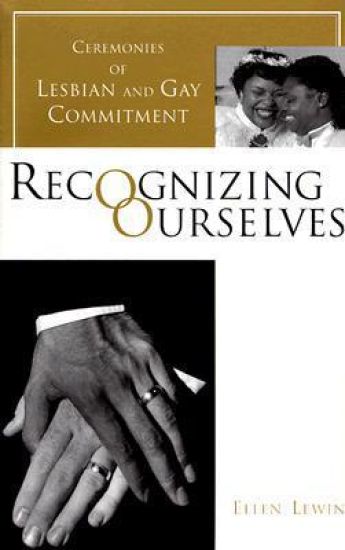
Recognizing Ourselves

Recognizing Ourselves

Ellen Lewin

Columbia University Press
1998
sidottu
In April 1993, as part of the March on Washington for Lesbian, Gay, and Bi Equal Rights and Liberation, hundreds of couples participated in "the Wedding," a symbolic commitment ceremony held in front of the Internal Revenue Service building. Part protest and part affirmation of devotion, the event was a reminder that marriage rights have become a major issue among lesbians and gay men, who cannot marry legally and can only claim domestic partner rights in a few locations in the United States. Yet despite official lack of recognition, same-sex wedding ceremonies have been increasing in frequency over the past decade. Ellen Lewin, who has consecrated her own lesbian relationship with a commitment ceremony, decided to explore the myriad ways in which lesbians and gay men create meaningful ceremonies for themselves. She offers the first comprehensive account of lesbian and gay weddings in modern America. A series of richly detailed profiles-the result of extensive interviews and participation in the planning and realization of many of these commitment rituals-is woven together to show how new traditions, and ultimately new families, are emerging within contemporary America. Just as the book is a moving portrait of same-sex couples today, it is also a significant political document on a new arena in the struggle for lesbian and gay rights. In a larger sense, Lewin's work is about the politics surrounding same-sex marriages and the ramifications for central dimensions of American culture such as kinship, community, morality, and love. Lewin explores the ceremonies themselves, which range from traditional church weddings to Wicca rituals in the countryside, with portraits of the planning, the joys, and the anxieties that led up to the weddings. She introduces Bob and Mark, a leather fetishist couple who sanctified their love by legally changing their last names and exchanging vows in tuxedos, leather bow ties, and knee-high police boots. In an equally absorbing profile, Lewin describes Khadija, from a working-class black family deeply suspicious of whites (and especially Jews) and Shulamith, raised in a Zionist household. She tells of how the two women struggled to reconcile their widely disparate upbringings and how they ultimately combined elements of African and Jewish traditions in their wedding. These, among many other stories, make Recognizing Ourselves a vivid tapestry of lesbian and gay life in post-Stonewall United States.
Recognizing Ourselves

Recognizing Ourselves

Ellen Lewin

Columbia University Press
1999
pokkari
In April 1993, as part of the March on Washington for Lesbian, Gay, and Bi Equal Rights and Liberation, hundreds of couples participated in "the Wedding," a symbolic commitment ceremony held in front of the Internal Revenue Service building. Part protest and part affirmation of devotion, the event was a reminder that marriage rights have become a major issue among lesbians and gay men, who cannot marry legally and can only claim domestic partner rights in a few locations in the United States. Yet despite official lack of recognition, same-sex wedding ceremonies have been increasing in frequency over the past decade. Ellen Lewin, who has consecrated her own lesbian relationship with a commitment ceremony, decided to explore the myriad ways in which lesbians and gay men create meaningful ceremonies for themselves. She offers the first comprehensive account of lesbian and gay weddings in modern America. A series of richly detailed profiles-the result of extensive interviews and participation in the planning and realization of many of these commitment rituals-is woven together to show how new traditions, and ultimately new families, are emerging within contemporary America. Just as the book is a moving portrait of same-sex couples today, it is also a significant political document on a new arena in the struggle for lesbian and gay rights. In a larger sense, Lewin's work is about the politics surrounding same-sex marriages and the ramifications for central dimensions of American culture such as kinship, community, morality, and love. Lewin explores the ceremonies themselves, which range from traditional church weddings to Wicca rituals in the countryside, with portraits of the planning, the joys, and the anxieties that led up to the weddings. She introduces Bob and Mark, a leather fetishist couple who sanctified their love by legally changing their last names and exchanging vows in tuxedos, leather bow ties, and knee-high police boots. In an equally absorbing profile, Lewin describes Khadija, from a working-class black family deeply suspicious of whites (and especially Jews) and Shulamith, raised in a Zionist household. She tells of how the two women struggled to reconcile their widely disparate upbringings and how they ultimately combined elements of African and Jewish traditions in their wedding. These, among many other stories, make Recognizing Ourselves a vivid tapestry of lesbian and gay life in post-Stonewall United States.
Bio-pics

Bio-pics

Ellen Cheshire

Wallflower Press
2014
pokkari
Bio-pics: A Life in Pictures offers a series of case studies which throw light on this most unique of genres. Is the bio-pic a genre in its own right? Or are such films merely footnotes in other more traditional genres such as the western or costume drama, depending on the historical figure under scrutiny. Unlike other genre forms bio-pics seemingly share no familiar iconography, codes or conventions. They can be set anywhere and at any time. What links them is quite simply that the films depict the life of an 'important' person. Through a carefully selected range of thematically linked (English-language) bio-pics released since 1990 this book explores key issues surrounding their resurgence, narrative structure, production, subject representation or misrepresentation, and critical response. The films under discussion are grouped around a profession (writers, singers, politicians, sportsmen, criminals, artists) allowing for comparisons to be drawn in approaches to similar subject matter.
Signs and Wonders

Signs and Wonders

Ellen Armour

Columbia University Press
2016
sidottu
We are told modernity's end will destabilize familiar ways of knowing, doing, and being, but are these changes we should dread-or celebrate? Four significant events (and the iconic images that represent them) catalyze this question: the consecration of openly gay Episcopalian bishop Gene Robinson, the mistreatment of prisoners at Abu Ghraib prison, the politicization of the death of Terri Schiavo, and the disastrous response to Hurricane Katrina. Framed by an original appropriation of Michel Foucault, and drawing on resources in visual culture theory and the history of photography, Ellen T. Armour explores the anxieties, passions, and power dynamics bound up in the photographic representation and public reception of these events. Together, these phenomena expose modernity's benevolent and malevolent disruptions and reveal the systemic fractures and fissures that herald its end, for better and for worse. In response to these signs and wonders, Armour lays the groundwork for a theology and philosophy of life better suited to our (post)modern moment: one that owns up to the vulnerabilities that modernity sought to disavow and better enables us to navigate the ethical issues we now confront.