The T. S. Eliot Studies Annual strives to be the leading venue for the critical reassessment of Eliot’s life and work in light of the ongoing publication of his letters, critical volumes of his complete prose, the new edition of his complete poems, and the forthcoming critical edition of his plays. All critical approaches are welcome, as are essays pertaining to any aspect of Eliot’s work as a poet, critic, playwright, editor, or foremost exemplar of literary modernism. Book Review Editor: Kevin Rulo Editorial Advisory Board: Ronald Bush David E. Chinitz Robert Crawford Anthony Cuda Julia Daniel Lyndall Gordon John Haffenden Benjamin Lockerd Gabrielle McIntire John Morgenstern Jahan Ramazani Christopher Ricks Ronald Schuchard Vincent Sherry Jewel Spears Brooker Jayme Stayer
Drawing on the latest developments in scholarship and criticism, The New Cambridge Companion to T. S. Eliot opens up fresh avenues of appreciation and inquiry to a global twenty-first century readership. Emphasizing major works and critical issues, this collection of newly commissioned essays from leading international scholars provides seven full chapters reassessing Eliot's poetry and drama; explores important contemporary critical issues that were previously untreated, such as the significance of gender and sexuality; and challenges received accounts of his at times controversial critical reception. Complete with a chronology of Eliot's life and work and an up-to-date select bibliography, this authoritative and accessible introduction to Eliot's complete oeuvre will be an essential resource for students.
Drawing on the latest developments in scholarship and criticism, The New Cambridge Companion to T. S. Eliot opens up fresh avenues of appreciation and inquiry to a global twenty-first century readership. Emphasizing major works and critical issues, this collection of newly commissioned essays from leading international scholars provides seven full chapters reassessing Eliot's poetry and drama; explores important contemporary critical issues that were previously untreated, such as the significance of gender and sexuality; and challenges received accounts of his at times controversial critical reception. Complete with a chronology of Eliot's life and work and an up-to-date select bibliography, this authoritative and accessible introduction to Eliot's complete oeuvre will be an essential resource for students.
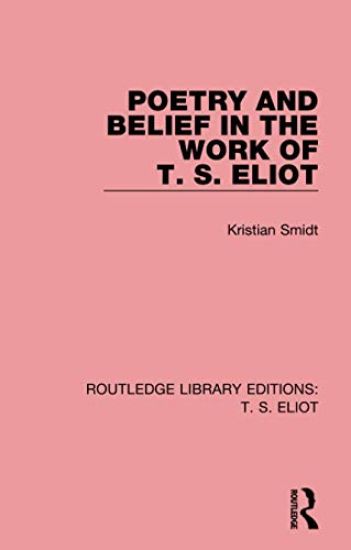
This title, first published in 1961, explores the general background of attitudes, beliefs and ideas from which Eliot’s works have originated. This study examines the influences of Eliot’s work, and includes Eliot’s personal views as told to the author. The book also looks at technique, structure and imagery of his poetry. This title will be of interest to students of literature.
This title, first published in 1961, explores the general background of attitudes, beliefs and ideas from which Eliot’s works have originated. This study examines the influences of Eliot’s work, and includes Eliot’s personal views as told to the author. The book also looks at technique, structure and imagery of his poetry. This title will be of interest to students of literature.
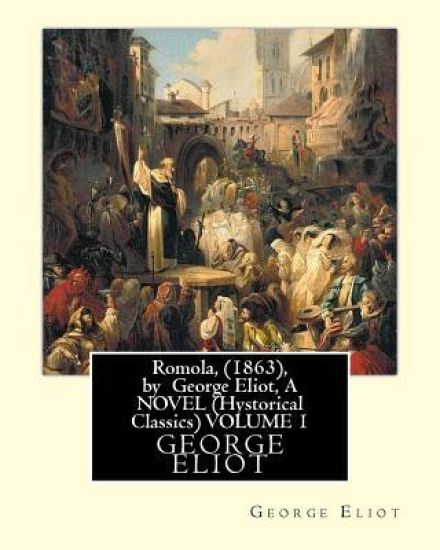
Romola (1862-63) is a historical novel by George Eliot set in the fifteenth century, and is "a deep study of life in the city of Florence from an intellectual, artistic, religious, and social point of view". citation needed] It first appeared in fourteen parts published in Cornhill Magazine from July 1862 to August 1863 . The story takes place amidst actual historical events during the Italian Renaissance, and includes in its plot several notable figures from Florentine history.Florence, 1492: Christopher Columbus has sailed towards the New World, and Florence has just mourned the death of its legendary leader, Lorenzo de' Medici. In this setting, a Florentine trader meets a shipwrecked stranger, who introduces himself as Tito Melema, a young Italianate-Greek scholar. Tito becomes acquainted with several other Florentines, including Nello the barber and a young girl named Tessa. He is also introduced to a blind scholar named Bardo de' Bardi, and his daughter Romola. As Tito becomes settled in Florence, assisting Bardo with classical studies, he falls in love with Romola. However, Tessa falls in love with Tito, and the two are "married" in a mock ceremony. Tito learns from Fra Luca, a Dominican monk, that his adoptive father has been forced into slavery and is asking for assistance. Tito introspects, comparing filial duty to his new ambitions in Florence, and decides that it would be futile to attempt to rescue his adoptive father. This paves the way for Romola and Tito to marry. Fra Luca shortly thereafter falls ill and before his death he speaks to his estranged sister, Romola. Ignorant of Romola's plans, Fra Luca warns her of a vision foretelling a marriage between her and a mysterious stranger who will bring pain to her and her father. After Fra Luca's death, Tito dismisses the warning and advises Romola to trust him. Tito and Romola become betrothed at the end of Carnival, to be married at Easter after Tito returns from a visit to Rome... etc... Christian Bernhard, Freiherr von Tauchnitz (August 25, 1816 Schleinitz, present day Unterkaka - August 11, 1895 Leipzig), the founder of the firm of Bernhard Tauchnitz, was the nephew of the first-mentioned. Christian's father died when he was young and his uncle played an important part in his development. His printing and publishing firm was started at Leipzig (Germany) on February 1, 1837.Bernhard started the Collection of British and American Authors in 1841, a reprint series familiar to anglophone travellers on the continent of Europe. These inexpensive paperbound editions, a direct precursor to mass-market paperbacks, were begun in 1841, and eventually ran to over 5,000 volumes. In 1868 he began the Collection of German Authors, followed in 1886 by the Students' Tauchnitz Editions.
This is a critical handbook on T. S. Eliot's poetical works and verse dramas with their text and critical interpretation for students of Asian and African countries. An exhaustive discussion is made through critical analysis of Eliot's literary personality as a poet and theorist. Eliot exercised a strong influence on Anglo-American culture from the 1920s until late in the century. His experiments in diction, style, and versification revitalized English poetry, and in a series of critical essays, he shattered old orthodoxies and erected new ones. The publication of Four Quartets led to his recognition as the greatest living English poet and man of letters, and in 1948 he was awarded both the Order of Merit and the Nobel Prize for Literature.Eliot was to pursue four careers: editor, dramatist, literary critic, and philosophical poet. He was probably the most erudite poet of his time in the English language. His undergraduate poems were "literary" and conventional. His first important publication, and the first masterpiece of Modernism in English, was "The Love Song of J. Alfred Prufrock". The poem "The Waste Land" is known for its obscure nature-its slippage between satire and prophecy; its abrupt changes of speaker, location, and time. Eliot's concern with faith and doubt, chaos and calamity and decline in the sensibility of the modern people is reflected through his poems and plays. Modernity and the sense for the modernist make him unparalleled and the most popular modern poet. His great musical sense in his poetry reminds of his use of rhymes, metre and rhythm. This rimming of poetry with music brings meaningful beauty and concept.
Robin Davies here demonstrates that Nabokov’s Pale Fire has a classical unity and represents a direct attack on T.S. Eliot’s philosophical position, particularly as given in The Waste Land and as represented by Eliot’s later tendency for conservatism in literature, politics, and religion. After Nabokov was forced into exile from Germany and then France in the 1930s with his young son and Jewish wife, Eliot’s passivism must have seemed to him the very antithesis of survival. The enigmatic Pale Fire and its surface triviality suggested that there could be self-consistent logic within the obvious commentary of Charles Kinbote and John Shade’s poem. Davies places this work in its vast European context, forming a bridge between Russian and European literature which will be appreciated by scholars of both.
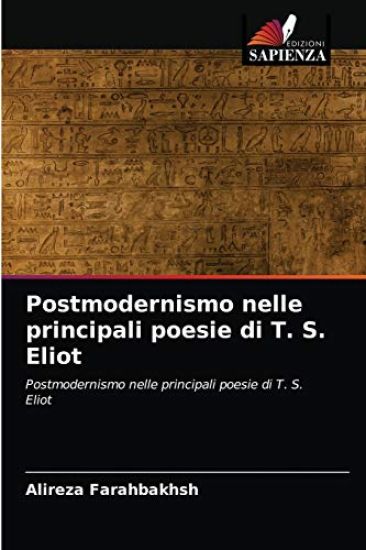
En tant que l'un des hommes de lettres les plus influents du XXe si cle, Thomas Stearns Eliot a impressionn diff rentes g n rations de lecteurs et stimul une quantit substantielle d'analyse critique. La r ception g n rale et historique d'Eliot a t en termes d'attachement au symbolisme, l'imagisme, la po sie m taphysique, au classicisme, au mysticisme et au modernisme fran ais. En tant que po te, critique et dramaturge, Eliot a t salu comme l'un des fondateurs de New Criticism et l'un des meilleurs repr sentants de l' criture moderniste, qui pr sentent tous deux des contrastes radicaux avec l'esth tique postmoderne. Cependant, les grands crivains peuvent tre relus la lumi re de nouvelles th ories critiques et philosophiques, et un po te du calibre d'Eliot ne fait pas exception. Ce livre explore les similitudes et les diff rences entre l' criture postmoderne, th oris e par des auteurs tels que Michel Foucault, Jacque Derrida, Jacque Lacan, Roland Barthes et Paul de Man, et les principaux po mes d'Eliot, dont La chanson d'amour de J. Alfred Prufrock, Geronion, The Waste Land, The Hollow Men, Journey of the Magi, Ash Wednesday et Four Quartets .
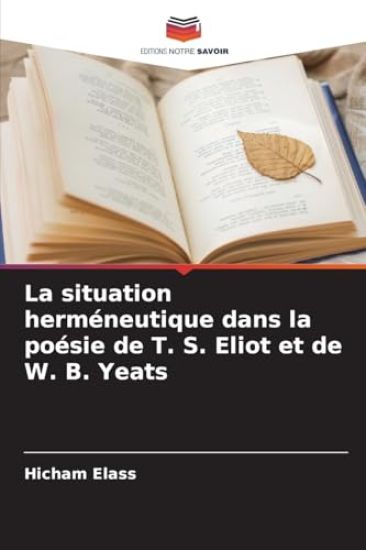
Cette tude, compos e de trois chapitres, s'inscrit dans le cadre de l'herm neutique philosophique du philosophe allemand Hans-Georg Gadamer, en se concentrant plus particuli rement sur la primaut de la situation herm neutique dans la compr hension de la po sie de Thomas Stearns Eliot et de William Butler Yeats.L'enqu te men e tout au long des trois chapitres r v le qu'Eliot et Yeats proposent tous deux une approche qui peut tre exp riment e dans l'herm neutique philosophique de Gadamer. Dans un sens, il existe une affinit entre l'herm neutique de Gadamer et la po tique d'Eliot et de Yeats. Cette affinit est ce qui contribue substantiellement la r alisation d'une compr hension herm neutique significative de la po sie authentique d'Eliot et de Yeats; une po sie qui parle plus puissamment la situation herm neutique actuelle et pointe vers des aspects de notre r alit d'une mani re pertinente. Cela est d son pouvoir dialogique inh rent, obtenu gr ce l'utilisation d lib r e par Eliot et Yeats de la musique, du symbolisme, de la po sie impersonnelle et du mythe. Gadamer fait l' loge de cette po sie dialogique, dans la mesure o elle facilite la r v lation de v rit s possibles. Cette dition, dans son ensemble, est une lecture revigorante pour tous les bibliophiles.
Questo studio, composto da tre capitoli, opera nell'ambito dell'Ermeneutica filosofica del filosofo tedesco Hans-Georg Gadamer, concentrandosi in particolare sul primato della situazione ermeneutica nella comprensione della poesia di Thomas Stearns Eliot e William Butler Yeats. L'indagine condotta nei tre capitoli rivela che sia Eliot che Yeats propongono un approccio che pu essere sperimentato nell'Ermeneutica filosofica di Gadamer. In un certo senso, esiste un'affinit tra l'ermeneutica di Gadamer e la poetica di Eliot e Yeats, affinit che contribuisce in modo sostanziale alla realizzazione di una comprensione ermeneutica significativa della poesia autentica di Eliot e Yeats, una poesia che parla in modo pi incisivo alla situazione ermeneutica attuale e indica aspetti della nostra realt in modo rilevante. Ci dovuto al suo intrinseco potere dialogico, ottenuto grazie all'uso deliberato della musica, del simbolismo, della poesia impersonale e del mito da parte di Eliot e Yeats. Questa poesia dialogica molto apprezzata da Gadamer, in quanto ci che facilita la rivelazione di possibili verit . Questa edizione, nel suo complesso, una lettura stimolante per tutti i bibliofili.