Kirjahaku
Etsi kirjoja tekijän nimen, kirjan nimen tai ISBN:n perusteella.
1000 tulosta hakusanalla John Locke
This book has been considered by academicians and scholars of great significance and value to literature. This forms a part of the knowledge base for future generations. So that the book is never forgotten we have represented this book in a print format as the same form as it was originally first published. Hence any marks or annotations seen are left intentionally to preserve its true nature.
This is a reproduction of the original artefact. Generally these books are created from careful scans of the original. This allows us to preserve the book accurately and present it in the way the author intended. Since the original versions are generally quite old, there may occasionally be certain imperfections within these reproductions. We're happy to make these classics available again for future generations to enjoy
The reasonableness of Christianity as delivered in the Scriptures
John Locke
Alpha Edition
2020
pokkari
This book has been considered by academicians and scholars of great significance and value to literature. This forms a part of the knowledge base for future generations. So that the book is never forgotten we have represented this book in a print format as the same form as it was originally first published. Hence any marks or annotations seen are left intentionally to preserve its true nature.
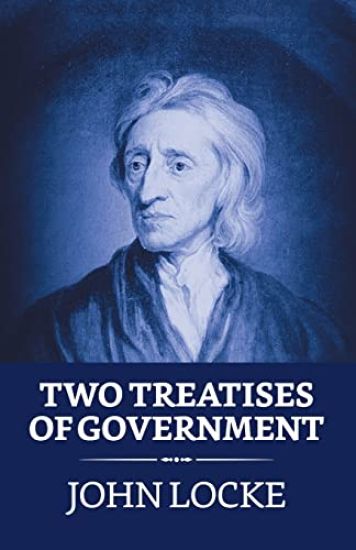
John Locke (1632-1704) is among the most influential political philosophers of the modern period. In the Two Treatises of Government, he defended the claim that men are by nature free and equal against claims that God had made all people naturally subject to a monarch. The Second Treatise consists of a short preface and nineteen chapters. In chapter i, Locke defines political power as the right to make laws for the protection and regulation of property. In his view, these laws only work because the people accept them and because they are for the public good. The Treatises were written with this specific aim--to defend the Glorious Revolution. Locke also sought to refute the pro-Absolutist theories of Sir Robert Filmer, which he and his Whig associates felt were getting far too popular.
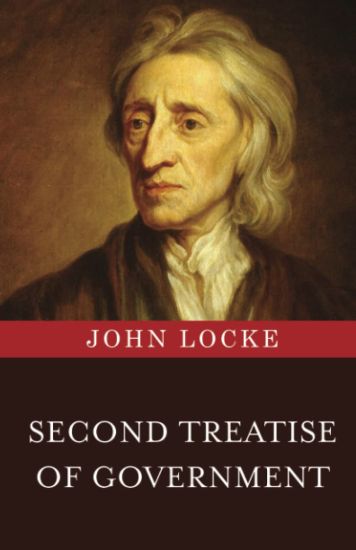
The Second Treatise of Government is one of the most important political treatises ever written. The principles of individual liberty, the rule of law, government by consent of the people, and the right to private property are taken for granted as fundamental to the human condition now. Most liberal theorists writing today look back to Locke as the source of their ideas. Some maintain that religious fundamentalism, "post-modernism," and socialism are today the only remaining ideological threats to liberalism. To the extent that this is true, these ideologies are ultimately attacks on the ideas that Locke, arguably more than any other, helped to make the universal vocabulary of political discourse.
The Second Treatise of Government by John Locke is a section of the Two Treatise of Government written by the author in 1689. It is a work of political philosopy that places sovereignty into the hands of the people. Locke's fundamental argument is that people are equal and invested with natural rights in a state of nature in which they live free from outside rule. In the state of nature, natural law governs behavior, and each person has license to execute that law against someone who wrongs them by infringing on their rights. People take what they need from the earth, but hoard just enough to cover their needs. Eventually, people begin to trade their excess goods with each other, until they develop a common currency for barter, or money. Money eliminates limits on the amount of property they can obtain (unlike food, money does not spoil), and they begin to gather estates around themselves and their families. People then exchange some of their natural rights to enter into society with other people, and be protected by common laws and a common executive power to enforce the laws. People need executive power to protect their property and defend their liberty. The civil state is beholden to the people, and has power over the people only insofar as it exists to protect and preserve their welfare. Locke describes a state with a separate judicial, legislative, and executive branch, he legislative branch being the most important of the three, since it determines the laws that govern civil society.
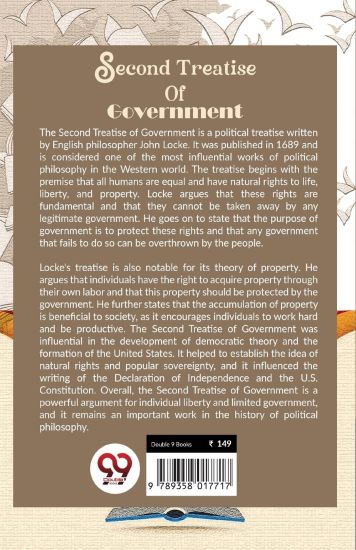
The Second Treatise of Government is a political treatise written by English philosopher John Locke. It was published in 1689 and is considered one of the most influential works of political philosophy in the Western world. The treatise begins with the premise that all humans are equal and have natural rights to life, liberty, and property. Locke argues that these rights are fundamental and that they cannot be taken away by any legitimate government. He goes on to state that the purpose of government is to protect these rights and that any government that fails to do so can be overthrown by the people. Locke's treatise is also notable for its theory of property. He argues that individuals have the right to acquire property through their own labor and that this property should be protected by the government. He further states that the accumulation of property is beneficial to society, as it encourages individuals to work hard and be productive. The Second Treatise of Government was influential in the development of democratic theory and the formation of the United States. It helped to establish the idea of natural rights and popular sovereignty, and it influenced the writing of the Declaration of Independence and the U.S. Constitution. Overall, the Second Treatise of Government is a powerful argument for individual liberty and limited government, and it remains an important work in the history of political philosophy.

An Essay Concerning Human Understanding-Volume 1' is a groundbreaking work by John Locke that explores the nature of human knowledge and understanding. In the book's first volume, Locke argues that the human mind is like a blank slate, or "tabula rasa," at birth and that all knowledge is acquired through experience and observation. Locke delves into the mechanics of human perception and cognition, exploring the ways in which we acquire knowledge and form beliefs about the world around us. He argues that all knowledge is ultimately derived from sensory experience and that our understanding of the world is shaped by the way our minds process and interpret this sensory input. Throughout the book, Locke provides a rigorous and detailed analysis of the workings of the human mind, examining everything from the nature of ideas and concepts to the role of language and communication in shaping our understanding of the world. 'An Essay Concerning Human Understanding' is a foundational work in the field of philosophy, and continues to be studied and debated by scholars to this day.
Limborch's edition and Popple's translation, as on whether it is true that Popple translated the Epistola into English 'a l'insu de Mr Locke', and consequently whether Locke was right or wrong in saying that the translation was made 'without my privity'. Long research into documents hitherto unpublished, or little known, or badly used, has persuaded me that Locke not only knew that Popple had undertaken to translate the Gouda Latin text, but also that Locke followed Popple's work very closely, and even that the second English edition of 1690 was edited by Locke himself. In these circumstances it does not seem possible to speak of an original text, that in Latin, and an English translation; rather they are two different versions of Locke's thoughts on Toleration. The accusations of unreliability levelled at Popple therefore fall to the ground, and the Latin and English texts acquire equal rights to our trust, since they both deserve the same place among Locke's works. Consequently the expression 'without my privity', which a number of people had seen as revealing an innate weakness in Locke's moral character, reacquires its precise meaning: testifying to Locke's profound modesty and integrity.
In this, the second of his Two Treatises of Government, John Locke examines humankind's transition from its original state of nature to a civil society. According to Locke, legitimate government arises to enforce the natural law and the property rights of individuals; when a government fails to do this, or attempts to exert powers beyond those granted by the people, revolution is justified. One can see the lasting influence of Locke's ideas through their familiarity to the modern reader - the roots of classical liberalism are here, and the arguments presented in this text have relevance to any modern student of political theory. The introduction and annotations included in this edition are intended to contextualize the work and prevent misunderstanding, without advancing any particular scholarly interpretation or merely summarizing Locke's arguments. This edition has its origin in the acclaimed Broadview Anthology of Social and Political Thought and adheres to the anthology's format and high standards of accuracy and accessibility.
The Second Treatise of Government and A Letter Concerning Toleration
John Locke
GD Media
2025
pokkari

Large Print - Second Treatise Of Government - Grand Type Collector's Edition - Matte Hardcover with Dust Jacket
John Locke
Grand Type Classics
2025
sidottu