Kirjojen hintavertailu. Mukana 11 699 587 kirjaa ja 12 kauppaa.

Kirjahaku

Etsi kirjoja tekijän nimen, kirjan nimen tai ISBN:n perusteella.

1000 tulosta hakusanalla Kenneth Copeland

Landscape, Nature and the Body Politic

Landscape, Nature and the Body Politic

Kenneth Olwig; Yi-fu Tuan

University of Wisconsin Press
2002
sidottu
Landscape, Nature, and the Body Politic explores the origins and lasting influences of two contesting but intertwined discourses that persist today when we use the words landscape, country, scenery, nature, national. In the first sense, the land is a physical and bounded body of terrain upon which the nation state is constructed (e.g., the purple mountain majesties above the fruited plain, from sea to shining sea). In the second, the country is constituted through its people and established through time and precedence (e.g., land where our fathers died, land of the Pilgrims' pride). Kenneth Olwig's extended exploration of these discourses is a masterful work of scholarship both broad and deep, which opens up new avenues of thinking in the areas of geography, literature, theater, history, political science, law, and environmental studies. Olwig tracks these ideas though Anglo-American history, starting with seventeenth-century conflicts between the Stuart kings and the English Parliament, and the Stuart dream of uniting Scotland with England and Wales into one nation on the island of Britain. He uses a royal production of a Ben Jonson masque, with stage sets by architect Inigo Jones, as a touchstone for exploring how the notion of ""landscape"" expands from artful stage scenery to a geopolitical ideal. Olwig pursues these contested concepts of the body politic from Europe to America and to global politics, illuminating a host of topics, from national parks and environmental planning to theories of polity and virulent nationalistic movements.
Landscape, Nature and the Body Politic

Landscape, Nature and the Body Politic

Kenneth Olwig; Yi-fu Tuan

University of Wisconsin Press
2002
nidottu
Landscape, Nature, and the Body Politic explores the origins and lasting influences of two contesting but intertwined discourses that persist today when we use the words landscape, country, scenery, nature, national. In the first sense, the land is a physical and bounded body of terrain upon which the nation state is constructed (e.g., the purple mountain majesties above the fruited plain, from sea to shining sea). In the second, the country is constituted through its people and established through time and precedence (e.g., land where our fathers died, land of the Pilgrims' pride). Kenneth Olwig's extended exploration of these discourses is a masterful work of scholarship both broad and deep, which opens up new avenues of thinking in the areas of geography, literature, theater, history, political science, law, and environmental studies. Olwig tracks these ideas though Anglo-American history, starting with seventeenth-century conflicts between the Stuart kings and the English Parliament, and the Stuart dream of uniting Scotland with England and Wales into one nation on the island of Britain. He uses a royal production of a Ben Jonson masque, with stage sets by architect Inigo Jones, as a touchstone for exploring how the notion of ""landscape"" expands from artful stage scenery to a geopolitical ideal. Olwig pursues these contested concepts of the body politic from Europe to America and to global politics, illuminating a host of topics, from national parks and environmental planning to theories of polity and virulent nationalistic movements.

Defending White Collar Crime

Defending White Collar Crime

Kenneth Mann

Yale University Press
1988
pokkari
The first inside look at how the elite white-collar crime defense bar goes about its work. Mann's book reveals that these lawyers see their main task as controlling information about their clients, especially the flow of harmful information to government investigators. As both lawyer and sociologist, Mann was able to gain access only rarely available to scholars. His book raises important questions for the bar and for the administration of justice. "A pioneering study. . . . This is a splendid book. I think it is destined to become the classic study of the white-collar crime defense bar." —George C. Kiser, Social Science Quarterly "An excellent introduction to white-collar criminal defense for practitioners, law students, and potential clients. . . . I would make this book required reading for all prosecutors."—Lawrence B. Pedowitz, former federal prosecutor, Legal Times of New York "Analytical, detailed, well illustrated, and an authoritative portrait of American white-collar crime attorneys at work."—M. David Ermann, Contemporary Sociology "Sheds light on some of the most fundamental ethical questions that can arise in law practice. For this reason, [Mann's] book is not only a significant contribution to the sociology of the legal profession, but a sociological study with special value for lawyers."—Ted Schneyer, American Bar Foundation Research Journal
Belonging to America

Belonging to America

Kenneth L. Karst

Yale University Press
1991
pokkari
Who are the real citizens of America? Which people truly qualify for equality under the law? Two hundred years ago, an honest answer to these questions would have excluded not only women, slaves, and Indians, but also Germans, Scotch-Irish, Catholics, and Jews. Yet the Declaration of Independence expresses a profound commitment to the ideal of equal citizenship. Throughout their history Americans have simultaneously believed in equality and accepted the subordination of groups of people—and both views have been reflected in American law. In this lively and original book, a leading constitutional law scholar shows how American law has both reflected and defined what it means to be an American, to "belong to America." Kenneth L. Karst shows that the ideal of equal citizenship has long been a vital part of the culture of American public life, and he tells a powerful story about how the idea of equality has developed in America, providing examples from throughout American history, from Dred Scott to Brown vs. Board of Education, from affirmative action to gender discrimination, and from the treatment of American Indians to the status of Christianity. Karst explores the psychological impact of discrimination on those who have been its victims—who, in one way or another, have been told by society that they do not belong. And he argues that the principle of equal citizenship can and should guide the nation's future just as it has shaped its past.
Law's Promise, Law's Expression

Law's Promise, Law's Expression

Kenneth L. Karst

Yale University Press
1995
pokkari
The conservative "social issues agenda" is targeted to voters who have felt left out, even threatened, by the successes of the civil rights movement, the women's movement, and the gay rights movement. The agenda centers on the expressive capacities of law and promises a cultural counterrevolution. It evokes visions of an earlier social order in which most citizens who were black or female or gay stayed "in their place"—and the place was a subordinate one. In this lively and provocative book, a constitutional law scholar argues eloquently that most of the social issues agenda for law violates the constitutional principle of equal citizenship.Kenneth Karst, author of the prize-winning Belonging to America: Equal Citizenship and the Constitution, discusses a broad range of controversial issues, from street crime to pornography, from school prayers to sodomy, from abortion to welfare to the participation of women and gays in the armed forces. In most of these areas of law the social issues agenda sounds a persistent theme: an ideology of masculinity that treats power as its own justification and equates the proof of manhood with the expression of dominance. Translating this ideology into law raises grave constitutional questions. In the social-issues contexts of race, gender, sexuality, and religion, Karst argues, judicial review of governmental action should focus on concerns for the full inclusion of all Americans in the national community.
The Lightning Field

The Lightning Field

Kenneth Baker

Yale University Press
2008
sidottu
A profoundly timely and moving personal essay by one of America’s leading art critics Walter De Maria's Lightning Field (1977) is one of the 20th century's most significant works of art. Situated in a remote area of desert in southwestern New Mexico, it comprises 400 polished, stainless-steel poles (spaced 220 feet apart) installed in a grid measuring one mile by one kilometer. A sculpture to be explored on foot, The Lightning Field is intended to be experienced over an extended period of time. Critic Kenneth Baker visited The Lightning Field numerous times over the course of the past 30 years in order to write this text. Inspired and challenged by this remarkable artwork, Baker speculates on the course of our contemporary human condition. But, rather than building on ideas in narrative sequence, he deploys quotation to effect multiple perspectives and points of view. Baker's citations and elegantly crafted prose are arrayed––in a metaphorical parallel to De Maria's choreographing of the vast landscape of the American Southwest––to create a compelling text.
American Christmas Cards 1900-1960

American Christmas Cards 1900-1960

Kenneth L. Ames

Yale University Press
2011
pokkari
The power of Christmas derives from the appeal of its repeated rituals, the presumed antiquity of its traditions, and its ability to adapt to changing cultural conditions. Christmas cards seemed inevitable and ubiquitous, but in recent years the genre has been visibly in decline. It is now evident that the Christmas card was a culturally specific artifact, a distinctive way in which a fundamental human gesture could be expressed within a commercial, materialistic, and rapidly changing society. This stylish book explores the imagery, graphic forms, subject matter, and significance of Christmas cards in their chronological timeframe to reveal an important area of American material culture. There is much to surprise and delight.Distributed for the Bard Graduate CenterExhibition Schedule:Bard Graduate Center(09/28/11-12/30/11)
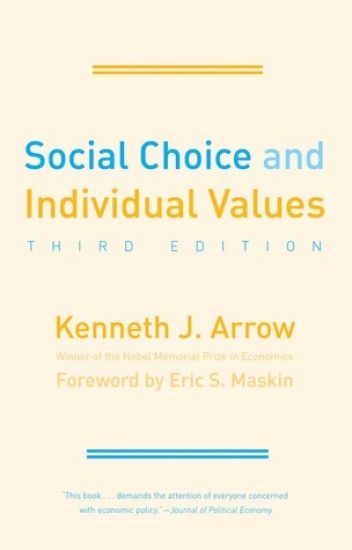
Social Choice and Individual Values

Social Choice and Individual Values

Kenneth J. Arrow; Eric S. Maskin

Yale University Press
2012
pokkari
Originally published in 1951, Social Choice and Individual Values introduced “Arrow’s Impossibility Theorem” and founded the field of social choice theory in economics and political science. This new edition, including a new foreword by Nobel laureate Eric Maskin, reintroduces Arrow’s seminal book to a new generation of students and researchers."Far beyond a classic, this small book unleashed the ongoing explosion of interest in social choice and voting theory. A half-century later, the book remains full of profound insight: its central message, ‘Arrow’s Theorem,’ has changed the way we think.”—Donald G. Saari, author of Decisions and Elections: Explaining the Unexpected
The Jews and the Reformation

The Jews and the Reformation

Kenneth Austin

Yale University Press
2020
sidottu
The first comprehensive account of Protestant and Catholic attitudes toward Jews and Judaism in the European Reformation"Austin’s examination of Christian attitudes to Jews during the Reformation throws fascinating new light on the turbulent history of early modern Europe."—Tony Barber, Financial Times "Best Books of 2020: History" ?In this rich, wide-ranging, and meticulously researched account, Kenneth Austin examines the attitudes of various Christian groups in the Protestant and Catholic Reformations towards Jews, the Hebrew language, and Jewish learning. Martin Luther’s writings are notorious, but Reformation attitudes were much more varied and nuanced than these might lead us to believe. This book has much to tell us about the Reformation and its priorities—and has important implications for how we think about religious pluralism more broadly.
Frederic Church

Frederic Church

Kenneth John Myers; Kevin J. Avery; Gerald L. Carr; Mercedes Volait

Yale University Press
2017
pokkari
A beautiful overview of fascinating paintings of the classical world and the Holy Land by a beloved American artist Frederic Church (1826–1900), one of the leading painters of 19th-century America and the Hudson River School, also journeyed around the globe to find fresh inspiration for his highly detailed compositions. Among Church’s lesser-known masterpieces are his paintings of the Middle East, Italy, and Greece, produced in the late 1860s through late 1870s, which explore themes of human history and achievement. Taking a closer look at this geographical and thematic shift in Church’s practice, this handsome book brings together the artist’s major paintings of Athens, Rome, Jerusalem, and the surrounding region. The essays concentrate on a set of six major paintings of architectural and archaeological marvels; one essay also spotlights Olana, Church’s home in New York State, which reflects the influence of Middle Eastern design. This impressive volume stands apart in its new approach to the artist’s work and its quest to determine why and how this quintessentially American figure was drawn to scenery and themes from the other side of the globe.Distributed for the Detroit Institute of ArtsExhibition Schedule:Detroit Institute of Arts (10/22/17–01/15/18)Reynolda House Museum of American Art, Winston-Salem, NC (02/08/18–05/13/18)Wadsworth Atheneum Museum of Art, Hartford, CT (06/03/18–08/26/18)
The Other Modern Movement

The Other Modern Movement

Kenneth Frampton

Yale University Press
2021
sidottu
A revealing new look at modernist architecture, emphasizing its diversity, complexity, and broad inventiveness “[Frampton] remains a formidable force in architecture . . . The Other Modern Movement offers an opportunity to re-examine the Western canon of 20th-century architecture—which Frampton himself was crucial in establishing—and delve deeper into the work of lesser-known practitioners.”—Josephine Minutillo, Architectural Record Usually associated with Mies and Le Corbusier, the Modern Movement was instrumental in advancing new technologies of construction in architecture, including the use of glass, steel, and reinforced concrete. Renowned historian Kenneth Frampton offers a bold look at this crucial period, focusing on architects less commonly associated with the movement in order to reveal the breadth and complexity of architectural modernism. The Other Modern Movement profiles nineteen architects, each of whom consciously contributed to the evolution of a new architectural typology through a key work realized between 1922 and 1962. Frampton’s account offers new insights into iconic buildings like Eileen Gray’s E-1027 House in France and Richard Neutra’s Kaufmann House in Palm Springs, California, as well as lesser-known works such as Antonin Raymond’s Tokyo Golf Club and Alejandro de la Sota’s Maravillas School Gymnasium in Madrid. Foregrounding the ways that these diverse projects employed progressive models, advanced new methods in construction techniques, and displayed a new sociocultural awareness, Frampton shines a light on the rich legacy of the Modern Movement and the enduring potential of the unfinished modernist project.
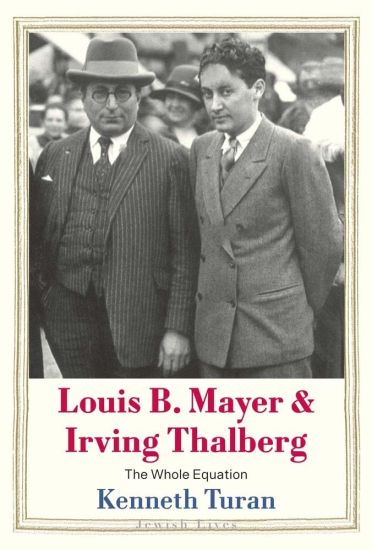
Louis B. Mayer and Irving Thalberg

Louis B. Mayer and Irving Thalberg

Kenneth Turan

YALE UNIVERSITY PRESS
2025
sidottu
Kenneth Turan brings to life the extraordinary partnership of Louis B. Mayer and Irving Thalberg and their role in creating the film industry as we know it “Sharply observant.”—Farran Smith Nehme, Wall Street Journal One was a tough junkman’s son, the other a cosseted mama’s boy, but they dreamed the same mighty dream: that the right movies could make a profit and change both the culture and individual lives. Sharing a religion and an evangelical zeal for film, Louis B. Mayer (1884–1957) and Irving Thalberg (1899–1936) were unlikely partners in one of the most significant collaborations in movie history. Over the course of their decade-long relationship, as key players at Metro-Goldwyn-Mayer and major players in Hollywood, they joined forces in redefining and mastering the template for the film industry. Mayer, older by more than a dozen years, was the business-minded face of the studio, while Thalberg worked closely with the creative corps, especially writers; together they rarely set a foot wrong. And while Mayer initially viewed Thalberg as the son he never had, the two would go from passionate friends to near enemies before Thalberg’s shocking death at the age of thirty-seven. In the first joint biography of the two men in fifty years, film critic Kenneth Turan traces their fraught relationship while examining the complicated history of Jewish identity in Hollywood.
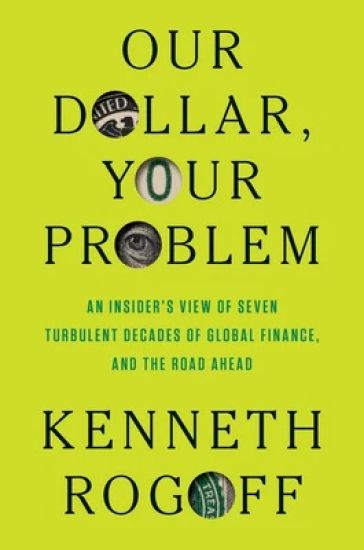
Our Dollar, Your Problem

Our Dollar, Your Problem

Kenneth Rogoff

YALE UNIVERSITY PRESS
2025
sidottu
A National Bestseller • Recommended by Financial Times as “What to Read in 2025” “The central argument of Our Dollar, Your Problem—that the greenback’s pre-eminence was never guaranteed and might plausibly be overturned—could hardly be more timely.”—The Economist A leading economist explores the global rise of the U.S. dollar and shows why its future stability is far from assured Our Dollar, Your Problem argues that America’s currency might not have reached today’s lofty pinnacle without a certain amount of good luck. Drawing in part on his own experiences, including with policymakers and world leaders, Kenneth Rogoff animates the remarkable postwar run of the dollar—how it beat out the Japanese yen, the Soviet ruble, and the euro—and the challenges it faces today from crypto and the Chinese yuan, the end of reliably low inflation and interest rates, political instability, and the fracturing of the dollar bloc. Americans cannot take for granted that the Pax Dollar era will last indefinitely, not only because many countries are deeply frustrated with the system, but also because overconfidence and arrogance can lead to unforced errors. Rogoff shows how America’s outsized power and exorbitant privilege can spur financial instability—not just abroad but also at home.
Our Dollar, Your Problem: An Insider's View of Seven Turbulent Decades of Global Finance, and the Road Ahead
A National Bestseller - Recommended by Financial Times as "What to Read in 2025" "The central argument of Our Dollar, Your Problem--that the greenback's pre-eminence was never guaranteed and might plausibly be overturned--could hardly be more timely."--The Economist A leading economist explores the global rise of the U.S. dollar and shows why its future stability is far from assured Our Dollar, Your Problem argues that America's currency might not have reached today's lofty pinnacle without a certain amount of good luck. Drawing in part on his own experiences, including with policymakers and world leaders, Kenneth Rogoff animates the remarkable postwar run of the dollar--how it beat out the Japanese yen, the Soviet ruble, and the euro--and the challenges it faces today from crypto and the Chinese yuan, the end of reliably low inflation and interest rates, political instability, and the fracturing of the dollar bloc. Americans cannot take for granted that the Pax Dollar era will last indefinitely, not only because many countries are deeply frustrated with the system, but also because overconfidence and arrogance can lead to unforced errors. Rogoff shows how America's outsized power and exorbitant privilege can spur financial instability--not just abroad but also at home.
Louis B. Mayer and Irving Thalberg: The Whole Equation
Kenneth Turan brings to life the extraordinary partnership of Louis B. Mayer and Irving Thalberg and their role in creating the film industry as we know it "Sharply observant."--Farran Smith Nehme, Wall Street Journal A New Yorker Best Book of the Year One was a tough junkman's son, the other a cosseted mama's boy, but they dreamed the same mighty dream: that the right movies could make a profit and change both the culture and individual lives. Sharing a religion and an evangelical zeal for film, Louis B. Mayer (1884-1957) and Irving Thalberg (1899-1936) were unlikely partners in one of the most significant collaborations in movie history. Over the course of their decade-long relationship, as key players at Metro-Goldwyn-Mayer and major players in Hollywood, they joined forces in redefining and mastering the template for the film industry. Mayer, older by more than a dozen years, was the business-minded face of the studio, while Thalberg worked closely with the creative corps, especially writers; together they rarely set a foot wrong. And while Mayer initially viewed Thalberg as the son he never had, the two would go from passionate friends to near enemies before Thalberg's shocking death at the age of thirty-seven. In the first joint biography of the two men in fifty years, film critic Kenneth Turan traces their fraught relationship while examining the complicated history of Jewish identity in Hollywood.
Foundations of Business Telecommunications Management

Foundations of Business Telecommunications Management

Kenneth C. Grover

Kluwer Academic/Plenum Publishers
1986
nidottu
lnfonnation technology is about more than computers. Thus, it was a recurring-and rather infuriating-aspect of the early discussions on infonnation technology that those who participated tended either to ignore or to severely understate the role in infonnation technology of telecommunications. This very fine book by Ken Grover goes a long way toward correcting that misconception. However important the computer and computer-based equipment might be, the role of telecommunications equip­ ment has also been and continues to be significant. Moreover, as the author brings out, it is going to be even more important. As this enthralling story unfolds the reader will find him or herself continually remarking that there cannot be more-but again and again, there is. Those who are already of the world of telecommunications will, on reading this work, be proud of their colleague. Those who are already of the world of computers will learn a great deal and, it is to be hoped, will in future be fairer toward telecommunications than they have been in the past. Those who are new to the world of information technology will sally forth better balanced than most.
The Emerging Consensus in Social Systems Theory

The Emerging Consensus in Social Systems Theory

Kenneth C. Bausch

Kluwer Academic/Plenum Publishers
2001
sidottu
In The Emerging Consensus of Social Systems Theory Bausch summarizes the works of over 30 major systemic theorists. He then goes on to show the converging areas of consensus among these out-standing thinkers. Bausch categorizes the social aspects of current systemic thinking as falling into five broadly thematic areas: designing social systems, the structure of the social world, communication, cognition and epistemology. These five areas are foundational for a theoretic and practical systemic synthesis. They were topics of contention in a historic debate between Habermas and Luhmann in the early 1970's. They continue to be contentious topics within the study of social philosophy. Since the 1970's, systemic thinking has taken great strides in the areas of mathematics, physics, biology, psychology, and sociology. This book presents a spectrum of those theoretical advances. It synthesizes what various strains of contemporary systems science have to say about social processes and assesses the quality of the resulting integrated explanations. Bausch gives a detailed study of the works of many present-day systems theorists, both in general terms, and with regard to social processes. He then creates and validates integrated representations of their thoughts with respect to his own thematic classifications. He provides a background of systemic thinking from an historical context, as well as detailed studies of developments in sociological, cognitive and evolutionary theory. This book presents a coherent, dynamic model of a self-organizing world. It proposes a creative and ethical method of decision-making and design. It makes explicit the relations between structure and process in the realms of knowledge and being. The new methodology that evolves in this book allows us to deal with enormous complexity, and to relate ideas so as to draw out previously unsuspected conclusions and syntheses. Therein lies the elegance and utility of this model.
Technology, Science Teaching, and Literacy

Technology, Science Teaching, and Literacy

Kenneth P. King

Kluwer Academic/Plenum Publishers
2001
nidottu
This book deals with the use of technology in science teaching. The author is not, nor has ever had an intention of being a “techie. ” Rather, I spent the first decade of my professional life as a high school physics teacher, making occasional uses of technology to further student understanding and to automate my own teaching practices. During my graduate work, my interest in the use of technology continued. Catalyzed, to some extent by the increasing availability of graphical interfaces for computers, the realization struck that the computer was more and more becoming a tool that all teachers could use to support their teaching practice—not simply those with a passion for the technology itself. The rapid changes in the hardware and software available, however, frequently caused me to reflect on the usefulness of technology—if it were to change at such a rapid pace, would anyone, save for those who diligently focused on the development of these tools, be able to effectively use technology in science teaching? Was change to rapid to yield a useful tool for teachers? To address this interest, I examined the nature of science teaching during this century—using the equally fluid notion of “scientific literacy”—which formed the organizing principle for this study. The result is a examination of how technology was used to accomplishing this goal of producing scientifically literate citizens. What was observed is that technology, indeed, consistently came to the service of teachers as they attempted to achieve this goal.
Kandinsky

Kandinsky

Kenneth Lindsay; Peter Vergo

Da Capo Press Inc
1994
pokkari
Of all the giants of twentieth-century art, Wassily Kandinsky (1866-1944) was the most prolific writer. Here, available for the first time in paperback, are all of Kandinsky's writings on art, newly translated into English. Editors Kenneth C. Lindsay and Peter Vergo have taken their translations directly from Kandinsky's original texts, and have included select interviews, lecture notes, and newly discovered items along with his more formal writings. The pieces range from one-page essays to the book-length treatises On the Spiritual in Art (1911) and Point and Line to Plane (1926), and are arranged in chronological order from 1901 to 1943. The poetry, good enough to stand on its literary merits, is presented with all the original accompanying illustrations. And the book's design follows Kandinsky's intentions, preserving the spirit of the original typography and layout.Kandinsky was nearly thirty before he bravely gave up an academic career in law for his true passion, painting. Though his art was marked by extraordinarily varied styles, Kandinsky sought a pure art throughout, one which would express the soul, or "inner necessity," of the artist. His uncompromising search for an art which would elicit a response to itself rather than to the object depicted resulted in the birth of nonobjective art,and in these writings, Kandinsky offered the first cogent explanation of his aims. His language was characterized by its desire for vivification, of the infusion of life into mundane things.Considered as a whole, Kandinsky's writings exceed all expectations of what an artist should accomplish with words. Not only do his ideas and observations make us rethink the nature of art and the way it reflects the aspirations of his era, but they touch on matters vital to the situation of the human soul.
Nazi Plunder

Nazi Plunder

Kenneth Alford

Da Capo Press Inc
2003
pokkari
World War II was the most devastating conflict in human history, but the tragedy did not end on the battlefields. During the war, Germany- and, later, the Allies- plundered Europe's historic treasures. Between 1939 and 1945, German armed forces roamed from Dunkirk to Stalingrad, looting gold, silver, currency, paintings and other works of art, coins, religious artifacts, and millions of books and other documents. The value of these items, many of which were irreplaceable, is estimated in the billions of dollars. The artwork alone, looted under Hitler's direction, exceeded the combined collections of the Metropolitan Museum, the British Museum, and the Louvre. As the war wound to its conclusion in 1945, occupying forces continued the looting. The story of these celebrated works of art and other vanished treasures- and the mystery of where they went- is a remarkable tale of greed, fraud, deceit, and treachery. Kenneth Alford's Nazi Plunder is the latest word on this fascinating subject.