
Kirjahaku
Etsi kirjoja tekijän nimen, kirjan nimen tai ISBN:n perusteella.
1000 tulosta hakusanalla Levin J. Allen

This study examines the arguments that the democratic movement has had to overcome. A history of franchise extension in the USA, France, Germany and the United Kingdom provides the context for examining the attitudes to democracy of John Adams, de Tocqueville, Hegel and Carlyle.

The book views the 'hungry forties' through the writings of the conservative Thomas Carlyle, the liberal John Stuart Mill and the socialist Friedrich Engels. It is unsurprising that one of the most fraught decades of modern British history produced socio-political literature of such interest and intensity. The rapid growth of industrial cities, the emergence of working-class organizations and rising middle class power as well as revolutions abroad in 1848 made this a tumultuous time. These writers provide extensive, diverse and high quality reflections on the tensions produced in this key period of transition to an industrial, democratic society.

First published in in 1976, Hermann Levin Goldschmidt’s Contradiction Set Free, (Freiheit für den Widerspruch), reflects the push to explore new forms of critical thinking that gained momentum in the decade between Theodor Adorno’s Negative Dialectics of 1966 and Paul Feyerabend’s Against Method in 1975.The book articulates Goldschmidt’s reclamation of an epistemologically critical position that acknowledges the deep underlying link between the modes of production of knowledge and the social and political life they produce. In signalling a breakout from the academic rut and its repressive hold, Goldschmidt pointed beyond the ossified methods of a philosophical discourse whose oppressive consequences could no longer be ignored.Contradiction Set Free makes available for the first time in English a pivotal work by one of the great critical thinkers of the 20th century.

First published in in 1976, Hermann Levin Goldschmidt’s Contradiction Set Free, (Freiheit für den Widerspruch), reflects the push to explore new forms of critical thinking that gained momentum in the decade between Theodor Adorno’s Negative Dialectics of 1966 and Paul Feyerabend’s Against Method in 1975.The book articulates Goldschmidt’s reclamation of an epistemologically critical position that acknowledges the deep underlying link between the modes of production of knowledge and the social and political life they produce. In signalling a breakout from the academic rut and its repressive hold, Goldschmidt pointed beyond the ossified methods of a philosophical discourse whose oppressive consequences could no longer be ignored.Contradiction Set Free makes available for the first time in English a pivotal work by one of the great critical thinkers of the 20th century.

For Walter Benjamin and Gilles Deleuze, who both authored seminal theoretical works on early cinema and photography, the history of modern media begins much earlier, in Baroque culture and science. Benjamin, Deleuze and the Baroque argues that their media theories were informed by their respective readings of the philosophy and mathematics of G.W. Leibniz, and the Baroque can thus be seen as the locus of modern media. By critically comparing Benjamin and Deleuze’s interpretations of the Baroque, Levin demonstrates the extent to which their theories of visual culture are intertwined with critiques of Enlightenment historiography and politics. Using a hermeneutic comparative approach, this book argues that the juxtaposition of Benjamin’s reception of Leibniz with Deleuze’s highlights the extent to which both authors’ theories of image and media were informed by Leibniz’s concepts of expression and perspectivism, themselves inspired by ground-breaking evolutions in optics and perspective. Providing close readings of Deleuze’s The Fold and Benjamin’s Origin of the German Trauerspiel, which remain understudied in the English language, it explores how, in their dual roles of philosopher and cultural critic, the pair may illuminate our own age of multiple crises through the Baroque.

Adora is a 6 year old girl, living with her dad in Southern California. This is Adora's second book and it includes 24 fun songs for other six year olds. Adora is the inspiration for 1,000's of artists from all over the world who created original artworks based on her photos. She loves to cook on her YouTube cooking channel. She also likes to write little songs together with her dad. Follow her on www.adoralevin.com www.growababy.com www.instagram.com/adoralevin/


A compelling and revealing insight into the life of Camilla, Duchess of Cornwall, highlighting how she has grown to become one of the key members of the royal family

Kurt G del's Incompleteness Theorems sent shivers through Vienna's intellectual circles and directly challenged Ludwig Wittgenstein's dominant philosophy. Alan Turing's mathematical genius helped him break the Nazi Enigma Code during WWII. Though they never met, their lives strangely mirrored one another--both were brilliant, and both met with tragic ends. Here, a mysterious narrator intertwines these parallel lives into a double helix of genius and anguish, wonderfully capturing not only two radiant, fragile minds but also the zeitgeist of the era.
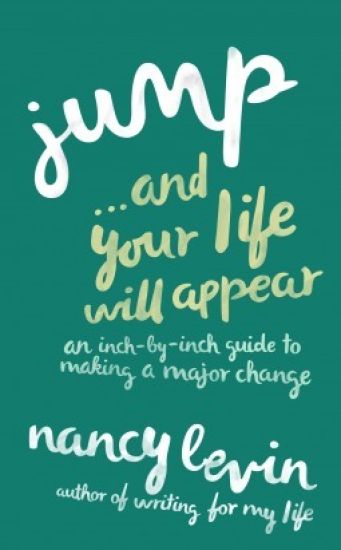
Are you ready to make changes in your life--but feel something is holding you back? Is your soul asking you to take a leap--but you're too afraid to take it? Are you ready for something new--but aren't sure where to start? If this sounds like you, the book you hold in your hands will give you the courage and faith you need to jump across the threshold from where you are--to where you want to be. Jump . . . And Your Life Will Appear is a step-by-step guide to clearing the path ahead so you can let go and make the change you need the most. With a series of effective exercises, coach and author Nancy Levin will walk you through your fear, usher you up to the moment of jumping, and help you navigate what awaits on the other side. Whether you want to switch careers, move to a different part of the world, set boundaries with someone in your life, or increase your capacity for self-love, Jump . . . And Your Life Will Appear will support you on a practical path from start to finish.
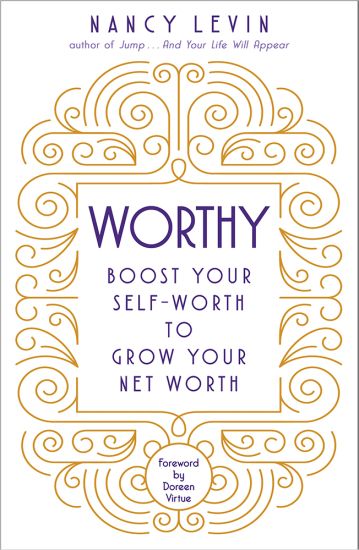
When we feel that we aren't enough, or that we aren't good enough, we also fear that we'll never have enough.Money. We love it. We hate it. If we don't have enough, we're struggling to get more. If we do have it, we're fighting to hold on to it. Why does money have to be such a source of anxiety? Is it possible to find peace? Yes According to master integrative coach Nancy Levin, the real key to creating financial freedom isn't changing what we do, it's changing our limiting beliefs about how we feel --and that requires more than just learning how to invest. In Worthy, Nancy makes an essential, eye-opening connection: the state of our net worth is a direct reflection of our self-worth. Then she shows us how to get to the root of the problem and do the internal work that's needed to replace feelings of unworthiness with a solid sense of our own value. Filled with inspiring real-life stories and thought-provoking questions and answers, her 10-step plan helps us to: - Get real about the money issues we face every day - Examine the excuses we use to avoid creating the life we really want - Be willing to see ourselves as worthy of abundance in all its forms - Take back our financial power --and watch amazing things start to happen Whether we're looking for financial ease or a new relationship with money and ourselves, Worthy will give us the tools to clear the path for wholeness, fulfillment, and richness in all areas of our lives, not just in our bank accounts.
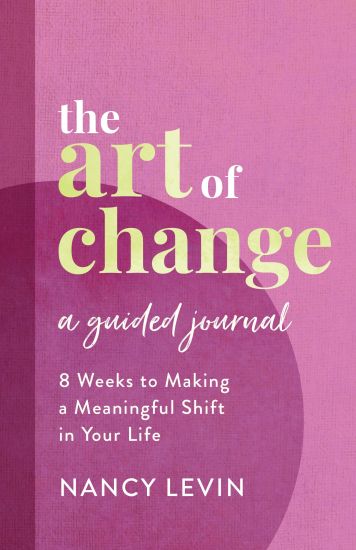
In this guided journal, master life coach Nancy Levin shows you how to tap into your desire and find the power you need to create lasting change.There's an art to making change--and it's nowhere near as hard as you think.Change begins with your commitment to your own evolution. As author and life coach Nancy Levin shares, when you practice the eight dimensions of reinvention, you can embody the art of change by consciously curating what you want to bring into your life and what you choose to release.Nancy will be with you every step of the way, coaching you through this guided journal as you move in the direction of your reinvention: a return to the essence of who you are instead of endless versions of who you think you need to be. By dissolving the obstacles in your way, you can tap into your desire and discover the power available to you for creating lasting change.Each week, you'll explore one of the eight dimensions of reinvention through bite-size, actionable daily prompts designed to take you into the heart of who you are.· Week 1: Vision: Your vision is the touchstone that determines the choices you make and the actions you take.· Week 2: Calibration: Having a powerful vision for change requires the ability to continuously assess your journey and course-correct when you need to.· Week 3: Beliefs: What ultimately holds you back is what you believe about yourself--which is why it's a good idea to dig deep and uncover any hidden beliefs.· Week 4: Self-Worth: If you believe you're not enough, you'll also believe there isn't enough or you'll never have enough. This gets shattered when you recognize that your worth is inherent.· Week 5: Boundaries: By firmly setting and holding your boundaries, you'll move out of blame and victimhood, and into responsibility and empowerment as you build a stronger relationship with yourself.· Week 6: Choice: Every choice you make either serves or sabotages you. Your present-moment choices predict your future--so if you don't make conscious choices to support your vision, your future will end up looking a lot like your past or present.· Week 7: Self-Confidence: When you shift from the need for external validation and approval, you discover a limitless source of self-confidence. And when you chip away at the personas and roles you've been taught to take on, you reclaim the incredible person who's buried beneath.· Week 8: Visibility: Visibility is all about allowing yourself to be seen in the truth of who you are. Once you own and honor visibility, you claim the courage to make the changes that will lead toward greater happiness, fulfillment, and purpose--and change becomes a natural part of your journey.Whether you're determined to shift a small habit or move massive mountains, The Art of Change will meet you where you are and take you where you want to go. This journal is for truth seekers and brave, curious souls who are ready to make a shift in a short period of time--and to become skilled practitioners in the art of change.

Embrace Your Shadow to Find Your Light: A Shadow Work Journal of Prompts, Exercises & Meditations
Nancy Levin
Hay House LLC
2024
muu
A Shadow Work Journal of Prompts, Exercises & Meditations Embark on a transformative inner-work journey into the unexplored depths of your psyche with this shadow work journal. Writing prompts, exercises, and QR-linked meditations illuminate the disowned and repressed parts of yourself, inviting you to embrace all of who you are from the darkest shadows to the brightest light. Whether you are facing life's challenges or seeking self-healing, this journal is a compass to navigate through shadow. Each entry will propel you toward heightened self-awareness as you integrate your shadow and unlock a profound sense of wholeness. This journal is rooted in the wisdom of psychoanalyst Carl Jung and modern shadow work teacher Debbie Ford. Master coach and trainer, Nancy Levin, alchemizes their principles to guide you to cast light on your own hidden aspects, revealing the reservoirs of your purpose and brilliance, so you can claim every part of yourself with love.

Difference algebra grew out of the study of algebraic difference equations with coefficients from functional fields. The first stage of this development of the theory is associated with its founder, J.F. Ritt (1893-1951), and R. Cohn, whose book Difference Algebra (1965) remained the only fundamental monograph on the subject for many years. Nowadays, difference algebra has overgrown the frame of the theory of ordinary algebraic difference equations and appears as a rich theory with applications to the study of equations in finite differences, functional equations, differential equations with delay, algebraic structures with operators, group and semigroup rings. The monograph is intended for graduate students and researchers in difference and differential algebra, commutative algebra, ring theory, and algebraic geometry. The book is self-contained; it requires no prerequisites other than the knowledge of basic algebraic concepts and a mathematical maturity of an advanced undergraduate.

Diabetes is seldom discussed in the teen arena, despite more and more young adults getting diagnosed. This book about one of the world's fastest-rising diseases both guides readers who have been diagnosed, and imparts practical information ranging from which new insulin medications are available to methods of keeping track of carbohydrates. With an authoritative and realistic voice, the author dispels common myths about diabetes and provides hope to young people living with this lifelong illness. This book is especially relevant for the teen that is at risk or recently diagnosed as it addresses topics specific to that age group, such as balancing the want for independence and the need to get help.

Focusing on Algernon Charles Swinburne's poems on Apollo, Yisrael Levin calls for a re-examination of the poet's place in Victorian studies in light of his contributions to nineteenth-century intellectual history. Swinburne's Apollonian poetry, Levin argues, shows the poet's active participation in late-Victorian debates about the nature and function of faith in an age of changing religious attitudes. Levin traces the shifts that took place in Swinburne's conception of Apollo over a period of four decades, from Swinburne's attempt to define Apollo as an alternative to the Judeo-Christian deity to Swinburne's formation of a theological system revolving around Apollo and finally to the ways in which Swinburne's view of Apollo led to his agnostic view of spirituality. Even though Swinburne had lost his faith and rejected institutional religion by his early twenties, he retained a distinct interest in spiritual issues and paid careful attention to developments in religious thought. Levin persuasively shows that Swinburne was not simply a poet provocateur who enjoyed controversy but failed to provide valid cultural commentary, but was rather a profound thinker whose insights into nineteenth-century spirituality are expressed throughout his Apollonian poetry.

The essays in this classic volume range from broad concerns with critical theory and aesthetic formulation to specific analysis of forms and texts. Levin discusses such matters as the symbolic interpretation of literature, the development of literary criticism during the past half-century, European attitudes toward contemporary American writers, and re-evaluations of Joyce, Proust, Balzac, Cervantes, Melville, and Hemingway. Because Levin is both a learned scholar and imaginative critic, there is no comparable book that offers the wit, taste, and learning one finds in these pages. His historical and comparative approaches to literary theory enable Levin to place a given work precisely by relating it to other works and manifestations of culture. World literature is not the province of this work. But Levin views it as the horizon against which our own traditions may be measured. Just as anthropologists discover similar processes working through diverse cultures, so through can we glean understanding of common patterns through the analysis of world literature, our own peculiarly specialized branch of the science of man. The effect of convention, in shaping the extent to which literature may be conceived as an institution, has been widely discussed. A Gallery of Mirrors raises theoretical questions that touch the methodology of humanistic scholarship, with regard to other disciplines, and the status of art, with regard to other modes of knowledge. With changing schools of critical thought, Levin relies considerably on semantics as a precision instrument for defining concepts in the terms of those for whom they were most meaningful.