Kirjojen hintavertailu. Mukana 11 699 587 kirjaa ja 12 kauppaa.

Kirjahaku

Etsi kirjoja tekijän nimen, kirjan nimen tai ISBN:n perusteella.

1000 tulosta hakusanalla Maria Le

The Linwoods; or, "Sixty years since" in America. By the author of "Hope Leslie," "Redwood," &c. By: Catharine Maria Sedgwick: Volume 1 (in two volume
A story of familial and national discord, conciliation, and redemption, The Linwoods is perhaps the major work of one of the leading writers of early American literature. Set during the American Revolution, Catharine Sedgwick's last historical romance addresses issues of virtuous citizenship, civic identity, and the political development of the nation. The primary narrative thread tells the story of two families: the Linwoods, who are loyalists, and the Lees, who are revolutionaries. Much of the novel narrates the transformation of the Linwood children, especially the heroine, Isabella, from Tory to Rebel. In the process, Isabella not only rebels against British control of the colonies, but challenges the institution of slavery, gender norms, and patriarchal authority. Disguise, intrigues of Rebel and Tory spies, cross-racial and cross-gender passing, as well as cases of mistaken identity not only make for a compelling read, but also foster an anti-aristocratic skepticism of surface appearances and external markers of virtue and identity that resonated with the rhetoric of Jacksonian democracy....... Catharine Maria Sedgwick (December 28, 1789 - July 31, 1867), was an American novelist of what is sometimes referred to as "domestic fiction". She promoted Republican motherhood. Early life: Catharine Maria Sedgwick was born December 28, 1789 in Stockbridge, Massachusetts. Her mother was Pamela Dwight (1752-1807) of the New England Dwight family, daughter of General Joseph Dwight (1703-1765) and granddaughter of Ephraim Williams, founder of Williams College. Her father was Theodore Sedgwick (1746-1813), a prosperous lawyer and successful politician. He was later elected Speaker of the United States House of Representatives and in 1802 was appointed a justice of the Massachusetts Supreme Judicial Court. As a child, Sedgwick was cared for by Elizabeth Freeman, a former slave whose freedom Theodore Sedgwick helped gain by arguing her case in county court in 1781. After winning her freedom Freeman declined her previous owner's job offer, and instead accepted a job working for the Sedgwick family. As a young woman, Sedgwick attended a finishing school in Boston to complete her education. One of her schoolmates, Susan Anne Ridley Sedgwick (1788-1867), would become her sister-in-law and a published author. Sedgwick was engaged at one point to Harmanus Bleecker, a friend of her father and law partner of her brother Theodore (1780-1839). They did not marry, and Sedgwick turned down several other marriage proposals, instead choosing to remain single and focus on her career. Mary Russell Mitford (16 December 1787 - 10 January 1855) was an English author and dramatist. She was born at Alresford in Hampshire. She is best known for Our Village, a series of sketches of village scenes and vividly drawn characters based upon life in Three Mile Cross, a hamlet in the parish of Shinfield, near Reading in Berkshire, where she lived.
The Linwoods; or, "Sixty years since" in America. By the author of "Hope Leslie," "Redwood," &c. By: Catharine Maria Sedgwick: Volume 2 (in two volume
A story of familial and national discord, conciliation, and redemption, The Linwoods is perhaps the major work of one of the leading writers of early American literature. Set during the American Revolution, Catharine Sedgwick's last historical romance addresses issues of virtuous citizenship, civic identity, and the political development of the nation. The primary narrative thread tells the story of two families: the Linwoods, who are loyalists, and the Lees, who are revolutionaries. Much of the novel narrates the transformation of the Linwood children, especially the heroine, Isabella, from Tory to Rebel. In the process, Isabella not only rebels against British control of the colonies, but challenges the institution of slavery, gender norms, and patriarchal authority. Disguise, intrigues of Rebel and Tory spies, cross-racial and cross-gender passing, as well as cases of mistaken identity not only make for a compelling read, but also foster an anti-aristocratic skepticism of surface appearances and external markers of virtue and identity that resonated with the rhetoric of Jacksonian democracy.... Catharine Maria Sedgwick (December 28, 1789 - July 31, 1867), was an American novelist of what is sometimes referred to as "domestic fiction". She promoted Republican motherhood. Early life: Catharine Maria Sedgwick was born December 28, 1789 in Stockbridge, Massachusetts. Her mother was Pamela Dwight (1752-1807) of the New England Dwight family, daughter of General Joseph Dwight (1703-1765) and granddaughter of Ephraim Williams, founder of Williams College. Her father was Theodore Sedgwick (1746-1813), a prosperous lawyer and successful politician. He was later elected Speaker of the United States House of Representatives and in 1802 was appointed a justice of the Massachusetts Supreme Judicial Court. As a child, Sedgwick was cared for by Elizabeth Freeman, a former slave whose freedom Theodore Sedgwick helped gain by arguing her case in county court in 1781. After winning her freedom Freeman declined her previous owner's job offer, and instead accepted a job working for the Sedgwick family. As a young woman, Sedgwick attended a finishing school in Boston to complete her education. One of her schoolmates, Susan Anne Ridley Sedgwick (1788-1867), would become her sister-in-law and a published author. Sedgwick was engaged at one point to Harmanus Bleecker, a friend of her father and law partner of her brother Theodore (1780-1839). They did not marry, and Sedgwick turned down several other marriage proposals, instead choosing to remain single and focus on her career. Mary Russell Mitford (16 December 1787 - 10 January 1855) was an English author and dramatist. She was born at Alresford in Hampshire. She is best known for Our Village, a series of sketches of village scenes and vividly drawn characters based upon life in Three Mile Cross, a hamlet in the parish of Shinfield, near Reading in Berkshire, where she lived.
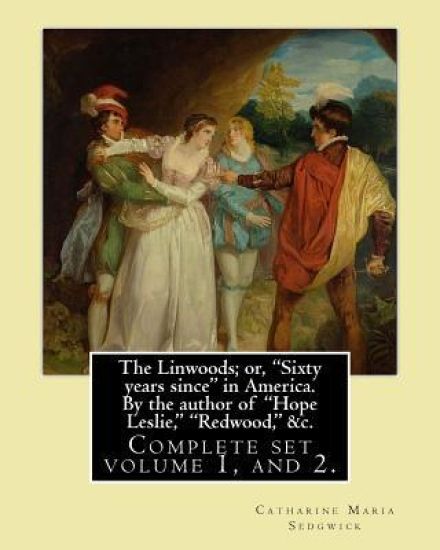
The Linwoods; or, "Sixty years since" in America. By the author of "Hope Leslie," "Redwood," &c. By: Catharine Maria Sedgwick: Complete ser volume 1,
A story of familial and national discord, conciliation, and redemption, The Linwoods is perhaps the major work of one of the leading writers of early American literature. Set during the American Revolution, Catharine Sedgwick's last historical romance addresses issues of virtuous citizenship, civic identity, and the political development of the nation. The primary narrative thread tells the story of two families: the Linwoods, who are loyalists, and the Lees, who are revolutionaries. Much of the novel narrates the transformation of the Linwood children, especially the heroine, Isabella, from Tory to Rebel. In the process, Isabella not only rebels against British control of the colonies, but challenges the institution of slavery, gender norms, and patriarchal authority. Disguise, intrigues of Rebel and Tory spies, cross-racial and cross-gender passing, as well as cases of mistaken identity not only make for a compelling read, but also foster an anti-aristocratic skepticism of surface appearances and external markers of virtue and identity that resonated with the rhetoric of Jacksonian democracy... Catharine Maria Sedgwick (December 28, 1789 - July 31, 1867), was an American novelist of what is sometimes referred to as "domestic fiction". She promoted Republican motherhood. Early life: Catharine Maria Sedgwick was born December 28, 1789 in Stockbridge, Massachusetts. Her mother was Pamela Dwight (1752-1807) of the New England Dwight family, daughter of General Joseph Dwight (1703-1765) and granddaughter of Ephraim Williams, founder of Williams College. Her father was Theodore Sedgwick (1746-1813), a prosperous lawyer and successful politician. He was later elected Speaker of the United States House of Representatives and in 1802 was appointed a justice of the Massachusetts Supreme Judicial Court. As a child, Sedgwick was cared for by Elizabeth Freeman, a former slave whose freedom Theodore Sedgwick helped gain by arguing her case in county court in 1781. After winning her freedom Freeman declined her previous owner's job offer, and instead accepted a job working for the Sedgwick family. As a young woman, Sedgwick attended a finishing school in Boston to complete her education. One of her schoolmates, Susan Anne Ridley Sedgwick (1788-1867), would become her sister-in-law and a published author. Sedgwick was engaged at one point to Harmanus Bleecker, a friend of her father and law partner of her brother Theodore (1780-1839). They did not marry, and Sedgwick turned down several other marriage proposals, instead choosing to remain single and focus on her career.............. Mary Russell Mitford (16 December 1787 - 10 January 1855) was an English author and dramatist. She was born at Alresford in Hampshire. She is best known for Our Village, a series of sketches of village scenes and vividly drawn characters based upon life in Three Mile Cross, a hamlet in the parish of Shinfield, near Reading in Berkshire, where she lived.
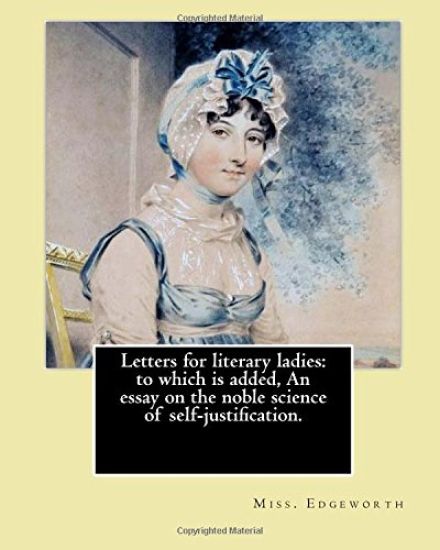
Letters for literary ladies: to which is added, An essay on the noble science of self-justification. By: Miss. Edgeworth ( Maria Edgeworth).: Maria
Maria Edgeworth (1 January 1768 - 22 May 1849) was a prolific Anglo-Irish writer of adults' and children's literature. She was one of the first realist writers in children's literature and was a significant figure in the evolution of the novel in Europe. She held advanced views, for a woman of her time, on estate management, politics and education, and corresponded with some of the leading literary and economic writers, including Sir Walter Scott and David Ricardo. Early life: Maria Edgeworth was born at Black Bourton, Oxfordshire. She was the second child of Richard Lovell Edgeworth (who eventually fathered 22 children by four wives) and Anna Maria Edgeworth; Maria was thus an aunt of Francis Ysidro Edgeworth. She spent her early years with her mother's family in England, until her mother's death when Maria was five. When her father married his second wife Honora Sneyd in 1773, she went with him to his estate, Edgeworthstown, in County Longford, Ireland. Maria was sent to Mrs. Lattafi re's school in Derby after Honora fell ill in 1775. After Honora died in 1780 Maria's father married Honora's sister Elizabeth (then socially disapproved and legally forbidden from 1833 until the Deceased Wife's Sister's Marriage Act 1907). Maria transferred to Mrs. Devis's school in London. Her father's attention became fully focused on her in 1781 when she nearly lost her sight to an eye infection. Returning home at the age of 14, she took charge of her many younger siblings and was home-tutored in law, Irish economics and politics, science, and literature by her father. She also started her lifelong correspondences with learned men, mainly members of the Lunar Society. She became her father's assistant in managing the Edgeworthstown estate, which had become run-down during the family's 1777-1782 absence; she would live and write there for the rest of her life. With their bond strengthened, Maria and her father began a lifelong academic collaboration "of which she was the more able and nimble mind." Present at Edgeworthstown was an extended family, servants and tenants. She observed and recorded the details of daily Irish life, later drawing on this experience for her novels about the Irish. She also mixed with the Anglo-Irish gentry, particularly Kitty Pakenham (later the wife of Arthur Wellesley, 1st Duke of Wellington), Lady Moira, and her aunt Margaret Ruxton of Black Castle. Margaret supplied her with the novels of Anne Radcliffe and William Godwin and encouraged her in her writing. Though Maria Edgeworth spent most of her childhood in England, her life in Ireland had a profound impact on both her thinking and views surrounding her Irish culture. Fauske and Kaufman conclude, " She] used her fiction to address the inherent problems of acts delineated by religious, national, racial, class based, sexual, and gendered identities." Edgeworth used works such Castle Rackrent and Harrington to express her feelings on controversial issues......
What You Should Know About Your Child.: Based on Lectures Delivered by Maria Montessori
This work has been selected by scholars as being culturally important and is part of the knowledge base of civilization as we know it.This work is in the public domain in the United States of America, and possibly other nations. Within the United States, you may freely copy and distribute this work, as no entity (individual or corporate) has a copyright on the body of the work.Scholars believe, and we concur, that this work is important enough to be preserved, reproduced, and made generally available to the public. To ensure a quality reading experience, this work has been proofread and republished using a format that seamlessly blends the original graphical elements with text in an easy-to-read typeface.We appreciate your support of the preservation process, and thank you for being an important part of keeping this knowledge alive and relevant.
What You Should Know About Your Child.: Based on Lectures Delivered by Maria Montessori
This work has been selected by scholars as being culturally important and is part of the knowledge base of civilization as we know it.This work is in the public domain in the United States of America, and possibly other nations. Within the United States, you may freely copy and distribute this work, as no entity (individual or corporate) has a copyright on the body of the work.Scholars believe, and we concur, that this work is important enough to be preserved, reproduced, and made generally available to the public. To ensure a quality reading experience, this work has been proofread and republished using a format that seamlessly blends the original graphical elements with text in an easy-to-read typeface.We appreciate your support of the preservation process, and thank you for being an important part of keeping this knowledge alive and relevant.
The History of Maria Kittle. By Ann Eliza Bleecker. In a Letter to Miss Ten Eyck
The 18th century was a wealth of knowledge, exploration and rapidly growing technology and expanding record-keeping made possible by advances in the printing press. In its determination to preserve the century of revolution, Gale initiated a revolution of its own: digitization of epic proportions to preserve these invaluable works in the largest archive of its kind. Now for the first time these high-quality digital copies of original 18th century manuscripts are available in print, making them highly accessible to libraries, undergraduate students, and independent scholars.Rich in titles on English life and social history, this collection spans the world as it was known to eighteenth-century historians and explorers. Titles include a wealth of travel accounts and diaries, histories of nations from throughout the world, and maps and charts of a world that was still being discovered. Students of the War of American Independence will find fascinating accounts from the British side of conflict. ++++The below data was compiled from various identification fields in the bibliographic record of this title. This data is provided as an additional tool in helping to insure edition identification: ++++Library of CongressW012713Hartford: Printed by Elisha Babcock, 1797. 70, 2] p.; 12
Two Voyages to Sierra Leone, During the Years 1791-2-3, in a Series of Letters, by Anna Maria Falconbridge. To Which is Added, a Letter From the Author, to Henry Thornton,
The 18th century was a wealth of knowledge, exploration and rapidly growing technology and expanding record-keeping made possible by advances in the printing press. In its determination to preserve the century of revolution, Gale initiated a revolution of its own: digitization of epic proportions to preserve these invaluable works in the largest archive of its kind. Now for the first time these high-quality digital copies of original 18th century manuscripts are available in print, making them highly accessible to libraries, undergraduate students, and independent scholars.Rich in titles on English life and social history, this collection spans the world as it was known to eighteenth-century historians and explorers. Titles include a wealth of travel accounts and diaries, histories of nations from throughout the world, and maps and charts of a world that was still being discovered. Students of the War of American Independence will find fascinating accounts from the British side of conflict. ++++The below data was compiled from various identification fields in the bibliographic record of this title. This data is provided as an additional tool in helping to insure edition identification: ++++Bodleian Library (Oxford)T180977London: printed for the author, and sold by different booksellers throughout the kingdom, 1794. vii, 1],279, 5]p.; 8