Kirjojen hintavertailu. Mukana 11 514 522 kirjaa ja 12 kauppaa.

Kirjahaku

Etsi kirjoja tekijän nimen, kirjan nimen tai ISBN:n perusteella.

1000 tulosta hakusanalla Mark P Sebar

Mark Tobey / Teng Baiye
Mark Tobey and Teng Baiye: Seattle / Shanghai is the first book to explore artistic and intellectual exchanges between Chinese artist Teng Baiye (1900–1980) and his American contemporary Mark Tobey (1890–1976). Essays by Jo-Anne Birnie Danzker and David Clarke consider Teng's influence as both a cultural interpreter and an artistic practitioner on the development of Tobey's distinctive artistic practice and — through Tobey — on the discourse on abstraction in midcentury American art.
Graphic Classics Volume 8: Mark Twain - 2nd Edition

Graphic Classics Volume 8: Mark Twain - 2nd Edition

Mark Twain; Antonella Caputo

Eureka Productions
2007
nidottu
"Graphic Classics: Mark Twain" is revised, with an all-new comics adaptation of "Tom Sawyer Abroad" by Tom Pomplun and George Sellas. Returning from the first edition are "The Mysterious Stranger" by Rick Geary, "A Dog's Tale" by Lance Tooks, "The Celebrated Jumping Frog" by Kevin Atkinson and "The Carnival of Crime in Connecticut" by Antonella Caputo and Nick Miller. Also "Is He Living or Is He Dead?", "A Curious Pleasure Excursion" and eight women artists interpret Mark Twain's "Advice to Little Girls." This book comes with a dramatic cover painting by George Sellas.
Mark Bradford: Merchant Posters

Mark Bradford: Merchant Posters

Gregory R Miller Company
2010
sidottu
This book gathers for the first time an extensive selection of American artist—or “builder and demolisher,” as he describes himself—Mark Bradford's gorgeous, searing and heavily textured “merchant posters.” The original printed posters, collected by Bradford from around his Central Los Angeles neighborhood, are brightly colored local advertisements that target the area's vulnerable lower-income residents. For Bradford, they serve as both the formal and conceptual underpinnings of his works on paper, décollages/collages that engage with the pressures of the cityscape. “The sheer density of advertising creates a psychic mass, an overlay that can sometimes be very tense or aggressive,” he notes; “If there's a 20-foot wall with one advertisement for a movie about war, then you have the repetition of the same image over and over—war, violence, explosions, things being blown apart. As a citizen, you have to participate in that every day. You have to walk by until it's changed.” Eagerly anticipated, this is the first large-scale publication by a major publisher about the work of this important and increasingly influential artist. Artist and writer Malik Gaines considers Bradford's play with signs in relation to literary and performative theories of African-American forms; writer and cultural critic Ernest Hardy addresses social issues, in Los Angeles and more broadly, raised by Bradford's source material; Heidi Zuckerman Jacobson examines the language in the work as it relates to Concrete poetry; and Dia Art Foundation Director Philippe Vergne looks at the surface of the work and Bradford's processes of mining and excavation.
Mark of the Beast: Puzzle Master Saga Book Four
Eighteen years have passed since Cephas Paulson survived his brutal ordeal inside the mountain. Faith has returned to the world, but the "Mark of the Beast" vaccine used by the Corps has inflicted unforeseen genetic damage to all who took it, dividing the world into "The Washed" and "The Marked." With the Four network disbanded, Cephas and Martha stand as the only remaining hope for the Christian world - until they too disappear.Their children, Jocie and Austin, are left alone with nowhere to go and no one to trust. Born with her father's talent for puzzles, Jocie realizes that Cephas has scattered the clues for finding her parents not only throughout her life but through time itself. As the pieces come together, it's clear that the puzzle she's solving is much larger than she'd imagined and that her past, present, and future all depend on her finding the solution.
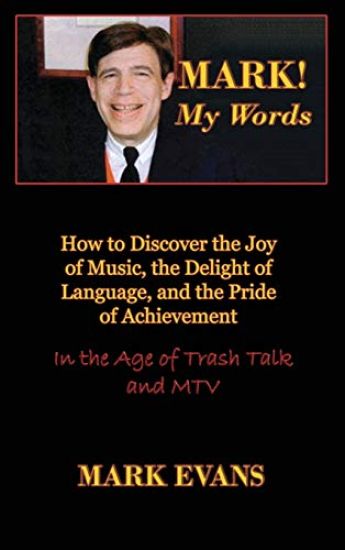
Mark! My Words (How to Discover the Joy of Music, the Delight of Language, and the Pride of Achievement in the Age of Trash Talk and MTV)
Classical music, jazz, film scores, and the masterpieces of musical theater are in danger of fading into an undeserved oblivion. This crisis extends not only to music, but also to an ignorance of good books, art, theater, and films. This crisis is exacerbated by our vanishing history, a decline in language, and a pervasive celebrity culture. If this problem is not solved, our nation's cultural and artistic heritage will be irretrievably lost. "Mark My Words" by Mark Evans is the first book to address the challenge of this crisis. The author, a composer, writer, and broadcaster presents compelling evidence that change and progress are not synonymous and that "new and improved" often means a bigger box and fewer corn flakes .He explains why we have become a nation of hares instead of tortoises. In today's high tech world, students are emerging from school: - Unfamiliar with any music other than what they've heard on MTV. - Unable to write, spell, or speak using the English language correctly. - As experts on the lives of celebrities, but ignorant of the most basic facts of American history. - Spending countless hours texting, tweeting, and downloading on the latest digital devices, but without reading any book that hasn't been assigned to them in years. - With a healthy respect for the present, but a complete disdain for the past. In "Mark My Words" readers will encounter: - True achievers in the arts who are ignored while we celebrate the accomplishments by geniuses of self-promotion. - Teenagers who are mesmerized by pop culture and say they would rather be the assistant to a celebrity than president of a university or a successful business enterprise. - Composers of classical music who have turned music into mathematics and have lost their audience as a result, while great composers are dismissed and ridiculed by critics. - Promoters of rock, pop, and rap music that have corrupted our musical culture while crying all the way to the bank. - Modern artists who promote the credo "Art is what you can get away with." - Graduates of prestigious colleges who are who are unfamiliar with the great events of American history, and who can't tell the difference between the words of Thomas Jefferson and those of Karl Marx. - Librarians who are busy taking our best books off the shelves of their libraries. - Teachers who smile and nod while children make mistakes in reading. - Lawyers and government bureaucrats who can't write a simple English sentence - English professors who have never read a play by Shakespeare. But "Mark My Words" isn't just about our cultural problems; it also offers solutions to those problems. You'll meet real heroes in "Mark My Words" like the inner city teacher who changed the lives of her students by starting her own school. You'll celebrate the achievements of composers, writers, and artists who have stood for integrity in an age of cultural confusion. The solution cannot be found in academia, government, or the entertainment industry. It can be found in our own energy, inspiration, and resolve. This book is dedicated to the proposition that we should pursue "cultural conservation," devoting the same energy to preserving our cultural resources that we devote to preserving our natural resources. "Mark My Words" details what we can do as a society and what you can do as an individual to embark on an exciting journey of discovery that can truly impact your daily life. If you are a parent, a grandparent, a teacher, a student, or someone who cares about music, books, art, language, and our history as a nation, you will want to read this book.
Mark! My Words (How to Discover the Joy of Music, the Delight of Language, and the Pride of Achievement in the Age of Trash Talk and MTV)
Classical music, jazz, film scores, and the masterpieces of musical theater are in danger of fading into an undeserved oblivion. This crisis extends not only to music, but also to an ignorance of good books, art, theater, and films. This crisis is exacerbated by our vanishing history, a decline in language, and a pervasive celebrity culture. If this problem is not solved, our nation's cultural and artistic heritage will be irretrievably lost. "Mark My Words" by Mark Evans is the first book to address the challenge of this crisis. The author, a composer, writer, and broadcaster presents compelling evidence that change and progress are not synonymous and that "new and improved" often means a bigger box and fewer corn flakes .He explains why we have become a nation of hares instead of tortoises. In today's high tech world, students are emerging from school: - Unfamiliar with any music other than what they've heard on MTV. - Unable to write, spell, or speak using the English language correctly. - As experts on the lives of celebrities, but ignorant of the most basic facts of American history. - Spending countless hours texting, tweeting, and downloading on the latest digital devices, but without reading any book that hasn't been assigned to them in years. - With a healthy respect for the present, but a complete disdain for the past. In "Mark My Words" readers will encounter: - True achievers in the arts who are ignored while we celebrate the accomplishments by geniuses of self-promotion. - Teenagers who are mesmerized by pop culture and say they would rather be the assistant to a celebrity than president of a university or a successful business enterprise. - Composers of classical music who have turned music into mathematics and have lost their audience as a result, while great composers are dismissed and ridiculed by critics. - Promoters of rock, pop, and rap music that have corrupted our musical culture while crying all the way to the bank. - Modern artists who promote the credo "Art is what you can get away with." - Graduates of prestigious colleges who are who are unfamiliar with the great events of American history, and who can't tell the difference between the words of Thomas Jefferson and those of Karl Marx. - Librarians who are busy taking our best books off the shelves of their libraries. - Teachers who smile and nod while children make mistakes in reading. - Lawyers and government bureaucrats who can't write a simple English sentence - English professors who have never read a play by Shakespeare. But "Mark My Words" isn't just about our cultural problems; it also offers solutions to those problems. You'll meet real heroes in "Mark My Words" like the inner city teacher who changed the lives of her students by starting her own school. You'll celebrate the achievements of composers, writers, and artists who have stood for integrity in an age of cultural confusion. The solution cannot be found in academia, government, or the entertainment industry. It can be found in our own energy, inspiration, and resolve. This book is dedicated to the proposition that we should pursue "cultural conservation," devoting the same energy to preserving our cultural resources that we devote to preserving our natural resources. "Mark My Words" details what we can do as a society and what you can do as an individual to embark on an exciting journey of discovery that can truly impact your daily life. If you are a parent, a grandparent, a teacher, a student, or someone who cares about music, books, art, language, and our history as a nation, you will want to read this book.
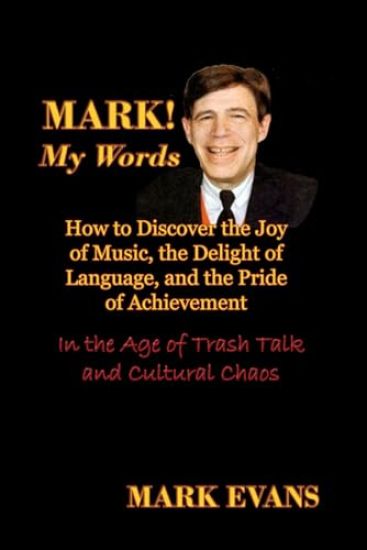
Mark! My Words (How to Discover the Joy of Music, the Delight of Language, and the Pride of Achievement in the Age of Trash Talk and Cultural Chaos)
Classical music, jazz, film scores, and the masterpieces of musical theater are in danger of fading into an undeserved oblivion. This crisis extends not only to music, but also to an ignorance of good books, art, theater, and films. Students are emerging from school unfamiliar with our past and unprepared for our future This crisis is exacerbated by our vanishing history, a decline in language, and a pervasive celebrity culture. If this problem is not solved, our nation's cultural and artistic heritage will be irretrievably lost. "Mark My Words" by Mark Evans is the first book to address the challenge of this crisis. The author, a composer, writer, and broadcaster presents compelling evidence that change and progress are not synonymous and that "new and improved" often means a bigger box and fewer corn flakes .He explains why we have become a nation of hares instead of tortoises. In today's high tech world, students are emerging from school: -Unfamiliar with any music other than what they've encountered through social media -Unable to write, spell, or speak using the English language correctly. -As experts on the lives of celebrities, but ignorant of the most basic facts of American history. -Spending countless hours texting, tweeting, and downloading on the latest digital devices, but without reading any book that hasn't been assigned to them in years. -With a healthy respect for the present, but a complete disdain for the past. In "Mark My Words" readers will encounter: -True achievers in the arts who are ignored while we celebrate the accomplishments by geniuses of self-promotion. -Teenagers who are mesmerized by pop culture and say they would rather be the assistant to a celebrity than president of a university or a successful business enterprise. -Composers of classical music who have turned music into mathematics and have lost their audience as a result, while great composers are dismissed and ridiculed by critics. -Promoters of rock, pop, and rap music that have corrupted our musical culture while crying all the way to the bank. -Modern artists who promote the credo "Art is what you can get away with." -Graduates of prestigious colleges who are who are unfamiliar with the great events of American history, and who can't tell the difference between the words of Thomas Jefferson and those of Karl Marx. -Librarians who are busy taking our best books off the shelves of their libraries. -Teachers who smile and nod while children make mistakes in reading. -Lawyers and government bureaucrats who can't write a simple English sentence -English professors who have never read a play by Shakespeare. But "Mark My Words" isn't just about our cultural problems; it also offers solutions to those problems. You'll meet real heroes in "Mark My Words" like the inner city teacher who changed the lives of her students by starting her own school. You'll celebrate the achievements of composers, writers, and artists who have stood for integrity in an age of cultural confusion. The solution cannot be found in academia, government, or the entertainment industry. It can be found in our own energy, inspiration, and resolve. This book is dedicated to the proposition that we should pursue "cultural conservation," devoting the same energy to preserving our cultural resources that we devote to preserving our natural resources. "Mark My Words" details what we can do as a society and what you can do as an individual to embark on an exciting journey of discovery that can truly impact your daily life. If you are a parent, a grandparent, a teacher, a student, or someone who cares about music, books, art, language, and our history as a nation, you will want to read this book.
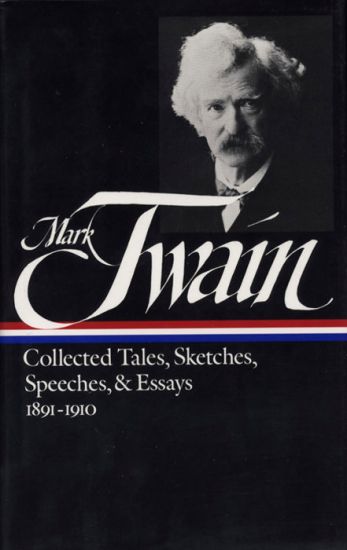
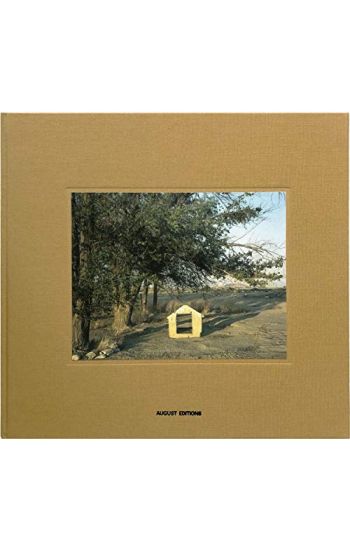
Mark Ruwedel: Dog Houses
Photographed over a ten-year period, Dog Houses is a collection of 30 forlorn and often humorous color images of canine shelters found throughout the Southern California desert landscape. American photographer Mark Ruwedel (b. 1954), known for his majestic "Westward" series of residual landforms created by expanding railroad lines across the nineteenth-century American West, turns his discerning eye to the last western frontier—the American desert. Dog Houses, part of Ruwedel's larger "Desert House" series, takes readers to a place where signs of human activity in the landscape are much more recent and revealing. Like their human counterparts, the doghouses in these photographs constitute an inventory of an iconic yet surprisingly flexible form. Often made from discarded material left over from the construction of human houses, the funny and sometimes haunting structures evoke the asymmetrical yet reciprocal relationship between owner and animal.