Kirjojen hintavertailu. Mukana 11 577 569 kirjaa ja 12 kauppaa.

Kirjahaku

Etsi kirjoja tekijän nimen, kirjan nimen tai ISBN:n perusteella.

1000 tulosta hakusanalla Monet Thompson

Money Income and Employment

Money Income and Employment

Erich Schneider

Routledge
2010
nidottu
Part One of this book deals with the theory of how money is created and destroyed. Essential principles are illustrated by considering various models of banking systems. Part Two provides an account of the modern theory of income and employment. * Theory backed up with examples of the simplest to the most complicated models, for example: * The model of "a closed economy without a government" to one in which government expenditure and revenue affect the level of national income * The model in which the rate of interest and quantity of money have no effect and the model in which they are variables relevant to the determination of income
Money and Markets

Money and Markets

Roger Koppl

Routledge
2015
nidottu
Important and celebrated economist Leland Yeager is one of the architects of the 'Virginia School' of political economy that has produced two Nobel laureates (James Buchanan and Ronald Coase) and the Public Choice movement. A number of top class contributors have here been brought together to produce a festschrift in Yeager’s honor – edited by Roger Koppl, and including the aforementioned Buchanan, Gordon Tullock, David Colander, Deirdre McCloskey and Roger Garrison.
Money and Exchange

Money and Exchange

Sasan Fayazmanesh

Routledge
2012
nidottu
Whether a theoretical system is realistic or not has been a concern in economics, particularly in monetary theory, over the past century. Following John R. Hicks’ proposal that a realistic monetary theory could be constructed along an evolutionary path, starting with the workings of a real market, this volume considers whether we can look to the medieval economy as the point of departure. Drawing upon the work of Aristotle, scholastic economists, Adam Smith, Karl Marx, William Stanley Jevons, Léon Walras and many modern monetary theorists, this intriguing book provides a critical analysis of some basic theories of monetary analysis. Concentrating primarily on certain fundamental building blocks it covers:the theory and mathematical properties of barter and monetary relations the distinction between barter and monetary relations and money and non-money commodities the concept of exchange as an equation, and the notion of the exchange relation as a relation of equality.This groundbreaking study dispels some of the old myths and conjectures concerning money and exchange and opens up the way for the development of new approaches, both realistic and evolutionary, of interest to researchers and students of the history of monetary theory and economic thought.
Money and Banking in Jean-Baptiste Say's Economic Thought
The aim of this work is to make available to English-language readers a translation of Jean-Baptiste Say’s main texts on money and banking which were not at present accessible in English. The work includes chapters from his books taking into account the variants between the different editions, articles and hitherto unpublished manuscripts. Comprehension of these different texts is facilitated by an introduction designed to place them in their context and by a chronological table giving the main events of Say’s life and editorial activity in parallel with the main political, economic and monetary events of the time.
Money, Credit and the Economy (Routledge Revivals)
The Theory of Money and Finance, by the same author, provided an introduction to the basic theory and concluded by introducing the idea of monetary disequilibrium, with the money supply process operating through bank credit creation. First published in 1981, this book develops that theme and provides empirical evidence in support of such an approach.
Money, Credit and the Economy (Routledge Revivals)
The Theory of Money and Finance, by the same author, provided an introduction to the basic theory and concluded by introducing the idea of monetary disequilibrium, with the money supply process operating through bank credit creation. First published in 1981, this book develops that theme and provides empirical evidence in support of such an approach.
Money in Economic Theory

Money in Economic Theory

Hasse Ekstedt

Routledge
2012
sidottu
The financial crash of 2008 showed the fragility of the financial system. A key question which surfaced in the aftermath of the global crisis was why economists were unable to predict this crash. This new volume argues that this failure can be attributed, at least in part, to the poor and inconsistent treatment of money and monetary matters in economic theory. The book takes this problem as its starting point, and from there aims to develop a more consistent treatment of the topic.Here, Hasse Ekstedt affirms that the treatment of money in economic theory has been inconsistent and that the topic of money can in fact be seen as anomalous. He argues that this anomaly depends on deficiencies in the economic theory, which through an equilibrium approach mainly perceives money as an index of measurement.In contrast, this volume puts forward the case for money as a non-equilibrium concept, and that the stability of money and financial markets are to be sought in social and institutional structures. In particular, the volume discusses the relationship between the market and public bodies, as well as addressing economic and financial stability in general and in relation to the globalized economy, particularly focussing on the problem of structural stability. In doing so, the book offers a new approach both to money and to its role in economic theory.
Money and Markets

Money and Markets

Roger Koppl

Routledge
2006
sidottu
Important and celebrated economist Leland Yeager is one of the architects of the 'Virginia School' of political economy that has produced two Nobel laureates (James Buchanan and Ronald Coase) and the Public Choice movement. A number of top class contributors have here been brought together to produce a festschrift in Yeager’s honor – edited by Roger Koppl, and including the aforementioned Buchanan, Gordon Tullock, David Colander, Deirdre McCloskey and Roger Garrison.
Money Laundering – An Endless Cycle?
This book provides a detailed examination of anti-money laundering policies and legislative frameworks in a number of jurisdictions and considers how successful these jurisdictions have been in implementing international measures to combat money laundering. Looking at the instruments and proposals put in place by a number of institutions including the United Nations (UN), the Financial Action Task Force (FATF) and the European Union, the book begins by reclassifying and expanding the traditional global anti-laundering policy to include aspects such as having a national money laundering strategy in place, the implementation of international instruments and the role of government and regulatory agencies. Ryder then offers a comparative analytical review of the anti-money laundering policies adopted in the United States of America, Canada, the United Kingdom and Australia and considers to what extent they have followed and implemented the identified global anti-money laundering policy. Money Laundering – An Endless Cycle? will be of particular interest to academics and students in the fields of Law, Finance, Banking and Criminology.
Money in the Middle East and North Africa
Monetary policy in the Middle East and North African (MENA) countries remains an understudied area; this book fills an important gap by examining monetary policy frameworks and monetary policy strategies in the region. Building on the editors’ earlier book, Monetary Policy and Central Banking in the Middle East and North Africa, which focused on central bank independence issues and on exchange rate regimes, this book emphasises monetary policy strategies. Part I contains an overview of the financial markets and institutions which condition the choice of monetary policy strategy in the countries of the region, followed by single-country studies on aspects of the monetary policy frameworks of Lebanon, Egypt, Jordan, the Palestinian Territory and Turkey. Part II includes analyses of the prospects for inflation targeting in Egypt, Morocco and Tunisia, of the monetary transmission mechanism in the Gulf Cooperation Council countries, of the relative advantages of inflation targeting and exchange rate fixity with reference to Egypt, of the problem of fiscal dominance in Egypt, and of the inflationary implications of exchange rate fixity for Saudi Arabia and Kuwait. The contributors are experts from universities inside and outside the MENA region, from central banks in the region and from outside institutions such as the European Central Bank and the International Monetary Fund.
Money and Banking in the UK (RLE: Banking & Finance)
This book is concerned with developments in three main areas of monetary history: domestic commercial banking; monetary policy; and the UK’s international financial position. For ease of analysis the 160 years under study are arranged into three clear chronological divisons. Part 1 covers the years 1826-1913, a period in which the UK emerged as the world’s leading economic power. It was in these years that an extensive and fully-operative domestic banking system was established. Part 2 covers 1914 to 1939 – the years which marked a break in the traditional monetary arrangements of the Victorian and Edwardian eras. Part 3 covers 1939-1986 when the dominance of state influence within the domestic money markets was re-established by the Second World War and the acceptance by the authorities of the obligation to ‘manage’ the economy which meant that successive postwar governments took direct responsibility for the conduct of monetary and credit policy.
Money and Growth
Allyn Young is one of the central figures in the development of American economic thought, and is one of the originators of modern endogenous growth theory. This book allows full appreciation of the full extent of Young's work because many of his most significant contributions are buried in obscure journals and unsigned articles. This volume addresses this by reprinting much of Young's lost work, as well as other selected pieces that reveal the scope of his vision which encompasses two of the grand themes of economics, growth and money. The volume includes sections on: * the socialist movement * the first world war and its aftermath * money * theories of growth
Money and the Market

Money and the Market

Kevin Dowd

Routledge
2014
nidottu
Kevin Dowd asserts that state intervention into financial and monetary systems has failed, and that we would be better off if financial markets were left to regulate themselves. This collection will appeal to students, researchers and policy makers in the monetary and financial area.
Money, Time and Rationality in Max Weber
This unique study into the roots of Max Weber's Political Economy, is an intriguing read and a valuable contribution to the Weberian literature. Parsons argues that Weber's analysis is highly influenced by the Austrian School of Economics and the relationship between his critique of centrally planned economies and that of Mises.
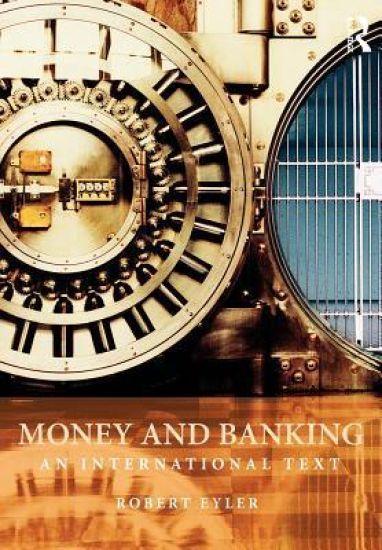
Money and Banking

Money and Banking

Robert Eyler

Routledge
2009
sidottu
This book focuses on the core issues in money and banking. By using simple applications for anyone that understands basic economics, the lessons in the book provide any student or reader with a background in how financial markets work, how banks as businesses function, how central banks make decisions, and how monetary policy affects the global economy. Money and Banking is split into sections based on subject matter, specifically definitions and introductions, financial markets, microeconomic issues, macroeconomy policy, and international finance. It also covers:- derivative and currency markets- the microeconomics of banking- trade and currency movements- asymmetric information and derivative markets - the future of financial markets and their participantsBy providing a mix of microeconomic and macroeconomic applications, focusing on both international examples and open economy macroeconomics, this book reduces the minutiae seen in competing books. Each chapter provides summaries of what should be learned along the way and why the chapter’s topic is important, regardless of current events. For undergraduate business, economics or social science students otherwise, this book is a concise source of information on money, banking and financial markets.
Money and Banking

Money and Banking

Robert Eyler

Routledge
2009
nidottu
This book focuses on the core issues in money and banking. By using simple applications for anyone that understands basic economics, the lessons in the book provide any student or reader with a background in how financial markets work, how banks as businesses function, how central banks make decisions, and how monetary policy affects the global economy. Money and Banking is split into sections based on subject matter, specifically definitions and introductions, financial markets, microeconomic issues, macroeconomy policy, and international finance. It also covers:- derivative and currency markets- the microeconomics of banking- trade and currency movements- asymmetric information and derivative markets - the future of financial markets and their participantsBy providing a mix of microeconomic and macroeconomic applications, focusing on both international examples and open economy macroeconomics, this book reduces the minutiae seen in competing books. Each chapter provides summaries of what should be learned along the way and why the chapter’s topic is important, regardless of current events. For undergraduate business, economics or social science students otherwise, this book is a concise source of information on money, banking and financial markets.
Money and Finance in Africa

Money and Finance in Africa

Erin Fleetwood

Routledge
2013
nidottu
This reissue, first published in 1964, describes the contemporary problems faced and solutions found by the monetary and financial authorities of six African countries: Ghana, Morocco, Nigeria, the Rhodesias, the Sudan and Tunisia, from the establishment of their central banks until 1962.This study explores the special economic and social factors of these African countries and places emphasis upon the atmosphere of rapid change, growth and development. The author indicates common denominators, whilst making due allowance for the character of each individual country.