Kirjojen hintavertailu. Mukana 11 244 527 kirjaa ja 12 kauppaa.

Kirjahaku

Etsi kirjoja tekijän nimen, kirjan nimen tai ISBN:n perusteella.

1000 tulosta hakusanalla Peter P. Hinks

Management heute

Management heute

Horst Steinmann; Georg Schreyögg; Herbert A. Henzler; Jörn F. Voigt; Ekkehard Kappler; Heinz Benölken; Peter Greipel; Lutz Wicke; Rudolf Mann; Heribert Meffert; Friedrich A. Rode; Ingrid Keller; Hans von Bergen; Tom Sommerlatte; Peter Heintel; Ewald E. Krainz; Wilhelm Rall; Jörg Schneider; Walter Böckmann; Gilbert J. B. Probst; Gifford Pinchot; Adrian P. Menz; Gerhard Schwarz; Werner W. Wilk

Gabler
1991
nidottu
Volle TerminpUine und die Uberflutung mit Informationen machen es oft nicht leicht, Zeit und MuBe zum Bticherlesen zu tinden. MANAGEMENT HEUTE bietet daher eine Auswahl hervorragender Managementliteratur zu aktuellen und wichtigen Fragen - eine Kostpro- be, die vielleicht dazu anregt, sich mit bestimmten Themen intensiver zu beschaftigen. Dieses Lesebuch umfaBt 21 Beitrage aus Veroffentlichungen des Be- triebswirtschaftlichen Verlags Dr. Th. Gabler. Es gibt einen kompakten Uberblick tiber die vielfaItigen Facetten des Managens und liefert konkre- tes Management-Know-how. Schon die Auswahl aus dem eigenen Verlagsprogramm war eine Her- ausforderung: GABLER ist auf der ganzen Breite der Wirtschaftsfachlite- ratur verlegerisch aktiv - yom Schulbuch bis zum wissenschaftlichen Forschungsbeitrag. Praxisrelevante Management-Themen machen nur einen Tell des Spektrums aus. Und davon konnten wir wiederum nur ei- nen kleinen Ausschnitt bier berlicksichtigen. Viele hervorragende Autoren sind nicht in dieses Buch aufgenommen worden. Das muB so sein - ein Lesebuch verlangt Auswahl, fordert Schwerpunktsetzung und manch schmerzhaften Schnitt. Es will beispielhaft Akzente setzen und baut dabei auch auf das Verstandnis derjenigen Autoren, deren Werke oft noch feiner auf Spezialthemen eingehen und deshalb in diesem Zusammenhang nicht mehr darstellbar waren. So muBten wir auch in den hier ausgewahlten Beitragen an manchen Stellen geringfiigige Anderungen gegentiber den Originalwerken vomeh- men, urn den Sinn-Zusammenhang zu erhalten. MANAGEMENT HEUTE - das wird fUr GABLER eine Herausforde- rung bleiben. Wir wollen dieses Lesebuch regelmaBig. herausgeben und ktinftig auch Ausschnitte geeigneter Werke aus anderen Verlagen tiber- nehmen.
Induktion und Morphogenese

Induktion und Morphogenese

F. E. Lehmann; Jean Brachet; H. O. Halvorson; A. Herman; H. Okada; J. Gorman; Wolfgang Beermann; Peter Karlson; Prof. Dr. P. Karlson; Bernt Linzen; Howard Holtzer; Friedrich Zilliken; Heinz Tiedemann; Franz Duspiva; Prof. Dr. F. Duspiva; Rudolf Weber

Springer-Verlag Berlin and Heidelberg GmbH Co. K
1963
nidottu
Mechanismen Enzymatischer Reaktionen

Mechanismen Enzymatischer Reaktionen

Th. Wieland; Kurt Wallenfels; Christian Streffer; Myron L. Bender; H. Fasold; U. Gröschel-Stewart; G. Gundlach; F. Turba; B. R. Rabin; A. P. Mathias; Herbert Witzel; C. Veeger; Peter Hemmerich; L. Jaenicke; G. Kohlhaw; H. Holzer; W. Schröter; J. Knappe; F. Lynen; V. M. Clark; V. Prelog; G. Pfleiderer; Horst Sund

Springer-Verlag Berlin and Heidelberg GmbH Co. K
1964
nidottu
Für Ulrich Conrads

Für Ulrich Conrads

Gerd Albers; Horst Von Bassewitz; Jürgen Becker; Günter Bock; Franziska Bollerey; Lucius Burkhardt; Peter Conradi; Lore Ditzen; Martina Düttmann; Werner Durth; Martin Einsele; Gerhard Fehl; Hermann Fehling; Daniel Gogel; Walter Förderer; Karin Fratzscher; Robert Frank; Joachim Ganz; Walter Rolfes; Werner Gehrmann; Anatol Ginelli; Max Guther; Hardt-Waltherr Hämer; Manfred Hamm; Kristiana Hartmann; Hermann Henselmann; Rainer Höynck; Hubert Hoffmann; Dieter Hoffmann-Axthelm; Gert Kähler; Claus Peter Koch; Hans P. Koellmann

Vieweg+teubner Verlag
2012
nidottu
Skrivdidaktik i grundskolan

Skrivdidaktik i grundskolan

Ann-Christin Randahl; Anna Maria Hipkiss; Hampus Holm; Sofia Pulls; Maria Levlin; Erika Sturk; Åsa Wedin; Synnøve Matre; Carla Jonsson; Anna-Lena Godhe; Ann-Catrine Edlund; Gert Rijlaarsdam; Peter Ström; Etienne Van Eden Skein; Shelley Stagg Peterson; Kristina Belancic; Randi Solheim; Anat Stavans; Lisa Molin; Vesna Busic; Kirk P H Sullivan; Anna Nilsson; Per Boström; Christian Waldmann; Yvonne Knospe; Eva Lindgren; Carina Hermansson; Annika Norlund Shaswar; Sofie Areljung

Studentlitteratur AB
2022
nidottu
Skrivandet är en självklar del av skolans alla ämnen, kanske till och med så självklar att vi inte riktigt tänker på den mängd av färdigheter som ingår. Så vad är då viktigt att ha kunskap om för att kunna stötta elevers skrivutveckling? Och hur går man till väga rent praktiskt?I den här boken tar författarna avstamp i skrivdidaktisk forskning. I tydliga resonemang lyfter de fram en rad viktiga aspekter på skrivande och skrivundervisning, men också hur vi kan förstå dem i samspel och som en helhet. I kapitlen ryms bland mycket annat interaktionen mellan läsande och skrivande, multimodalt skrivande, skrivande genom dataspelande och lek, svårigheter i skrivande och skrivande i flerspråkiga klassrum. Målet är att ge lärare redskap för att tänka bredare och djupare om sin skriv­undervisning och därmed kunna utveckla den.Boken riktar sig till såväl lärarstudenter som lärare i grundskolan. Samtliga kapitel visar forskningens potential att göra skillnad för elevers skrivutveckling och ger många konkreta undervisnings­exempel från grundskolans alla stadier.
Animal Behaviour: Evolution and Mechanisms

Animal Behaviour: Evolution and Mechanisms

Nils Anthes; Ralph Bergmüller; Wolf Blanckenhorn; H. Jane Brockmann; Claudia Fichtel; Lutz Fromhage; Joachim Frommen; Wolfgang Goymann; Juergen Heinze; Katharina Hirschenhauser; Heribert Hofer; Sylvia Kaiser; Peter M. Kappeler; Bart Kempenaers; Gerald Kerth; Judith Ingrid Korb; Kurt M. Kotrschal; Cornelila Kraus; Martha Manser; Nico Michiels; Robin F. A. Moritz; Mario Pahl; Dustin Penn; Norbert Sachser; Martin Schaefer; Carel P. van Schaik; Jutta M. Schneider; Isabella Schreiber; Michael Taborsky; Jürgen Tautz; Fritz Trillmich

Springer-Verlag Berlin and Heidelberg GmbH Co. K
2016
nidottu
The study of animal behaviour has become one of the fastest growing b- logical disciplines in recent decades. This development can be easily - ferred, for example, from the steady increase in the total number of pub- cations on any aspect of animal behaviour, in particular also in journals with a more general readership (e. g. Nature, Proceedings of the Royal - ciety or Current Biology), the ever-increasing number of participants at - ternational conferences (e. g. IEC or ISBE), and from the growing numbers of students choosing courses in this field. This development has several causes, of which I find three particularly compelling. First, it is incre- ingly being appreciated that behaviour is the crucial level at which an in- vidual s genotype and phenotype interface with the environment. Rec- nising behaviour as the main mechanism animals employ to ascertain their homeostasis, growth, survival and reproduction therefore provides a deep understanding of organismal integration and adaptation. Second, the ast- ishing success of the study of animal behaviour also has importantly to do with the intellectual flexibility and methodological inter-disciplinarity - quired for comprehensive analyses of behaviour. Today, students of beh- iour are jacks-of-all-trades; importing, applying and improving methods from many neighbouring disciplines, such as molecular genetics, physi- ogy or micro-electronics, as well as concepts and theories from less ob- ous sources, such as economics or sociology, for example."
Professor Petre P. Teodorescu: A Great Mathematician and Engineer

Professor Petre P. Teodorescu: A Great Mathematician and Engineer

Michael M. Dediu

Createspace Independent Publishing Platform
2012
nidottu
Based on my discussions and correspondence with Professor Teodorescu, and with others who know him, I present this homage book about Professor Teodorescu, on his 83rd birthday. Professor Petre P. Teodorescu is a great European personality in the fields of mathematics and mechanics, with a charming life history, which it is important to be known not only by specialists. For this reason we wrote this book for the general public, with only few technical details at this time, including numerous enchanting photographs taken at conferences and with other occasions, as well as notes about ideas and events from the last 83 years. I want to thank my wife Sophia for her continuous help and assistance. We wish all our distinguished readers good reading, and great enjoyment while discovering this great European personality, from whom many valuable lessons can be learned.
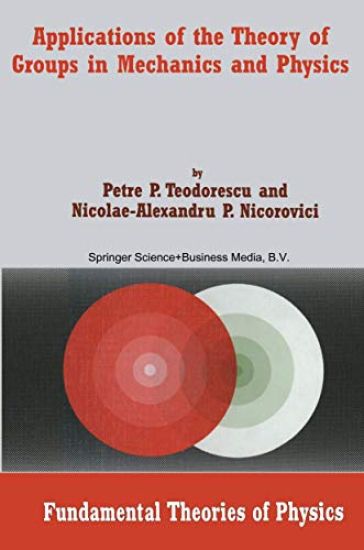
Applications of the Theory of Groups in Mechanics and Physics

Applications of the Theory of Groups in Mechanics and Physics

Petre P. Teodorescu; Nicolae-A.P. Nicorovici

Springer-Verlag New York Inc.
2004
sidottu
The notion of group is fundamental in our days, not only in mathematics, but also in classical mechanics, electromagnetism, theory of relativity, quantum mechanics, theory of elementary particles, etc. This notion has developed during a century and this development is connected with the names of great mathematicians as E. Galois, A. L. Cauchy, C. F. Gauss, W. R. Hamilton, C. Jordan, S. Lie, E. Cartan, H. Weyl, E. Wigner, and of many others. In mathematics, as in other sciences, the simple and fertile ideas make their way with difficulty and slowly; however, this long history would have been of a minor interest, had the notion of group remained connected only with rather restricted domains of mathematics, those in which it occurred at the beginning. But at present, groups have invaded almost all mathematical disciplines, mechanics, the largest part of physics, of chemistry, etc. We may say, without exaggeration, that this is the most important idea that occurred in mathematics since the invention of infinitesimal calculus; indeed, the notion of group expresses, in a precise and operational form, the vague and universal ideas of regularity and symmetry. The notion of group led to a profound understanding of the character of the laws which govern natural phenomena, permitting to formulate new laws, correcting certain inadequate formulations and providing unitary and non­ contradictory formulations for the investigated phenomena.
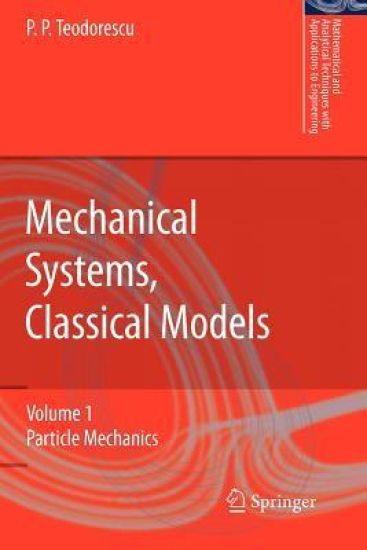
Mechanical Systems, Classical Models

Mechanical Systems, Classical Models

Petre P. Teodorescu

Springer-Verlag New York Inc.
2006
sidottu
In the study of a science of nature mathematics plays an important role. Mechanics is the first science of nature which was expressed in terms of mathematics by considering various mathematical models, associated to phenomena of the surrounding nature. Thus, its development was influenced by the use of a strong mathematical tool; on the other hand, we must observe that mechanics also influenced the introduction and the development of many mathematical notions. In this respect, the guideline of the present book is precisely the mathematical model of mechanics. A special accent is put on the solving methodology as well as on the mathematical tools used; vectors, tensors and notions of field theory. Continuous and discontinuous phenomena, various mechanical magnitudes are presented in a unitary form by means of the theory of distributions. Some appendices give the book an autonomy with respect to other works, special previous mathematical knowledge being not necessary. Some applications connected to important phenomena of nature are presented, and this also gives one the possibility to solve problems of interest from the technical, engineering point of view.
Mechanical Systems, Classical Models

Mechanical Systems, Classical Models

Petre P. Teodorescu

Springer-Verlag New York Inc.
2008
sidottu
As it was already seen in the first volume of the present book, its guideline is precisely the mathematical model of mechanics. The classical models which we refer to are in fact models based on the Newtonian model of mechanics, on its five principles, i. e. : the inertia, the forces action, the action and reaction, the parallelogram and the initial conditions principle, respectively. Other models, e. g. , the model of attraction forces between the particles of a discrete mechanical system, are part of the considered Newtonian model. Kepler’s laws brilliantly verify this model in case of velocities much smaller than the light velocity in vacuum. The non-classical models are relativistic and quantic. Mechanics has as object of study mechanical systems. The first volume of this book dealt with particle dynamics. The present one deals with discrete mechanical systems for particles in a number greater than the unity, as well as with continuous mechanical systems. We put in evidence the difference between these models, as well as the specificity of the corresponding studies; the generality of the proofs and of the corresponding computations yields a common form of the obtained mechanical results for both discrete and continuous systems. We mention the thoroughness by which the dynamics of the rigid solid with a fixed point has been presented. The discrete or continuous mechanical systems can be non-deformable (e. g.
Luca mikrokozma

Luca mikrokozma

Petar P Njegos

Globland Books
2023
pokkari
Luca mikrokozma (1845) hronoloski je prvo od ukupno tri Njegoseva najpoznatija dela. Ovih sest spevova u desetercu u kojima pesnik prikazuje traganje duse za lepotom bozanstva i uzrocima covekovog pada, mnogi smatraju najvecim poetsko-religioznim delom u srpskoj filozofskoj literaturi. Napisano je u jednom dahu i u potpunoj usamljenosti pesnika tokom prve cetiri nedelje velikog posta. Oslobodivsi se okova materije i vinuvsi se u nebeske predele, dusa vodjena andjelom dolazi do izvora saznanja gde ce, napivsi se vode sa ovog izvora, saznati kako je, posle Satanine pobune protiv Boga, doslo do izgnanstva coveka na Zemlju.
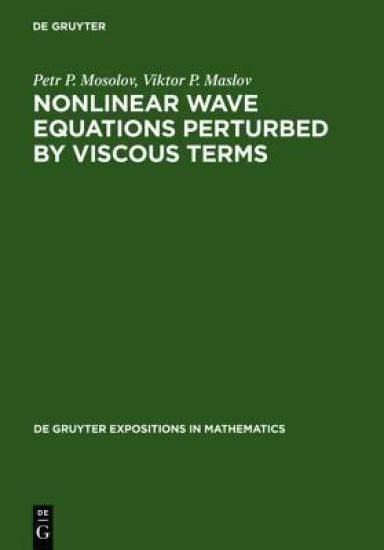
Nonlinear Wave Equations Perturbed by Viscous Terms

Nonlinear Wave Equations Perturbed by Viscous Terms

Petr P. Mosolov; Viktor P. Maslov

De Gruyter
2000
sidottu
The aim of the Expositions is to present new and important developments in pure and applied mathematics. Well established in the community over more than two decades, the series offers a large library of mathematical works, including several important classics. The volumes supply thorough and detailed expositions of the methods and ideas essential to the topics in question. In addition, they convey their relationships to other parts of mathematics. The series is addressed to advanced readers interested in a thorough study of the subject. Editorial Board Lev Birbrair, Universidade Federal do Ceará, Fortaleza, BrasilWalter D. Neumann, Columbia University, New York, USAMarkus J. Pflaum, University of Colorado, Boulder, USADierk Schleicher, Aix-Marseille Université, FranceKatrin Wendland, Trinity College Dublin, Dublin, Ireland Honorary Editor Victor P. Maslov, Russian Academy of Sciences, Moscow, Russia Titles in planning include Yuri A. Bahturin, Identical Relations in Lie Algebras (2019)Yakov G. Berkovich, Lev G. Kazarin, and Emmanuel M. Zhmud', Characters of Finite Groups, Volume 2 (2019)Jorge Herbert Soares de Lira, Variational Problems for Hypersurfaces in Riemannian Manifolds (2019)Volker Mayer, Mariusz Urbanski, and Anna Zdunik, Random and Conformal Dynamical Systems (2021)Ioannis Diamantis, Boštjan Gabrovšek, Sofia Lambropoulou, and Maciej Mroczkowski, Knot Theory of Lens Spaces (2021)
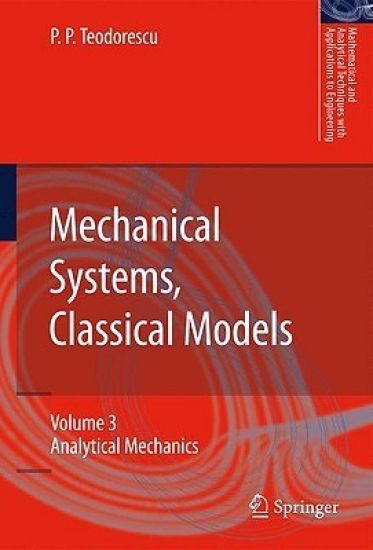
Mechanical Systems, Classical Models

Mechanical Systems, Classical Models

Petre P. Teodorescu

Springer
2009
sidottu
All phenomena in nature are characterized by motion. Mechanics deals with the objective laws of mechanical motion of bodies, the simplest form of motion. In the study of a science of nature, mathematics plays an important rôle. Mechanics is the first science of nature which has been expressed in terms of mathematics, by considering various mathematical models, associated to phenomena of the surrounding nature. Thus, its development was influenced by the use of a strong mathematical tool. As it was already seen in the first two volumes of the present book, its guideline is precisely the mathematical model of mechanics. The classical models which we refer to are in fact models based on the Newtonian model of mechanics, that is on its five principles, i.e.: the inertia, the forces action, the action and reaction, the independence of the forces action and the initial conditions principle, respectively. Other models, e.g., the model of attraction forces between the particles of a discrete mechanical system, are part of the considered Newtonian model. Kepler’s laws brilliantly verify this model in case of velocities much smaller then the light velocity in vacuum.
Applications of the Theory of Groups in Mechanics and Physics

Applications of the Theory of Groups in Mechanics and Physics

Petre P. Teodorescu; Nicolae A.P. Nicorovici

Springer
2010
nidottu
The notion of group is fundamental in our days, not only in mathematics, but also in classical mechanics, electromagnetism, theory of relativity, quantum mechanics, theory of elementary particles, etc. This notion has developed during a century and this development is connected with the names of great mathematicians as E. Galois, A. L. Cauchy, C. F. Gauss, W. R. Hamilton, C. Jordan, S. Lie, E. Cartan, H. Weyl, E. Wigner, and of many others. In mathematics, as in other sciences, the simple and fertile ideas make their way with difficulty and slowly; however, this long history would have been of a minor interest, had the notion of group remained connected only with rather restricted domains of mathematics, those in which it occurred at the beginning. But at present, groups have invaded almost all mathematical disciplines, mechanics, the largest part of physics, of chemistry, etc. We may say, without exaggeration, that this is the most important idea that occurred in mathematics since the invention of infinitesimal calculus; indeed, the notion of group expresses, in a precise and operational form, the vague and universal ideas of regularity and symmetry. The notion of group led to a profound understanding of the character of the laws which govern natural phenomena, permitting to formulate new laws, correcting certain inadequate formulations and providing unitary and non­ contradictory formulations for the investigated phenomena.
Mechanical Systems, Classical Models

Mechanical Systems, Classical Models

Petre P. Teodorescu

Springer
2010
nidottu
In the study of a science of nature mathematics plays an important role. Mechanics is the first science of nature which was expressed in terms of mathematics by considering various mathematical models, associated to phenomena of the surrounding nature. Thus, its development was influenced by the use of a strong mathematical tool; on the other hand, we must observe that mechanics also influenced the introduction and the development of many mathematical notions. In this respect, the guideline of the present book is precisely the mathematical model of mechanics. A special accent is put on the solving methodology as well as on the mathematical tools used; vectors, tensors and notions of field theory. Continuous and discontinuous phenomena, various mechanical magnitudes are presented in a unitary form by means of the theory of distributions. Some appendices give the book an autonomy with respect to other works, special previous mathematical knowledge being not necessary. Some applications connected to important phenomena of nature are presented, and this also gives one the possibility to solve problems of interest from the technical, engineering point of view.