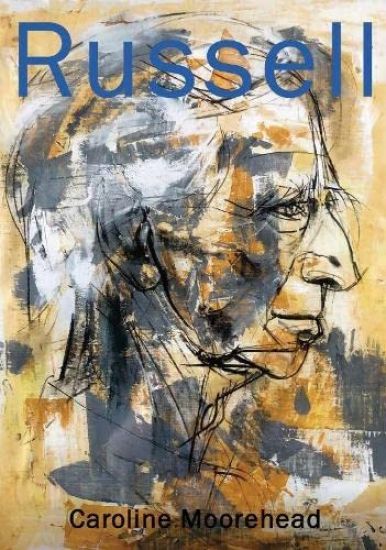
‘Fascinating’, ‘brilliant’, ‘oddly moving’, ‘a warm human picture’ – this biography was enthusiastically received when it came out in 1957. And no wonder. It is not only the lively story of a distinguished man but a lucid account of his work and its significance. The author, who was himself a philosopher and journalist, has followed the bright thread of Russell’s personality with affectionate insight, from the three-day-old baby who looked about him ‘in a very energetic way’, and the boy who jibbed at taking Euclid on trust, through the many turns of his life, to the undimmed octogenarian, still questioning and still deeply concerned. The subject is a great one and the biographer has matched it.
Originally published in 1973, this volume documents Bertrand Russell’s travels in America covering the period 1896-1945. It is presented in two halves with the first a biographical account of Russell’s involvement with the United States, with special reference to the seven visits he made there during this time period. Throughout this section the most representative of Russell’s journalistic writings are highlighted and these are presented as full texts in the second half of the book.This collection is assembled to provide an understanding of Russell’s deep and many-sided involvement with the United States during his life. A documented account, it is supplemented with important letters, photographs and newspaper articles.
Originally published in 1984, this volume documents Bertrand Russell’s travels in America covering the period 1945-1970. It is presented in two halves with the first a biographical account of Russell’s involvement with the United States, with special reference to the seven visits he made there during this time period. Throughout this section the most representative of Russell’s journalistic writings are highlighted and these are presented as full texts in the second half of the book.This collection is assembled to provide an understanding of Russell’s deep and many-sided involvement with the United States during his life. A documented account, it is supplemented with important letters, photographs and newspaper articles.
Originally published in 1973, this volume documents Bertrand Russell’s travels in America covering the period 1896-1945. It is presented in two halves with the first a biographical account of Russell’s involvement with the United States, with special reference to the seven visits he made there during this time period. Throughout this section the most representative of Russell’s journalistic writings are highlighted and these are presented as full texts in the second half of the book.This collection is assembled to provide an understanding of Russell’s deep and many-sided involvement with the United States during his life. A documented account, it is supplemented with important letters, photographs and newspaper articles.
Originally published in 1984, this volume documents Bertrand Russell’s travels in America covering the period 1945-1970. It is presented in two halves with the first a biographical account of Russell’s involvement with the United States, with special reference to the seven visits he made there during this time period. Throughout this section the most representative of Russell’s journalistic writings are highlighted and these are presented as full texts in the second half of the book.This collection is assembled to provide an understanding of Russell’s deep and many-sided involvement with the United States during his life. A documented account, it is supplemented with important letters, photographs and newspaper articles.
Although scholars from many disciplines have turned their attention to Russell’s work and appraised its significance for a number of fields, and an extensive literature on him emerged, until this book, first published in 1963, no thorough study on Russell’s contribution to education – an area to which he devoted no small part of his energies – had yet appeared. The book is based on interviews with Russell as well as diligent research in his writings and the sources of his thought and will enlighten all who think seriously about education. It addresses specifically the usefulness of Russell’s thought for American educators, which was challenging as Russell dared to question traditional ends and means of education at the time.
This volume of Bertrand Russell's Collected Papers finds Russell focused on writing Principia Mathematica during 1905–08. Eight previously unpublished papers shed light on his different versions of a substitutional theory of logic, with its elimination of classes and relations, during 1905-06. A recurring issue for him was whether a type hierarchy had to be part of a substitutional theory. In mid-1907 he began writing up the final version of Principia, now using a ramified theory of types, and eleven unpublished drafts from 1907-08 deal with this. Numerous letters show his thoughts on the process.The volume's 80-page introduction covers the evolution of his logic from 1896 until 1909, when volume I of Principia went to the printer.
First published in 1989, this book considers Bertrand Russell’s philosophy through his correspondence with others. Indeed, his exchanges with his elders in philosophy, with his contemporaries, and with one of his most outstanding pupils are brought to life in this judicious exposition: meticulously documented before being judged with insight and sympathy, as well as impartiality. Elizabeth Ramsden Eames here explores the issues that emerged from Russell’s exchanges with certain other philosophers, and interprets the resulting reciprocal influences and reactions. The conversations presented cover subjects such as: the nature of relations; pluralism versus monism; the relation of the subject and object in knowledge; the analysis of experience; the definition of truth; the analysis of belief; and the theory of meaning. These have been in the forefront of philosophical discussion in our time, and Russell’s dialogue with his contemporaries promises to illumine them.
First published in 1989, this book considers Bertrand Russell’s philosophy through his correspondence with others. Indeed, his exchanges with his elders in philosophy, with his contemporaries, and with one of his most outstanding pupils are brought to life in this judicious exposition: meticulously documented before being judged with insight and sympathy, as well as impartiality. Elizabeth Ramsden Eames here explores the issues that emerged from Russell’s exchanges with certain other philosophers, and interprets the resulting reciprocal influences and reactions. The conversations presented cover subjects such as: the nature of relations; pluralism versus monism; the relation of the subject and object in knowledge; the analysis of experience; the definition of truth; the analysis of belief; and the theory of meaning. These have been in the forefront of philosophical discussion in our time, and Russell’s dialogue with his contemporaries promises to illumine them.
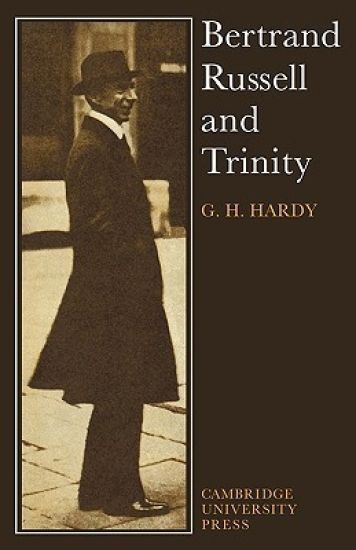
In 1916 Bertrand Russell was prosecuted and fined for publishing (in defence of a conscientious objector) 'statements likely to prejudice the recruiting and discipline of His Majesty's forces.' He was almost immediately afterwards dismissed from his Lectureship at Trinity College, Cambridge, by the College Council. This expulsion provoked a storm of protest and the true facts of the case became obscured by misconceptions, prejudices and uninformed gossip, to the discredit of the College. In 1942, therefore G. H. Hardy the mathematician printed for private circulation to another generation of Fellows at Trinity a full account of the incident in an attempt to explain what really happened. This is now made public. Besides provoking an authoritative record of a celebrated but misinterpreted episode in Russell's eventful academic career, this document contains interesting evidence about attitudes to pacifism in the First World War and in particular about the sympathies of such distinguished colleagues and contemporaries of Russell as Cornford, Housman, McTaggart and Whitehead.
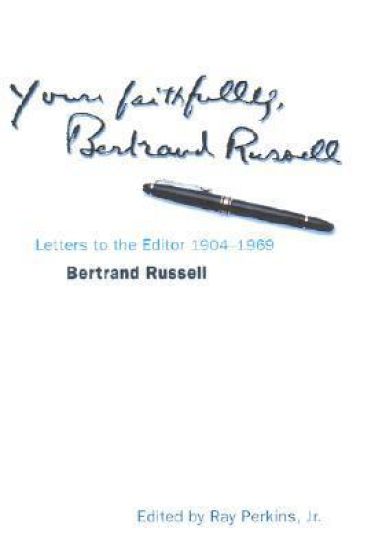
This comprehensive volume captures one of the twentieth century's greatest philosopher's lifelong battle with the forces of injustice, ignorance, and cruelty - a crusade not always welcomed by his own government, which twice imprisoned him. Russell used his more than 400 letters to the editor, most of which are collected in this volume, to reach large numbers of the public quickly when his controversial stances made it difficult to have his articles published in the popular press. Yours Faithfully, Bertrand Russell allows us to see Russell at his polemical best, dueling wittily and wisely with both ordinary citizens and the most powerful political leaders of his day, freely expressing his insights on a wide range of subjects from war and peace to human rights, early childhood education, sexual ethics, and religion. These letters tell us much about the social and political history of our last century and relay an inspiring story of one man's protracted efforts to infuse the public spirit with reason and compassion.
This comprehensive volume captures one of the twentieth century's greatest philosopher's lifelong battle with the forces of injustice, ignorance, and cruelty - a crusade not always welcomed by his own government, which twice imprisoned him. Russell used his more than 400 letters to the editor, most of which are collected in this volume, to reach large numbers of the public quickly when his controversial stances made it difficult to have his articles published in the popular press. Yours Faithfully, Bertrand Russell allows us to see Russell at his polemical best, dueling wittily and wisely with both ordinary citizens and the most powerful political leaders of his day, freely expressing his insights on a wide range of subjects from war and peace to human rights, early childhood education, sexual ethics, and religion. These letters tell us much about the social and political history of our last century and relay an inspiring story of one man's protracted efforts to infuse the public spirit with reason and compassion.
Bertrand Russell was not only one of the greatest philosophers of the twentieth century, he was also a humanitarian and activist who fought for many moral, social, and political causes. During his lifetime, the general public knew him for his activism and popular works, in which he tackled such diverse topics as sexual ethics, religion, war, and nuclear disarmament. Besides the great achievements in mathematical logic on which his reputation rests, Russell was a pioneer in moral philosophy, and his work in this area informed and guided his activism. Russell created one of the first versions of a meta-ethical theory known as emotivism (sometimes also called the 'boo-hooray' theory, later popularized by A.J. Ayer and C.L. Stevenson) which maintains that ethical statements cannot be true or false - they are simply expressions of emotional attitudes. That Russell could hold such a theory while being at the same time an ardent activist is one feat. That his version was superior to more popular versions of emotivism is another. Yet, despite the fact that Russell held on to some form of emotivism for most of his professional life, and despite the fact that the theory is present in some of his best-known books, it was virtually ignored until the late 1990s. Michael K. Potter's book brings an important new dimension to our understanding of Russell's life, his activism, and his contribution to moral philosophy.
Although there has been a significant revival in interest in Bertrand Russell's work in recent years, most professional philosophers would still argue that Russell was not interested in language. Here, in the first full-length study of Russell's work on language throughout his long career, Keith Green shows that this is in fact not the case. In examining Russell's work, particularly from 1900 to 1950, Green exposes a repeated emphasis on, and turn to, linguistic considerations. Green considers how 'linguistics' and 'philosophy' were struggling in the twentieth century to define themselves and to create appropriate contemporary disciplines. They had much in common during certain periods, yet seemed to continue in almost total ignorance of one another. This negative relation has been noted in the past by Roy Harris, whose work provides some of the inspiration for the present book. Taking those two aspects, Green's aim here is to provide the first full-length consideration of Russell's varied work in language, and to read it in the context of developing contemporary (i.e. with Russell's work) linguistic theory. The main aims of this important new book, in focusing exclusively on Russell's work on language throughout his career, are: to place Russell within the changing contexts of contemporary linguistic thought; to read Russell's language-theories against the grain of his own linguistic practice; to assess the relationship between linguistic and philosophical thought during Russell's career; and, to reassess his place in the history of linguistic thought in the twentieth century. As such, this fascinating study will make a vital contribution to Russell studies and to the study of the relationship between philosophy and linguistics.