Relations between the European Community and the United States are taking on a new momentum. Are we heading towards a period of greater US-EC co-operation, or will the rapidly changing economic structure in Europe lead to possible conflicts across the Atlantic? This book offers an analysis of the economic implications of the current European Commu
This book presents the general framework of the psychoanalytic approach to groups, describing the main elements of a psychoanalytic model of the group and of the subject within the group. It describes the various problems posed by extending the field of investigation and practices of psychoanalysis.
Complete with valuable FORTRAN programs that help solve nondifferentiable nonlinear LtandLo.-norm estimation problems, this important reference/text extensively delineates ahistory of Lp-norm estimation. It examines the nonlinear Lp-norm estimation problem that isa viable alternative to least squares estimation problems where the underlying errordistribution is nonnormal, i.e., non-Gaussian.Nonlinear LrNorm Estimation addresses both computational and statistical aspects ofLp-norm estimation problems to bridge the gap between these two fields . . . contains 70useful illustrations ... discusses linear Lp-norm as well as nonlinear Lt, Lo., and Lp-normestimation problems . . . provides all appropriate computational algorithms and FORTRANlistings for nonlinear Lt- and Lo.-norm estimation problems . . . guides readers with clear endof-chapter notes on related topics and outstanding research publications . . . contains numericalexamples plus several practical problems .. . and shows how the data can prescribe variousapplications of Lp-norm alternatives.Nonlinear Lp-Norm Estimation is an indispensable reference for statisticians,operations researchers, numerical analysts, applied mathematicians, biometricians, andcomputer scientists, as well as a text for graduate students in statistics or computer science.
Scene of one of the biggest genocides of the last century Rwanda has become a household word, yet bitter disagreements persist as to its causes and consequences. Through a blend of personal memories and historical analysis, and informed by a lifelong experience of research in Central Africa, the author challenges conventional wisdom and suggests a new perspective for making sense of the appalling brutality that has accompanied the region’s post-independence trajectories.All four states adjacent to Rwanda are inhabited by Hutu and Tutsi and thus contained in germ the potential for ethnic conflict, but only in Burundi did this potential reach genocidal proportions when, in 1972, in response to a local insurrection, at least 200,000 Hutu civilians were killed by a predominantly Tutsi army. By widening his analytic lens the author shows the critical importance of the Burundi bloodshed to an understanding of the roots of the Rwanda genocide, and in later years the significance of the mass murder of Hutu civilians by Kagame’s Tutsi army, not just in Rwanda but in the Congo. The regional dimension of ethnic conflict, traceable to Belgian-engineered Hutu revolution in Rwanda in 1959, three years before its independence, is the principal missing piece in the genocidal puzzle of the Great Lakes region of central Africa. But this is by no means the only one. Reassembling the missing pieces within and outside Rwanda is not the least of the merits of this highly readable reassessment of a widely misunderstood human tragedy.
Scene of one of the biggest genocides of the last century Rwanda has become a household word, yet bitter disagreements persist as to its causes and consequences. Through a blend of personal memories and historical analysis, and informed by a lifelong experience of research in Central Africa, the author challenges conventional wisdom and suggests a new perspective for making sense of the appalling brutality that has accompanied the region’s post-independence trajectories.All four states adjacent to Rwanda are inhabited by Hutu and Tutsi and thus contained in germ the potential for ethnic conflict, but only in Burundi did this potential reach genocidal proportions when, in 1972, in response to a local insurrection, at least 200,000 Hutu civilians were killed by a predominantly Tutsi army. By widening his analytic lens the author shows the critical importance of the Burundi bloodshed to an understanding of the roots of the Rwanda genocide, and in later years the significance of the mass murder of Hutu civilians by Kagame’s Tutsi army, not just in Rwanda but in the Congo. The regional dimension of ethnic conflict, traceable to Belgian-engineered Hutu revolution in Rwanda in 1959, three years before its independence, is the principal missing piece in the genocidal puzzle of the Great Lakes region of central Africa. But this is by no means the only one. Reassembling the missing pieces within and outside Rwanda is not the least of the merits of this highly readable reassessment of a widely misunderstood human tragedy.
In recent decades, Saudi Arabia has committed itself to playing the part of mediator in intra-national and international conflicts in the greater Middle East region. Examples include the two Saudi-introduced Arab Peace Initiatives of 1982 and 2002, mediation attempts between Algeria and Morocco in the West Sahara conflict, Iraq and Syria during the Iran-Iraq War and Iran and Iraq towards the end of their military conflict.Saudi Arabian Foreign Relations provides a new insight to current studies on Saudi foreign policy and mediation in international relations. The book offers a detailed analysis of Saudi Arabia’s intermediary role in the intra-state conflicts in Yemen, Lebanon and the Palestinian territories, and the successes and limitations of each. Additionally, it provides an updated examination of Saudi Arabia’s role towards resolution of the larger Arab-Israeli conflict. Saudi Arabian Foreign Relations contributes to a far deeper understanding of Saudi foreign policy, and therefore will be of great interest to students and scholars of Middle East Politics and International Relations.
Provides an in-depth study of the medieval Cathar community, which, during the thirteenth century, became the focus of systematic repression by the Catholic Church, were branded as heretics, and suffered successive waves of persecution and execution, but whose faith led them to defy the Catholic Church and the Inquisition for more than thirty years. Reprint. 10,000 first printing.
Founded in the mid-17th century, Rationalism was philosophy's first step into the modern era. This volume contains the essential statements of Rationalism's three greatest figures: Descartes, who began it; Spinoza, who epitomized it; and Leibniz, who gave it its last serious expression.
This book provides a comprehensive introduction to the latest advances in the mathematical theory and computational tools for modeling high-dimensional data drawn from one or multiple low-dimensional subspaces (or manifolds) and potentially corrupted by noise, gross errors, or outliers. This challenging task requires the development of new algebraic, geometric, statistical, and computational methods for efficient and robust estimation and segmentation of one or multiple subspaces. The book also presents interesting real-world applications of these new methods in image processing, image and video segmentation, face recognition and clustering, and hybrid system identification etc. This book is intended to serve as a textbook for graduate students and beginning researchers in data science, machine learning, computer vision, image and signal processing, and systems theory. It contains ample illustrations, examples, and exercises and is made largely self-contained with three Appendices which survey basic concepts and principles from statistics, optimization, and algebraic-geometry used in this book.René Vidal is a Professor of Biomedical Engineering and Director of the Vision Dynamics and Learning Lab at The Johns Hopkins University. Yi Ma is Executive Dean and Professor at the School of Information Science and Technology at ShanghaiTech University. S. Shankar Sastry is Dean of the College of Engineering, Professor of Electrical Engineering and Computer Science and Professor of Bioengineering at the University of California, Berkeley.
Helping Children with Reading and Spelling contains a basic kit of suggestions to help children who struggle with learning to read and spell. The materials build on the content of an earlier manual, Learning Difficulties in Reading and Writing, which has been widely and successfully used by teachers. The detailed teaching sequences, combining the enjoyment of content with the more systematic practice of subskills, which were particularly appreciated in the earlier volume, have been further developed here.The book is consistent with: * English National Curriculum Programmes of Study, and * the Code of Practice on the Identification and Assessment of Special Educational Needs.Teachers using the manual will be following the school-based stages of intervention recommended by the Code and will be providing, when necessary, an invaluable basis for further action. Its practical A4 format, photocopiable materials and case examples make this an invaluable handbook for day to day use in the classroom.
First published in 1998. This is part I of the sociology of colonies, and Volume XVII of the twenty-one in the Race, Class and Social Structure series. Written in the language in the 1932, this part provides an introduction to the study of race contact, and the social problems involved in expansion of peoples.
First published in 1998. This is part II of the sociology of colonies, and Volume XVIII of the twenty-one in the Race, Class and Social Structure series. Written ten years after part one, in the language in the 1941, this part provides an introduction to the study of the conflict of manners and customs, the progress of law in the colonies: this is the social phenomenon of the relationship between one people and another in a distant country.
A History of Indigenous Latin America is a comprehensive introduction to the people who first settled in Latin America, from before the arrival of the Europeans to the present. Indigenous history provides a singular perspective to political, social and economic changes that followed European settlement and the African slave trade in Latin America. Set broadly within a postcolonial theoretical framework and enhanced by anthropology, economics, sociology, and religion, this textbook includes military conflicts and nonviolent resistance, transculturation, labor, political organization, gender, and broad selective accommodation. Uniquely organized into periods of 50 years to facilitate classroom use, it allows students to ground important indigenous historical events and cultural changes within the timeframe of a typical university semester. Supported by images, textboxes, and linked documents in each chapter that aid learning and provide a new perspective that broadly enhances Latin American history and studies, it is the perfect introductory textbook for students.
A History of Indigenous Latin America is a comprehensive introduction to the people who first settled in Latin America, from before the arrival of the Europeans to the present. Indigenous history provides a singular perspective to political, social and economic changes that followed European settlement and the African slave trade in Latin America. Set broadly within a postcolonial theoretical framework and enhanced by anthropology, economics, sociology, and religion, this textbook includes military conflicts and nonviolent resistance, transculturation, labor, political organization, gender, and broad selective accommodation. Uniquely organized into periods of 50 years to facilitate classroom use, it allows students to ground important indigenous historical events and cultural changes within the timeframe of a typical university semester. Supported by images, textboxes, and linked documents in each chapter that aid learning and provide a new perspective that broadly enhances Latin American history and studies, it is the perfect introductory textbook for students.
First published in 1998. This is part I of the sociology of colonies, and Volume XVII of the twenty-one in the Race, Class and Social Structure series. Written in the language in the 1932, this part provides an introduction to the study of race contact, and the social problems involved in expansion of peoples.
First published in 1998. This is part II of the sociology of colonies, and Volume XVIII of the twenty-one in the Race, Class and Social Structure series. Written ten years after part one, in the language in the 1941, this part provides an introduction to the study of the conflict of manners and customs, the progress of law in the colonies: this is the social phenomenon of the relationship between one people and another in a distant country.
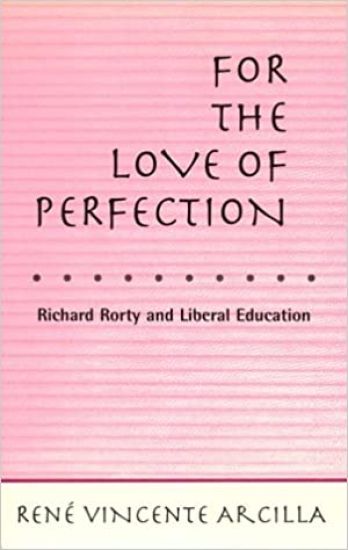
For the Love of Perfection examines Richard Rorty's pragmatist philosophy for thinking about the aims and processes of liberal education. Offering a radical re-interpretation of the philosopher's arguments against metaphysics, René V. Arcilla demonstrates how Rorty's thinking may be re-envisioned to take greater account of today's multicultural society.
For the Love of Perfection examines Richard Rorty's pragmatist philosophy for thinking about the aims and processes of liberal education. Offering a radical re-interpretation of the philosopher's arguments against metaphysics, René V. Arcilla demonstrates how Rorty's thinking may be re-envisioned to take greater account of today's multicultural society.
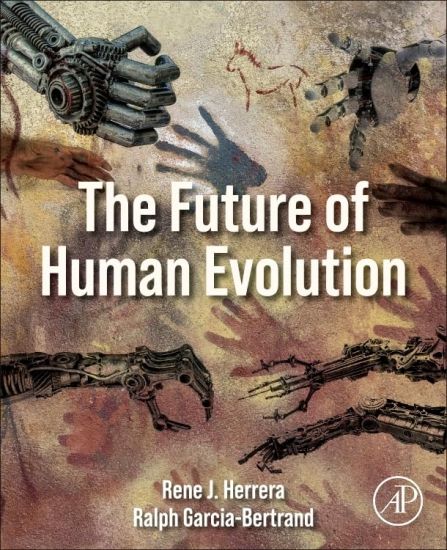
The Future of Human Evolution provides a discussion of how cultural, biological and microevolutionary (drift, selection, and mutation) pressures might affect our future as a species. The book is split into twelve chapters, beginning with evolutionary forecasting, and gene and culture coevolution. It then discusses life expectancy and population growth, followed by chapters on mutation rates, climate change and diet. This book also explores artificial selection and ‘designer babies’, trans-humanism and artificial intelligence (machine-human symbiosis), inequality and the colonization of space. The Future of Human Evolution serves as a valuable resource for both researchers and students studying human evolution and human population genetics, as well as non-academics with an interest in human evolution.










![The Sociology of the Colonies [Part 1]](/covers/9780415176354.jpg)
![The Sociology of Colonies [Part 2]](/covers/9780415176361.jpg)


![The Sociology of the Colonies [Part 1]](/covers/9780415863407.jpg)
![The Sociology of Colonies [Part 2]](/covers/9780415863414.jpg)