This is a ``must-have'' for anyone who desires to effectively and successfully sell their products, projects, ideas or services. The new edition has been revised and expanded to include detailed coverage of the current methods and procedures required by the government and used by commercial companies for bid preparation; the latest applications for identifying and tracking fund sources; new desktop publishing techniques for rapid proposal preparation along with available software; and storyboarding methods. The concept of ``straight-line'' control is presented for the first time and a complete case study provided to illustrate how to evolve a proposal from development through strategic marketing planning.
"The authors have done a commendable and impressive job of addressing a topic of long-lasting and increasing significance in U.S. politics."---F. Chris Garcia, University of New Mexico"This is a path-breaking book that will be read across disciplines beyond political science."---James Jennings, Tufts UniversityOver the past four decades, the United States has experienced the largest influx of immigrants in its history. Not only has the ratio of European to non-European newcomers changed, but recent arrivals are coming from the Asian subcontinent, Southeast Asia, South America, and other regions which have not previously supplied many immigrants to the United States.In this timely study, a team of political scientists examines how the arrival of these newcomers has affected the efforts of long-standing minority groups---Blacks, Latinos, and Asian Pacific Americans---to gain equality through greater political representation and power. The authors predict that, for some time to come, the United States will function as a complex multiracial hierarchy, rather than as a genuine democracy. Ronald Schmidt, Sr. is Professor of Political Science at California State University, Long Beach.Yvette M. Alex-Assensoh is Associate Professor of Political Science and Dean of the Office for Women's Affairs (OWA) at Indiana University, Bloomington.Andrew L. Aoki is Professor of Political Science at Augsburg College.Rodney E. Hero is the Packey J. Dee Professor of American Democracy at the University of Notre Dame.
Alice has a particular set of skills. Catching murderers is one of them. 97-year-old Alice Atkinson should be comfortably living out her days at the Silvermoon Retirement Village, winning money off her friends at card games. But a lifetime of living in the grey area between right and wrong finds her restless. Then during the annual poker tournament her friend drops dead. No one thinks anything of it, after all death isn't unheard of at a retirement village. But Alice is convinced there's more to it. Dusting off her old skills, she enlists the help of Vanessa a young staff member, to be somewhat reluctant sidekick. Alice is determined to find out the truth of why her friend died and who did it. She's faced con artists, thieves, and murderers. But that was nothing compared to what she's up against now. If you like your mysteries clean, funny, and cozy, then check out the Silvermoon Retirement Village series, where age means nothing when it comes to investigating murder
In the 1920s and ’30s Art Deco influenced everything from art and architecture, interiors and furnishings, automobiles and boats, to the small personal objects that are part of everyday life. The items in this thematically structured book demonstrate Deco style at its most alluring. They were then the height of fashion, and are highly prized collectibles today. They demonstrate an era of close cooperation between designers and manufacturers, who aimed to produce goods that were not only fit for purpose, but also well made and beautiful. This informative showcase of portable classics of avant-garde modern design from Britain, Europe (particularly France) and the United States will appeal both to collectors and to anyone with an interest in Deco style and the history of fashion, taste and design. It is the first book to bring together the small collectibles – from cigarette cases and lighters to powder compacts and cosmetics accessories, watches, jewelry, even cameras – that demonstrate the style, glamour and sophistication of the Jazz Age.
How religious are Americans these days? How many still believe in God, in Biblical miracles, in heaven and hell? Do people pray? How much money is being given to churches, by Episcopalians, Presbyterians, Roman Catholics, Lutherans, and other groups? American Piety, the first of a three-volume study of religious commitment, answers these and a host of other questions about the contemporary religious scene. Particularly startling are the contrasts in beliefs, practices, and experiences revealed among the eleven major Christian denominations whose membership is compared.
Religion is alive and well in the modern world, and the social-scientific study of religion is undergoing a renaissance. For much of this century, respected social theorists predicted the death of religion as inevitable consequence of science, education, and modern economics. But they were wrong. Stark and Bainbridge set out to explain the survival of religion. Using information derived from numerous surveys, censuses, historical case studies, and ethnographic field expeditions, they chart the full sweep of contemporary religion from the traditional denominations to the most fervent cults. This wealth of information is located within a coherent theoretical framework that examines religion as a social response to human needs, both the general needs shared by all and the desires specific to those who are denied the economic rewards or prestige enjoyed by the privileged. By explaining the forms taken by religions today, Stark and Bainbridge allow us to understand its persistence in a secular age and its prospects for the future.
Finally, social scientists have begun to attempt to understand religious behavior rather than to discredit it as irrational, ignorant, or foolish--and Rodney Stark and Roger Finke have played a major role in this new approach. Acknowledging that science cannot assess the supernatural side of religion (and therefore should not claim to do so), Stark and Finke analyze the observable, human side of faith. In clear and engaging prose, the authors combine explicit theorizing with animated discussions as they move from considering the religiousness of individuals to the dynamics of religious groups and then to the religious workings of entire societies as religious groups contend for support. The result is a comprehensive new paradigm for the social-scientific study of religion.
This simulating book gathers five lectures that ask questions of the broadest general intellectual interest: What is religion? Do other peoples have the same emotional states as we do? Why do humans make use of body imagery? In Circumstantial Deliveries, Rodney Needham shows that the comparative study of societies may furnish the answers. Circumstantial Deliveries challenges the methodology and substance of many conventional ideas about human nature and calls for more radical and comparative analyses. For instance, the author discredits the notion that to primitive peoples the colors red, white, and black symbolize blood, semen, and feces, respectively, arguing that an extensive comparative study of primitive societies discovered no such relationship. These essays sound a common theme: "If a deeper appreciation of the value of life can be had from reading Crime and Punishment, or if a more acute assessment of the springs of action can be acquired from Hamlet, then in principle it should be conceded that like benefits may be derived from a sympathetic observation of other men engaged in their daily affairs." This title is part of UC Press's Voices Revived program, which commemorates University of California Press’s mission to seek out and cultivate the brightest minds and give them voice, reach, and impact. Drawing on a backlist dating to 1893, Voices Revived makes high-quality, peer-reviewed scholarship accessible once again using print-on-demand technology. This title was originally published in 1981.
This title is part of UC Press's Voices Revived program, which commemorates University of California Press’s mission to seek out and cultivate the brightest minds and give them voice, reach, and impact. Drawing on a backlist dating to 1893, Voices Revived makes high-quality, peer-reviewed scholarship accessible once again using print-on-demand technology. This title was originally published in 1974.
This title is part of UC Press's Voices Revived program, which commemorates University of California Press’s mission to seek out and cultivate the brightest minds and give them voice, reach, and impact. Drawing on a backlist dating to 1893, Voices Revived makes high-quality, peer-reviewed scholarship accessible once again using print-on-demand technology. This title was originally published in 1974.
This simulating book gathers five lectures that ask questions of the broadest general intellectual interest: What is religion? Do other peoples have the same emotional states as we do? Why do humans make use of body imagery? In Circumstantial Deliveries, Rodney Needham shows that the comparative study of societies may furnish the answers. Circumstantial Deliveries challenges the methodology and substance of many conventional ideas about human nature and calls for more radical and comparative analyses. For instance, the author discredits the notion that to primitive peoples the colors red, white, and black symbolize blood, semen, and feces, respectively, arguing that an extensive comparative study of primitive societies discovered no such relationship. These essays sound a common theme: "If a deeper appreciation of the value of life can be had from reading Crime and Punishment, or if a more acute assessment of the springs of action can be acquired from Hamlet, then in principle it should be conceded that like benefits may be derived from a sympathetic observation of other men engaged in their daily affairs." This title is part of UC Press's Voices Revived program, which commemorates University of California Press’s mission to seek out and cultivate the brightest minds and give them voice, reach, and impact. Drawing on a backlist dating to 1893, Voices Revived makes high-quality, peer-reviewed scholarship accessible once again using print-on-demand technology. This title was originally published in 1981.
Rulers of all kinds, from feudal monarchs to democratic presidents and prime ministers, justify themselves to themselves through a variety of rituals, rhetoric, and dramatisations, using everything from architecture and coinage to etiquette and portraiture. This kind of legitimation - self-legitimation - has been overlooked in an age which is concerned principally with how government can be justified in the eyes of its citizens. In this book, Rodney Barker argues that at least as much time is spent by rulers legitimating themselves in their own eyes, and cultivating their own sense of identity, as is spent in trying to convince ordinary subjects. Once this dimension of ruling is taken into account, a far fuller understanding can be gained of what rulers are doing when they rule. It can also open the way to a more complete grasp of what subjects are doing, both when they obey and when they rebel.
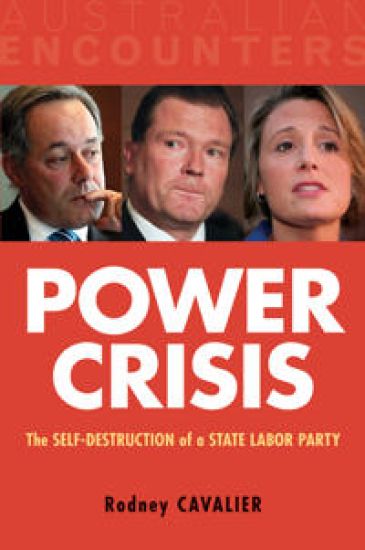
Written by former minister and Labor historian Rodney Cavalier, Power Crisis is an explosive account of the self-destruction of the New South Wales Labor government, which has seen a turnover of four premiers in five years, and is heading for rejection and even humiliation by voters at the next state election. While the catalyst was the thwarted attempt to privatise electricity, Cavalier reveals that the real issue is the takeover of Labor by a professional political class without connection to the broader community or the party's traditions. Featuring interviews with ex-premiers Iemma and Rees, Power Crisis contrasts the current turmoil and self-indulgence with the stability within New South Wales Labor over generations before, and asks, 'What went wrong?'
This textbook provides a thorough and precise account of all the major areas of English grammar. For practical reasons the author concentrates on Standard English and only selected aspects of its regional variation. The book is written for students who may have no previous knowledge of linguistics and little familiarity with ‘traditional’ grammar. All grammatical terms, whether traditional or more recent, are therefore carefully explained, and in the first three chapters the students is introduced to the theoretical concepts and methodological principles needed to follow the later descriptive chapters. Nevertheless, the book is more than a straightforward ‘grammar of English’. Rodney Huddleston does not espouse any formalised contemporary model of syntax and morphology, but he adopts the framework of modern ‘structural’ linguistics, in a very broad understanding of that term. The grammatical categories postulated derive from a study of the combinational and contrastive relationships the words and other forms enter into, and Dr Huddleston pays particular attention to the problem of choosing between alternative analyses and justifying the analysis he proposes. In this sense his book is addressed to the student of linguistics, who will find Introduction to the Grammar of English a much needed foundation for more advanced work in theoretical linguistics.
A thorough and precise account of all the major areas of English grammar. For practical reasons Rodney Huddleston concentrates on Standard English and only selected aspects of its regional variation. The book is written for students who may have no previous knowledge of linguistics and little familiarity with 'traditional' grammar. All grammatical terms, whether traditional or more recent, are therefore carefully explained, and in the first three chapters the student is introduced to the theoretical concepts and methodological principles needed to follow the later descriptive chapters.
This book presents a new and comprehensive descriptive grammar of English, written by the principal authors in collaboration with an international research team of a dozen linguists in five countries. It represents a major advance over previous grammars by virtue of drawing systematically on the linguistic research carried out on English during the last forty years. It incorporates insights from the theoretical literature but presents them in a way that is accessible to readers without formal training in linguistics. It is based on a sounder and more consistent descriptive framework than previous large-scale grammars, and includes much more explanation of grammatical terms and concepts, together with justification for the ways in which the analysis differs from traditional grammar. The book contains twenty chapters and a guide to further reading. Its usefulness is enhanced by diagrams of sentence structure, cross-references between sections, a comprehensive index, and user-friendly design and typography throughout.
This is a comparative study of the role of English and French towns in feudal society in the middle ages. In bringing together much material which dissolves old categories and simplifications in the study of medieval towns, Professor Hilton provides an important new perspective on medieval society and on the nature of feudalism. He argues that medieval towns were not, as is often thought, the harbingers of capitalism, and emphasises the way in which urban social structures fitted into, rather than challenged, feudalism.