

Kirjahaku
Etsi kirjoja tekijän nimen, kirjan nimen tai ISBN:n perusteella.
1000 tulosta hakusanalla Allen Say

The Letters Of Jennie Allen To Her Friend Miss Musgrove
Grace Donworth; Frederic R. (ILT) Gruger
Kessinger Pub
2007
pokkari




The Victory Of Allen Rutledge
Alexander Corkey; Florence Rutledge (ILT) Wilde
Kessinger Pub
2008
pokkari
Recollections Of Henry Watkins Allen: Brigadier-General Confederate States Army, Ex-Governor Of Louisiana (1866)
Sarah A. Dorsey
KESSINGER PUBLISHING, LLC
2008
sidottu


B. Sprague Allen: Tides in English Taste (1619-1800). Volume 1
B Sprague Allen
Harvard University Press
2013
sidottu

B. Sprague Allen: Tides in English Taste (1619-1800). Volume 2
B Sprague Allen
Harvard University Press
2013
sidottu
Focusing on the vexed friendship between Hart Crane and Allen Tate, this book examines twentieth-century American poetry's progress toward institutional sanction and professional organization, a process in which sexual identities, poetic traditions, and literary occupations were in question and at stake. Langdon Hammer combines biography and formalist analysis to argue that American modernism was a Janus-faced phenomenon, at once emancipatory and elitist, which simultaneously attacked traditional cultural authority and reconstructed it in new forms. Hammer shows how Crane and Tate, working in relation to each other and to T. S. Eliot, created for themselves the competing roles of "genius" and "poet-critic." Crane embraced the self-authorizing powers of the individual talent at the cost of standing outside the emerging consensus of high modernist literary culture, an aesthetic isolation which converged with his social isolation as a gay man. Tate, turning against Crane, linked the modernist defense of tradition to an embattled heterosexual masculinity, while he adapted Eliot's stance to a career sustained by criticism and teaching. Ending his book with a discussion of Robert Lowell's career, Hammer maintains that Lowell's "confessional" poetry recapitulates the conflict enacted by Crane and Tate. Originally published in 1993. The Princeton Legacy Library uses the latest print-on-demand technology to again make available previously out-of-print books from the distinguished backlist of Princeton University Press. These editions preserve the original texts of these important books while presenting them in durable paperback and hardcover editions. The goal of the Princeton Legacy Library is to vastly increase access to the rich scholarly heritage found in the thousands of books published by Princeton University Press since its founding in 1905.
Focusing on the vexed friendship between Hart Crane and Allen Tate, this book examines twentieth-century American poetry's progress toward institutional sanction and professional organization, a process in which sexual identities, poetic traditions, and literary occupations were in question and at stake. Langdon Hammer combines biography and formalist analysis to argue that American modernism was a Janus-faced phenomenon, at once emancipatory and elitist, which simultaneously attacked traditional cultural authority and reconstructed it in new forms. Hammer shows how Crane and Tate, working in relation to each other and to T. S. Eliot, created for themselves the competing roles of "genius" and "poet-critic." Crane embraced the self-authorizing powers of the individual talent at the cost of standing outside the emerging consensus of high modernist literary culture, an aesthetic isolation which converged with his social isolation as a gay man. Tate, turning against Crane, linked the modernist defense of tradition to an embattled heterosexual masculinity, while he adapted Eliot's stance to a career sustained by criticism and teaching. Ending his book with a discussion of Robert Lowell's career, Hammer maintains that Lowell's "confessional" poetry recapitulates the conflict enacted by Crane and Tate. Originally published in 1993. The Princeton Legacy Library uses the latest print-on-demand technology to again make available previously out-of-print books from the distinguished backlist of Princeton University Press. These editions preserve the original texts of these important books while presenting them in durable paperback and hardcover editions. The goal of the Princeton Legacy Library is to vastly increase access to the rich scholarly heritage found in the thousands of books published by Princeton University Press since its founding in 1905.

Heartland Utopia: William Allen White on the Ideal Midwestern Town
Charles Delgadillo; Jason Stacy
UNIVERSITY PRESS OF KANSAS
2026
sidottu

This new textbook is an abridgment of the author's earlier Woody Allen's Angst: Philosophical Commentaries on His Serious Films (McFarland, 1997; "invaluable"--Choice.) Five main topics are explored: the desire of many of his characters to ground their lives in traditional ethical values despite their realization that such values may no longer be certain; the opposition between pessimism and optimism throughout his films; gender issues relating to romantic love, sexual desire and the ongoing changes in our cultural expectations of both men and women; the idea that contemporary American society is rapidly descending into barbarism precisely because of societal failure to maintain a sense of individual moral responsibility; and a critique of psychoanalysis as a method for understanding human behavior. Instructors considering this book for use in a course may request an examination copy here.
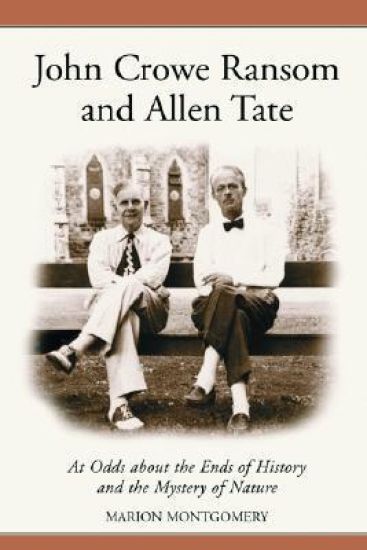
The Fugitives were an influential literary group that began at Vanderbilt University in the 1920s. Although the philosophically driven alliance was short-lived, two of its members, John Crowe Ransom and Allen Tate, went on to become influential Southern poets and theorists. In this work, a self-proclaimed third-generation Fugitive-Agrarian concentrates on the history and mystery of nature. The author supports the recovery of fundamental principles required for the economic, social and political health of our communities. He explores Fugitive-Agrarian concepts of nature, history, science, industry, person, family and community. His discussion focuses particular attention on John Crowe Ransom and Allen Tate and how they diverged in their philosophies of intellect and the written word.